
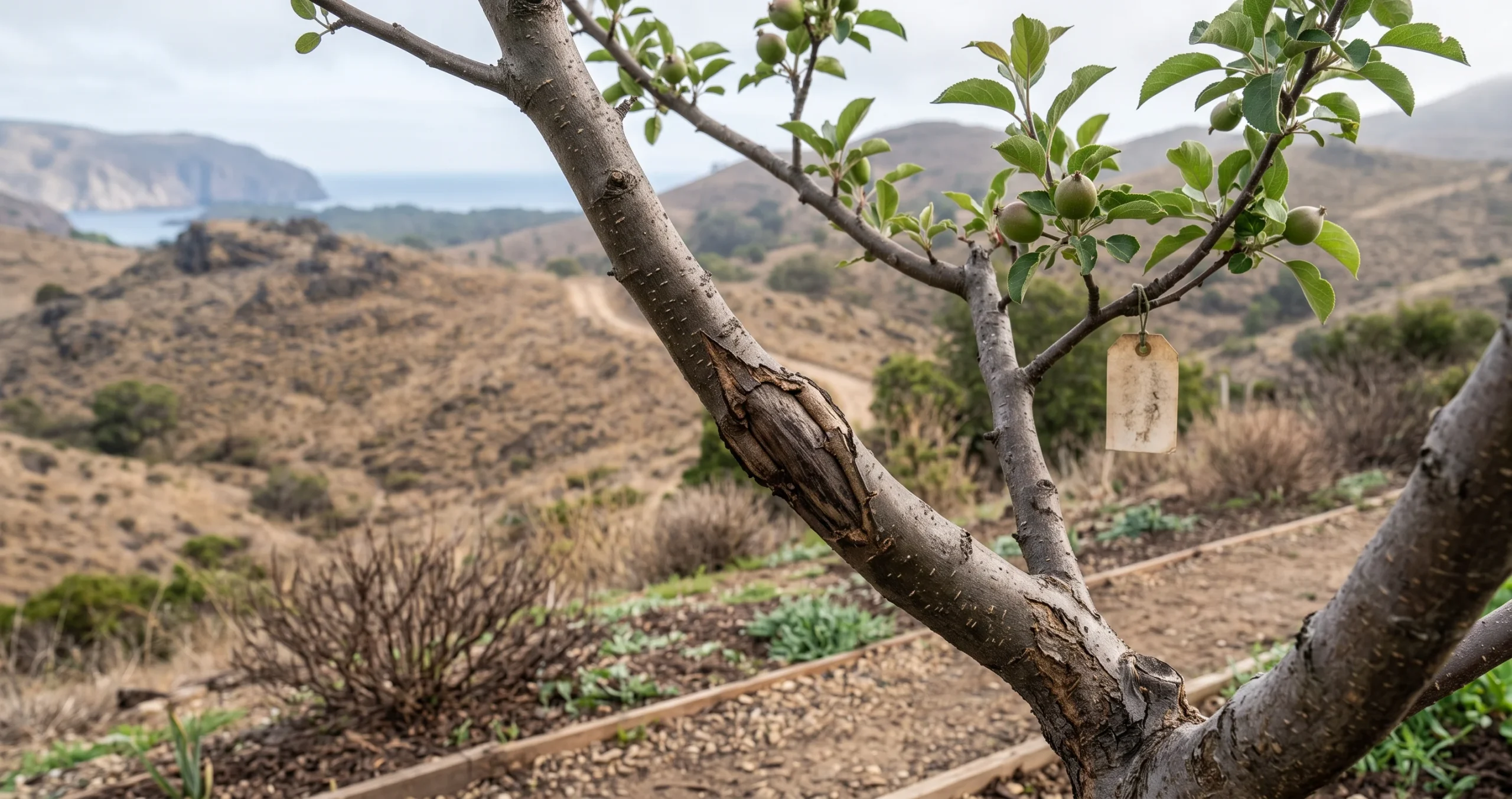
Imagine walking up to one apple tree and picking a green apple from one branch, a red apple from another, and a completely different cultivar from a third.
That sounds like a horticultural trick, but it is possible through grafting fruit trees. Instead of asking a single tree to genetically produce several kinds of fruit, a gardener physically joins pieces of compatible plants so they grow together as one functioning tree.
The technique can preserve a favorite old cultivar, change the variety growing on an established tree, control tree size through specialized rootstocks, or create a multi-variety tree when compatible scions are grafted onto different branches.
But there is one important limitation: grafting does not allow you to combine any fruits you want.
Success depends on botanical compatibility, accurate cuts, cambium contact, timing, and careful aftercare.
Table of Contents
- What Is Fruit Tree Grafting?
- Rootstock and Scion: The Two Parts of a Graft
- Why Compatibility Matters
- Can One Tree Really Grow Several Varieties?
- Best Fruit Trees for Beginner Grafting
- When Is the Best Time to Graft?
- Whip-and-Tongue Grafting
- Cleft Grafting
- The Secret to Success: Cambium Contact
- How to Care for a Healing Graft
- When Will a Graft Start Producing Fruit?
- Common Grafting Mistakes
- Common Myths
- Frequently Asked Questions
- Conclusion
What Is Fruit Tree Grafting?
Grafting joins living plant material from two plants so the tissues heal together and continue growing as a combined plant.
The lower portion is called the rootstock, or stock. It provides the root system and part of the trunk or branch structure.
The upper piece you want to propagate is the scion.
The scion contains buds from a desired cultivar. If the graft succeeds, those buds produce shoots genetically belonging to the cultivar from which the scion was collected.
That distinction explains something important about grafted fruit.
An apple scion grafted onto another compatible apple tree continues producing its own apple cultivar. The rootstock does not genetically blend with the scion and create a halfway fruit.
Penn State Extension explains that bench grafting allows growers to preserve desirable cultivars by attaching them to selected rootstocks. Rootstocks can also influence traits such as mature tree size, productivity, cold hardiness, and susceptibility to certain pests and diseases.
This is why grafting has become fundamental to fruit-tree production.
Rootstock and Scion: The Two Parts of a Graft
Think of the rootstock as the foundation.
Its roots anchor the tree, absorb water and minerals, and can strongly influence how vigorously the combined tree grows.
A dwarfing apple rootstock, for example, can help keep a cultivar substantially smaller than it would become on a vigorous standard rootstock.
The scion determines the cultivar growing above the graft.
If you graft a scion from a particular apple cultivar, the new shoot retains the genetic identity of that cultivar.
This is one reason grafting is so valuable for preserving fruit varieties.
Seeds do not reliably produce genetically identical copies of named apple cultivars. Vegetative propagation through grafting allows growers to preserve the cultivar instead.
Why Compatibility Matters When Grafting Fruit Trees
This is where the idea of a “fruit salad tree” often becomes exaggerated.
You cannot simply cut a branch from any fruit tree and attach it to any other fruit tree.
The plants must be sufficiently compatible for a durable graft union to form.
The safest approach for a beginner is usually grafting different cultivars within the same fruit type—for example, one apple cultivar onto an established compatible apple tree.
Pears are commonly grafted with compatible pears.
Stone fruits are more complicated. Peaches, plums, apricots, nectarines, and cherries belong to the genus Prunus, but sharing a genus does not guarantee that every possible combination will produce a healthy, long-lived union.
Compatibility can vary among species, cultivars, and rootstocks.
Beginners should therefore use known compatible combinations recommended by nurseries or Extension services rather than experimenting with unrelated trees.
An apple branch cannot simply be grafted onto an orange tree because both happen to produce fruit.
Botanical relationship matters.
Can One Tree Really Grow Several Varieties?
Yes.
Missouri Extension specifically notes that multiple grafts can be used to create an apple tree carrying several apple cultivars.
The process is often called top-working when an established tree is grafted to change its cultivar or branch structure. Instead of replacing the entire root system, the gardener uses the established tree as the stock and grafts new scions onto selected branches.
That creates some fascinating possibilities.
A gardener with limited space might maintain several compatible apple cultivars on one tree rather than planting a separate tree for every cultivar.
It can also help with pollination when appropriately chosen cultivars flower at compatible times.
However, a multi-grafted tree needs management.
One cultivar may grow much more vigorously than another. If that branch is allowed to dominate, it can shade or outgrow weaker grafts.
Multi-variety trees therefore require thoughtful pruning to maintain balance.
Best Fruit Trees for Beginner Grafting
For a beginner, apples are among the most practical choices.
There is extensive information about apple rootstocks and cultivar compatibility, scion wood is relatively straightforward to work with, and apples respond well to common grafting techniques.
Pears can also be good candidates when compatible combinations are used.
Stone fruits may require more attention to species, timing, technique, and disease concerns. Budding is frequently used commercially for peaches, plums, and cherries; Missouri Extension notes that budding can be particularly useful for stone fruits that are not as easily handled with certain whip or cleft grafts.
Start simple.
A compatible apple scion grafted onto an apple rootstock or established apple tree is a much better first project than attempting an exotic combination involving several unrelated fruits.
When Is the Best Time to Graft?
Timing depends on the species and technique.
For many dormant scion-grafting projects, late winter through early spring is the key period.
Penn State Extension describes late March to early April as an appropriate bench-grafting period in its regional guidance, with both scion and stock dormant. Scion wood is collected earlier from dormant, recent-season growth and stored so it remains dormant and does not dry out.
Local climate changes the calendar.
The correct week in Pennsylvania will not necessarily be the correct week in Georgia, California, or the Pacific Northwest.
Instead of relying only on a national date, use your local Extension service to determine the appropriate grafting window for your region and fruit species.
Good scion wood is typically healthy one-year growth containing viable buds.
Keep collected scions cool and moist enough to prevent dehydration, but not waterlogged.
Whip-and-Tongue Grafting: A Good Match for Similar-Sized Wood
Whip-and-tongue grafting works especially well when the scion and rootstock are approximately the same diameter.
Missouri Extension recommends it for stock and scions of similar size, preferably around 1/4 to 1/2 inch in diameter.
Both pieces receive matching long diagonal cuts.
A second smaller cut forms a “tongue” in each surface. When the two pieces slide together, the tongues interlock and create a larger area of contact.
This mechanical fit helps hold the pieces together.
More importantly, it creates an opportunity to align the thin living cambial tissues near the outside of the stems.
Once aligned, the union is wrapped securely with appropriate grafting tape or another recommended material to prevent movement and reduce moisture loss.
Penn State advises leaving two or three buds on a bench-grafted scion and wrapping the union firmly while callus develops.
Whip-and-tongue cuts require a very sharp knife and careful technique.
Practice on disposable pruned branches before cutting valuable scion wood.
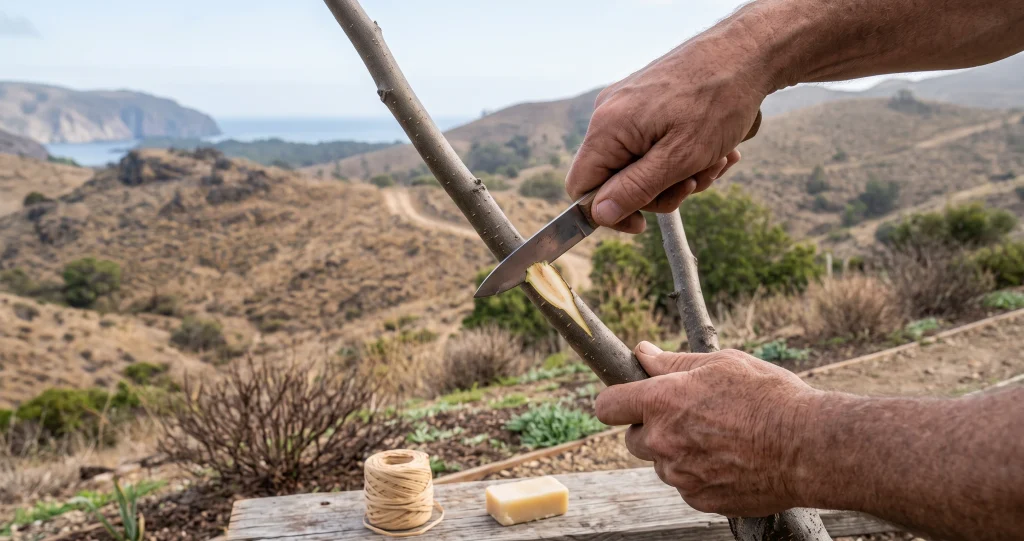
Cleft Grafting: Adding a New Variety to a Larger Branch
Cleft grafting solves a different problem.
Suppose you already have an established apple tree and want to convert one branch to another compatible cultivar.
The existing branch may be much thicker than your pencil-sized scion.
A whip-and-tongue graft is no longer the obvious choice.
Cleft grafting allows smaller scions to be inserted into a larger stock. Missouri Extension describes cleft grafting as a common technique for top-working trees and recommends using appropriate branches rather than extremely large limbs.
The stock branch is cut cleanly and split through its center.
The lower end of the dormant scion is shaped into a wedge and carefully inserted near the outside of the split.
This positioning matters because the cambium of the scion needs to meet the cambium of the stock.
Often two scions are inserted, one near each side of the cleft.
The exposed surfaces must then be protected against drying using appropriate grafting materials.
Cleft grafting can be extremely useful for changing varieties on established trees, but cutting major branches is more consequential than bench grafting a small rootstock.
Beginners should start on appropriately sized branches and understand the pruning consequences before making large cuts.
The Secret to Success: Cambium Contact
The most important part of grafting fruit trees is almost invisible.
Just beneath the bark is a thin layer of actively dividing tissue called the cambium.
For a successful graft union, cambial regions of the scion and stock must make good contact.
This is why simply taping one branch on top of another will not work.
The plants need living tissues positioned closely enough to produce callus and eventually establish functional connections across the graft union.
If the stock and scion are not exactly the same diameter, do not automatically center the smaller piece.
Instead, align the cambium along at least one side. Both Penn State and Missouri Extension emphasize cambial alignment as critical to successful union formation.
Clean cuts also matter.
Crushed, dirty, or dried surfaces reduce the chances of success.
Make cuts with sharp tools, minimize handling of freshly exposed surfaces, join the pieces promptly, and secure them before alignment is disturbed.
How to Care for a Graft While It Heals
Completing the cut is only half the job.
A new graft is vulnerable to drying, movement, competing shoots, and physical damage.
Secure the union firmly with suitable grafting tape or another material appropriate for the technique.
Depending on the graft, exposed cut surfaces may also require grafting wax or compound to reduce moisture loss.
Keep the tree adequately watered.
Penn State specifically advises preventing dehydration while bench-grafted trees establish because drying can compromise the developing union.
Watch the rootstock carefully.
Shoots emerging below the graft compete with the desired scion and should generally be removed.
On top-worked trees, vigorous shoots can appear around large cuts and compete with new graft growth.
Also protect vigorous new scions from wind and accidental breakage.
A successful graft may initially produce a surprisingly fast-growing shoot, but the young union has not yet developed the mechanical strength of an old branch.
Check wrapping material as the graft expands.
Some products degrade or stretch naturally. Materials that do not must be loosened or removed at the appropriate time so they do not girdle the growing stem. Missouri Extension advises cutting non-decaying wrapping about a month after growth begins.
When Will the New Graft Produce Fruit?
A graft that begins growing is not automatically ready to produce a crop.
First it must establish shoots and develop a strong branch structure.
How quickly fruit appears depends on the fruit type, cultivar, rootstock, age of the underlying tree, vigor, pruning, growing conditions, and grafting situation.
A scion placed on an established tree may behave differently from the same cultivar bench-grafted onto a young rootstock.
Avoid pushing the young graft to carry a heavy crop before it develops adequate structure.
The first priority is a strong, well-positioned branch.
For gardeners interested in deliberately shaping fruit trees after establishment, our guide to espalier fruit tree training explains how apples and pears can be trained into narrow horizontal forms against supports.
Common Grafting Mistakes
Using Incompatible Plants
The fact that two plants both produce edible fruit does not make them graft-compatible.
Use combinations with established compatibility.
Missing the Cambium
This is one of the most important technical mistakes.
A graft can look perfectly taped from the outside while the cambial layers underneath barely touch.
Allowing Scion Wood to Dry Out
Dormant scions need protection from dehydration between collection and grafting.
Dry scion wood has much poorer prospects.
Using Dull or Dirty Tools
A grafting knife needs to produce clean surfaces.
Ragged cuts make accurate cambial contact more difficult.
Letting Rootstock Shoots Take Over
Growth below the graft belongs to the rootstock, not the scion cultivar.
Remove competing growth when appropriate so the desired graft receives resources and light.
Forgetting the Label
Several dormant apple scions can look nearly identical.
Label each graft immediately with the cultivar and grafting date.
Otherwise your carefully constructed multi-variety tree may become a mystery tree.
Common Myths About Grafting Fruit Trees
Myth: Grafting Mixes the DNA of Two Fruits
The rootstock and scion heal together, but they do not become a new hybrid fruit.
The scion retains its cultivar identity.
Myth: You Can Graft Any Fruit Onto Any Tree
Compatibility has biological limits.
An apple tree cannot become an apple-orange-peach-avocado tree simply through clever cutting.
Myth: A Multi-Grafted Tree Needs No Special Pruning
Different cultivars can grow at different rates.
Without pruning, one vigorous graft can dominate weaker branches.
Myth: Grafting Is the Same as Cross-Pollination
They are completely different processes.
Pollination is involved in sexual reproduction and seed formation. Grafting is vegetative propagation involving physical union of plant tissues.
Myth: Once a Graft Starts Growing, It Cannot Fail
Bud growth is encouraging, but the union is still young.
Wind damage, dehydration, girdling ties, disease, or structural failure can still cause problems.
Frequently Asked Questions
Can one apple tree grow several apple varieties?
Yes.
Compatible apple cultivars can be grafted onto different branches of the same tree. Missouri Extension specifically identifies multi-cultivar apple trees as a possible use of multiple grafts.
What is the easiest fruit tree to graft?
Apples are an excellent starting point because compatibility and rootstock information are widely available and several established grafting techniques work well with them.
Pears can also be approachable when known compatible combinations are selected.
What is the difference between rootstock and scion?
The rootstock provides the root system and lower portion of the grafted plant.
The scion is the desired cultivar placed onto that stock and produces the new shoot and, eventually, its cultivar’s fruit.
What is the best time for grafting fruit trees?
For many dormant scion grafts, late winter to early spring is common, but exact timing varies by climate, species, and technique.
Use local Extension guidance rather than relying on one national calendar.
Is whip-and-tongue grafting difficult?
It requires precise knife work but is highly useful when the scion and rootstock have similar diameters.
Practice the cuts on spare branches before working with valuable scions.
When should I use a cleft graft?
Cleft grafting is useful when attaching small scions to a larger stock, especially when top-working an established tree to another cultivar.
How do I know if my graft worked?
Successful scion buds eventually begin healthy growth, and callus tissue develops around the union.
Do not disturb the graft simply to inspect its internal connection.
Can I graft an apple onto a pear?
Some members of the rose family show varying degrees of graft compatibility, but compatibility cannot be assumed simply because plants are related.
For a beginner seeking a durable multi-variety tree, use proven apple-on-apple or pear-on-compatible-pear combinations rather than experimental pairings.
Conclusion
The idea of one tree producing multiple varieties sounds almost impossible until you understand what the tree actually is.
It is not one cultivar mysteriously learning to produce several fruits.
It is a living framework carrying genetically distinct but compatible branches.
Successful grafting fruit trees depends on matching compatible plant material, selecting the right technique, creating clean cuts, aligning cambial tissues, preventing the union from drying, and caring for the new growth while it becomes structurally secure.
Whip-and-tongue grafting works especially well when stock and scion are similar in diameter.
Cleft grafting provides another option when small scions must be attached to larger established branches.
For a beginner, apples offer one of the clearest places to start.
Master one compatible graft first.
Then another branch can carry another cultivar.
With time, careful pruning, and successful unions, a single established tree can become something extraordinary: one trunk and root system supporting several distinct varieties of fruit.
External Sources :