
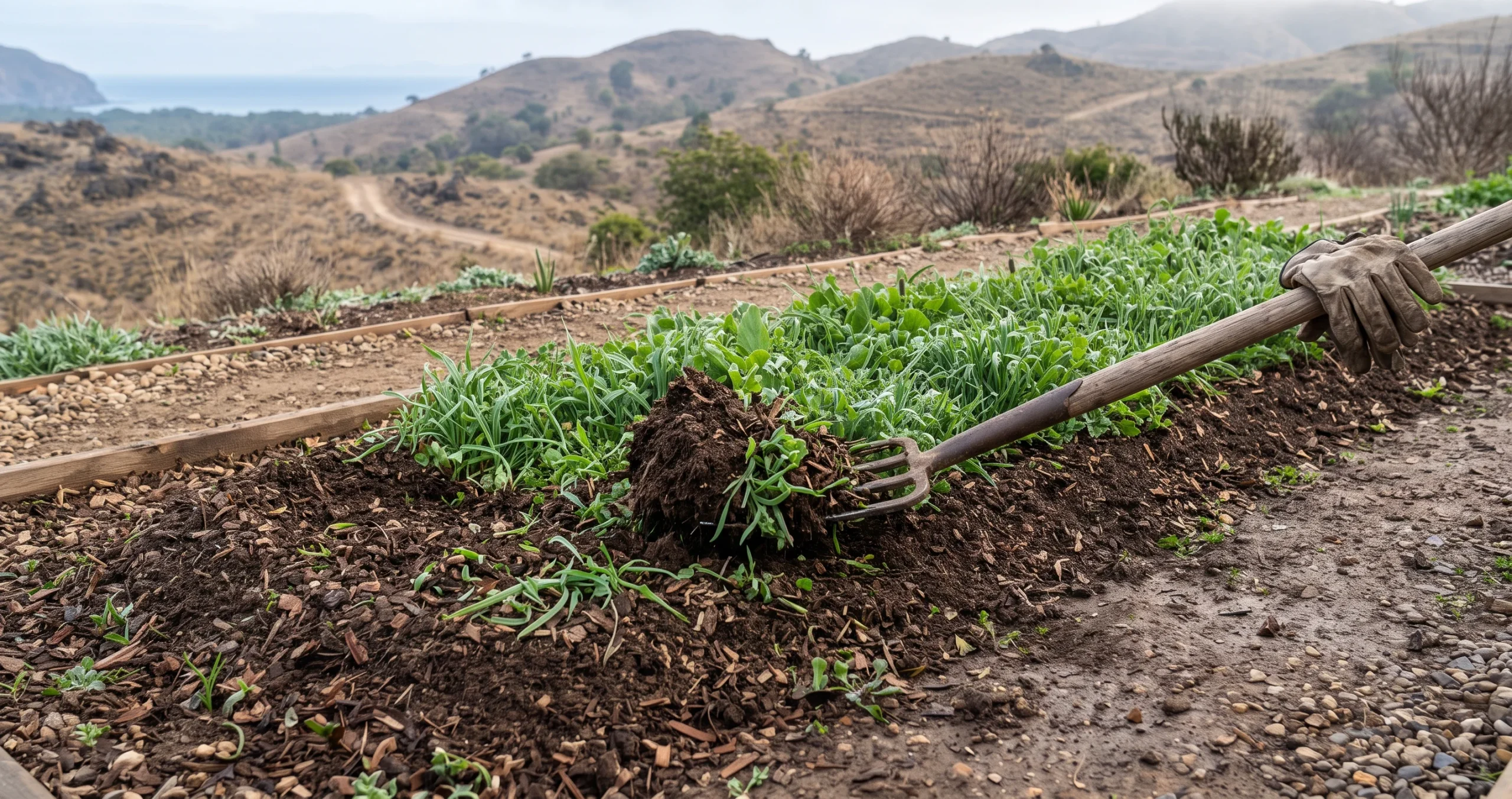
When the last tomatoes are harvested and the vegetable garden begins to empty, leaving the beds bare until spring can seem perfectly reasonable.
But bare soil is not resting. Rain can strike its surface, wind can carry particles away, nutrients can move beyond the reach of future crops, and weeds are left with open ground to colonize.
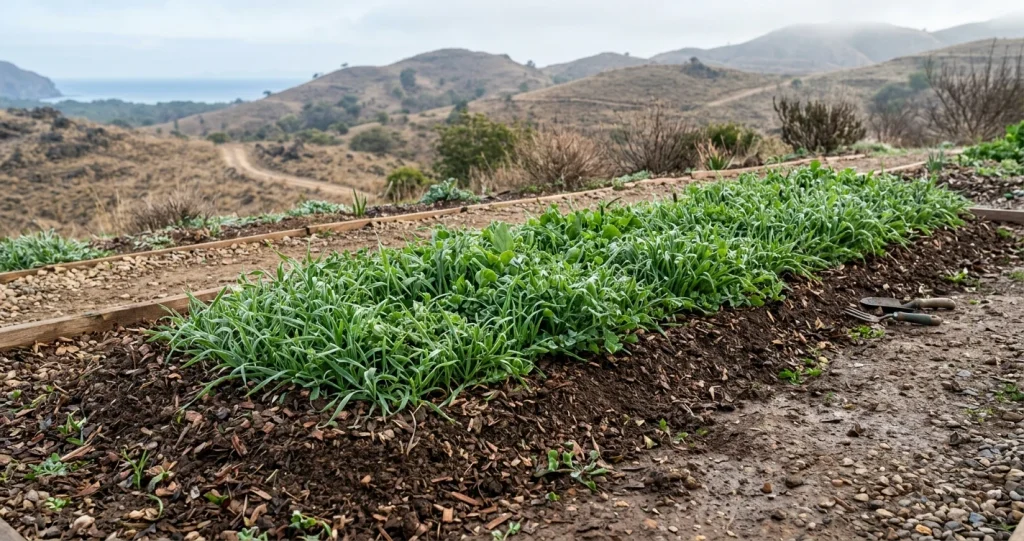
That is why cover crops winter soil health strategies can be so useful in a home garden. Instead of leaving soil exposed during the off-season, gardeners deliberately sow plants such as winter rye, clover, or field peas to protect and improve the ground until vegetables return.
The surprising part is that you usually do not grow these plants to harvest them.
Their main crop is healthier soil.
Table of Contents
- What Are Cover Crops?
- Why Bare Winter Soil Is Vulnerable
- How Cover Crops Reduce Erosion
- How Cover Crops Suppress Weeds
- What Roots Do for Soil Structure
- Clover: A Nitrogen-Fixing Option
- Winter Rye: The Cold-Weather Workhorse
- Field Peas: Useful but Climate Dependent
- Choosing a Cover Crop for Your Climate
- How to Plant a Cover Crop
- When and How to Terminate It
- Common Cover Crop Mistakes
- Common Myths
- FAQ
- Conclusion
What Are Cover Crops?
A cover crop is grown primarily for what it does for the soil, rather than for a harvest that ends up on the dinner table.
Farmers have used cover crops for generations, but the same principle works on the scale of a backyard vegetable bed.
University of Maryland Extension describes cover crops as a way to reduce winter erosion, retain nutrients, feed soil microorganisms, add organic material, and improve soil quality. They are often called green manures, particularly when their plant material is incorporated into the soil.
Common choices include grasses such as cereal rye and oats, legumes such as clover and field peas, and other plants such as forage radish.
Each does something slightly different.
That is why the best cover crop is not necessarily the plant with the longest list of benefits. It is the one that matches your garden, climate, planting schedule, and main soil goal.
Why Bare Winter Soil Is Vulnerable
Imagine two neighboring vegetable beds during a winter rainstorm.
One is bare.
The other is covered with living plants and roots.
Raindrops hit exposed soil directly in the first bed. Soil particles can loosen, surface structure can deteriorate, and runoff may carry material away.
In the planted bed, leaves intercept some of that rain while roots help hold soil in place.
Penn State Extension identifies reduced erosion and nutrient loss, better soil structure, increased organic matter, and weed suppression among the major benefits of cover crops.
That makes winter less of an empty season.
The garden may not be producing tomatoes or beans, but the cover crop is still doing useful work.
How Cover Crops Reduce Erosion
Erosion is easiest to notice when soil physically washes down a slope, but smaller losses can occur without producing a dramatic muddy stream.
Cover crops provide two forms of protection.
Above ground, stems and leaves reduce direct exposure to rain and wind.
Below ground, roots form a living network through the soil.
Winter rye is particularly useful in this role because it produces an extensive root system and tolerates cold conditions well. University of Maryland Extension describes it as very hardy and notes that it can be planted later in fall than many other cover crop options.
For gardeners who normally leave vegetable beds bare from October until April, that living cover can represent months of additional soil protection.
Cover Crops Winter Soil Health and Weed Suppression
Weeds love vacancies.
When vegetable plants disappear and bare soil remains, unwanted plants gain access to light, water, nutrients, and physical space.
A well-established cover crop occupies some of that space first.
Dense leaves shade the surface while roots compete below ground. The effect varies considerably by species and how well the crop establishes, but weed suppression is a recognized cover-crop benefit.
Winter cereal rye is especially notable.
University of Minnesota Extension rates winter cereal rye highly for both erosion prevention and weed competition.
This does not mean a cover crop makes weed seeds disappear.
Instead, think of it as competition.
You are deliberately filling an empty ecological space with plants you selected rather than leaving that space available for weeds to claim.
What Cover Crop Roots Do Beneath the Surface
The most interesting work may be happening where you cannot see it.
Roots grow through pores and spaces in the soil. Different cover crops produce different root systems, from dense fibrous networks to deeper taproots.
While those roots are alive, they interact with the surrounding soil environment.
After termination, root residues remain and eventually decompose.
Cover crop residues and roots can contribute organic matter, and soil organisms process that material over time. University of Maryland Extension notes that cover crops can feed beneficial soil microbes involved in building good soil texture and maintaining drainage.
Cover crops should not be advertised as an instant cure for severely compacted or poorly drained soil.
Their effects accumulate through biological processes and repeated management.
For another way to keep organic material in the garden rather than removing it, read our guide to chop-and-drop mulching, which explains how suitable plant residues can protect soil and gradually return organic matter.
Clover: The Nitrogen-Fixing Option
Clover is popular because it belongs to the legume family.
Legumes form relationships with compatible bacteria in root nodules. These bacteria convert atmospheric nitrogen into forms the plant can use—a process called biological nitrogen fixation.
When the cover crop eventually decomposes, some of that nitrogen can become available within the soil nutrient cycle.
Crimson clover is a common fall-planted option.
It can also produce attractive red flowers if allowed to reach bloom, although gardeners must balance flowering with the need to terminate the crop before it becomes difficult to manage or sets unwanted seed.
Cold tolerance varies.
Crimson clover is not equally winter-hardy in every region, so gardeners in colder climates should check local Extension recommendations rather than assuming a cover crop that survives winter in one state will behave identically in another.
Winter Rye: The Cold-Weather Workhorse
If you need something tough, cereal rye—often called winter rye—is difficult to ignore.
It germinates in cool conditions, survives cold winters in many regions, develops extensive roots, captures available nutrients, and provides strong soil coverage.
It can also be sown later in fall than many alternatives.
There is a tradeoff.
Winter rye can become a substantial plant very quickly when spring temperatures rise.
If you wait too long to terminate it, you may face a tall, fibrous stand precisely when you are trying to prepare beds for vegetables.
Its high-carbon residue also decomposes more slowly than tender legume material.
For gardeners planning very early spring vegetables, a winter-killed crop such as oats may sometimes be easier to manage than overwintering rye.
For gardeners planting tomatoes, peppers, cucumbers, or other warm-season crops later, there may be more time to manage an overwintering crop.
Field Peas: Nitrogen With a Catch
Field peas are another legume option.
They can contribute nitrogen through biological fixation and mix particularly well with cereal grains.
University of Minnesota Extension describes field or winter peas as providing moderate nitrogen fixation and notes that they can break down relatively quickly, making them useful ahead of early crops in suitable systems.
Their limitation is cold hardiness.
A field pea that performs well in one climate may winter-kill in another. Austrian winter peas offer greater cold tolerance than some alternatives, but even they are not reliably winter-hardy in every northern climate.
Winter-kill is not automatically bad.
Sometimes it is exactly what a gardener wants.
A crop that dies naturally during winter can leave a protective residue on the surface without producing vigorous spring growth that must be killed.
Choosing a Cover Crop for Your Climate
Start with one question:
What do you want the cover crop to accomplish?
For strong winter survival, erosion control, and weed suppression, winter rye can be an excellent choice.
For nitrogen contribution, a suitable clover or field pea may be preferable.
For easier spring management in a cold climate, gardeners may deliberately select oats or another crop expected to winter-kill.
Mixtures can combine functions.
For example, a grass can provide dense roots and substantial biomass while a legume contributes biologically fixed nitrogen.
But climate still decides whether those plants survive.
Do not rely only on a national planting calendar. Find your USDA hardiness context, expected first frost, and—more importantly—your local Extension recommendations for cover crop planting dates.
University of Maryland, for example, recommends most fall cover crops be established early enough to develop before hard frost and short days slow growth.
The correct date in Minnesota, Maryland, Georgia, and California will not necessarily be the same.
How to Plant a Cover Crop
Cover cropping does not require complicated equipment in a home garden.
After removing the previous vegetable crop, clear large debris and weeds. Lightly loosen or rake the surface if necessary.
Broadcast the seed evenly at the rate recommended for that species and your garden area.
Lightly rake to establish seed-to-soil contact, then water gently.
The goal is quick, even establishment.
Do not scatter a handful of seed over a large bed and expect dense weed suppression. A cover crop needs adequate plant density to perform its job effectively.
Timing matters just as much as seeding rate.
A crop sown too late may germinate but fail to develop enough roots and foliage before winter conditions slow growth.
When Should You Turn a Cover Crop Into the Soil?
This is where many first-time cover croppers make mistakes.
Do not wait until the day you want to plant tomatoes and then suddenly dig a mature stand of rye into the soil.
If you plan to incorporate the vegetation, it needs time to begin decomposing.
Penn State Extension recommends turning cover crops under at least two to three weeks before planting the garden and warns against allowing them to set seed.
For a small bed, cut or mow the crop first.
Then chop or incorporate manageable material into the upper soil layer rather than trying to bury an intact jungle.
But digging is not your only option.
University of Maryland Extension describes cutting cover crops to ground level and smothering them with a tarp as another termination method. The resulting residues can remain as mulch in a no-till system.
This distinction matters.
Termination means stopping the cover crop’s growth.
Incorporation means mixing its residue into the soil.
You can terminate without incorporating.
Common Cover Crop Mistakes
Planting Too Late
Seeds need enough favorable weather to establish.
A crop that barely germinates before severe cold will not provide the same coverage as one given enough time to develop roots and foliage.
Letting the Crop Set Seed
This can turn your helpful cover into next season’s weed problem.
Terminate at the appropriate developmental stage and before unwanted seed maturation.
Choosing Winter Rye Without Planning for Spring
Rye is exceptionally useful partly because it survives conditions that kill less hardy plants.
That same toughness means you need a termination plan.
Planting the Wrong Legume for the Climate
“Clover” and “peas” are not single interchangeable winter-proof categories.
Species and cultivars differ in cold tolerance.
Incorporating Too Close to Planting
Fresh residues require decomposition.
When incorporation is your strategy, leaving a buffer before vegetable planting reduces the problems associated with trying to plant immediately into large amounts of freshly buried material.
Assuming More Biomass Is Always Better
A huge cover crop looks impressive, but more material also means more residue to manage.
Match biomass production to your spring schedule and management method.
Common Myths About Cover Crops
Myth: Cover Crops Are Only for Farmers
A 100-square-foot vegetable bed has the same basic vulnerability to erosion, weeds, and bare-soil exposure as a field.
The scale changes.
The biological principles do not.
Myth: Every Cover Crop Adds Nitrogen
Only certain plants, particularly legumes working with appropriate nitrogen-fixing bacteria, can add biologically fixed nitrogen to the system.
Winter rye does not fix atmospheric nitrogen.
Instead, it is valuable for capturing existing nutrients, protecting soil, producing biomass, and suppressing weeds.
Myth: Cover Crops Must Be Dug Into the Soil
No.
Incorporation is one option.
Gardeners can also cut and smother cover crops, leaving the residue on the surface as mulch in an appropriate no-till system.
Myth: Cover Crops Eliminate the Need for Compost
Cover crops and compost overlap in some benefits, but they are not identical.
Compost brings already decomposed organic material into the garden. Cover crops grow living roots in place before becoming residue themselves.
They can complement each other.
Myth: You Can Plant Any Cover Crop Anywhere
Climate, soil, planting date, winter temperature, and next season’s crop all matter.
Successful cover cropping begins with selection, not with a universal bag of seed.
Frequently Asked Questions
What is the best winter cover crop for a vegetable garden?
There is no single best choice.
Winter rye is excellent for cold tolerance, erosion protection, and weed suppression. Clover can contribute nitrogen, while field peas can be useful legumes where climate and planting timing suit them.
Does winter rye improve soil?
Its extensive root system protects and occupies soil, captures nutrients, produces organic residue, and can contribute to improved soil structure over time.
It is particularly useful when strong winter survival is needed.
Does clover add nitrogen to garden soil?
Leguminous clovers form associations with nitrogen-fixing bacteria.
The nitrogen accumulated in plant biomass enters nutrient cycling as plant material decomposes, but the process should not be interpreted as instant fertilizer appearing in the soil.
Should I dig cover crops into my garden?
You can, but you do not have to.
Incorporation can accelerate decomposition, while cut-and-smother or mulch-based approaches allow residue to remain on the surface.
How long before spring planting should I incorporate a cover crop?
For home gardens, Penn State Extension recommends incorporating the crop at least two to three weeks before planting so organic material has time to begin decomposing.
Can I mix winter rye and clover?
Yes.
Grass-legume mixtures are commonly used because the species can provide complementary functions. However, use appropriate seeding rates and select varieties that fit your climate.
What happens if I let a cover crop flower?
Flowering is not automatically a problem, and flowering clover can provide resources for pollinators.
However, allowing cover crops to mature and produce viable seed can create unwanted volunteers. Termination timing should therefore reflect both your soil goals and your next planting date.
Are cover crops worth planting in a small raised bed?
They can be.
The benefits of keeping living roots in soil, reducing bare ground, competing with weeds, and producing organic residue are relevant even at small scales.
Just choose a species that will be easy to terminate in the limited space.
Conclusion
An empty vegetable bed may look finished for the year, but the soil underneath it is still exposed to weather and biological change.
Cover crops turn that unused period into another phase of garden management.
A dense stand of winter rye can hold soil, capture nutrients, and compete with weeds. Clover can combine soil coverage with biological nitrogen fixation, while field peas can provide another legume option in climates where their growth and winter survival fit the garden schedule.
The key to cover crops winter soil health is not simply throwing seed onto an empty bed.
Choose the crop according to your climate and goal. Sow it early enough to establish. Decide before winter how you will terminate it, and leave enough time between spring termination and vegetable planting when residues will be incorporated.
You do not even have to dig everything under.
Cutting and smothering can turn the cover crop into surface residue, allowing it to continue protecting the ground as mulch.
The vegetable garden may appear quiet in winter.
With the right cover crop, the soil is anything but inactive.
Internal Sources :
- Chop-and-Drop Mulching: The Low-Effort Way to Feed Your Soil.
- Worm Castings: Why Gardeners Call It “Black Gold” for Soil
External Sources :