
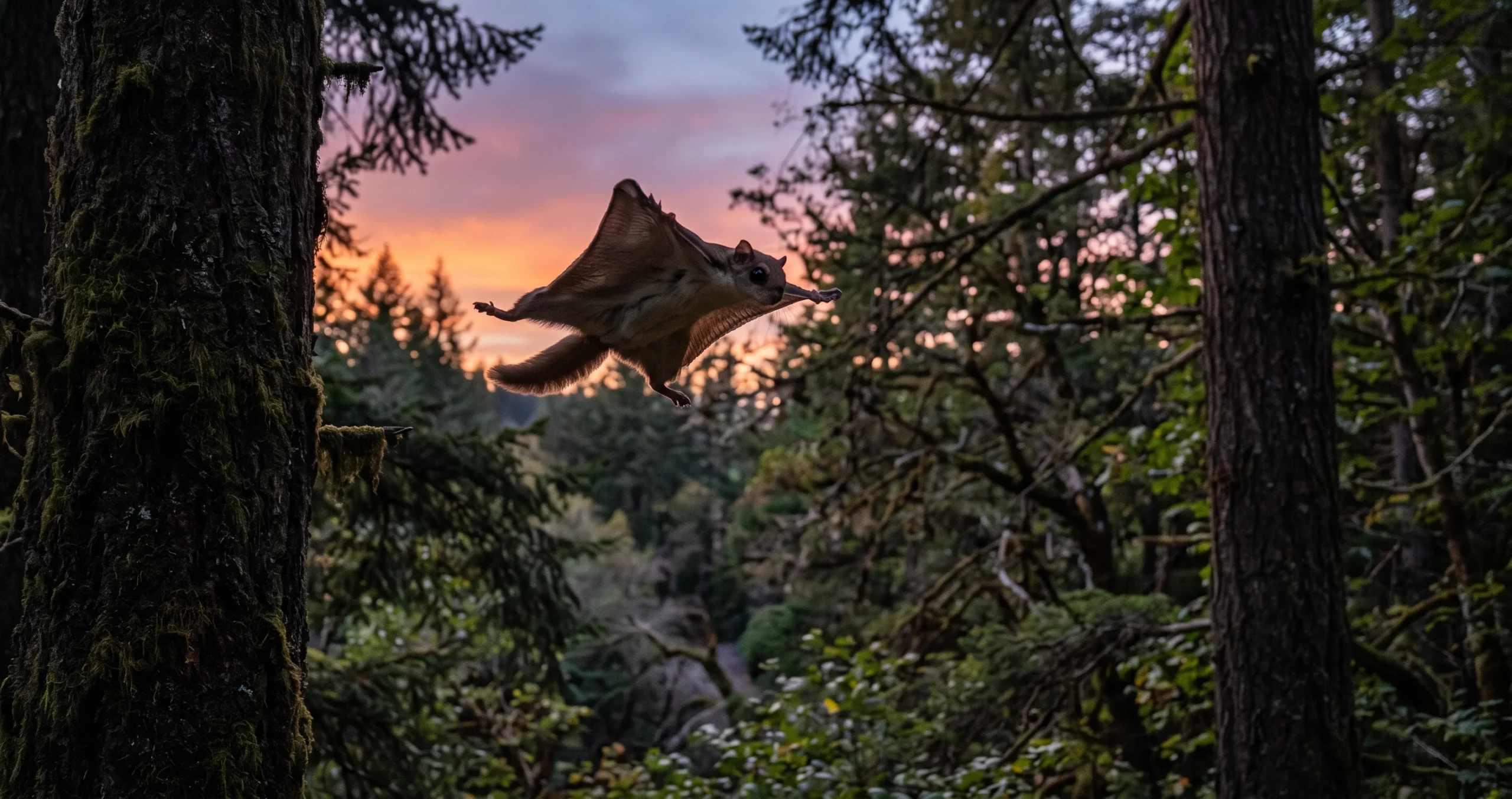
Flying squirrels have one of the most misleading names in the animal kingdom. They can cross impressive gaps between trees, turn in midair, and make controlled landings, but they never produce the powered flight used by bats and birds. Their secret is the flying squirrel gliding membrane, a specialized sheet of fur-covered skin called the patagium that transforms the animal’s body into a controllable aerodynamic surface.
By spreading its limbs, changing the shape of this membrane, moving its tail, and adjusting its body before landing, a flying squirrel can turn a leap from a tree into a remarkably controlled glide. North American flying squirrels can travel more than 150 feet in a single glide under favorable conditions.
Table of Contents
- Flying Squirrels Glide Rather Than Fly
- How the Flying Squirrel Gliding Membrane Works
- The Strange Wrist Structure That Supports the Membrane
- How a Flying Squirrel Launches
- How Flying Squirrels Steer
- How They Land Without Crashing
- How Far and High Flying Squirrels Can Glide
- Why Gliding Is Useful
- Flying Squirrels vs. Sugar Gliders
- Common Myths
- FAQ
- Conclusion
Flying Squirrels Glide Rather Than Fly
True flight and gliding are not the same form of locomotion.
Birds and bats generate sustained thrust with flapping wings. This allows them to remain airborne, gain altitude, and actively propel themselves through the air.
A flying squirrel cannot do that.
Instead, it begins with height and a powerful leap. Once airborne, it stretches its limbs outward and exposes the patagium. The membrane creates aerodynamic forces that slow the squirrel’s descent while allowing it to travel horizontally. Smithsonian educational material describes gliding as movement that begins with an initial thrust but lacks the sustained propulsion characteristic of true flight.
Gravity is always pulling the squirrel downward.
The animal simply turns that loss of altitude into forward travel.
That distinction explains why a flying squirrel cannot launch from the ground and fly upward like a bird. It needs an elevated starting point such as a tree trunk or branch.
How the Flying Squirrel Gliding Membrane Works
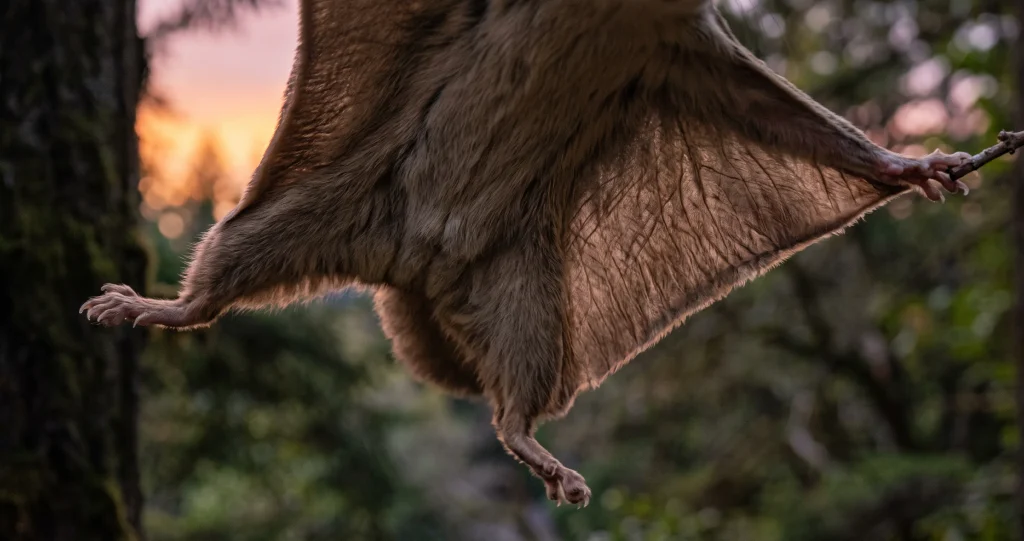
The flying squirrel gliding membrane is called the patagium.
In North American flying squirrels, this loose, furred skin stretches between the forelimbs and hind limbs. When the squirrel is climbing normally, the membrane folds alongside the body and is relatively inconspicuous.
Everything changes during launch.
The squirrel spreads all four limbs outward, pulling the membrane taut and dramatically increasing the surface area of its body.
Instead of falling like an ordinary squirrel, it now presents a broad aerodynamic surface to the air.
The effect is sometimes compared with a parachute, but the squirrel is doing more than simply slowing its fall. Its body functions as a controllable gliding surface capable of producing lift and directing movement forward.
Smithsonian researchers have studied flying squirrel aerodynamics with physical models in wind tunnels to understand how these surprisingly broad, almost square “wings” behave.
The membrane therefore acts less like a passive flap of loose skin and more like an adjustable biological airfoil.
The Strange Wrist Structure That Supports the Membrane
One of the most remarkable parts of the system is hidden near the wrist.
Flying squirrels possess a specialized structure called the styliform cartilage. It projects from the wrist and helps support the outer portion of the gliding surface.
Research comparing flying and non-gliding squirrel wrists found anatomical specializations that stabilize the base of this cartilage and help flying squirrels control their wing tip.
That makes the wrist an important part of the squirrel’s aerodynamic equipment.
A study of flying squirrel wing-tip anatomy found that the styliform cartilage helps create an upturned portion of the gliding surface. Researchers proposed that this structure may reduce induced drag and contribute to stability and control, somewhat like the winglets found at the ends of some aircraft wings.
Later anatomical research confirmed that the styliform cartilage is a distinct specialized structure associated with flying squirrel gliding adaptations.
This is one reason the flying squirrel gliding membrane should not be thought of as merely stretched skin.
Bones, cartilage, muscles, limbs, membrane, and tail all work together as one flight-control system.
How a Flying Squirrel Launches
Every glide begins with a decision about where to go.
A flying squirrel starts from an elevated tree and launches itself outward. That initial jump provides the momentum needed to begin the glide.
Immediately after leaving the tree, the squirrel extends its forelegs and hind legs.
The folded patagium opens.
Its body changes almost instantly from the narrow profile of a climbing rodent into a broad gliding surface.
The initial portion of a glide can be relatively steep while the animal accelerates. Research on flying squirrel body proportions and gliding performance suggests that once suitable gliding speed has been reached, the trajectory can become flatter, increasing horizontal distance.
The animal is therefore constantly trading height for forward movement.
The higher the starting position and the more favorable the trajectory, the greater the potential distance.
But distance is not always the goal.
A squirrel may simply need to cross a small opening to reach another trunk.
How Flying Squirrels Steer in Midair
A flying squirrel does not leap and hope for the best.
Once airborne, it can make adjustments to its trajectory.
Movement of the limbs changes the shape and tension of the flying squirrel gliding membrane. Adjustments to body position can therefore influence aerodynamic forces acting on the squirrel.
The tail also contributes to control.
The National Wildlife Federation describes flying squirrels using slight leg movements to steer and the tail during the approach to landing. Smithsonian educational material likewise notes that the tail can function like a rudder and reports observations of impressive mid-glide maneuvering.
These adjustments allow the squirrel to correct its direction rather than following a completely fixed ballistic path.
That ability matters enormously in a forest.
Branches move. Landing surfaces vary in size. Obstacles can lie between two trees.
A successful glider must control more than distance. It must arrive at a usable landing surface with manageable speed and the correct body orientation.
How Flying Squirrels Land Without Crashing
Landing may be the most impressive part of the entire glide.
During much of the journey, the squirrel is moving both forward and downward. Hitting a tree trunk at full gliding speed would be dangerous.
The squirrel therefore changes its body configuration during the final approach.
Research on gliding performance describes flying squirrels increasing their angle of attack near the end of a glide. This can produce an upward swoop that reduces forward speed before contact.
The animal essentially converts some of its forward motion into a brief upward movement.
Its body becomes more upright.
The feet move toward the landing surface.
The tail and flying squirrel gliding membrane contribute to controlling the final approach, and the squirrel contacts the trunk ready to grip the bark.
The National Wildlife Federation notes another clever behavior. After landing, a flying squirrel may quickly move to the opposite side of the tree trunk, potentially making it harder for a predator following its trajectory to capture it.
The entire sequence can happen within seconds:
Leap → Spread → Glide → Steer → Flare → Grip
It is a sophisticated aerial maneuver performed by an animal without true wings.
How Far and High Can Flying Squirrels Glide?
There is no single distance that applies to every flying squirrel.
Species, body size, starting height, terrain, landing elevation, and environmental conditions all affect performance.
For North American flying squirrels, the National Wildlife Federation reports glides exceeding 150 feet, or roughly 46 meters.
Some larger flying squirrel species can travel considerably farther under favorable conditions.
Smithsonian reporting on research into flying squirrel aerodynamics describes a Japanese giant flying squirrel observed gliding nearly 160 feet and mentions reports of much longer downhill glides.
Historical scientific analysis of flying squirrel body proportions also includes observations and estimates of several-hundred-meter glides by large Petaurista squirrels when substantial vertical drops and favorable terrain were available. These exceptional observations should not be treated as the routine performance of the smaller North American species.
This distinction is important for accurate wildlife information.
A claim that “flying squirrels glide 300 meters” without naming the species and conditions can be highly misleading.
How High Can They Glide?
Flying squirrels do not normally gain sustained altitude during a glide.
They begin high and end lower.
They may briefly swoop upward immediately before landing as they change their angle of attack, but this is part of slowing and positioning themselves rather than powered climbing.
In other words, the flying squirrel gliding membrane helps convert existing height into horizontal travel.
The squirrel must climb another tree before it can regain that lost altitude.
Why Gliding Is So Useful
Gliding provides a shortcut through the forest canopy.
Without it, a squirrel attempting to reach another tree might have to descend a trunk, cross the ground, and climb again.
That costs time and energy and can expose the animal to terrestrial predators.
Gliding creates another option.
A squirrel can climb to an appropriate launch point, cross an open space through the air, land on another trunk, and continue moving through the canopy.
This ability can help flying squirrels move between feeding sites, nesting locations, and shelter while reducing the need to travel on the forest floor.
The behavior is particularly suited to arboreal animals living in environments where trees provide repeated elevated launch and landing sites.
Flying squirrels are also predominantly nocturnal. Large eyes assist their nighttime activity, while their aerial mobility allows them to exploit a three-dimensional forest environment that looks very different after sunset.
For more unusual animal adaptations, explore the wildlife features on secretsofthegreengarden.com, including our guides to specialized senses, locomotion, and survival strategies.
Flying Squirrels vs. Sugar Gliders
A flying squirrel and a sugar glider can look remarkably similar while airborne.
Both stretch a membrane between their limbs. Both travel between trees without powered flight. Both use body and tail movements to help control their trajectories.
Yet they are not close versions of the same animal.
Flying squirrels are rodents belonging to the squirrel family Sciuridae.
Sugar gliders are marsupials.
Their resemblance is an excellent example of convergent evolution: unrelated lineages evolving similar functional solutions to similar environmental challenges.
The Australian Museum describes the sugar glider’s membrane as extending from the fifth finger to the ankle and reports gliding distances of up to about 50 meters. Its bushy tail contributes to stability and steering.
Flying squirrels have their own distinctive anatomical solution.
Their specialized styliform cartilage extends from the wrist and supports part of the flying squirrel gliding membrane. Sugar gliders do not possess the same flying-squirrel wrist system. Anatomical research instead identifies specialized muscles involved in controlling the sugar glider membrane.
This makes the similarity even more fascinating.
Evolution did not copy one anatomical blueprint.
It produced separate versions of a biological glider.
Other Mammals Have Learned to Glide Too
Flying squirrels and sugar gliders are only part of a broader evolutionary pattern.
Several mammal groups have independently evolved membranes that allow them to move through the air without powered flight.
These include other gliding marsupials, colugos, and African anomalures, sometimes called scaly-tailed flying squirrels even though they are not true squirrels.
Their membrane anatomy varies.
For example, the Australian Museum describes the tiny feathertail glider as having a membrane extending from elbow to knee, while its distinctive feather-like tail contributes to steering.
Different animals therefore solve the same physical problem using different anatomical arrangements.
The repeated evolution of gliding shows how useful aerial shortcuts can be for animals living in trees.
Common Myths About Flying Squirrels
Myth: Flying squirrels can actually fly
They cannot perform sustained powered flight. They launch from elevated positions and glide while gradually losing altitude.
Myth: The membrane is just a parachute
The comparison is useful but incomplete. The squirrel actively alters its body position and membrane configuration to control its trajectory. Its specialized wrist anatomy also contributes to control of the gliding surface.
Myth: The tail alone controls steering
The tail is important, but steering involves the entire body. Limb position and changes in the flying squirrel gliding membrane also affect the animal’s trajectory.
Myth: Flying squirrels and sugar gliders are close relatives
They are not. Flying squirrels are placental rodents, while sugar gliders are marsupials. Their similar gliding forms evolved independently.
Myth: A flying squirrel can glide upward to another higher tree
A flying squirrel cannot sustain powered ascent. Its glide fundamentally depends on losing gravitational potential energy, although it can make a brief upward swoop during the landing maneuver.
FAQ
What is the flying squirrel gliding membrane called?
It is called the patagium. It stretches between the forelimbs and hind limbs and expands when the squirrel spreads its legs during a glide.
Why are they called flying squirrels if they cannot fly?
The name refers to their remarkable ability to travel through the air between trees. Technically, however, their locomotion is gliding rather than powered flight.
How far can a flying squirrel glide?
North American flying squirrels can cover more than 150 feet in a glide. Distances vary considerably among species and depend on factors such as starting height and terrain.
How does a flying squirrel steer?
The squirrel alters the position of its limbs and body, changing the configuration of its patagium. Its tail also contributes to stability and directional control.
How does a flying squirrel stop before hitting a tree?
During its final approach, it can increase its angle of attack and swoop upward, reducing speed before placing its feet against the trunk.
Is a sugar glider a type of flying squirrel?
No. Sugar gliders are marsupials, while flying squirrels are rodents. Both independently evolved membranes that permit controlled gliding.
Conclusion
Flying squirrels do not need powered wings to become extraordinary aerial travelers.
The flying squirrel gliding membrane turns the body into a broad aerodynamic surface when the animal extends its four limbs. Specialized wrist anatomy helps support and control that surface, while movements of the legs, body, and tail allow the squirrel to adjust its trajectory.
Landing is equally sophisticated. Instead of simply crashing into its destination, the squirrel can change its angle of attack, reduce speed, raise its body, and arrive feet-first against a tree trunk.
North American species can exceed 150 feet in a single glide, while some larger Asian flying squirrels can travel much farther under favorable terrain and height conditions.
Sugar gliders demonstrate that evolution discovered a similar solution elsewhere. These Australian marsupials also stretch a patagium between their limbs, yet their anatomy and evolutionary history are separate from those of flying squirrels.
So the name “flying squirrel” may be technically inaccurate, but the real mechanism is arguably more interesting.
These squirrels turn gravity, skin, cartilage, limbs, and precise body control into a natural glider.
External sources :