
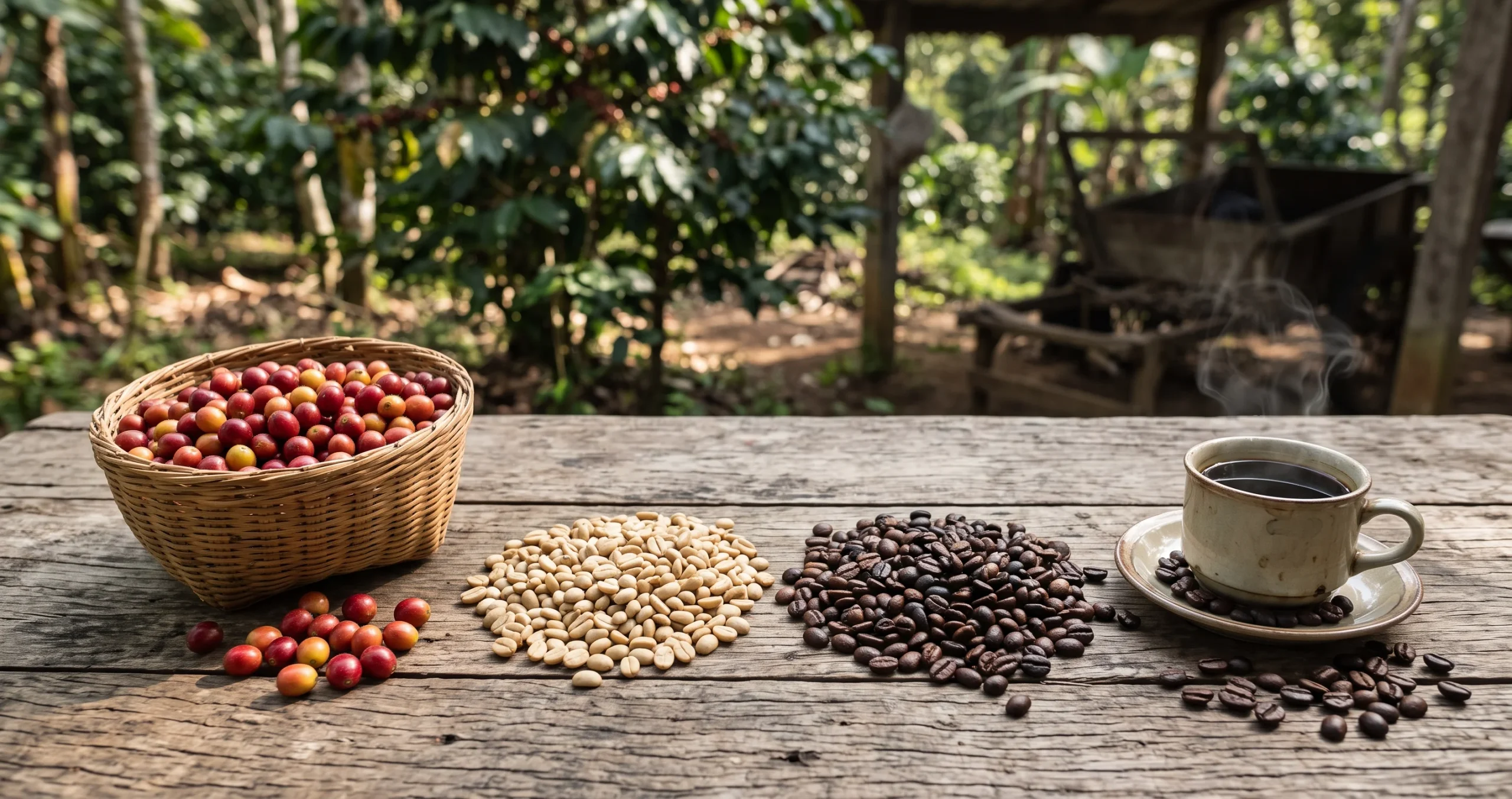
Most coffee begins with ripe fruit harvested from a coffee plant. But Kopi Luwak coffee takes an extraordinary detour through the digestive system of a small, nocturnal mammal called the Asian palm civet.
This unusual coffee is made from seeds recovered after civets eat coffee cherries. The fruit pulp is digested, while the seeds pass through the animal’s body before being collected and processed.
The process sounds fascinating, but it also raises important questions about wildlife biology, coffee quality, and animal welfare. Behind the luxury reputation of Kopi Luwak lies a complicated story involving natural feeding behavior, scientific research, and the treatment of captive animals.
Table of Contents
- What Is Kopi Luwak Coffee?
- Meet the Asian Palm Civet
- How Kopi Luwak Coffee Is Made
- What Happens During Digestion?
- Does Kopi Luwak Taste Better?
- Why Is Kopi Luwak So Expensive?
- Wild-Collected vs. Captive-Produced Coffee
- The Animal Welfare Problem
- Ethical Sourcing and Animal-Free Alternatives
- Common Myths
- Frequently Asked Questions
- Conclusion
What Is Kopi Luwak Coffee?
Kopi Luwak is a type of coffee produced from beans that have passed through the digestive system of a civet. The name comes from Indonesian: kopi means coffee, while luwak refers to the civet associated with its production.
The most commonly associated species is the Asian palm civet, scientifically known as Paradoxurus hermaphroditus.
Unlike conventional coffee production, where cherries are harvested directly from plants, traditional Kopi Luwak production involves collecting seeds from the droppings of free-ranging civets.
These seeds are subsequently cleaned, processed, roasted, and brewed.
An important detail is that coffee beans are not true botanical beans. They are seeds found inside the fruit of the coffee plant, commonly called coffee cherries.
The civet digests much of the surrounding fruit material, but the coffee seeds generally remain sufficiently intact to be recovered.
Meet the Asian Palm Civet
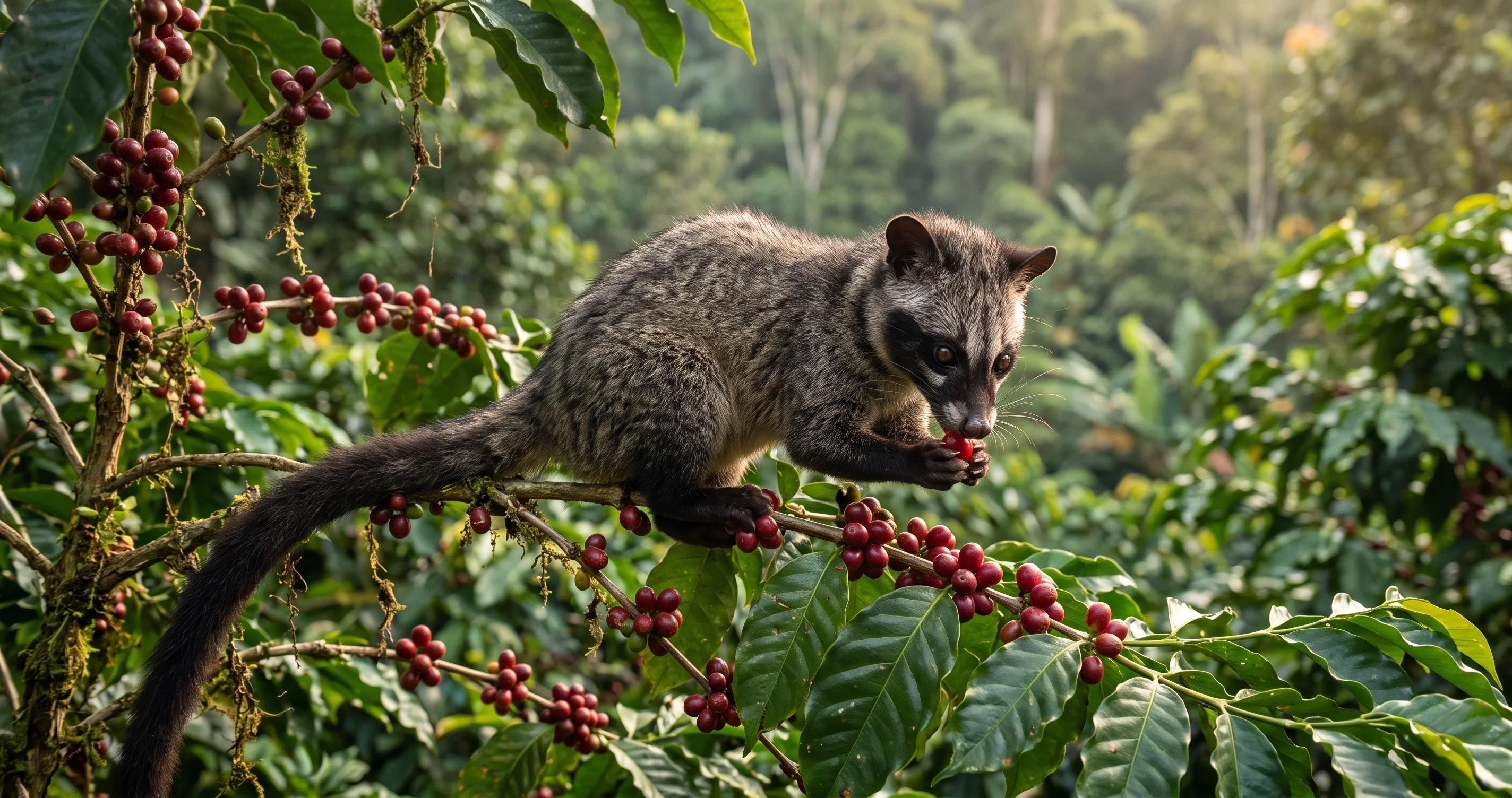
The Asian palm civet is a small mammal native to parts of South and Southeast Asia. Although its pointed face and long tail may resemble those of a cat, it belongs to the family Viverridae rather than the cat family.
Asian palm civets have elongated bodies, short legs, grayish or brownish coats, and distinctive dark facial markings. Their flexible bodies and climbing abilities help them move through trees in search of food.
A Nocturnal Animal With a Varied Diet
These mammals are primarily active at night and consume a wide range of foods.
Their diet includes fruit, insects, and small animals. Coffee cherries may become part of that diet where coffee plants are accessible.
Civets do not exist simply to eat coffee. Their feeding behavior reflects the broader dietary flexibility that allows them to survive in forests, plantations, and some human-modified environments.
Their Role in Seed Dispersal
Fruit-eating civets can also contribute to seed dispersal.
When they swallow fruits and later deposit seeds elsewhere, they may help distribute certain plant species across the landscape.
The effectiveness of this process depends on the plant, the condition of the seeds, and the locations where they are deposited.
This ecological role is far more important to understanding civets than their association with an expensive beverage.
How Kopi Luwak Coffee Is Made
The production of Kopi Luwak coffee follows a distinctive sequence, beginning with a ripe coffee cherry and ending with roasted coffee beans.
Step 1: The Civet Eats Coffee Cherries
Coffee plants produce fleshy fruits that typically turn red or yellow as they ripen, depending on the variety.
Civets may eat these fruits when they encounter them. Their ability to choose edible fruit has contributed to the belief that civets naturally select the highest-quality coffee cherries.
However, that belief should not be treated as proof that every cherry eaten by a civet is superior to those harvested by people.
Step 2: The Fruit Enters the Digestive System
After swallowing the cherries, the civet digests much of the surrounding fruit material.
The seeds travel through the gastrointestinal tract, where they are exposed to digestive fluids, enzymes, and microorganisms.
Although some changes may occur during this passage, the seeds are not completely digested.
Their internal structure remains sufficiently intact for later recovery and processing.
Step 3: The Seeds Are Recovered
In traditional wild collection, people search for civet droppings containing coffee seeds.
The recovered seeds must be separated from the surrounding waste.
This stage is one reason the coffee has attracted international attention. Nevertheless, the collection process alone does not guarantee that the resulting product is hygienic or high-quality.
Step 4: Cleaning, Drying, and Roasting
Recovered seeds require careful post-collection processing.
Cleaning removes contamination, while drying and other processing stages prepare the coffee for roasting. The exact sequence can vary among producers.
Roasting develops many of the aromas and flavors associated with finished coffee.
Proper handling, hygiene, and roasting are essential. The fact that the seeds passed through an animal does not make them automatically safe to consume.
Step 5: Brewing the Coffee
After roasting, Kopi Luwak can be ground and brewed using conventional coffee-making equipment.
The final beverage may look much like ordinary coffee.
Its distinctive reputation comes primarily from its unusual production history rather than a visibly different appearance.
What Happens to Coffee Beans During Digestion?
One of the most interesting scientific questions concerns the changes that coffee seeds undergo inside the civet.
Researchers have investigated whether digestive enzymes and microorganisms alter the chemical composition of the seeds.
Some studies report measurable differences between civet-processed coffee and conventionally processed coffee, including differences in certain chemical compounds.
However, the results depend on factors such as the coffee variety, processing methods, roasting conditions, and analytical techniques.
Does Fermentation Occur Inside the Civet?
Microbial activity may contribute to changes during gastrointestinal passage, but descriptions of a controlled fermentation process inside the animal can oversimplify what happens.
The digestive tract is a complex biological environment, not a standardized coffee fermentation vessel.
Scientists continue to investigate which changes can be attributed specifically to digestion and which arise from other production stages.
A detectable chemical difference does not automatically mean that the resulting coffee tastes better.
Does Kopi Luwak Coffee Really Taste Better?
Kopi Luwak is frequently marketed as having a smoother flavor, reduced bitterness, or a distinctive aroma.
These descriptions are not universal characteristics that every sample will possess.
Coffee flavor depends on numerous variables, including the coffee species, growing environment, ripeness, post-harvest processing, roast level, freshness, and brewing technique.
What Scientific Research Suggests
Chemical studies provide evidence that some civet-processed coffees differ from comparison samples.
However, determining whether those differences improve flavor requires carefully designed sensory testing.
Taste is also subjective. A coffee that one person considers smooth may seem unremarkable to another.
The scientific evidence does not establish that passage through a civet consistently produces a superior cup.
Consumers should therefore distinguish between measurable chemical changes, individual tasting preferences, and promotional claims.
Why Is Kopi Luwak So Expensive?
Kopi Luwak became internationally recognized as a luxury coffee partly because of its unusual origin and the story surrounding its production.
Traditional collection from free-ranging animals can require considerable labor, and naturally recovered quantities may be limited.
Exclusivity, international publicity, and specialty-product marketing have also contributed to its premium reputation.
However, a high price does not necessarily indicate exceptional quality or ethical production.
Some commercially produced civet coffee comes from captive animals rather than from seeds collected in the wild.
This distinction matters because consumer demand for an unusual product can create incentives for intensive animal confinement.
Wild-Collected vs. Captive-Produced Kopi Luwak
Traditionally, Kopi Luwak could be collected from droppings left by free-ranging civets.
In this situation, the animal eats fruit as part of its normal behavior, and people recover the seeds afterward.
Captive production is fundamentally different.
Civets may be confined in enclosures and supplied with coffee cherries specifically to produce marketable beans.
Why the Difference Matters
A free-ranging civet can move, climb, seek shelter, and select food from its environment.
A captive civet depends on humans for food, housing, and opportunities to express natural behavior.
Captivity does not automatically mean that every animal experiences identical conditions, but documented welfare problems in the industry are serious.
Claims such as “wild,” “natural,” or “ethically sourced” should not be accepted without reliable supporting evidence.
The Hidden Animal Welfare Problem
The greatest concern surrounding commercial Kopi Luwak is not the digestive process itself. It is the treatment of animals used to supply the product.
Investigations and welfare research have documented problems involving captive civets, including restrictive housing, inadequate environmental conditions, and poor management.
Confinement and Restricted Movement
Asian palm civets are active animals adapted to exploring complex environments.
Small or barren cages can prevent climbing, roaming, and other natural behaviors.
For a largely nocturnal species, unsuitable lighting and repeated daytime disturbance may create additional welfare challenges.
Inappropriate Feeding Practices
Wild civets consume a varied diet rather than coffee cherries alone.
Captive feeding practices that rely too heavily on coffee fruit may fail to meet their nutritional and behavioral needs.
A balanced diet and appropriate veterinary care are essential for captive animal welfare, but they do not eliminate every concern associated with commercial production.
Stress and Behavioral Problems
Restrictive environments can contribute to chronic stress and abnormal behavior.
Welfare assessments must consider physical health, behavioral opportunities, housing conditions, and how animals are handled.
The fact that a civet is alive and producing coffee seeds is not evidence that it is living under acceptable conditions.
Can Kopi Luwak Be Ethically Sourced?
Some sellers advertise wild-collected or cruelty-free Kopi Luwak.
In principle, collecting seeds from naturally deposited droppings avoids the direct confinement associated with captive production.
However, independently verifying the origin of a finished product can be difficult.
Supply chains may involve multiple collectors, processors, and sellers. Labels alone do not necessarily provide reliable proof of where the seeds came from.
Consumers seeking to avoid contributing to animal suffering should be cautious about unverified ethical claims.
Animal-Free Alternatives to Civet Coffee
Researchers and coffee producers have explored fermentation and processing techniques that may reproduce some chemical or sensory characteristics associated with civet coffee.
These approaches can involve microorganisms, enzymes, or controlled post-harvest fermentation.
Such methods do not require coffee cherries to pass through a living animal.
However, producing similar chemical characteristics does not guarantee an identical flavor profile.
The most promising advantage of animal-free approaches is the possibility of experimenting with unusual processing methods without relying on captive wildlife.
Common Myths About Kopi Luwak Coffee
Myth 1: Civets Completely Digest the Coffee Beans
False. Civets digest much of the fruit pulp, while the seeds generally pass through sufficiently intact to be recovered.
Myth 2: All Kopi Luwak Comes From Wild Animals
False. Captive production exists, and claims of wild sourcing can be difficult to verify.
Myth 3: Kopi Luwak Is Automatically the Best Coffee
Not established. Chemical differences do not necessarily translate into superior flavor.
Myth 4: The Coffee Is Safe Without Processing
False. Recovered seeds require appropriate cleaning, processing, and roasting under hygienic conditions.
Myth 5: Civets Naturally Depend on Coffee Cherries
False. Coffee cherries are only one potential food source in a much broader omnivorous diet.
Frequently Asked Questions
What animal produces Kopi Luwak coffee?
The animal most commonly associated with Kopi Luwak is the Asian palm civet, Paradoxurus hermaphroditus, a nocturnal mammal native to parts of Asia.
Is the Asian palm civet a type of cat?
No. Despite its catlike appearance, the Asian palm civet belongs to the family Viverridae, not Felidae.
Do civets digest the coffee beans?
They digest much of the fruit surrounding the seeds, but the seeds generally remain intact enough to be recovered and processed.
Is Kopi Luwak safe to drink?
Properly handled and processed Kopi Luwak can be prepared as coffee. Safety depends on hygiene, processing, and storage, not on the unusual origin of the beans alone.
Does Kopi Luwak taste better than regular coffee?
There is no universal scientific basis for claiming it always tastes better. Flavor varies among products, and personal preferences differ.
Does Kopi Luwak production harm civets?
Some commercial production systems have documented serious animal welfare problems, particularly where civets are confined in unsuitable conditions.
Can consumers identify cruelty-free Kopi Luwak?
Verification is challenging. Marketing labels are not sufficient evidence of animal welfare or genuinely wild collection.
Conclusion :
Kopi Luwak coffee reveals an unusual connection between wildlife feeding behavior and human food production.
The Asian palm civet naturally consumes fruit, including coffee cherries, and can pass the seeds through its digestive system. Those seeds may then be recovered and transformed into roasted coffee.
Yet the biological curiosity should not overshadow the animal behind the product.
Scientific research has identified potential chemical differences in civet-processed coffee, but claims of consistently superior flavor remain uncertain. Meanwhile, captive production raises substantial ethical concerns.
Understanding Kopi Luwak means appreciating both the fascinating biology of the Asian palm civet and the importance of protecting wildlife from unnecessary exploitation.
External sources :
1. Lachenmeier & Schwarz (2021) — Digested Civet Coffee Beans (Kopi Luwak). A peer-reviewed discussion of coffee authenticity, species differences, digestion-related claims, and animal protection.
2. Welfare and Management of Civets in Civet Coffee Tourism Plantations (2023). Research documenting welfare and husbandry conditions in civet coffee tourism operations and wildlife markets.
3. Metabolite Profiling of Premium Civet Luwak Bio-Transformed Coffee (2023). A peer-reviewed chemical analysis comparing civet coffee with conventional coffee samples.