
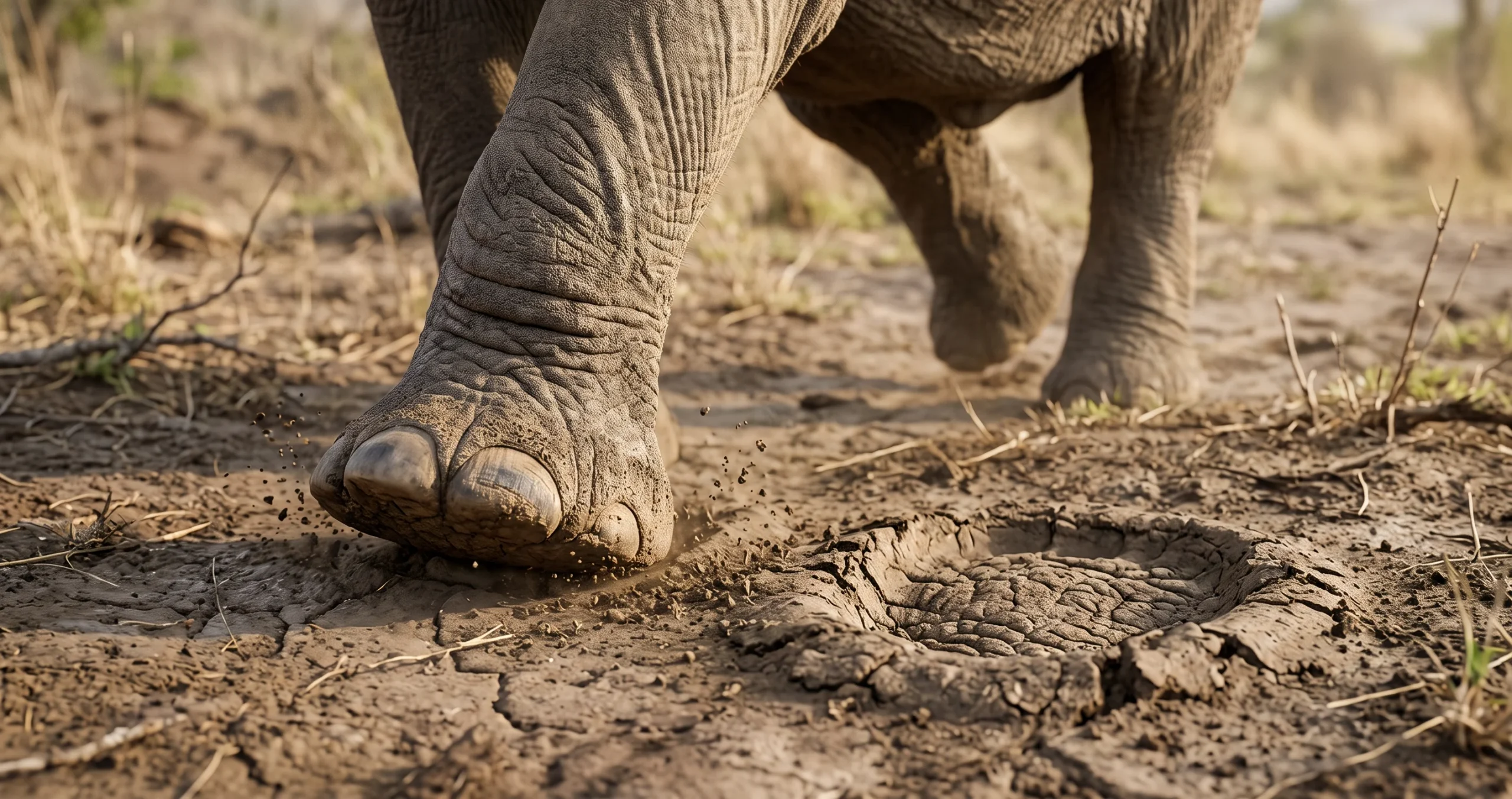
An elephant can weigh several tons, yet its enormous body rests on four remarkably specialized feet. Beneath the thick, wrinkled skin lies an intricate system of bones, tendons, connective tissues, and cushioning structures that makes walking possible.
Understanding elephant foot anatomy reveals one of nature’s most impressive examples of biological engineering. Elephants have internal fatty cushions that help manage enormous loads, unusual skeletal arrangements that support their weight, and sensory capabilities associated with detecting vibrations through the ground.
These adaptations help explain how the world’s largest living land animals move across grasslands, forests, and rocky terrain. They also reveal why elephant feet are far more sophisticated than their massive, rounded appearance suggests.
Table of Contents
- Elephant Foot Anatomy: Bones, Toes, and Hidden Structures
- The Remarkable Cushion Inside an Elephant’s Foot
- How Elephant Feet Support Several Tons
- The Science Behind an Elephant’s Quiet Steps
- How Elephants Detect Ground Vibrations
- Elephant Footprints and Their Hidden Clues
- African vs. Asian Elephant Feet
- Elephant Foot Health and Conservation
- How Evolution Shaped Elephant Feet
- Common Myths About Elephant Feet
- Frequently Asked Questions
- Conclusion
Elephant Foot Anatomy: Bones, Toes, and Hidden Structures
A Massive Foot With a Surprising Internal Design
At first glance, an elephant’s foot resembles a thick pillar ending in a broad, rounded sole. Internally, however, its structure is much more complicated.
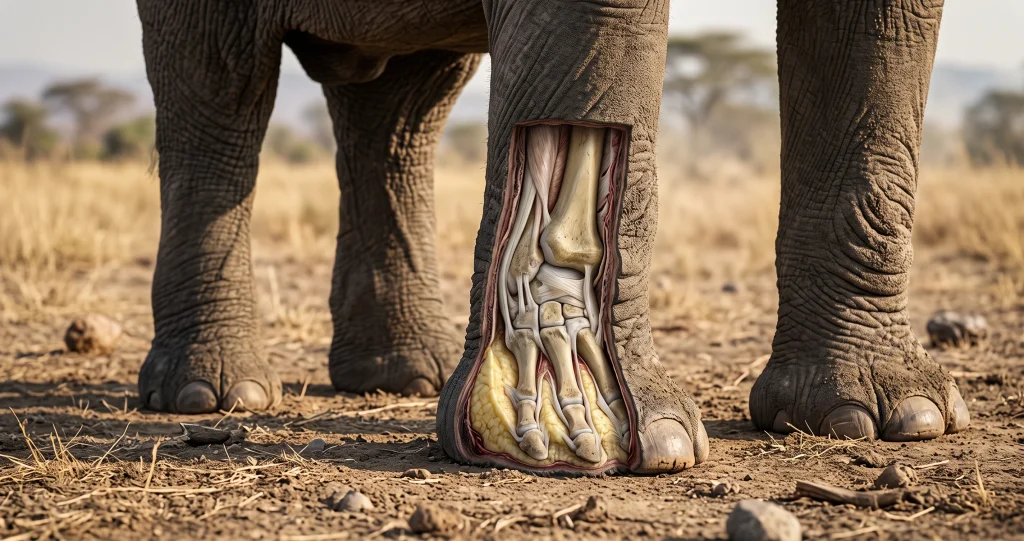
Elephants have five digits within each foot, although the number of visible toenails varies. Their toes are positioned within a large supportive structure that includes bones, ligaments, tendons, and specialized soft tissues.
Unlike humans, who normally place their heels and toes directly against the ground, elephants have an elevated skeletal heel supported by a substantial internal cushion.
This arrangement is sometimes described as digitigrade-like because much of the skeletal weight-bearing system is supported through the digits. However, the broad external sole contacts the ground, making elephant foot posture more complex than that of a typical toe-walking animal.
Bones, Ligaments, and Connective Tissues
The elephant’s foot contains the same basic categories of skeletal elements found in other mammals, including wrist or ankle bones, metapodials, and phalanges.
Strong ligaments help stabilize the joints, while tendons connect muscles to skeletal structures and transmit forces during movement.
One particularly interesting feature is the enlarged supportive structure sometimes called the prepollex in the forefoot and prehallux in the hindfoot.
These structures are not ordinary additional toes. They are specialized cartilaginous elements that can become partly ossified and contribute to supporting the foot’s soft tissues.
Together, these anatomical components create a strong but adaptable foundation for an extraordinarily heavy animal.
The Remarkable Cushion Inside an Elephant’s Foot
Nature’s Built-In Pressure-Distribution System
One of the most important features of elephant foot anatomy is the large fibro-fatty cushion positioned beneath and behind the skeletal elements.
This cushion contains fatty tissue organized within a network of fibrous connective tissue. Rather than behaving like a simple bag of fat, it forms a mechanically supported structure that changes shape under pressure.
As an elephant places weight on its foot, the cushion deforms and helps spread loading forces across a wider area.
The fibrous network also restricts excessive tissue movement, helping the foot remain stable under substantial pressure.
More Than a Biological Shock Absorber
The elephant foot cushion is often described as a natural shock absorber, but that comparison is incomplete.
Its function involves pressure distribution, mechanical support, deformation, and the management of forces during standing and walking.
The cushion is not filled with air, nor does it function like a pneumatic tire. Its properties arise from the interaction of fatty tissue, connective tissue, and surrounding skeletal structures.
This combination allows the foot to remain supportive while accommodating changes in loading throughout each step.
How Elephant Feet Support Several Tons of Body Weight
Weight Distribution and Walking Mechanics
Supporting several tons requires more than strong bones. An elephant must distribute forces across its limbs while maintaining stability during movement.
Its broad feet provide a substantial contact area with the ground, helping distribute pressure. The internal cushions and connective tissues contribute to this mechanical system.
The front limbs generally carry a larger proportion of body weight during quiet standing because of the elephant’s body proportions and mass distribution.
The hind limbs contribute to propulsion, while all four limbs participate in supporting and controlling movement.
How Elephants Walk Differently From Humans
Elephants usually walk using a coordinated four-limbed gait in which their feet contact the ground in a carefully timed sequence.
Even when moving quickly, their locomotion differs from the running patterns familiar in humans and many other mammals.
Biomechanical studies have shown that elephants can move at surprisingly high speeds without adopting a conventional aerial running phase in which every foot is simultaneously off the ground.
Their movement combines specialized limb mechanics, carefully controlled foot placement, and changes in loading across each step.
These adaptations help manage the mechanical demands of moving an exceptionally large body.
The Science Behind an Elephant’s Surprisingly Quiet Steps
An elephant moving through a forest can sometimes seem remarkably quiet for an animal of its size.
Part of this impression may result from the structure of its feet. The broad soles and deformable cushioning tissues help manage contact forces as the animal steps onto the ground.
However, quiet movement does not mean that an elephant produces no sound or vibration.
Footstep noise depends on walking speed, the force of contact, soil characteristics, vegetation, and the surrounding environment.
A foot pressing into soft soil may produce less sharp audible impact than one stepping onto hard, uneven ground.
Elephants can also produce measurable ground vibrations while moving. Their apparent quietness to human ears should therefore not be confused with an absence of mechanical impact.
How Elephants Detect Vibrations Through the Ground
The Science of Seismic Communication
Elephants communicate using vocalizations, body movements, touch, and other signals. Some of their low-frequency communication can also produce vibrations that travel through the ground.
These ground-transmitted signals are known as seismic vibrations.
Because seismic energy can propagate through soil, elephants may receive information from signals generated beyond their immediate surroundings.
Research on elephant behavior indicates that these animals can respond to certain experimentally presented ground vibrations.
Sensory Structures and Possible Detection Pathways
Elephant feet contain mechanosensitive structures capable of responding to physical deformation and pressure.
Specialized sensory receptors, including Pacinian-type corpuscles, are relevant to scientific discussions of vibration sensitivity.
Researchers have also investigated whether vibrations transmitted through the skeleton could contribute to hearing-related pathways.
These possibilities are not mutually exclusive, and the precise contribution of different sensory pathways remains an active area of investigation.
What Experiments Actually Demonstrate
Behavioral experiments provide evidence that elephants can detect and respond to some seismic signals under particular conditions.
However, these findings do not establish that elephants can identify every distant sound or interpret all vibrations as meaningful messages.
Signal strength, soil conditions, distance, competing vibrations, and previous experience can influence detection.
The most scientifically accurate conclusion is that ground vibration sensitivity forms a fascinating component of elephant sensory biology, with important questions still unanswered.
Elephant Footprints: What Their Tracks Reveal
The Story Written in the Soil
Elephant footprints are among the most recognizable animal tracks in the natural world.
Their large, rounded impressions can reveal information about movement direction, approximate foot dimensions, and the surfaces an elephant has crossed.
The underside of an elephant’s foot has distinctive grooves and patterns that may sometimes appear in well-preserved tracks.
Researchers can examine these patterns alongside track measurements to investigate elephant movement and, under suitable conditions, potentially distinguish individuals.
Why Footprint Depth Can Be Misleading
A deep footprint does not necessarily mean that an elephant is unusually heavy.
Soft, wet soil can produce a deep impression, while firm, dry ground may preserve only a shallow mark from the same animal.
Walking speed, foot placement, and uneven terrain also affect the resulting track.
Scientists therefore interpret footprints within their environmental context rather than using a single measurement to calculate an elephant’s exact weight or age.
African vs. Asian Elephant Feet
Similar Foundations, Subtle Differences
African and Asian elephants share the same fundamental foot design: internally supported digits, substantial cushioning tissues, and broad weight-bearing soles.
However, differences in body proportions, foot shape, and visible toenails can help distinguish them.
African savanna elephants commonly have four visible toenails on their front feet and three on their hind feet.
Asian elephants commonly have five visible toenails on their front feet and four on their hind feet.
These are typical patterns rather than universal rules. Individual variation, wear, injury, and differences among elephant species can affect the visible count.
African forest elephants also deserve separate consideration because they are a distinct living species with their own commonly observed toenail patterns.
Consequently, toenail counts should be treated as supporting identification clues, not definitive proof of species identity.
Elephant Foot Health and Conservation
Why Healthy Feet Are Essential
Elephant foot anatomy is remarkably effective, but these specialized structures can still develop serious problems.
Cracks, infections, nail abnormalities, and damage to the sole can interfere with normal walking.
Because elephants must repeatedly load their feet with substantial body weight, even a localized injury may become significant.
In severe cases, persistent foot disorders can affect mobility, feeding opportunities, and overall welfare.
The Importance of Suitable Ground Surfaces
In natural environments, elephants move across different substrates, including soil, sand, vegetation, and occasionally rocky ground.
These varied surfaces create different loading conditions and opportunities for natural foot wear.
In captivity, prolonged exposure to unsuitable hard surfaces, restricted movement, and inadequate foot care may contribute to health problems.
Research on foot pressure distribution suggests that particular regions of the elephant foot experience higher loading than others, potentially helping explain the location of some disorders.
A peer-reviewed study published in Royal Society Open Science examined these patterns in African and Asian elephants and highlighted their relevance to welfare and husbandry.
Appropriate veterinary monitoring, suitable substrates, movement opportunities, and regular foot examinations are therefore important elements of elephant care.
How Evolution Shaped the Elephant’s Foot
The Evolution of a Remarkable Support System
Modern elephants belong to Proboscidea, a mammalian lineage with a long and diverse evolutionary history.
Their ancestors included animals with different body sizes, limb proportions, and foot structures.
As some proboscidean lineages evolved increasingly massive bodies, supporting those bodies placed substantial demands on the limbs and feet.
The specialized skeletal and cushioning structures of living elephants reflect adaptations associated with these demands.
The Surprising Story of the Sixth Toe
One particularly fascinating discovery concerns the structures sometimes described as an elephant’s sixth toes.
Research published in Science in 2011 demonstrated that these supportive elements are enlarged sesamoid-derived structures rather than ordinary additional digits.
They begin largely as cartilage and may become partly ossified during development.
The researchers also investigated how these structures relate to the evolution of elephant foot support.
This discovery illustrates an important evolutionary principle: existing anatomical structures can be modified to perform new or expanded functions.
Elephants did not simply develop bigger versions of ordinary mammalian feet. Their evolutionary history produced a distinctive combination of skeletal and soft-tissue specializations.
Common Myths About Elephant Feet
Myth 1: Elephant Feet Are Solid Columns of Bone
Their feet contain numerous bones, joints, tendons, ligaments, and substantial cushioning tissues. The internal arrangement is flexible and mechanically complex.
Myth 2: Elephants Walk Entirely on Soft Fat
The fatty cushions work together with the skeleton and connective tissues. Neither system could adequately explain the foot’s function in isolation.
Myth 3: Elephant Footsteps Are Completely Silent
Elephants produce audible sounds and measurable ground vibrations while walking. Their feet can moderate contact forces without eliminating them.
Myth 4: Elephants Can Interpret Every Ground Vibration
Experiments support sensitivity to certain seismic signals, but interpretation depends on the signal and environmental conditions. Their sensory abilities should not be exaggerated.
Myth 5: Footprints Reveal an Elephant’s Exact Weight
Footprint dimensions and depth depend on multiple factors. Tracks may provide useful clues, but they are not precise weighing instruments.
Frequently Asked Questions
Why Are Elephant Feet So Soft Underneath?
Elephant feet contain substantial fibro-fatty cushions surrounded by supportive connective tissues. These structures help distribute pressure and accommodate deformation under body weight, although the outer sole itself is tough rather than uniformly soft.
Do Elephants Walk on Their Toes?
Their skeletal posture is often described as subunguligrade or toe-supported, but the broad external sole contacts the ground. The large internal cushion helps create this unusual combination.
Can Elephants Feel Vibrations Through Their Feet?
Research supports the ability of elephants to detect certain ground-transmitted vibrations. Foot receptors are a plausible detection pathway, although researchers continue to investigate how different sensory mechanisms contribute.
Why Are Elephant Footsteps Relatively Quiet?
Their broad soles, cushioning tissues, and controlled walking movements can help moderate contact forces. Actual sound levels vary with speed, terrain, and environmental conditions.
How Many Toes Do Elephants Have?
Elephants have five anatomical digits in each foot, although not every digit has a clearly visible external toenail. Their supportive predigit structures are sometimes called sixth toes, but they are anatomically different from ordinary digits.
Do Elephant Footprints Identify Individual Animals?
Under favorable conditions, distinctive sole patterns and repeated measurements may help researchers distinguish individuals. However, incomplete impressions and changing ground conditions can limit identification accuracy.
Can Elephants Develop Foot Problems?
Yes. Elephants can experience infections, cracked soles, nail disorders, and other foot injuries. These conditions can become serious because of the mechanical demands placed on their feet.
Conclusion:
Elephant foot anatomy demonstrates how evolution can produce extraordinary solutions to the challenges of supporting a massive body.
What appears externally to be a simple, rounded foot contains an elaborate system of bones, connective tissues, specialized supportive structures, and fibro-fatty cushioning.
These features help elephants stand, walk, distribute pressure, and move across varied landscapes. Their sensory biology adds another remarkable dimension, suggesting that the ground beneath their feet can carry information as well as support their weight.
Scientists continue to investigate the details of elephant locomotion, seismic sensitivity, and foot health, revealing how much remains to be learned about these familiar giants.
Every elephant footprint represents far more than the weight of an enormous animal. It reflects millions of years of evolutionary specialization hidden beneath a single step.
External Sources:
1. Hutchinson et al. (2011), Science. From Flat Foot to Fat Foot: Structure, Ontogeny, Function, and Evolution of Elephant “Sixth Toes”. https://pubmed.ncbi.nlm.nih.gov/22194576/ Supports the anatomy and evolutionary adaptations sections.
2. Panagiotopoulou et al. (2016), Royal Society Open Science. Foot Pressure Distributions During Walking in African Elephants. https://pmc.ncbi.nlm.nih.gov/articles/PMC5098964/ Supports locomotion, foot pressure, and welfare discussions.