
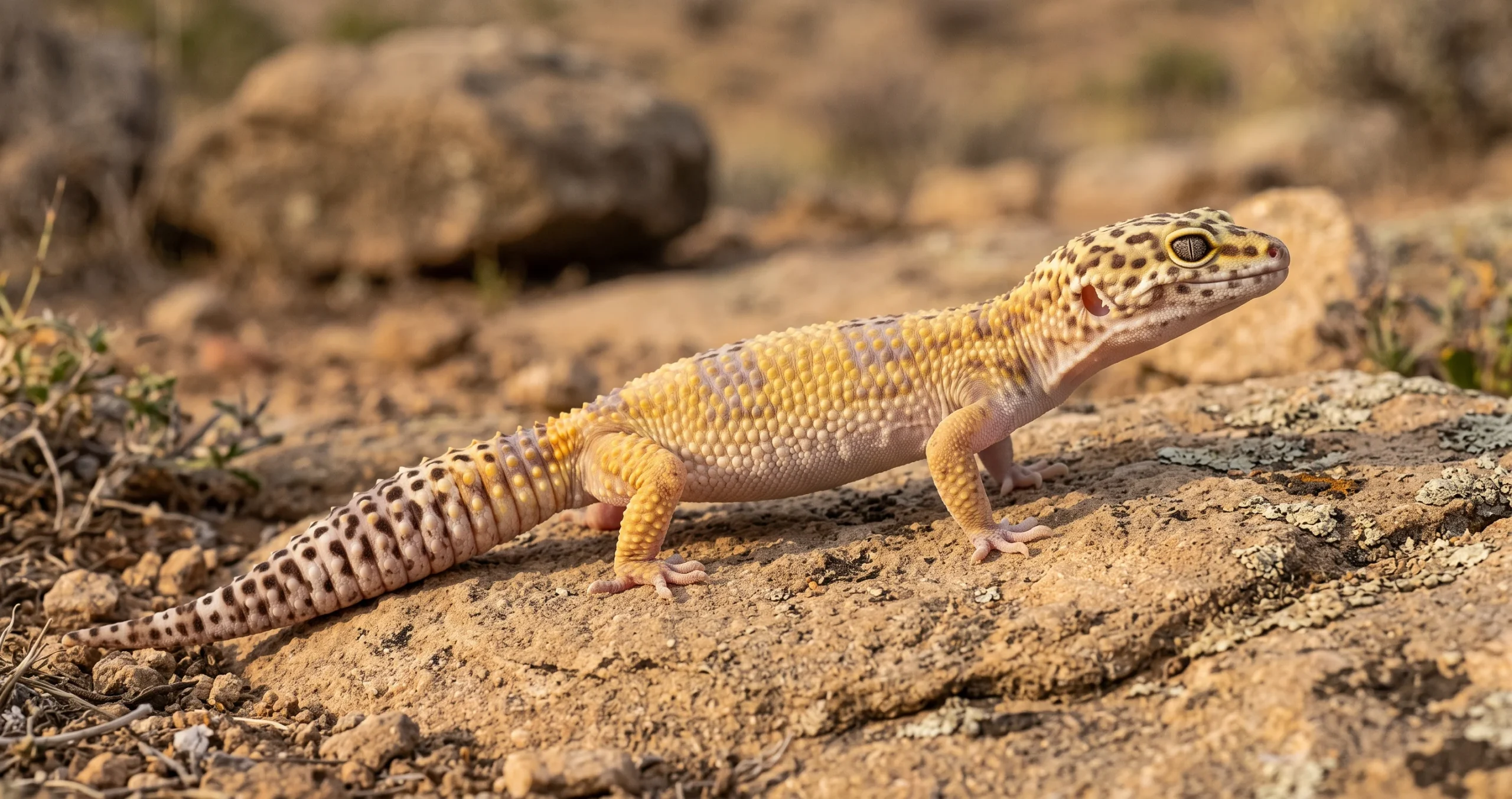
The leopard gecko (Eublepharis macularius) possesses one of the most fascinating survival adaptations in the reptile world. Its thick, spotted tail is far more than an attractive feature. It acts as an energy reserve, provides a remarkable defense against predators, and can even grow back after being lost.
The science of leopard gecko tail regeneration reveals an extraordinary combination of evolutionary adaptations. These small, ground-dwelling lizards can store valuable nutrients in their tails, sacrifice that reserve during a dangerous encounter, and gradually develop a functional replacement.
Understanding these abilities offers a fascinating glimpse into reptile biology, natural selection, and the remarkable ways animals survive in challenging environments.
Table of Contents
- Why Leopard Geckos Store Fat in Their Tails
- Leopard Gecko Tail Autotomy: A Remarkable Defense
- What Happens After a Leopard Gecko Loses Its Tail
- How Leopard Gecko Tail Regeneration Works
- Original Tail vs. Regenerated Tail
- Other Surprising Leopard Gecko Adaptations
- Common Myths About Leopard Gecko Tails
- Frequently Asked Questions
- Conclusion
Why Leopard Geckos Store Fat in Their Tails
A Natural Energy Storage System
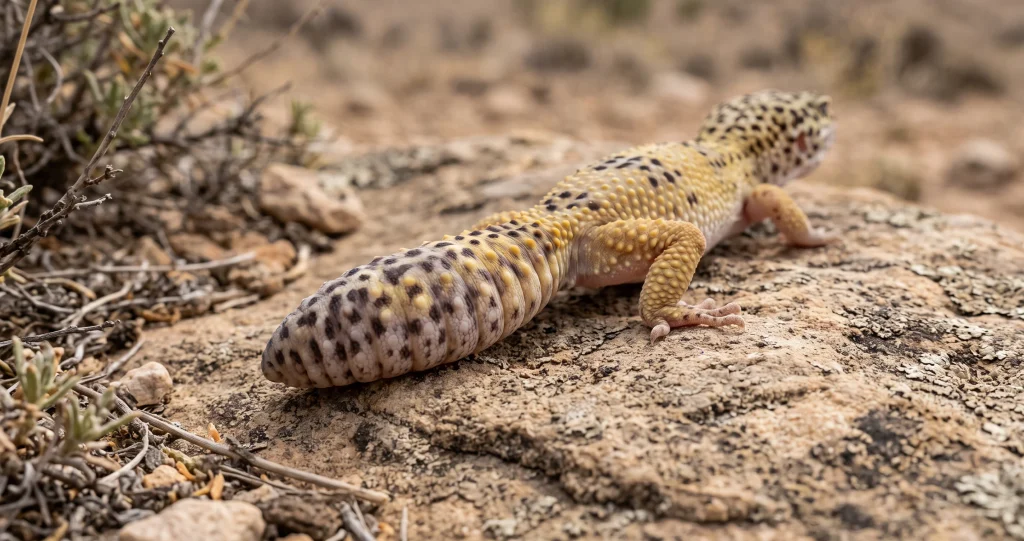
Unlike many lizards with long, slender tails, leopard geckos often develop noticeably thick tails containing substantial fat deposits.
These deposits consist largely of stored lipids, which serve as an important energy source when food is limited. Rather than relying entirely on recently consumed insects, the animal can draw on stored energy to help support its metabolism.
This adaptation is especially valuable for a reptile living in environments where food availability can fluctuate.
Leopard geckos naturally inhabit parts of South and Central Asia, including rocky, dry regions where temperatures and seasonal conditions influence insect activity.
During periods when prey becomes less accessible, stored fat provides an additional source of energy.
Why Tail Fat Matters for Survival
Maintaining an energy reserve can help an animal survive temporary shortages without immediately exhausting its available resources.
For leopard geckos, the tail provides a specialized location for storing some of these reserves. Fat storage is not limited exclusively to the tail, but its contribution is particularly visible.
This arrangement also creates an evolutionary trade-off. The tail is both a valuable energy reserve and a body part that can be sacrificed during a predator encounter.
Losing it may improve the gecko’s immediate chances of escaping, but the animal must subsequently function without much of that stored energy.
What Tail Thickness Reveals About Health
A well-fed adult leopard gecko commonly has a relatively thick tail, although natural differences exist between individuals.
Tail thickness can therefore offer useful clues about nutritional condition. However, it should never be treated as a complete measure of health.
Age, body size, reproductive status, previous tail loss, and individual variation can all influence appearance.
An unusually thin tail may reflect inadequate nutrition, illness, parasites, or other underlying problems. In captive animals, unexplained weight loss or progressive tail thinning warrants evaluation by a qualified reptile veterinarian.
Similarly, an exceptionally thick tail does not automatically indicate ideal health. Overall body condition, behavior, appetite, and veterinary assessment provide a more reliable picture.
Leopard Gecko Tail Autotomy: A Remarkable Defense Mechanism
The Ability to Escape by Losing a Tail
One of the most remarkable leopard gecko adaptations is caudal autotomy, the ability to detach part of the tail in response to danger.
When threatened or physically restrained, a leopard gecko may release its tail and escape while the predator’s attention shifts toward the detached appendage.
This process is possible because the original tail contains specialized anatomical structures that facilitate separation.
In leopard geckos, fracture planes associated with the caudal vertebrae help make controlled tail loss possible. Surrounding tissues also have adaptations that can limit damage during separation.
Autotomy is not simply the result of a tail breaking like an ordinary bone. It is a specialized biological defense mechanism shaped by evolution.
Why the Detached Tail Keeps Moving
After separation, the detached tail may continue twisting, wriggling, or making brief movements.
These movements result from activity within the tail’s remaining muscles and nervous tissue, which can temporarily function independently of the gecko’s brain.
The motion can attract a predator’s attention, potentially giving the gecko valuable time to retreat into a crevice or another protected location.
However, this defense does not guarantee escape. Its effectiveness depends on the predator, environment, and circumstances of the encounter.
The Hidden Cost of Tail Loss
Although tail autotomy can be lifesaving, it comes with significant biological costs.
A leopard gecko that loses its tail also loses stored fat, experiences tissue damage, and must devote energy to recovery.
The tail also contributes to movement, body positioning, and behavioral signaling. Losing it can temporarily change how the animal interacts with its surroundings.
For these reasons, tail autotomy should be understood as an emergency survival mechanism rather than a harmless ability.
What Happens After a Leopard Gecko Loses Its Tail
The First Stage of Recovery
Following autotomy, the exposed tissues begin a coordinated healing response.
The separation site must close and become protected while the animal maintains normal physiological functions.
The specialized anatomy involved in autotomy can help reduce excessive bleeding, but this does not eliminate the possibility of complications.
In healthy animals, tissue repair and the early stages of regeneration can proceed without human intervention.
Nevertheless, injury, contamination, poor environmental conditions, or underlying illness may interfere with recovery.
Rebuilding Lost Energy Reserves
The loss of a fat-rich tail creates an additional metabolic challenge.
The gecko must support its normal activities while supplying nutrients and energy for tissue repair and regrowth.
Food availability and nutritional condition can therefore influence recovery.
Regeneration is not an instant process. Its progress varies with age, health, nutrition, temperature, and other environmental factors.
In captive leopard geckos, appropriate husbandry is important, and signs of infection, abnormal healing, or reduced appetite require professional veterinary attention.
How Leopard Gecko Tail Regeneration Works
A Remarkable Biological Reconstruction
The process of leopard gecko tail regeneration demonstrates how certain reptiles can rebuild complex structures after losing a body part.
Once the wound begins healing, cells near the injury site participate in coordinated repair and tissue formation.
Regeneration involves changes in cellular activity, tissue organization, and developmental signaling.
Researchers studying this process investigate how cells proliferate, communicate, and contribute to the formation of replacement structures.
The resulting tail contains multiple tissue types, including muscle, connective tissue, nerves, blood vessels, skin, and internal support structures.
However, the regenerated tail is not a perfect anatomical reconstruction of the original.
Why the New Tail Looks Different
An original leopard gecko tail contains segmented caudal vertebrae.
By contrast, a regenerated tail generally develops a continuous cartilaginous support structure rather than recreating the original series of vertebrae.
This difference is one reason regenerated tails may have a distinct shape.
The replacement often appears shorter, rounder, smoother, or more bulbous than the original.
Its coloration and markings may also differ. Instead of reproducing the same arrangement of spots and bands, regenerated skin may display a more uniform or irregular pattern.
These changes are normal consequences of regeneration rather than automatic evidence of disease.
Can the Replacement Tail Store Fat Again?
Yes. A regenerated leopard gecko tail can develop fat deposits and regain an important energy-storage function.
However, the amount of fat stored depends on the animal’s condition, feeding history, and other biological factors.
Regeneration restores useful functions, but it does not necessarily reproduce every structural feature of the original tail.
This distinction makes leopard gecko tail regeneration particularly interesting to scientists studying tissue repair.
Research on leopard geckos and other regenerating lizards helps investigators explore the cellular mechanisms that allow complex tissues to regrow.
Original Tail vs. Regenerated Tail
Although both versions can serve important biological functions, several differences are usually visible.
| Feature | Original tail | Regenerated tail |
|---|---|---|
| Shape | Naturally tapered, often thick | Frequently rounder or more bulbous |
| Internal support | Segmented vertebrae | Primarily a cartilaginous rod |
| Skin pattern | Typical spots and bands | Often altered or less distinct |
| Fat storage | Present | Can develop again |
| Appearance | Original anatomical structure | Functional but modified replacement |
The differences highlight an important principle of biological regeneration: restoring function does not always require rebuilding the original anatomy exactly.
A regenerated tail can still help the gecko maintain energy reserves and perform ordinary activities, even when its internal structure and external appearance differ.
Other Surprising Leopard Gecko Adaptations
Movable Eyelids
Unlike many familiar gecko species, leopard geckos have movable eyelids.
This feature allows them to blink and close their eyes, helping protect the eye surface from environmental debris.
It is also reflected in their scientific classification within the eyelid gecko family, Eublepharidae.
Vocal Communication
Leopard geckos are capable of producing audible sounds.
They may squeak, chirp, or make other vocalizations, particularly during stressful encounters or certain social interactions.
These sounds are part of their behavioral repertoire, although they should not automatically be interpreted as friendly communication.
Ground-Dwelling Feet
Many geckos are famous for climbing smooth vertical surfaces using specialized adhesive toe pads.
Leopard geckos lack the same adhesive climbing system and are primarily terrestrial.
Their clawed toes are better suited to moving across rough ground, rocks, and other natural surfaces.
Activity and Temperature Regulation
Leopard geckos are often described as nocturnal, although activity around dusk and dawn is also common.
As ectothermic animals, they depend on environmental heat sources to regulate body temperature.
Shelter, suitable temperatures, and access to protected resting places are important components of their natural ecology.
Common Myths About Leopard Gecko Tails
Myth 1: A Thick Tail Always Means a Healthy Gecko
A thick tail can indicate substantial energy reserves, but it does not rule out illness or other health concerns.
Body condition must be assessed alongside additional physical and behavioral indicators.
Myth 2: Losing a Tail Is Harmless
Tail autotomy is a specialized defense, but it involves tissue loss and considerable metabolic costs.
It should never be intentionally triggered for entertainment, photography, or demonstrations.
Myth 3: A Regenerated Tail Is Identical to the Original
Regenerated tails commonly differ in internal anatomy, shape, and skin pattern.
They restore important functions without perfectly recreating the original structure.
Myth 4: Tail Regeneration Prevents Complications
The ability to regenerate does not make a leopard gecko immune to infection, injury, or healing difficulties.
Proper environmental conditions and veterinary attention remain important when complications arise.
Frequently Asked Questions
Do Leopard Geckos Store Fat in Their Tails?
Yes. Leopard geckos accumulate fat in their tails, creating an energy reserve that can be used when food availability decreases.
Can Leopard Geckos Survive Without Their Tails?
Yes. Tail loss is a natural defense mechanism, and many leopard geckos survive and regenerate a replacement. However, survival depends on the circumstances, the animal’s condition, and its ability to recover.
Do Leopard Gecko Tails Grow Back?
Yes. Leopard geckos can regenerate a replacement tail after autotomy, although its structure and appearance commonly differ from the original.
Why Does a Regenerated Tail Look Different?
Regenerated tails develop a cartilaginous internal support rather than the original segmented vertebrae. Differences in tissue organization and skin development can also alter their shape and markings.
Can a Leopard Gecko Drop Its Tail More Than Once?
A leopard gecko may experience additional tail loss after an earlier regeneration. However, the anatomy of a regenerated tail differs from that of the original, and subsequent injuries or losses do not necessarily follow the same process.
Does Tail Thickness Indicate Health?
Tail thickness provides useful information about energy reserves, but it is not a definitive health indicator. Unexpected thinning should be assessed in the context of the animal’s overall condition.
How Do Leopard Geckos Use Their Tails to Escape Predators?
When threatened, a leopard gecko may detach its tail. The separated tail can continue moving briefly, potentially distracting the predator while the gecko escapes.
Conclusion:
The leopard gecko’s tail combines three extraordinary biological functions: energy storage, defensive autotomy, and regeneration.
Its fat reserves help support survival during periods of limited food. Its ability to detach can provide a valuable opportunity to escape predators, while regeneration allows the animal to rebuild a functional replacement.
These abilities also demonstrate that survival adaptations often involve trade-offs. Losing a tail may save a gecko’s life, but it also removes stored energy and creates the demanding task of tissue repair.
The study of leopard gecko tail regeneration offers scientists valuable insights into how reptiles repair complex tissues and how evolution produces specialized solutions to environmental challenges.
From its distinctive appearance to its remarkable regenerative capacity, the leopard gecko reminds us that even familiar animals possess biological abilities that are far more complex than they first appear.
Educational note: This article is intended for wildlife education and does not replace professional veterinary advice. Never deliberately induce tail loss. Seek guidance from a qualified reptile veterinarian for injuries, abnormal tail thinning, or healing concerns.
External Sources:
1. McLean & Vickaryous (2011) — A novel amniote model of epimorphic regeneration: the leopard gecko, Eublepharis macularius. Explains the cellular and anatomical stages of regeneration. Read the full scientific study
2. Russell et al. (2015) — The regenerated tail of juvenile leopard geckos preferentially stores more fat than the original. Provides direct experimental evidence about fat storage in regenerated tails. Read the research abstract
3. Delorme, Lungu & Vickaryous (2012) — Scar-free wound healing and regeneration following tail loss in the leopard gecko. Examines healing and regeneration following tail separation. Read the research abstract.