
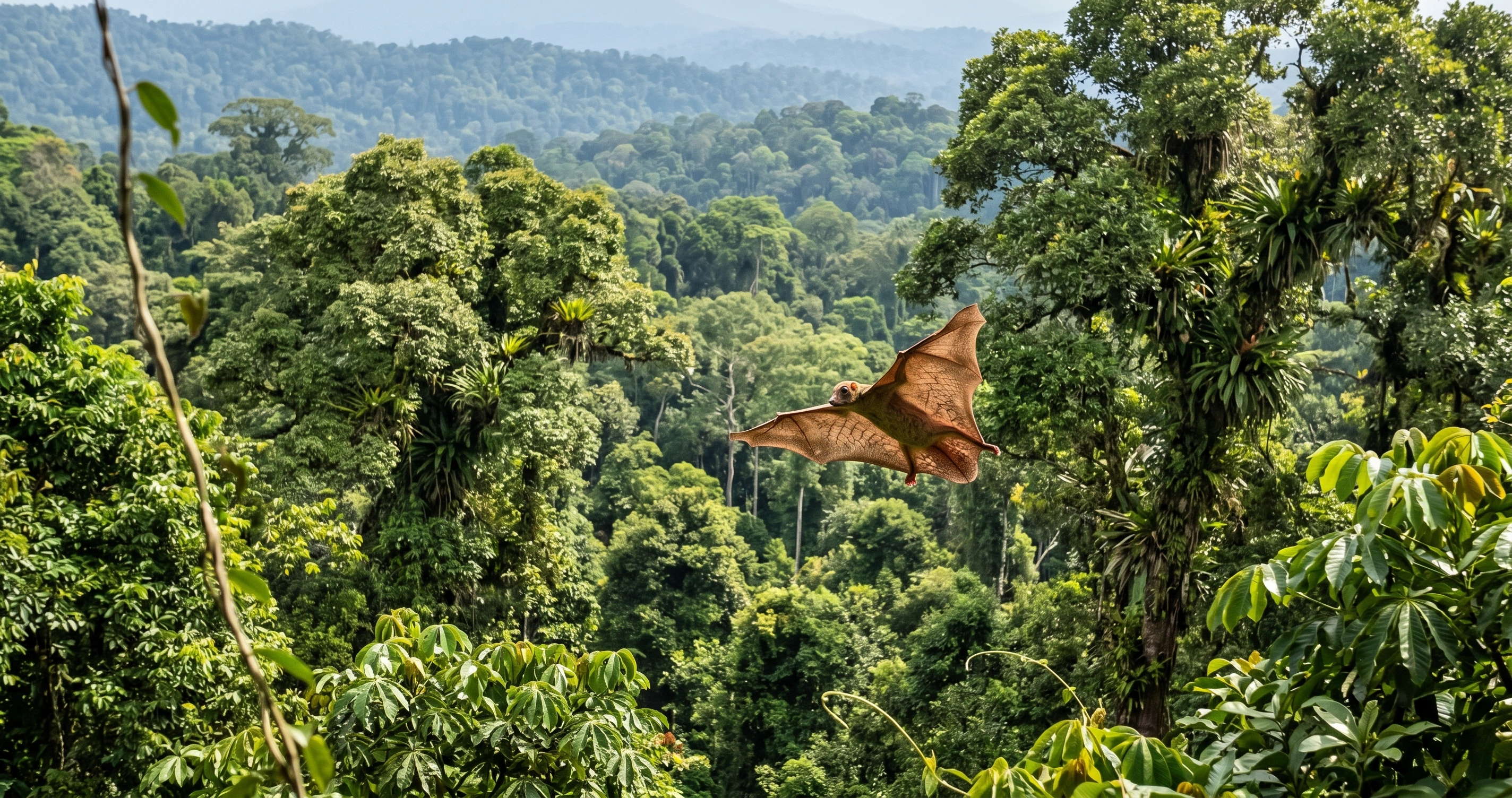
High in the tropical forests of Southeast Asia lives a mammal that appears to turn almost its entire body into a wing. The remarkable colugo gliding membrane stretches from the neck to the limbs, between the fingers and toes, and all the way to the tip of the tail, creating one of the most extensive flight surfaces found in any gliding mammal.
Colugos cannot truly fly. Instead, they launch themselves from trees and glide through the forest, using their enormous membrane to generate lift and control their descent. Documented glides can cover well over 100 meters under favorable conditions.
They are sometimes called “flying lemurs,” but that name is misleading twice over: colugos do not perform powered flight, and they are not lemurs.
Their real evolutionary identity is even more interesting.
Table of Contents
- What Is a Colugo?
- The Extraordinary Colugo Gliding Membrane
- Why the Membrane Is So Extensive
- How Colugos Glide
- How Far Can a Colugo Glide?
- Why Gliding Is Useful
- Why the “Flying Lemur” Name Is Wrong
- Where Colugos Fit on the Mammal Family Tree
- Why Colugos Look Awkward on the Ground
- What Colugos Eat
- Reproduction and Life in the Trees
- Where Colugos Live
- Conservation Status and Threats
- Common Myths
- FAQ
- Conclusion
What Is a Colugo?
Colugos are arboreal mammals native to Southeast Asia. Only two living species are traditionally recognized: the Sunda colugo (Galeopterus variegatus) and the Philippine colugo (Cynocephalus volans).
Together they form the order Dermoptera.
That makes colugos a highly distinctive evolutionary lineage rather than unusual squirrels, bats, or lemurs.
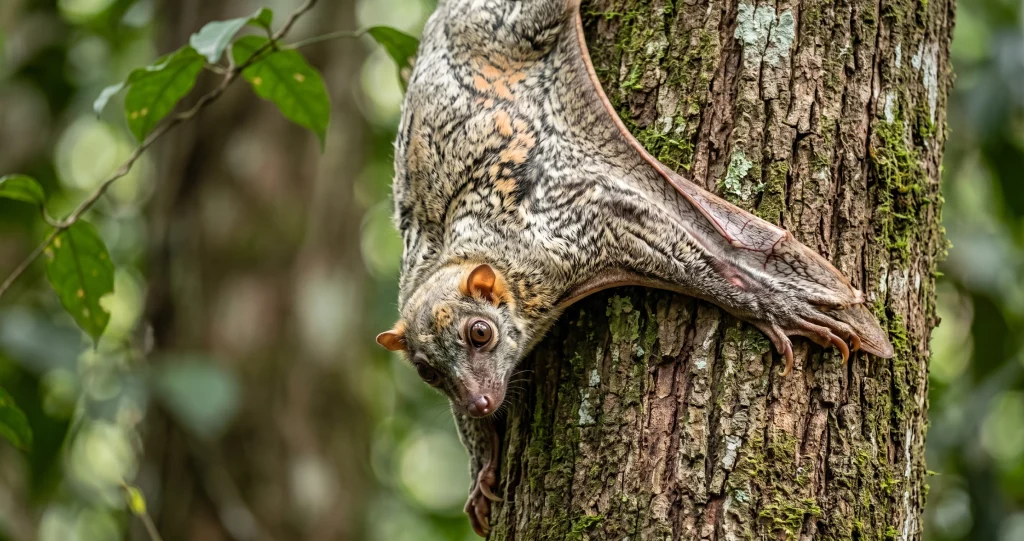
Adults have large eyes, relatively small heads, long limbs, and mottled fur that can blend remarkably well with tree bark. Their bodies are designed around life above the ground.
The feature dominating nearly every aspect of their anatomy is the patagium—the membrane used for gliding.
According to the Encyclopaedia Britannica overview of colugos, this membrane is more extensive than that of other gliding mammals and creates an exceptionally large surface when the animal spreads its limbs.
That is the secret behind its extraordinary aerial performance.
The Extraordinary Colugo Gliding Membrane
Many mammals can glide.
Flying squirrels have membranes stretching between their limbs. Sugar gliders use a similar general principle, and several other arboreal mammals have independently evolved structures that allow controlled aerial descent.
The colugo gliding membrane, however, takes the concept much further.
Its patagium extends along the sides of the body from the neck toward the limbs and tail. Membrane also stretches between the forelimbs and hind limbs.
Most remarkably, webbing extends between the individual fingers and toes.
Even the tail is incorporated into the flight surface.
When a colugo launches and spreads its limbs, the result is a broad, continuous aerodynamic surface with relatively few gaps.
Why the Colugo Gliding Membrane Is So Extensive
A gliding animal faces a basic problem.
Gravity is constantly pulling it downward.
Without wings capable of generating powered flight, a glider can only control how quickly it loses altitude while converting height into forward movement.
Increasing the surface area of the body can help.
When the colugo gliding membrane is fully extended, it increases the animal’s effective aerodynamic area enormously compared with its compact body.
That allows the colugo to generate lift as air flows around the membrane.
It cannot flap the patagium like a bat flaps its wings to sustain powered flight.
Instead, the animal begins with gravitational potential energy by climbing high in a tree. It then launches into open space and converts some of that height into forward travel.
The membrane slows its descent and gives the animal control over its trajectory.
In practical terms, trees become launch platforms.
How Colugos Glide
A glide begins with a powerful leap.
The colugo pushes away from the trunk and extends all four limbs.
As the patagium opens, the body transforms from a relatively narrow climbing animal into a broad aerodynamic shape.
The colugo can alter the position of its limbs and membrane during flight.
Those adjustments allow it to modify direction, stability, and angle of descent.
As it approaches another tree, it changes body orientation in preparation for landing.
The animal typically reaches the destination trunk feet-first or with its limbs prepared to grip the bark.
A successful glide therefore involves much more than falling with a parachute.
The colugo must select a destination, launch appropriately, control the membrane, and manage the considerable energy involved in landing.
How Far Can a Colugo Glide?
Popular descriptions sometimes give a single “maximum” distance as though every colugo has the same record.
Real gliding performance is more complicated.
Distance depends on launch height, destination height, surrounding vegetation, individual size, weather, and the amount of open space between trees.
Nevertheless, exceptionally long glides have been documented.
Research on free-ranging Malayan colugos recorded numerous glides and found an observed maximum of approximately 145 meters in the study population.
That is an extraordinary distance for an animal without powered flight.
It is worth emphasizing what such a number means.
It is a documented observation, not necessarily the absolute biological maximum possible for the species.
Researchers have also found that long glides can be energetically advantageous compared with descending one tree, traveling across the ground, and climbing another.
This helps explain why the colugo gliding membrane has become so extreme.
Why Gliding Is Useful
Tropical forests are vertically complex environments.
For an arboreal animal, moving between neighboring trees can present a problem when branches do not connect.
One option is to climb down.
But descending to the forest floor creates additional work. The animal must later climb back into the canopy, and the ground may expose it to predators or other risks.
Gliding offers an alternative.
A colugo can use height it has already gained to cross a horizontal gap.
Instead of descending and climbing again, it can move directly between trunks.
Research into colugo locomotion suggests that gliding can reduce the energetic costs associated with moving between trees, especially across substantial gaps.
It also allows the animal to remain within the habitat for which its anatomy is best suited: the trees.
Why the “Flying Lemur” Name Is Wrong
Colugos are commonly called flying lemurs.
Scientifically, the name is misleading.
First, colugos do not fly in the same sense as bats.
True powered flight requires the animal to produce aerodynamic force through repeated active wing movements. Bats can take off, flap their wings, gain altitude, and sustain flight.
Colugos glide.
Once launched, they gradually lose altitude.
Second, they are not lemurs.
True lemurs are primates native primarily to Madagascar and belong to an entirely different branch of the mammalian family tree.
Colugos belong to Dermoptera.
Calling one a flying lemur is therefore somewhat like calling a flying squirrel a “flying mouse.” The name captures a superficial resemblance rather than the animal’s actual evolutionary identity.
Where Colugos Fit on the Mammal Family Tree
Colugo taxonomy becomes particularly fascinating when we look beyond the order Dermoptera.
Modern molecular studies place colugos within a larger mammalian grouping called Euarchonta.
This group includes Dermoptera, Primates, and Scandentia—the tree shrews.
Research using genomic and molecular evidence has generally supported Dermoptera as the closest living sister group to primates, although the deeper details of early placental mammal relationships have been investigated extensively and historically debated.
That does not make colugos primates.
It means colugos and primates share a relatively recent common ancestral branch compared with many other mammal groups.
The relationship gives scientists an important perspective on primate evolution.
Studying colugo anatomy and genetics can help researchers investigate characteristics present near the evolutionary divergence of Dermoptera and Primates.
So while “flying lemur” is taxonomically wrong, there really is an interesting evolutionary relationship between colugos and primates.
Why Colugos Look Awkward on the Ground
Everything about the colugo gliding membrane makes sense in the canopy.
On the ground, the same specialization becomes inconvenient.
Colugos are not built for fast terrestrial running.
Their long limbs and extensive membrane interfere with the efficient gait seen in dedicated ground-dwelling mammals.
Movement can appear awkward and laborious.
Even climbing has an unusual appearance.
Colugos use their strong claws to grip tree trunks and move upward in a series of clinging movements and short hops.
They are far more impressive when moving between trees than across horizontal ground.
This difference illustrates an important evolutionary principle.
Animals do not need to be equally efficient at every kind of movement.
Natural selection can favor exceptional performance in the environment an animal uses most often, even when the resulting anatomy creates disadvantages elsewhere.
For the colugo, that environment is overwhelmingly arboreal.
What Colugos Eat
Colugos are primarily herbivorous.
Their diet includes leaves, shoots, flowers, sap, and fruit.
They possess unusual teeth that reflect this plant-based lifestyle.
The lower incisors have a comb-like structure, giving them an appearance unlike the simple incisors of many other mammals.
Colugos generally forage in trees rather than descending to search for food on the ground.
This further reinforces the importance of efficient canopy movement.
If food resources are distributed among multiple trees, gliding provides a practical way to travel between feeding areas.
The animal’s diet, locomotion, and anatomy therefore form an interconnected ecological system.
Reproduction and Life in the Trees
Female colugos usually produce a single young after pregnancy.
The newborn is relatively undeveloped and spends considerable time clinging to its mother.
Here the colugo gliding membrane performs another remarkable function.
A female can curl part of the membrane around her offspring, creating a pouch-like protective space while the young animal clings beneath her body.
This does not make colugos marsupials.
They are placental mammals.
But the arrangement provides an excellent example of an anatomical structure evolving for locomotion and then serving additional functions.
Young colugos remain closely associated with their mothers as they develop.
Eventually they must master the same arboreal skills that define adult life: climbing, launching, controlling a glide, and landing safely.
Where Colugos Live
Colugos occur in Southeast Asia.
The Sunda colugo has a distribution that includes parts of the Malay Peninsula and several islands of the region, including Borneo and Sumatra.
The Philippine colugo occurs in the southern Philippines.
They inhabit forested environments but can also occur in some modified habitats containing sufficient tree cover.
Colugos are mostly nocturnal.
During daylight hours, they may rest against trunks or among vegetation.
Their mottled gray, brown, reddish, or greenish coloration can blend effectively with bark, lichens, and surrounding vegetation.
Large eyes support activity under low-light conditions.
At night, the canopy becomes their highway.
Conservation Status and Threats
The two recognized colugo species are currently assessed as Least Concern on the IUCN Red List.
That classification is reassuring, but it does not mean colugos face no conservation pressures.
Habitat loss and forest fragmentation remain relevant concerns in Southeast Asia.
For an animal dependent on trees for shelter, feeding, reproduction, and locomotion, changes to forest structure matter enormously.
Fragmentation can be particularly important for a glider.
The colugo gliding membrane can cross impressive gaps, but it cannot replace an entire missing forest.
If distances between suitable trees become too large—or if feeding and resting habitat disappears completely—the advantages of gliding cannot compensate.
Colugos may tolerate certain plantations and disturbed habitats where appropriate trees remain, but conserving diverse, connected forest ecosystems offers much broader protection.
Hunting can also create localized pressure in parts of their distribution.
Conservation status should therefore be interpreted at the correct scale.
A species can remain globally classified as Least Concern while individual populations experience substantial regional threats.
For another remarkable example of a vertebrate whose unusual locomotion depends on specialized anatomy, read our article about how basilisk lizards run across the surface of water.
Common Myths About Colugos
Myth 1: Colugos Are Flying Lemurs
They are neither true flying mammals nor lemurs.
Colugos belong to their own mammalian order, Dermoptera.
Myth 2: Colugos Can Fly Like Bats
They cannot perform powered flight.
A colugo must launch from an elevated position and loses altitude as it glides.
Myth 3: The Membrane Only Connects the Front and Back Legs
The colugo gliding membrane is much more extensive.
It includes membrane between the limbs, around the tail, toward the neck, and even between the fingers and toes.
Myth 4: Colugos Are Flying Squirrels
Flying squirrels are rodents.
Colugos belong to Dermoptera and have a different evolutionary history.
Both evolved gliding independently.
Myth 5: Colugos Are Primates
They are not primates.
Molecular evidence indicates that Dermoptera is closely related to Primates, but the two remain distinct evolutionary lineages.
Myth 6: Colugos Are Helpless Climbers
Their movement can look awkward compared with squirrels or monkeys, especially on the ground.
They are nevertheless effective tree-dwelling animals equipped with strong claws for gripping bark.
Myth 7: Colugos Are Endangered Everywhere
Both recognized species are currently classified as Least Concern globally.
Habitat loss, fragmentation, and localized hunting can still threaten populations, so Least Concern should not be interpreted as “no conservation issues.”
FAQ
What is a colugo?
A colugo is an arboreal gliding mammal from Southeast Asia belonging to the order Dermoptera.
Two living species are traditionally recognized: the Sunda colugo and Philippine colugo.
Is a colugo actually a lemur?
No.
Lemurs are primates, while colugos belong to Dermoptera. “Flying lemur” is an old common name rather than a scientifically accurate classification.
Can a colugo actually fly?
No.
Colugos glide by launching from trees and stretching their enormous patagium to generate aerodynamic lift while gradually losing altitude.
How far can a colugo glide?
Field research has documented individual glides of approximately 145 meters.
The distance achievable in any particular glide depends on factors such as starting height, landing height, surrounding trees, and environmental conditions.
What makes the colugo gliding membrane unusual?
The membrane is exceptionally extensive.
It connects the limbs and extends toward the neck and tail while also spanning spaces between the fingers and toes, producing a remarkably continuous flight surface.
Are colugos related to bats?
Only distantly as fellow placental mammals.
Bats belong to the order Chiroptera and evolved powered flight independently.
Are colugos related to primates?
Yes, in an evolutionary sense.
Modern molecular evidence generally places Dermoptera as the closest living sister lineage to Primates. Colugos themselves, however, are not primates.
Why are colugos bad at walking on the ground?
Their anatomy is heavily specialized for climbing and gliding.
Long limbs, strong gripping claws, and an extensive membrane are extremely useful in trees but poorly suited to fast terrestrial locomotion.
What do colugos eat?
They are primarily herbivorous and consume leaves, shoots, flowers, sap, and fruit.
Are colugos endangered?
The Sunda and Philippine colugos are currently assessed globally as Least Concern.
Habitat loss, forest fragmentation, and hunting can nevertheless affect particular populations.
Conclusion
The colugo gliding membrane represents one of the most extreme compromises in mammalian locomotion.
On the ground, a colugo can appear awkward.
Put that same animal high on a tree and the reason for its unusual anatomy becomes immediately clear.
Its patagium does not merely stretch between the front and back legs. It extends around much of the body, incorporates the tail, and even continues between the fingers and toes.
When the limbs spread, almost the entire outline of the animal contributes to an aerodynamic surface.
That allows colugos to transform height into horizontal movement, with documented glides extending well beyond 100 meters.
The strategy keeps them in the canopy, where they feed, rest, reproduce, and avoid many of the costs associated with repeatedly descending to the forest floor.
Their famous nickname, “flying lemur,” hardly does them justice.
They do not truly fly, and they are not lemurs.
Instead, colugos occupy their own order, Dermoptera—a small surviving branch of the mammalian evolutionary tree that molecular research places remarkably close to the ancestry shared with primates.
Their membrane even provides protection for developing young, showing how a structure shaped primarily by locomotion can acquire additional roles.
Colugos demonstrate what can happen when evolution pushes one solution to an extraordinary extreme.
Flying squirrels have membranes.
Sugar gliders have membranes.
But the colugo has transformed almost its entire body into one.
Related Reading
Explore other remarkable animal adaptations involving movement, vision, and survival:
- How Basilisk Lizards Run Across the Surface of Water — Discover the specialized anatomy and rapid movements that allow basilisk lizards to support themselves briefly while running across water.
- Another Remarkable Nocturnal Southeast Asian Mammal Adaptation — Explore why tarsiers have evolved extraordinarily large eyes and how this adaptation supports their nocturnal lifestyle.
References and Further Reading
For additional information about colugos, their gliding adaptations, evolutionary relationships, natural history, and conservation:
Smithsonian’s National Zoo & Conservation Biology Institute — Authoritative zoological and conservation resource covering mammal biology, evolution, forest ecology, and animal adaptations.
Encyclopaedia Britannica — Colugo — Authoritative overview of Dermoptera, including colugo anatomy, gliding adaptations, distribution, diet, and natural history.
IUCN Red List of Threatened Species — The primary global resource for assessing the conservation status of species, including the Sunda colugo (Galeopterus variegatus) and Philippine colugo (Cynocephalus volans).