
WTable of Contents
- Introduction
- What Makes Basilisk Lizards So Special?
- The Science Behind Basilisk Lizard Water Running
- How the Foot-Slap and Air-Pocket Mechanism Works
- Why Size Matters: Why Adults Have Limits
- How Scientists Measured the Physics of Water Running
- How Basilisk Lizards Compare to Other Water-Walking Animals
- Why Water Running Is a Survival Strategy
- Common Myths About Basilisk Lizards
- Frequently Asked Questions
- Conclusion
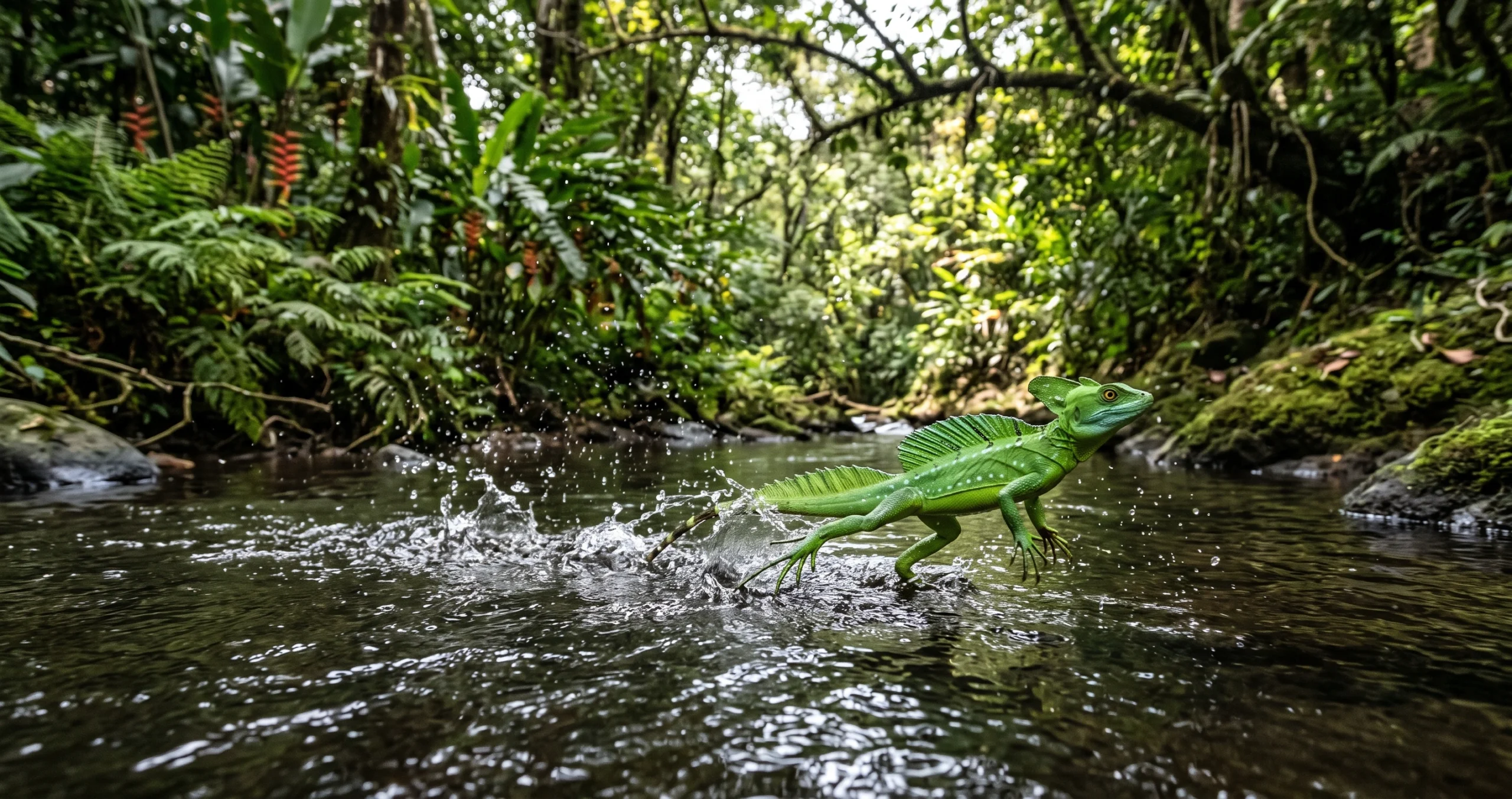
The remarkable phenomenon of basilisk lizard water running has earned these reptiles the nickname “Jesus lizards.” Watching one sprint across the surface of a tropical river almost seems to defy the laws of physics. Instead of immediately sinking, the lizard races over the water with astonishing speed, taking rapid strides that keep it above the surface long enough to escape predators.
This impressive ability isn’t magic, nor is it a miracle of surface tension alone. It results from a precise combination of specialized feet, rapid leg movements, carefully timed impacts, and the temporary creation of air pockets beneath each step. Scientists have spent decades studying this behavior to understand exactly how these reptiles accomplish something that seems impossible for an animal their size.
While juvenile basilisks can perform this feat with remarkable ease, larger adults gradually lose some of the ability as their increasing body weight pushes the limits of physics. Understanding how these lizards interact with water provides fascinating insights into biomechanics, evolution, and even the development of future robots capable of traversing challenging terrain.
If you enjoy learning about extraordinary animal adaptations, you may also like our article on How Birds-of-Paradise Use Ultra-Black Feathers to Win a Mate here on secretsofthegreengarden.com.
What Makes Basilisk Lizards So Special?
Basilisk lizards belong to the genus Basiliscus and inhabit the tropical rainforests of Central and northern South America.
They spend much of their time near rivers, streams, and ponds, where water serves as an escape route from predators.
Several species exist, including the common basilisk (Basiliscus basiliscus), green basilisk (Basiliscus plumifrons), brown basilisk (Basiliscus vittatus), and striped basilisk (Basiliscus galeritus).
All possess long toes, lightweight bodies, powerful hind legs, and excellent climbing abilities.
However, their most famous adaptation is their ability to sprint across water for several meters before eventually swimming.
This behavior is especially effective when escaping snakes, birds of prey, mammals, or other predators that may struggle to pursue them across open water.
The Science Behind Basilisk Lizard Water Running
Basilisk Lizard Water Running Depends on Three Precise Phases
Researchers have discovered that each stride consists of three distinct phases.
These occur so rapidly that the human eye usually perceives only a blur of motion.
The three phases are:
- Slap
- Stroke
- Recovery
Each phase contributes to keeping the lizard above the surface.
Failure in any one stage causes the foot to sink too deeply, ending the water run.
Unlike insects such as water striders, basilisks are far too heavy to rely on surface tension.
Instead, they exploit momentum and fluid dynamics.
How the Foot-Slap and Air-Pocket Mechanism Works
The most important part of basilisk lizard water running begins the instant each foot strikes the water.
Instead of gently stepping onto the surface, the foot slaps downward at remarkable speed.
This rapid impact creates a temporary cavity, forcing water downward while trapping a pocket of air beneath the foot.
For a brief moment, that air-filled cavity provides support.
The lizard immediately pushes backward against the surrounding water before withdrawing the foot.
Timing is everything.
The foot must exit before the air cavity collapses.
If the foot remains underwater too long, the cavity fills with water and no longer provides sufficient support.
The next step begins almost immediately, creating another air pocket.
This sequence repeats several times each second until the lizard reaches safety.
Scientists often compare the process to repeatedly striking the water before it has time to “close” around the foot.
Specialized Toes Increase Efficiency
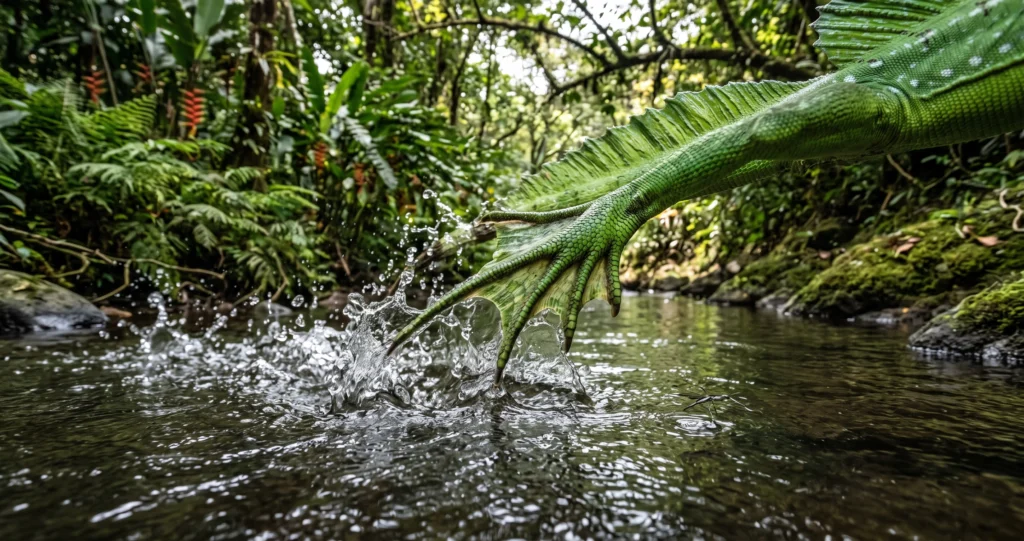
Basilisk feet possess another remarkable adaptation.
Each toe carries expandable fringes of skin.
When the foot enters the water, these fringes spread outward.
This increases the effective surface area, allowing the foot to push against more water.
During recovery, the fringes fold back against the toes.
Reducing surface area minimizes drag as the foot exits the water and swings forward for the next step.
The result is an elegant combination of maximum propulsion during contact and minimal resistance during recovery.
Why Size Matters: Why Adults Have Limits
Not every basilisk can run across water equally well.
Young basilisks outperform adults in many situations.
The reason lies in simple physics.
As animals grow, body mass increases faster than foot surface area.
This relationship means larger individuals must generate disproportionately greater upward force with each step.
Eventually, body weight becomes difficult to support using the available foot area and stride frequency.
Juvenile basilisks often weigh only a few grams.
Their relatively low mass allows them to remain above the surface more easily.
Adult basilisks may weigh several hundred grams.
Although they still possess strong legs and specialized feet, they cannot maintain water running for as long.
Many adults eventually transition from sprinting to swimming after only a short distance.
This illustrates one of biology’s most important engineering constraints: larger bodies often require entirely different solutions than smaller ones.
How Scientists Measured the Physics of Water Running
Understanding water running required much more than careful observation.
Researchers combined high-speed video cameras, force measurements, fluid dynamics, and mathematical modeling to analyze each step in remarkable detail.
One of the pioneering studies by researchers at Harvard University and the University of California recorded basilisks running across specially prepared water tracks.
High-speed cameras captured thousands of frames per second, allowing scientists to examine individual foot movements invisible during normal observation.
Pressure measurements and computer simulations revealed how much force each step generated.
Scientists measured cavity size, foot velocity, contact time, stride frequency, and body position.
These data confirmed that successful water running depends on generating enough downward momentum before the supporting air cavity collapses.
The research also inspired engineers studying robots capable of traversing flooded environments.
How Basilisk Lizards Compare to Other Water-Walking Animals
Several animals move across water, but they do so using very different physical principles.
Water Striders
Water striders rely almost entirely on surface tension.
Their tiny weight allows the water’s surface film to support them without breaking.
Basilisks are far too heavy for this strategy.
Grebes
Grebes sometimes appear to run across water during elaborate courtship displays.
Unlike basilisks, they use rapid paddling while already partially supported by buoyancy.
They do not rely on repeated air-pocket formation.
Western and Clark’s Grebes
During synchronized “rushing” displays, mating pairs sprint across the water together.
Although visually similar, their feet remain partially submerged, and buoyancy contributes significantly to support.
Humans
Humans cannot naturally run across water because our feet are too small relative to body weight.
Calculations suggest a person would need impossibly fast leg speeds or unrealistically large feet to replicate the basilisk’s performance.
Robotic Water Runners
Inspired by basilisks, engineers have developed lightweight robots capable of briefly running across water.
These machines help scientists better understand fluid dynamics while exploring possible applications in search-and-rescue technologies.
Why Water Running Is a Survival Strategy
Running across water is not a daily mode of transportation.
It is an emergency escape behavior.
When threatened, basilisks often sprint directly toward nearby water rather than away from it.
The ability provides several advantages.
Predators hesitate at water’s edge.
Many snakes lose speed while swimming.
Ground predators cannot match the lizard’s rapid transition from land to water.
Even if the basilisk eventually begins swimming, the initial burst often creates enough distance to escape successfully.
This adaptation likely evolved because individuals capable of surviving predator encounters left more offspring than slower competitors.
Common Myths About Basilisk Lizards
Myth 1: Basilisks walk on water because of surface tension.
Reality:
They are far too heavy for surface tension alone. Their movement depends on rapid foot impacts and temporary air cavities.
Myth 2: Adult basilisks can run across water indefinitely.
Reality:
Larger adults usually transition to swimming after relatively short distances because increasing body weight limits support.
Myth 3: Every lizard can learn this behavior.
Reality:
Only basilisks possess the combination of specialized anatomy, leg power, toe fringes, and coordination needed for efficient water running.
Myth 4: Water running is their normal way of traveling.
Reality:
Basilisks primarily move through trees and on land. Water running is an emergency escape strategy.
Myth 5: Scientists still don’t know how they do it.
Reality:
Decades of biomechanical research have revealed the physics behind the behavior in remarkable detail, although researchers continue refining their understanding of fluid interactions.
Why Basilisk Research Matters Beyond Biology
The study of basilisk locomotion has influenced several scientific disciplines.
Biomechanics researchers investigate how animals interact with fluids under extreme conditions.
Robotics engineers use basilisk-inspired designs to develop machines capable of crossing unstable surfaces.
Materials scientists explore lightweight structures that maximize force while minimizing energy expenditure.
Even aerospace engineers have drawn inspiration from biological locomotion strategies when studying rapid transitions between different environments.
Nature often solves engineering problems with elegant solutions that technology later seeks to imitate.
Frequently Asked Questions
How do basilisk lizards run across water?
They rapidly slap their feet against the surface, creating temporary air pockets that support each step long enough to keep moving forward.
Why can’t humans do the same?
Humans are far heavier relative to foot size and cannot move their legs quickly enough to generate the required support.
Can adult basilisks still run across water?
Yes, but generally not as effectively or for as long as juveniles because larger body mass increases the forces required.
How fast can a basilisk run across water?
Depending on size and conditions, some individuals reach speeds of approximately 5 feet (1.5 meters) per second while crossing several meters before swimming.
Why did this ability evolve?
It allows basilisks to escape predators rapidly by exploiting an environment that many predators cannot cross as efficiently.
Conclusion
The astonishing phenomenon of basilisk lizard water running demonstrates how evolution can exploit the laws of physics in remarkable ways. By combining rapid foot slaps, temporary air-pocket formation, expandable toe fringes, and precisely timed strides, these reptiles accomplish what appears impossible at first glance—running across the surface of water.
Although juveniles perform the feat more effectively than larger adults, the behavior remains one of nature’s most impressive escape strategies. Beyond its biological significance, basilisk locomotion continues inspiring research in biomechanics, robotics, and fluid dynamics, proving once again that some of the world’s most innovative engineering solutions originated in the natural world.
2 Internal Link Suggestions:
- https://secretsofthegreengarden.com/how-birds-of-paradise-use-ultra-black-feathers-to-win-a-mate/
- https://secretsofthegreengarden.com/why-periodical-cicadas-wait-exactly-17-years-to-emerge/
3 External Dofollow Authoritative Sources:
- Harvard University – Organismic and Evolutionary Biology: https://oeb.harvard.edu/
- Smithsonian’s National Zoo: https://nationalzoo.si.edu/
- Encyclopedia of Life – Green Basilisk: https://eol.org/