
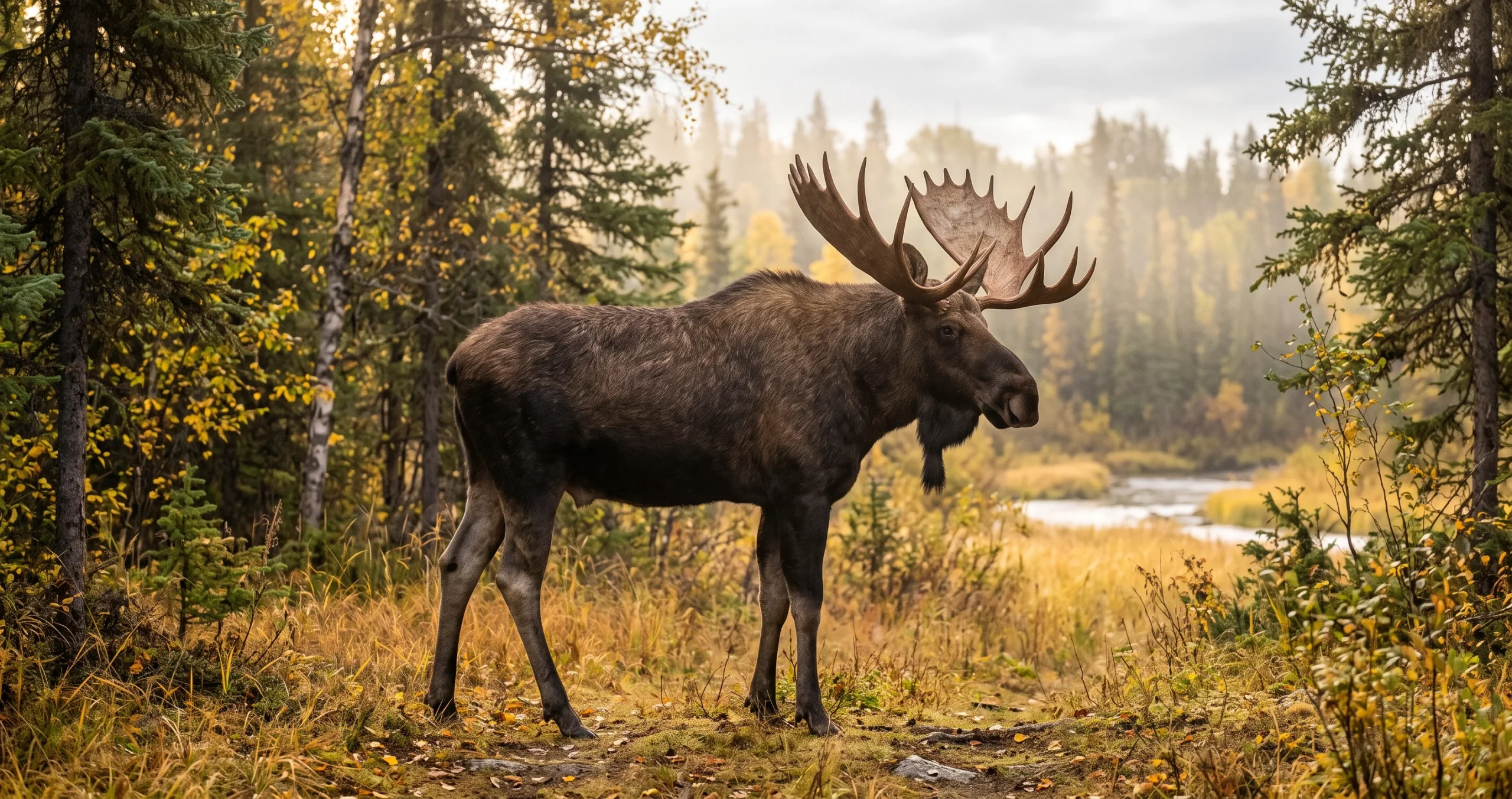
A bull moose walks through a northern forest carrying something extraordinary above its head: a huge structure made of bone that its body built in only a matter of months.
It looks permanent. It isn’t.
After the breeding season, those enormous antlers will eventually fall from the moose’s skull. The animal will spend part of the year without them, and then something remarkable happens—the entire biological construction process begins again.
Moose antler regeneration is one of the strangest recurring growth cycles among mammals. A bull grows living, blood-supplied antlers, transforms them into hardened bone, uses them during the breeding season, sheds them, heals, and then begins producing another set.
So how can an adult mammal repeatedly build such massive structures and simply throw them away?
The answer involves living velvet, rapidly growing tissue, an extraordinary blood supply, mineral metabolism, seasonal hormones, and specialized structures on the skull that never disappear.
Table of Contents
- Moose Antlers Start as Living Tissue
- Antlers Are Remarkably Fast-Growing Mammalian Structures
- Velvet Keeps the Growing Antlers Alive
- How Can a Moose Build That Much Bone?
- Hormones Run the Antler Calendar
- Why Build Something Enormous Just to Throw It Away?
- The Moose Eventually Drops the Entire Rack
- The Skull Heals—and Prepares to Do It Again
- Antlers and Horns Are Not the Same Thing
- Why Scientists Study Moose Antler Regeneration
- Frequently Asked Questions
- Conclusion
Moose Antlers Start as Living Tissue
Look at a mature bull moose in autumn and its antlers appear almost like permanent extensions of its skeleton.
Months earlier, however, those same structures looked completely different.
New antlers develop in association with permanent bony structures on the skull called pedicles. These pedicles remain after an old set of antlers has been shed and are central to the recurring antler cycle.
At the beginning of the growing season, a new antler is not simply a miniature version of the hard rack the bull will carry in autumn.
It is actively growing living tissue.
The developing antler is covered by a specialized skin commonly called velvet. Beneath that soft exterior is an active biological system supporting extraordinarily rapid growth.
This is the first strange part of the story.
The huge structure that will eventually become hard bone begins its seasonal life as sensitive, vascularized tissue.
Antlers Are Remarkably Fast-Growing Mammalian Structures
Antlers are famous among biologists because of the speed at which they can develop.
A bull does not have years to construct his rack. Most of the growth must occur within a relatively short seasonal window.
Cells in the developing antler proliferate rapidly. As development continues, tissues form, expand, and undergo changes that ultimately produce the mineralized structure seen later in the year.
This makes moose antler growth much more impressive than simply adding a little extra bone to something already present.
The animal is constructing a complex branching structure from growing tissue.
The exact rate is not identical in every moose. Age, genetics, nutrition, health, environmental conditions, and the stage of antler development can all influence how fast moose antlers grow.
What remains remarkable is the scale of the construction.
A mature bull can go from relatively small developing antlers to an enormous rack within one annual growth cycle.
Velvet Keeps the Growing Antlers Alive
The velvet covering a developing antler is not decorative fur.
It plays an essential biological role.
Growing antlers require oxygen and nutrients. The velvet supports an extensive vascular network that helps supply the rapidly developing tissue.
The growing structures also contain nerves, which means velvet antlers are sensitive.
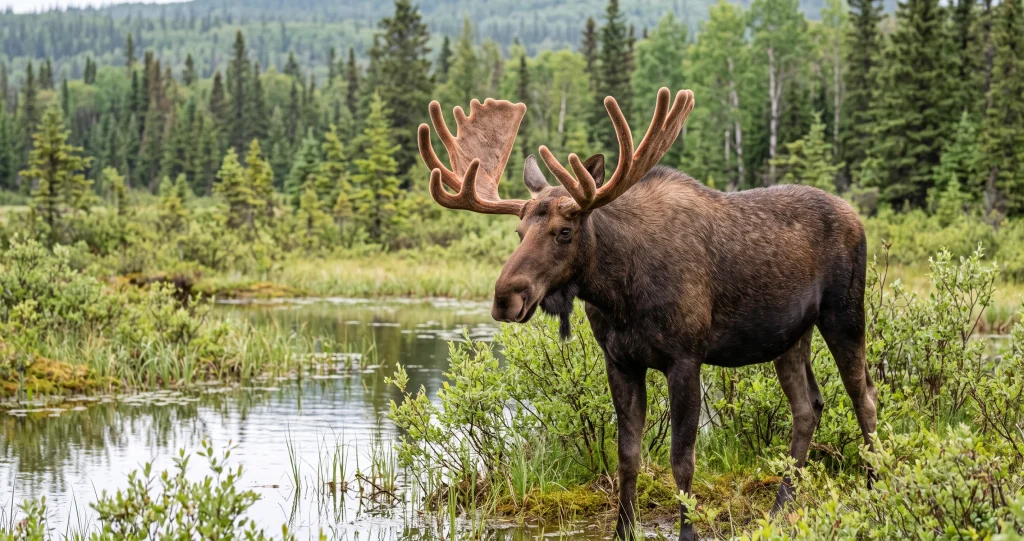
For much of the growth season, therefore, the structures above the bull’s head are not the hard, dry antlers people usually imagine.
They are active biological construction sites.
As the season advances, the internal tissues continue developing and the antlers progressively mineralize.
Eventually, growth approaches completion. Hormonal conditions change, blood supply to the velvet changes, and the soft covering dries and disappears.
Moose also rub their antlers against vegetation during this period, but rubbing should not be mistaken for the process that creates the hardened bone.
The major transformation is occurring biologically within the developing antler.
By the breeding season, the soft, blood-rich structure has become a massive hardened rack.
How Can a Moose Build That Much Bone?
Building a massive rack requires raw materials.
The bull needs energy and protein to support tissue growth. As the antlers mature, minerals including calcium and phosphorus become important components of the developing bone.
Those resources do not appear from nowhere.
Antler construction is tied to the animal’s overall nutritional and physiological condition. The body must manage resources required by the antlers while continuing to support the skeleton, muscles, organs, immune system, and everything else needed to keep a large mammal alive.
Nutrition therefore matters.
Age, genetics, health, habitat quality, and access to appropriate food can all contribute to differences in antler development among bulls.
Mineral metabolism is also more complicated than imagining that the moose simply empties calcium out of its skeleton and moves it into the antlers.
The animal’s diet, body stores, skeletal mineral balance, and physiology interact during the growth process.
By autumn, the finished rack represents months of extraordinary biological investment.
And then the moose prepares to lose it.
Hormones Run the Antler Calendar
The timing of this process is not random.
Moose antlers are closely connected to seasonal reproductive physiology.
Changing day length provides environmental information that helps synchronize annual biological cycles. Hormonal conditions also change throughout the year.
Testosterone is particularly important to understanding the antler cycle, although describing the process as simply “testosterone grows antlers” would be misleading.
During the growing season, the hormonal environment supports the antler’s development.
As the breeding season approaches, changing testosterone levels are associated with antler maturation, mineralization, and the transition away from velvet-covered growth.
The bull eventually enters the rut carrying hard antlers.
Later, reproductive hormone levels change again.
Those changes contribute to the processes that eventually cause the antlers to separate from their pedicles.
In other words, the rack is part of a biological calendar.
Grow it.
Harden it.
Use it.
Drop it.
Then eventually begin again.
Why Build Something Enormous Just to Throw It Away?
At first, the entire system seems incredibly wasteful.
Why would natural selection favor an animal that spends so much energy building a structure it will eventually discard?
The answer is closely connected to reproduction.
Antlers are important features in competition among male deer. During the rut, bull moose use body size, behavior, displays, and antlers when interacting and competing with other males.
The antlers can become physical equipment during contests.
They can also contribute to the overall visual display of a large bull.
This helps explain why natural selection can maintain such an expensive seasonal structure.
But a bull with large antlers should not automatically be assigned an exact age.
Antler characteristics are affected by maturity, but also by genetics, nutrition, health, body condition, and environmental circumstances.
The rack tells a biological story, but it is not a perfect birth certificate.
The Moose Eventually Drops the Entire Rack
Then comes perhaps the strangest part.
After investing enormous resources in growing the antlers, the bull loses them.
This is normal.
After the breeding season, changing hormonal conditions contribute to processes at the junction between the antler and the permanent pedicle.
Eventually, the connection weakens enough for the antler to separate.
It falls to the ground.
The second antler does not necessarily drop at exactly the same moment. A bull may temporarily walk around carrying only one side of its rack.
Then that one falls too.
What remains are the permanent pedicles.
Think about what has just happened.
The moose spent months constructing an enormous bony structure.
It supplied the growing tissue with blood.
It invested nutrients and minerals.
It transformed living velvet-covered growth into hardened bone.
Then its body discarded the whole thing.
And remarkably, the story still is not finished.
The Skull Heals—and Prepares to Do It Again
After shedding, the area associated with the pedicle undergoes healing.
The pedicles remain.
These permanent structures are critical because the next generation of antlers will develop in association with them when another growth season begins.
This repeated cycle is what makes moose antler regeneration scientifically remarkable.
Adult mammals are generally not famous for repeatedly regenerating huge, complex appendages.
Cervid antlers are an extraordinary biological exception.
Their cycle involves rapid tissue proliferation, vascular development, cartilage formation, bone formation, mineralization, shedding, wound healing, and regeneration.
Then the process repeats.
When seasonal physiology shifts again, new velvet-covered antlers begin appearing.
Blood vessels once more support rapidly growing tissue.
The structures lengthen.
Branches form.
In mature bull moose, the characteristic broad palmate portions can develop.
The antlers progressively mineralize until another hardened rack is ready for the next breeding season.
Months later, those antlers will also be shed.
The moose effectively runs the same biological construction project again and again.
Antlers and Horns Are Not the Same Thing
This extraordinary regeneration is possible partly because moose have antlers, not horns.
The terms are often used interchangeably in casual conversation, but biologically they describe different structures.
Antlers are made of bone and are periodically shed and regenerated.
True horns, such as those found in cattle, sheep, goats, and many antelopes, generally consist of a bony core covered by a keratin sheath. They typically remain attached rather than being completely discarded and rebuilt annually.
That difference is crucial.
A bull moose is not simply extending a permanent horn year after year.
It produces a new bony structure during each antler cycle.
Why Scientists Study Moose Antler Regeneration
The antler cycle interests researchers for reasons extending beyond the impressive appearance of a bull moose.
Antlers provide an unusual natural system for investigating mammalian growth and regeneration.
Within one repeating cycle, researchers can examine rapid cell proliferation, development of blood vessels, cartilage formation, bone formation, mineralization, hormonal regulation, shedding, healing, and regeneration.
Another fascinating characteristic is control.
Antler growth can be extraordinarily rapid, yet normal growth remains organized into a species-appropriate anatomical structure and eventually stops as the antler matures.
That makes antlers valuable for investigating how mammals regulate complex tissue development.
Scientists also study antlers for possible insights into regeneration, wound healing, bone biology, and related biological processes.
Those possibilities should not be exaggerated.
Studying antlers has not given medicine a way to simply regrow human limbs or reproduce the moose’s regenerative abilities in people.
Instead, antlers provide researchers with an extraordinary natural model for asking how rapid, repeated mammalian tissue growth can be controlled.
Frequently Asked Questions About Moose Antler Regeneration
How do moose regrow their antlers?
New antlers develop in association with permanent pedicles on the skull. During active growth, they are covered in vascularized velvet that supports the developing tissue before the antlers progressively mineralize and harden.
Are growing moose antlers alive?
Yes. During the active growth phase, antlers contain living tissue and are supplied by blood vessels and nerves beneath the velvet.
Once development is complete, the antlers become highly mineralized bony structures and the velvet is lost.
How fast do moose antlers grow?
Moose antlers can develop remarkably quickly, but there is no single growth rate appropriate for every bull throughout the season.
Age, genetics, nutrition, health, environmental conditions, and the particular stage of antler development can all affect growth.
Why do moose shed their antlers?
Antler shedding is tied to the seasonal reproductive and hormonal cycle. After the breeding season, hormonal changes contribute to biological processes at the antler-pedicle junction that eventually allow the antlers to separate.
Do moose antlers grow back after they fall off?
Yes.
The permanent pedicles remain on the skull, and another antler growth cycle can begin during the following growth season.
Do moose grow bigger antlers every year?
Not necessarily.
Antler characteristics can change as a bull matures, but nutrition, genetics, health, body condition, and environmental factors also influence the final rack.
Are moose antlers really bone?
Mature antlers are primarily bone.
What makes them unusual is how they get there. They begin as actively growing, vascularized structures covered in velvet before progressively mineralizing into the hardened antlers seen during the breeding season.
Are moose antlers the same as horns?
No.
Antlers are bony structures that are periodically shed and regenerated. True horns have a different structure and generally remain attached rather than being completely shed and regrown each year.
Conclusion: Build It, Drop It, Build It Again
Return to the bull moose standing beneath its enormous autumn rack.
What looks like a permanent crown is actually temporary.
Only months earlier, those antlers were actively growing structures covered in living velvet and supplied by blood vessels.
They expanded rapidly.
They mineralized.
They became hard bone.
Then, after the breeding season, the cycle moved in the opposite direction.
Hormonal conditions changed.
The antlers separated.
The bull dropped the enormous structures its body had spent months constructing.
The pedicles remained and the shedding areas healed.
Then another growth season eventually arrived.
That is the extraordinary biology behind moose antler regeneration.
A specialized combination of permanent pedicles, regenerative tissues, vascular support, nutrition, mineral metabolism, and seasonal hormonal control allows the bull to repeatedly produce an enormous temporary bony structure.
It is not permanent armor.
It is not a horn that simply grows larger throughout life.
It is a structure built for a season.
A bull moose builds it, hardens it, carries it, throws it away—and then prepares to build another.
Few recurring events in mammalian biology are quite as strange.