
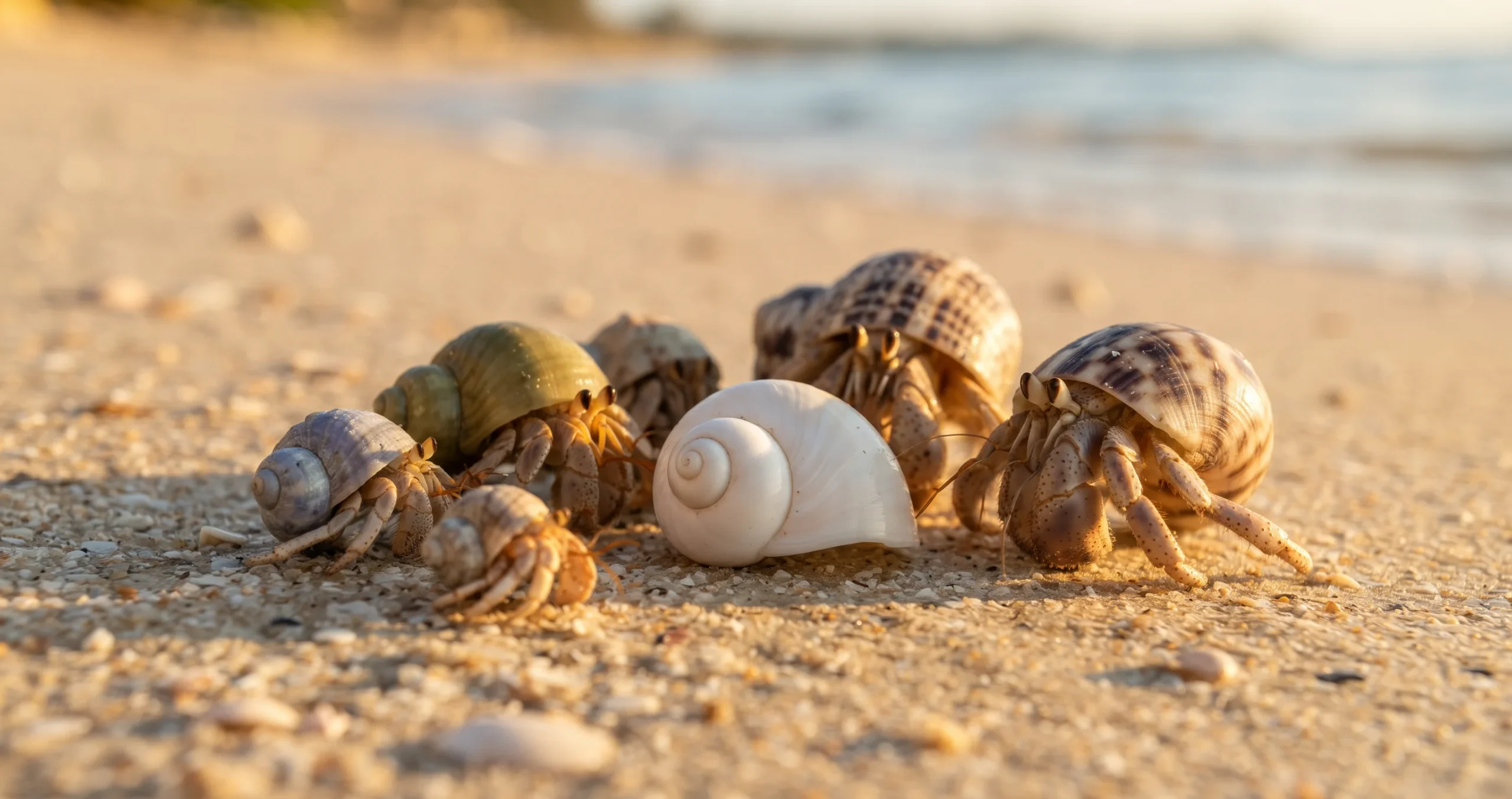
Imagine a group of hermit crabs gathered around an empty seashell. One crab is too large to fit inside, another is too small, and several others seem to be waiting for something to happen. Then, a larger crab moves into the available shell, leaving its old home behind. Almost immediately, another crab takes the abandoned shell, and the process continues.
This remarkable behavior is known as hermit crab shell trading, and it can create a sequence of exchanges called a vacancy chain. Instead of every crab finding a suitable shell independently, several individuals may benefit from a single newly available home.
It sounds almost like an organized housing market, but the biological explanation is more interesting. Hermit crabs must balance growth, protection, competition, and the limited supply of suitable shells.
Scientists have documented surprisingly complex shell-exchange behaviors in certain hermit crab species. These interactions reveal how a simple resource—an empty shell—can influence the lives of many animals.
Table of Contents
- What Are Hermit Crabs?
- Why Hermit Crabs Need New Shells
- How Hermit Crab Shell Trading Works
- What Is a Hermit Crab Vacancy Chain?
- Shell Trading in Land and Marine Hermit Crabs
- How Hermit Crabs Choose the Right Shell
- What Happens When Shells Are Scarce?
- Competition, Cooperation, and Shell Exchanges
- How Humans Affect Hermit Crab Shell Supplies
- How to Help Protect Hermit Crabs
- How to Observe Hermit Crabs Responsibly
- Frequently Asked Questions
What Are Hermit Crabs?
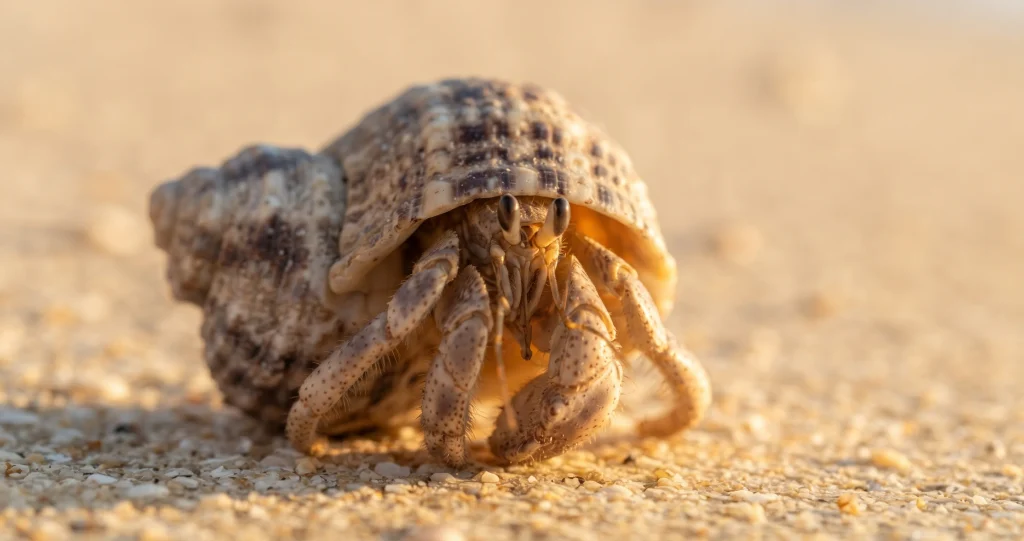
Hermit crabs are crustaceans belonging to a group of decapods that includes numerous species living in oceans, coastal habitats, and tropical terrestrial environments.
Unlike true crabs with heavily armored abdomens, most familiar hermit crabs have relatively soft, asymmetrical abdomens that fit inside empty gastropod shells.
A borrowed home
A hermit crab does not manufacture its own protective shell.
Instead, it usually occupies an empty shell originally produced by a snail or another gastropod.
The shell protects the crab’s vulnerable abdomen from predators, physical injury, and environmental stress.
Some species have specialized body structures that help them grip the shell securely.
Land and marine species
Most hermit crab species live in marine environments.
They may inhabit shallow coastal waters, reefs, seagrass beds, or deeper ocean habitats.
Land hermit crabs, including members of the genus Coenobita, spend much of their adult lives on land but still depend on moisture and suitable coastal conditions.
Their reproductive cycles generally involve the sea.
Although land and marine hermit crabs share the need for protective housing, their behavior and environmental requirements differ.
Why Hermit Crabs Need New Shells
Hermit crabs grow throughout their lives, although their growth rates vary considerably.
As their bodies increase in size, an occupied shell may eventually become too small.
Growth creates a housing problem
A shell that once provided excellent protection can become restrictive.
An undersized shell may prevent the crab from withdrawing completely when threatened.
It may also interfere with movement, feeding, and other activities.
Because the crab cannot enlarge the shell itself, it must locate a suitable replacement.
Molting and shell size
Like other crustaceans, hermit crabs grow through molting.
During a molt, the crab sheds its external skeleton and develops a new one.
The animal is particularly vulnerable while its new exoskeleton hardens.
A suitable shell provides important protection during this period.
Shell changes do not always occur immediately after molting, but growth creates an ongoing need for appropriately sized housing.
Larger is not always better
A shell that is excessively large may be difficult to carry.
Its weight and shape can affect the crab’s movement and energy expenditure.
A shell that is too small offers inadequate protection.
The best shell is therefore not necessarily the largest available one.
It is the shell that provides a useful balance of size, shape, protection, and mobility.
How Hermit Crab Shell Trading Works
Hermit crab shell trading begins when a crab encounters a shell that might offer better housing.
The crab may inspect the shell before deciding whether to move.
Inspecting a possible home
Hermit crabs can use their appendages and sensory abilities to evaluate shells.
They may examine the opening, interior, weight, and overall condition.
A crab can sometimes spend considerable time investigating a potential replacement.
If the shell is unsuitable, it may leave without moving in.
The moment of exchange
When a crab finds a suitable empty shell, it can withdraw from its current shell and quickly transfer its abdomen into the new one.
This brief transition exposes vulnerable body tissues.
The abandoned shell then becomes available to another crab.
If another individual has been waiting nearby, it may inspect and occupy the newly vacated shell.
One exchange can trigger another
Suppose a large crab finds a new shell that fits perfectly.
It leaves behind a slightly smaller shell, which becomes suitable for a medium-sized crab.
That crab abandons an even smaller shell, which another individual can use.
The process may continue through several crabs.
This sequence is the foundation of a vacancy chain.
What Is a Hermit Crab Vacancy Chain?
A vacancy chain is a series of resource exchanges in which one individual’s move creates an opportunity for another.
In hermit crabs, the resource is a protective shell.
A simple example
Imagine four crabs with different body sizes.
The largest crab discovers an empty shell that fits better than its current one.
It moves into the new shell and leaves its old shell behind.
The second-largest crab then occupies that abandoned shell, leaving another vacancy.
A smaller crab takes the next available shell, and the sequence continues.
Several individuals may obtain improved housing even though only one new shell entered the group.
Synchronous vacancy chains
In some documented cases, hermit crabs gather around a shell that is initially too large for most of them.
Individuals may form an arrangement in which smaller crabs wait near larger ones.
When an appropriately sized crab occupies the new shell, a rapid sequence of exchanges can follow.
Researchers describe this as a synchronous vacancy chain because several moves occur in close succession.
Asynchronous vacancy chains
Not all vacancy chains happen at once.
In an asynchronous chain, an abandoned shell may remain available for some time before another crab uses it.
The sequence unfolds through separate encounters rather than a closely coordinated group exchange.
Both types illustrate how shell availability can connect the decisions of different animals.
Is it really cooperation?
The behavior may look like a group deliberately helping every member find a better home.
However, scientists distinguish between coordinated-looking behavior and intentional cooperation.
Each crab may be responding to its own housing needs and the opportunities created by other individuals.
The resulting chain can benefit multiple crabs without requiring them to understand a shared plan.
Shell Trading in Land and Marine Hermit Crabs
Shell exchanges have been studied in both terrestrial and marine hermit crabs.
However, not every species performs the same behaviors.
Land hermit crabs
Certain land hermit crabs have been observed gathering around available shells and participating in sequential exchanges.
In some species, groups may wait near a shell until an individual capable of using it arrives.
The resulting chain can redistribute several shells among the participants.
Land hermit crabs also face special challenges because their shells help maintain a suitable moist environment around their bodies.
Marine hermit crabs
Marine hermit crabs also inspect and exchange shells.
Researchers have documented vacancy chains in marine systems, where shell availability can influence growth, competition, and survival.
Some exchanges involve direct interactions between occupied crabs.
Others begin with the discovery of an empty shell.
The exact behavior depends on species, shell supply, and local conditions.
Not a universal behavior
It would be inaccurate to suggest that every hermit crab joins organized shell-trading lines.
Some species exchange shells more frequently than others.
Some encounters involve competition rather than waiting.
Vacancy chains are a documented phenomenon, but their frequency and form vary across populations.
How Hermit Crabs Choose the Right Shell
A hermit crab’s shell choice can influence its ability to survive.
The animal evaluates several characteristics rather than relying on size alone.
Opening size and shape
The opening must allow the crab to enter and withdraw effectively.
An opening that is too narrow can restrict movement.
An excessively wide or poorly shaped opening may leave vulnerable tissues exposed.
Different species may prefer different shell forms.
Weight and mobility
Shell weight influences how easily a crab can travel.
A heavy shell may offer protection but require more energy to carry.
A lighter shell may improve movement but provide less physical protection.
The preferred balance depends on habitat, body size, and other environmental factors.
Shell condition
Cracks, holes, and erosion can reduce a shell’s usefulness.
A damaged shell may provide less protection or make moisture regulation more difficult.
Crabs may inspect potential homes before accepting them.
This behavior helps explain why a seemingly empty shell is not always a desirable replacement.
What Happens When Shells Are Scarce?
Shell availability is a major ecological constraint for many hermit crabs.
Suitable shells depend partly on the presence of shell-producing animals and the processes that make empty shells available.
Growth can be restricted
A crab living in an undersized shell may experience reduced growth opportunities.
It may also be more vulnerable to predators.
Competition for larger shells can become intense when suitable housing is limited.
Competition increases
When few suitable shells are available, hermit crabs may compete directly for occupied shells.
Some species engage in shell-fighting behavior involving physical contact or repeated movements against another crab’s shell.
The outcome can depend on body size, strength, shell quality, and species-specific behavior.
Not every interaction ends in a successful exchange.
Shell shortages affect populations
A shortage of appropriate shells can influence individual survival and reproduction.
The consequences vary among habitats and species.
Shell supply is therefore more than a minor convenience.
It is an important ecological resource that can shape hermit crab communities.
Competition, Cooperation, and Shell Exchanges
Vacancy chains occupy an interesting position between individual competition and group-level benefits.
The animals do not necessarily cooperate in the human sense.
Nevertheless, their interactions can create opportunities for several participants.
A chain of individual decisions
Each crab evaluates the shell available to it.
When one crab moves, the abandoned shell changes the options for another.
This creates a connected sequence of decisions.
The chain emerges from the behavior of individuals interacting with a shared resource.
Why waiting can be useful
A shell that is too large for a small crab may still attract its attention.
If a larger crab eventually occupies it, the abandoned shell may be more suitable.
Waiting near the original shell can therefore create an opportunity.
However, waiting also involves costs, including time, competition, and exposure to predators.
What scientists learn from vacancy chains
Researchers use these interactions to study animal decision-making and resource distribution.
Vacancy chains also occur in other ecological contexts, where one organism’s use of a resource makes another resource available.
Hermit crabs provide a particularly visible example because their shells can be exchanged directly.
How Humans Affect Hermit Crab Shell Supplies
Human activities can change the number and quality of shells available in coastal habitats.
The effects depend on local conditions and the intensity of disturbance.
Collecting empty shells
Beach visitors often collect attractive shells as souvenirs.
However, an empty shell may eventually provide housing for a hermit crab.
Removing shells can reduce the supply available to shell-dependent wildlife, particularly in heavily visited locations.
Not every beach experiences the same level of shell scarcity, but leaving natural shells in place is a useful precaution.
Coastal development
Construction, shoreline modification, pollution, and habitat degradation can affect coastal ecosystems.
These changes may influence both hermit crabs and the gastropods that produce shells.
The availability of suitable shells depends on the health of the wider ecosystem.
Protecting coastal habitats therefore supports more than the crabs themselves.
Plastic debris and unsuitable substitutes
In some disturbed environments, hermit crabs have been documented occupying artificial objects.
This behavior highlights the unusual pressures created by human debris.
Plastic containers and other discarded materials are not equivalent to natural shells.
Reducing coastal litter helps prevent animals from encountering potentially harmful substitutes.
How to Help Protect Hermit Crabs
Simple choices can reduce unnecessary disturbance to hermit crabs and their habitats.
Leave shells on the beach
One of the easiest actions is to leave natural shells where they are found.
Even an empty shell can become important housing for a growing crab.
Photographing attractive shells instead of collecting them preserves their ecological value.
Avoid disturbing occupied shells
A shell that appears empty may contain a withdrawn hermit crab.
Do not force an animal out to inspect it.
Removing a crab from its shell can expose vulnerable tissues and cause serious stress or injury.
Reduce coastal litter
Collecting safely removable trash during beach visits can help protect coastal wildlife.
Avoid disturbing living organisms or sensitive habitats while cleaning.
Dispose of fishing line, plastic packaging, and other waste responsibly.
Support responsible wildlife practices
Hermit crabs are sometimes sold as pets, particularly terrestrial species.
Many land hermit crabs in the pet trade have historically been collected from wild populations.
Captive care can also be demanding because these animals require suitable humidity, temperature, substrate, diet, and multiple appropriate shells.
Avoid impulse purchases and research the animal’s origin and long-term care requirements before considering ownership.
How to Observe Hermit Crabs Responsibly
Watching hermit crabs in nature can reveal surprisingly complex behavior.
Patience and minimal disturbance are essential.
Watch without handling
Observe crabs from a comfortable distance.
Allow them to move naturally rather than placing them together to encourage exchanges.
Forcing interactions can cause stress and competition.
Natural behavior is more informative when the animals are not being manipulated.
Look for shell inspection
A crab examining an empty shell may touch or rotate it before deciding whether to enter.
This process can take time.
Observe whether other crabs approach and whether an abandoned shell attracts attention.
These details can help reveal how a vacancy chain develops.
Respect coastal habitats
Stay on designated paths where appropriate.
Avoid trampling dunes, fragile vegetation, or intertidal organisms.
Do not remove animals from protected areas.
Local wildlife regulations may restrict collecting or handling.
Record observations carefully
Photographs or short videos can help document interesting interactions.
If you observe a possible vacancy chain, record the order of shell exchanges rather than assuming all nearby crabs participated.
Distinguishing direct observations from interpretations makes wildlife records more useful.
Frequently Asked Questions
Do hermit crabs really trade shells with each other?
Yes. Hermit crabs can exchange shells through direct interactions or by occupying shells abandoned by other individuals. In some species, a series of these moves creates a vacancy chain involving several crabs.
Why do hermit crabs line up around an empty shell?
In some documented situations, crabs gather around a shell that is too large for them. When a larger crab moves into it, the abandoned shell may become available to a smaller crab, triggering further exchanges. This behavior is not universal among all hermit crab species.
Should you collect empty shells from beaches?
Leaving natural shells in place is generally the better choice for wildlife. Empty shells can become essential housing for hermit crabs and contribute to coastal ecosystems. Follow local regulations, especially in protected areas.
Conclusion
Hermit crab shell trading reveals how a simple resource can connect the lives of multiple animals.
When one crab finds a better shell, its abandoned home may become an opportunity for another. In some species, this creates a vacancy chain in which several individuals exchange housing through a sequence of moves.
These interactions demonstrate how animal behavior can produce complex patterns without requiring a shared plan.
They also highlight the importance of natural shell supplies.
By leaving shells on beaches, reducing coastal litter, and observing wildlife without interference, people can help protect the resources these remarkable crustaceans need to survive.
External Sources
1. Social Context of Shell Acquisition in Coenobita clypeatus Hermit Crabs
This peer-reviewed study by Rotjan, Chabot, and Lewis (2010) directly investigates shell exchanges, waiting behavior, and the formation of groups that exchange shells in sequence. Behavioral Ecology.
2. Craigslist for Hermit Crabs
This university article describes research in which land hermit crabs formed size-ordered groups and exchanged shells rapidly after a larger crab moved into a vacant shell. Tufts University.
This scientific study examines the removal of shells from beaches and discusses the ecological functions of discarded shells, including their value as protective housing for hermit crabs. PLOS ONE.