
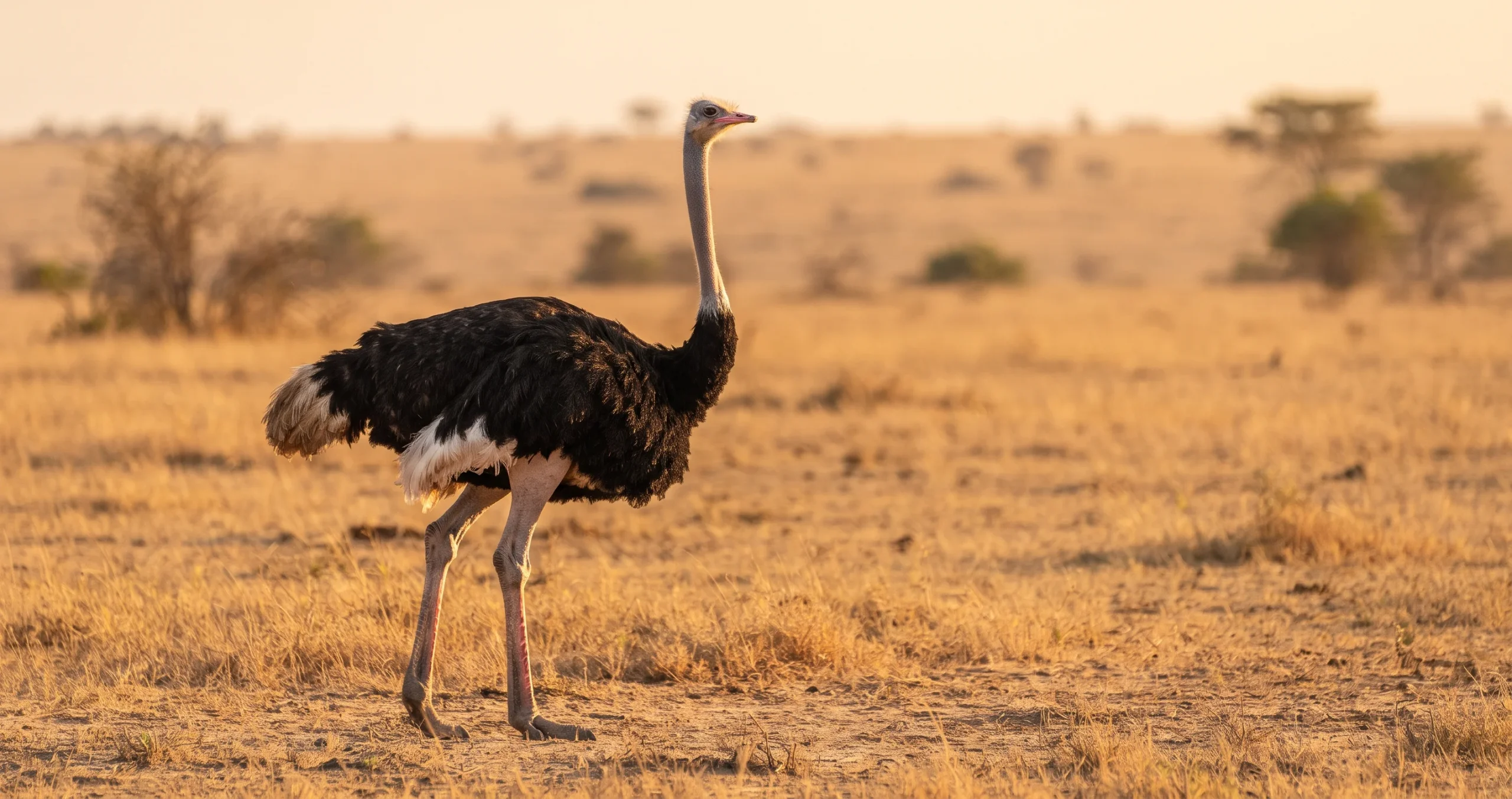
Picture an ostrich standing on a sunlit African plain. Something catches its attention, and the enormous bird suddenly lowers its long neck toward the ground. From a distance, its head seems to disappear completely.
Scenes like this may help explain the ostrich head in sand myth, one of the most persistent misconceptions about animal behavior. For generations, people have repeated the idea that ostriches bury their heads to hide from danger, as though being unable to see a predator would somehow make them safe.
But ostriches do not deliberately bury their heads in sand to escape threats. Their actual behavior is far more interesting. These powerful, flightless birds rely on excellent vision, remarkable running ability, defensive kicks, and carefully adapted nesting habits to survive.
Understanding where the story came from reveals something important about wildlife: an animal’s behavior can look completely different when observed without context.
Table of Contents
- The Ostrich Head in Sand Myth Explained
- Where Did the Ostrich Myth Come From?
- What Ostriches Actually Do When They Lower Their Heads
- How Ostriches Respond to Danger
- Ostrich Biology: Built for Life on the Ground
- Where Ostriches Live and How They Survive
- Ostrich Nesting Behavior and Egg Care
- Why Animal Myths Spread So Easily
- Other Common Animal Myths
- How to Observe Ostrich Behavior Responsibly
- Frequently Asked Questions
The Ostrich Head in Sand Myth Explained
The familiar story claims that frightened ostriches push their heads into the ground to avoid seeing danger.
According to this belief, the bird somehow assumes that a predator cannot see it if its own head is hidden.
There is no credible scientific evidence that ostriches use this strategy.
In fact, deliberately burying the head would interfere with breathing, vision, and awareness of approaching threats.
Why the story sounds believable
Ostriches have unusually long necks and relatively small heads compared with their enormous bodies.
When an ostrich lowers its head toward the ground, the head can become difficult to distinguish from surrounding vegetation or soil.
At a distance, especially in shimmering heat or uneven terrain, the neck may appear to vanish.
This visual illusion can make ordinary behavior look like an attempt to hide underground.
A misunderstanding of natural behavior
The ostrich head in sand myth is particularly interesting because it appears to have developed from real observations interpreted incorrectly.
Ostriches regularly lower their heads to feed, inspect the ground, and tend their nests.
They may also crouch or lie low in certain situations.
None of these actions requires burying the head beneath the surface.
The difference between what an observer sees and what an animal is actually doing is central to understanding the myth.
Where Did the Ostrich Myth Come From?
The belief that ostriches hide their heads has a surprisingly long history.
One commonly cited early source is the Roman naturalist Pliny the Elder, who wrote about ostriches in his encyclopedic work Natural History during the first century CE.
The ancient Roman connection
Pliny described a belief that ostriches could consider themselves concealed when their heads or necks were hidden.
His account is frequently associated with the modern idea of burying the head in sand.
However, ancient descriptions should not be treated as controlled scientific observations.
Pliny compiled information from many sources, including reports that were not independently verified.
The familiar modern image of an ostrich deliberately pushing its entire head underground is a simplified version of a much older misconception.
How the myth became a metaphor
Over time, the ostrich story became a popular metaphor for avoiding unpleasant realities.
People began using the phrase burying your head in the sand to describe someone who refuses to acknowledge a problem.
The metaphor is memorable because the imagined behavior seems absurd.
Unfortunately, its popularity helped reinforce a false impression of the real animal.
Why the myth survived
Many wildlife misconceptions persist because they are easy to visualize and repeat.
A short, dramatic explanation often spreads faster than a more complicated biological one.
In this case, the truth involves several different behaviors, including feeding, nest maintenance, and defensive responses.
The ostrich head in sand myth reduces all those behaviors to a single inaccurate story.
What Ostriches Actually Do When They Lower Their Heads
Ostriches spend much of their lives interacting with the ground.
Their long necks allow them to reach vegetation, inspect objects, and care for eggs without moving their entire bodies into awkward positions.
Feeding close to the ground
Ostriches eat a varied diet that includes plant material such as leaves, seeds, flowers, and other vegetation.
They may also consume insects and other small animals.
When feeding, they repeatedly lower their heads toward the soil.
From far away, a feeding ostrich can appear to be pressing its head into the ground.
This is one straightforward explanation for sightings that may reinforce the myth.
Lying low with the neck extended
An ostrich may sometimes crouch or rest with its neck extended close to the ground.
This posture can make the bird less conspicuous against its surroundings.
However, it is not the same as burying its head.
The bird remains aboveground and can still respond to changes in its environment.
The behavior should not be interpreted as a universal response to every predator encounter.
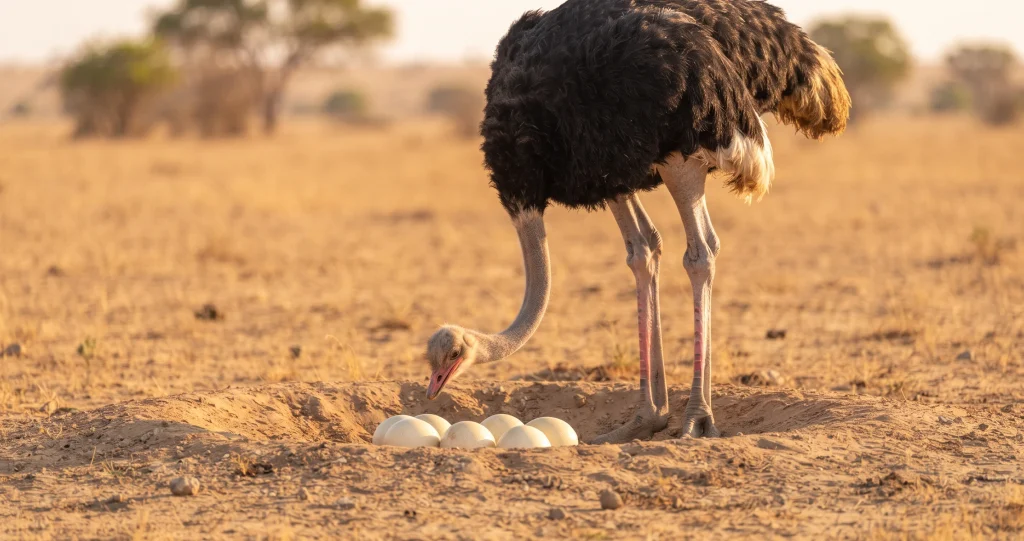
Checking eggs in a shallow nest
Ostriches build their nests as shallow depressions scraped into the ground.
Adults lower their heads into these depressions to inspect, turn, or reposition eggs.
When viewed from a distance, the head may temporarily disappear below the surrounding ground level.
This nesting behavior is another plausible contributor to the ostrich head in sand myth.
How Ostriches Respond to Danger
Rather than burying their heads, ostriches have several effective ways to respond to threats.
Their primary advantages include early detection, speed, powerful legs, and the ability to change direction while running.
Running away from predators
Ostriches are among the fastest-running birds.
Under favorable conditions, they can reach speeds of roughly 40–45 miles per hour (about 65–72 kilometers per hour) over short distances.
Their long, muscular legs are specialized for efficient movement across open ground.
Running allows them to escape many dangerous encounters without engaging in direct combat.
Powerful defensive kicks
When cornered or defending themselves, ostriches can deliver extremely forceful kicks.
Their feet have two toes, with a large claw on the inner toe.
A defensive strike can seriously injure a predator or a person.
This makes ostriches potentially dangerous animals to approach, even though they may appear calm.
Staying alert in open landscapes
Ostriches have large eyes and excellent vision.
Their height gives them an elevated view of the surrounding landscape, helping them detect movement at a distance.
They also rely on hearing and awareness of nearby animals.
In open habitats, detecting a predator early can provide enough time to move away.
Choosing the appropriate response
An ostrich’s reaction depends on the situation.
It may remain watchful, move away, run, or defend itself when necessary.
Adults protecting nests or chicks may behave differently from birds simply traveling or feeding.
These flexible responses are much more realistic than the idea of a bird automatically hiding its head whenever it becomes frightened.
Ostrich Biology: Built for Life on the Ground
The common ostrich, Struthio camelus, is the world’s largest living bird.
Unlike most birds, it cannot fly.
Its body is adapted for running, foraging, and surviving in terrestrial habitats.
An enormous flightless bird
Adult male ostriches can stand roughly 7–9 feet tall, although size varies.
Their large bodies are supported by powerful legs that provide speed and stability.
The wings are not used for powered flight, but they can assist with balance, displays, and other movements.
The bird’s long neck helps it scan the landscape and reach food.
Two toes instead of three or four
Ostriches are unusual among living birds because each foot has only two toes.
The larger toe carries a prominent claw, while the smaller toe helps with support.
This arrangement is part of their specialized running anatomy.
Combined with long legs and strong muscles, it contributes to efficient movement over open terrain.
Feathers and appearance
Adult males typically have predominantly black body plumage with contrasting white feathers on the wings and tail.
Females are generally more grayish-brown.
These differences can be useful during identification, although age and individual variation matter.
Young birds have different plumage from fully mature adults.
Where Ostriches Live and How They Survive
Wild common ostriches inhabit parts of Africa, especially open grasslands, savannas, and semi-arid landscapes.
Their distribution is not uniform across the continent.
Open country favors visibility
Grasslands and open scrub allow ostriches to detect approaching animals over relatively long distances.
Their tall bodies and long necks are well suited to these environments.
Open terrain also provides space for rapid running.
Dense forests would present very different movement and visibility challenges.
Adaptations to dry environments
Ostriches can obtain moisture from food and use available water sources when possible.
They are adapted to environments where water availability can vary considerably.
However, this does not mean they can survive indefinitely without water.
Their survival depends on suitable food, habitat, and environmental conditions.
Social behavior
Ostriches may live in groups, with social arrangements varying by season and reproductive activity.
Group living can provide opportunities for shared vigilance.
Several individuals scanning the surroundings may help detect danger.
Social interactions also play an important role during breeding and nesting.
Ostrich Nesting Behavior and Egg Care
Ostrich reproduction is especially relevant to the myth because their nests are located directly on the ground.
Unlike birds that build elevated nests in trees, ostriches use shallow depressions in open or partially sheltered areas.
A simple nest in the soil
A male ostrich prepares a shallow scrape in the ground.
Females lay their eggs in the communal nesting area.
The eggs are large, with thick shells that help protect the developing embryos.
The nest may contain eggs from more than one female, depending on the social structure of the breeding group.
Adults tend the eggs
The dominant female and male commonly perform much of the incubation.
In typical arrangements, the female incubates during the day and the male during the night.
Their plumage can help them blend with the environment under different lighting conditions.
Adults may use their beaks to reposition eggs within the nest.
Because the depression is below the surrounding surface, these movements can create the illusion that the bird is placing its head underground.
Why egg turning matters
Bird embryos develop inside shells that must remain within suitable environmental conditions.
Turning eggs can help support normal development during incubation.
Ostriches adjust their positions and tend the clutch as part of parental care.
These actions are purposeful nesting behaviors, not attempts to avoid danger.
Protecting chicks
After hatching, ostrich chicks are mobile and can follow adults.
Parents and other adults may provide protection while young birds learn to forage and navigate their surroundings.
Predators can threaten eggs and chicks, so vigilance remains important throughout the breeding season.
Why Animal Myths Spread So Easily
The ostrich head in sand myth is an example of how a real observation can become distorted through repeated storytelling.
People often interpret animal behavior using familiar human motivations.
Animals do not always behave as expected
A bird lowering its head may appear frightened to an observer who does not know its feeding or nesting habits.
A resting animal may seem inactive or helpless when it is actually conserving energy.
Without context, these behaviors can produce misleading explanations.
Repetition creates familiarity
When the same story appears in books, cartoons, sayings, and casual conversation, it begins to feel factual.
The ostrich image is particularly memorable because it is simple and visually unusual.
But familiarity is not evidence.
Reliable wildlife information should be based on direct observation, biological research, and accurate species identification.
Other Common Animal Myths
The ostrich is far from the only animal whose behavior has been misunderstood.
Myth: Bats are blind
Bats are not blind.
Different species use vision to varying degrees, and many also rely on echolocation to navigate and locate prey.
Their sensory abilities are more complex than the familiar expression suggests.
Myth: Toads cause warts
Human warts are caused by certain viruses, not by touching toads.
Some toads produce defensive skin secretions that can irritate tissues, so gentle handling and handwashing remain important.
But their bumpy skin does not transmit human warts.
Myth: Daddy longlegs are the most venomous spiders
The term daddy longlegs can refer to different animals.
Harvestmen are arachnids but not true spiders, and they lack venom glands.
Cellar spiders are true spiders with venom, but there is no credible evidence supporting the claim that they are exceptionally dangerous to humans.
The confusion comes partly from applying one common name to several unrelated groups.
Myth: Every animal freezes when frightened
Animals use many defensive strategies, including fleeing, hiding, warning displays, camouflage, and direct defense.
Remaining still is effective for some species in certain situations.
For others, rapid escape is a better option.
Ostriches are an excellent example of animals whose survival depends heavily on movement and awareness.
How to Observe Ostrich Behavior Responsibly
Seeing an ostrich in its natural habitat can be a memorable wildlife experience.
However, responsible observation requires maintaining a safe distance and respecting the bird’s behavior.
Watch from a suitable distance
Use binoculars or a telephoto lens rather than approaching closely.
Avoid surrounding or cornering birds.
An ostrich may react defensively if it perceives a threat, particularly near a nest or young chicks.
Avoid disturbing nesting areas
Ground nests can be difficult to recognize from a distance.
Approaching too closely may interrupt incubation or trigger defensive behavior.
Stay on designated routes in protected wildlife areas and follow local guidance.
Look for real behavior
Observe how ostriches feed, move, scan the landscape, and interact with other birds.
Notice how frequently their heads move toward the ground during ordinary activities.
These observations help replace the misleading mental image created by the ostrich head in sand myth with a more accurate understanding of the species.
Frequently Asked Questions
Do ostriches really bury their heads in the sand when scared?
No. Ostriches do not deliberately bury their heads in sand to hide from danger. They may lower their necks, feed near the ground, or tend eggs in shallow nest depressions, which can create a misleading appearance.
Why do ostriches put their heads close to the ground?
They lower their heads for several reasons, including feeding, resting, inspecting their surroundings, and caring for eggs. The behavior depends on context and should not automatically be interpreted as fear.
What do ostriches do when a predator approaches?
Ostriches may remain alert, move away, or run at high speed. If cornered or defending themselves, they can deliver powerful kicks. Their defensive behavior varies with the circumstances.
Conclusion
The ostrich head in sand myth has survived for centuries because it offers a simple, memorable explanation for an unusual-looking bird.
The truth is far more impressive.
Ostriches use their long necks to forage and tend nests, their excellent vision to monitor open landscapes, and their powerful legs to escape or defend against threats.
What looks like a bird hiding its head may simply be an adult checking eggs or feeding close to the ground.
By looking beyond familiar stories and examining real animal behavior, we gain a more accurate appreciation of how wildlife survives.
External Sources
1. San Diego Zoo Wildlife Alliance — Ostrich
A species profile explaining how ostriches live, feed, reproduce, and respond to threats.
2. Encyclopaedia Britannica — Ostrich
Useful background for distinguishing genuine ostrich adaptations from the familiar head-burying story.
3. Library of Congress — Do Ostriches Really Bury Their Heads in the Sand?
A focused educational resource addressing the misconception and the real behaviors that may have inspired it.