
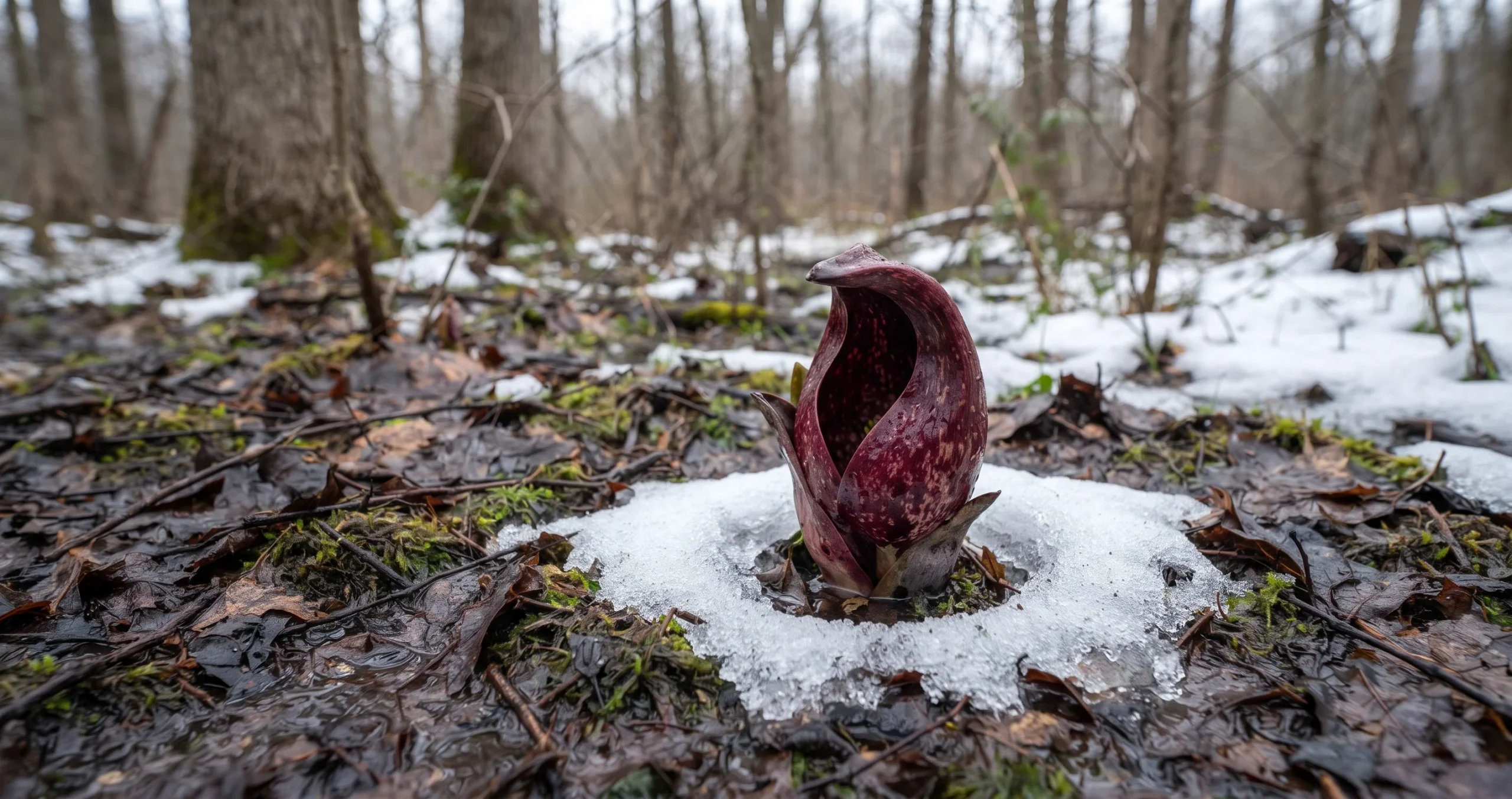
Imagine walking through a cold, muddy forest in late winter. Snow still covers the ground, the trees are bare, and most wildflowers are weeks away from blooming. Yet something unusual is already emerging from the frozen-looking landscape.
A strange, purple-and-green structure rises from the wet soil, sometimes surrounded by a small patch of melted snow. This is skunk cabbage, one of North America’s most fascinating early-blooming native plants.
Unlike most plants, eastern skunk cabbage can produce enough internal heat to warm its flowers above the surrounding air. This remarkable ability, called thermogenesis, allows it to become active while much of the forest remains dormant.
But its unusual warmth is only part of the story. Its powerful odor, hidden flowers, and relationships with early-season insects make it an extraordinary example of how plants adapt to challenging environments.
Table of Contents
- What Is Skunk Cabbage?
- Where Does Skunk Cabbage Grow?
- How Skunk Cabbage Produces Its Own Heat
- How Skunk Cabbage Melts Snow
- Why Skunk Cabbage Blooms So Early
- The Strange Smell Behind Its Name
- Skunk Cabbage and Wildlife
- How to Find and Observe Skunk Cabbage
- Common Myths About Skunk Cabbage
- Frequently Asked Questions
What Is Skunk Cabbage?
Eastern skunk cabbage, Symplocarpus foetidus, is a perennial wildflower native to parts of eastern North America.
It belongs to the arum family, Araceae, which also includes jack-in-the-pulpit, peace lilies, and other plants known for unusual floral structures.
Although its common name suggests an ordinary cabbage, it is not related to the familiar vegetable grown in gardens.
A flower that looks like a strange shell
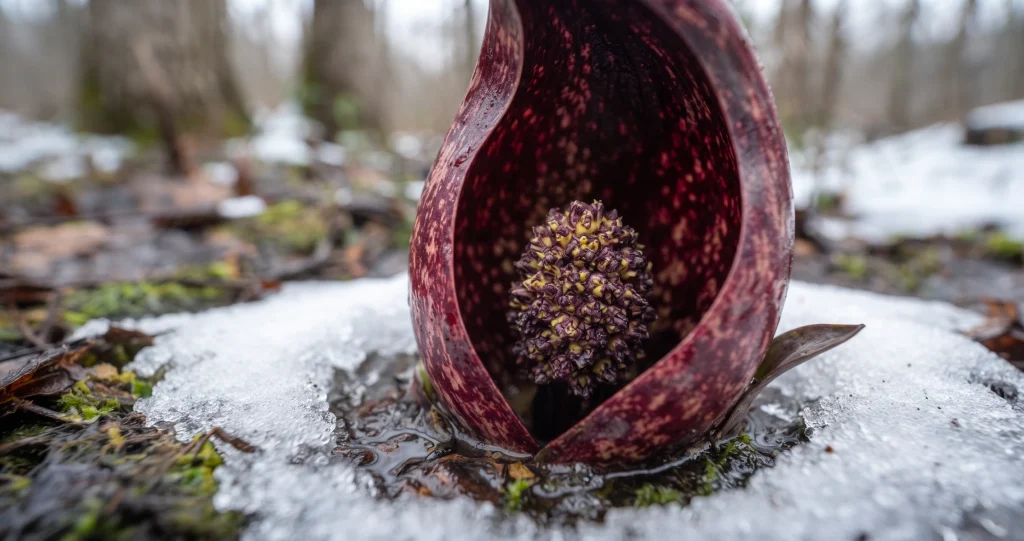
The first visible structure is often a thick, pointed, hood-like covering called a spathe.
Its colors range from deep burgundy and purple to mottled green and yellowish tones.
Inside the spathe sits a rounded, fleshy structure called the spadix, which carries numerous tiny flowers.
The spathe protects the flowering structure from direct exposure to the surrounding environment.
This unusual arrangement gives the plant its distinctive appearance long before its large leaves emerge.
The flowers appear before the leaves
One of the most surprising characteristics of this plant is the order in which it develops.
The flowering structure commonly emerges in late winter or very early spring, sometimes while snow remains on the ground.
The large green leaves appear later, as temperatures rise.
These leaves can become broad and conspicuous, forming dense patches in wet woodland habitats.
After flowering, the plant looks very different from the mysterious purple hood that first appeared through the snow.
Where Does Skunk Cabbage Grow?
Eastern skunk cabbage grows naturally in moist habitats across much of the eastern United States, extending into parts of the Midwest and eastern Canada.
It is particularly associated with wetlands, swampy woods, stream margins, and areas where groundwater keeps the soil consistently moist.
Wet forests and wooded swamps
The plant favors rich, damp soils containing abundant organic matter.
It often grows in shaded or partially shaded locations beneath deciduous trees.
During late winter, sunlight can reach the forest floor before the overhead canopy develops.
This seasonal light availability helps support the plant’s early growth cycle.
Springs and seepage areas
Groundwater-fed seeps are especially suitable habitats.
Water emerging from underground can keep nearby soil moist and sometimes relatively warmer than the surrounding frozen surface.
These conditions can create favorable microsites for early flowering.
However, the warmth visible around an emerging flower is not necessarily caused by groundwater alone.
The plant itself can generate metabolic heat.
Why moisture matters
Skunk cabbage is adapted to wet soils and does not thrive in ordinary dry garden conditions.
Its extensive underground structures help it persist as a long-lived perennial.
Because wetland soils are easily damaged by trampling, observing the plant from a firm trail or boardwalk is usually preferable to walking directly into its habitat.
How Skunk Cabbage Produces Its Own Heat
The ability to produce heat is the most extraordinary part of this plant’s biology.
Scientists call the process thermogenesis, meaning heat production by a living organism.
Plants also release energy through respiration
Like other plants, skunk cabbage uses cellular respiration to release energy from stored carbohydrates and other compounds.
Normally, much of the energy released through respiration supports cellular work, while some dissipates as heat.
In thermogenic flowers, specialized metabolic activity increases heat production.
The flowering structure can therefore become noticeably warmer than its surroundings.
The role of the alternative oxidase pathway
One important part of the process involves an alternative pathway in plant mitochondria.
Mitochondria are cellular structures involved in energy metabolism.
In thermogenic plants, an enzyme called alternative oxidase helps electrons move through a respiratory pathway that produces less usable chemical energy and releases a greater share of the energy as heat.
This process contributes to warming the floral tissues.
The plant is not burning fuel in the way a fire does, and it is not generating heat through sunlight alone.
It is using stored chemical energy through ordinary biological machinery operating in an unusual way.
How warm can the flower become?
Research has documented that eastern skunk cabbage can maintain its flowering tissues substantially warmer than the surrounding air during cold conditions.
Under suitable circumstances, the spadix can remain roughly 15–20°C (27–36°F) above ambient temperature, although the difference varies with weather and the plant’s developmental stage.
The plant does not maintain a perfectly constant temperature under all conditions.
Its heating ability is strongest during a particular part of flowering and becomes less pronounced as the reproductive phase ends.
How Skunk Cabbage Melts Snow
A warm flower surrounded by snow creates one of the most memorable sights of early spring.
The plant’s heat can warm the immediate area around the emerging spathe.
A small pocket of warmth
As the flowering structure rises through cold, wet soil, its metabolic heat may help melt nearby snow.
The result can be a small opening or depression around the plant.
This does not mean the plant is heating an entire forest floor.
Its warming effect is local and depends on snow depth, air temperature, soil conditions, and how actively the flower is producing heat.
The spathe helps protect the flowers
The thick spathe forms a partially enclosed space around the spadix.
This structure provides some protection from cold air and precipitation.
Its shape also helps create a distinct microenvironment around the flowers.
Together, the protective enclosure and metabolic heat allow flowering to occur during a season that would be difficult for many other wildflowers.
Snowmelt is not the only advantage
The ability to melt surrounding snow is visually dramatic, but thermogenesis is not necessarily an adaptation whose sole purpose is snow removal.
Heat may also influence floral development, reproductive processes, and interactions with insects.
Scientists study these possibilities because heat-producing flowers occur in several plant groups, often with different ecological functions.
Why Skunk Cabbage Blooms So Early
Flowering before most woodland plants offers both opportunities and challenges.
Early bloomers can take advantage of the relatively open forest canopy, but they also face cold temperatures and a limited number of active insects.
An early start to the growing season
The flowering structures may emerge before the ground has completely thawed.
By beginning reproductive development early, the plant occupies a seasonal window when relatively few other flowers are available.
However, early flowering does not automatically guarantee greater reproductive success.
The outcome depends on weather, pollinator activity, and other local conditions.
Heat may influence pollinator activity
Skunk cabbage flowers are visited by insects, including certain flies and beetles.
The warmth of the floral chamber may make it a more favorable environment for some insects during cold weather.
Heat can also help distribute volatile compounds responsible for the flower’s odor.
Researchers have proposed that these characteristics may influence insect attraction and behavior.
Nevertheless, the exact contribution of heat to pollination success is not completely established for every population or environmental condition.
Pollination during cold weather
The plant’s reproductive structures are arranged on the spadix, where small flowers develop within the protective spathe.
Insects entering the chamber may contact reproductive surfaces and potentially transfer pollen.
Not every insect visitor is necessarily an effective pollinator.
This distinction matters because observing an insect inside a flower does not automatically demonstrate successful pollen transfer.
The Strange Smell Behind Its Name
The name skunk cabbage comes from the strong odor released by the plant, particularly when its tissues are bruised or crushed.
The smell is often described as skunk-like, unpleasant, or reminiscent of decaying organic material.
Why the plant smells unusual
The plant produces volatile compounds that contribute to its characteristic odor.
These chemicals can become especially noticeable when leaves or other tissues are damaged.
The floral structures also release odors that may play a role in interactions with insects.
The scent is not simply a sign that the plant is rotting.
It is a natural feature of the species.
Does the smell attract insects?
Some early-season insects are attracted to odors associated with decomposing organic material.
Scientists have suggested that skunk cabbage’s scent may help attract certain fly visitors.
Combined with the plant’s warmth and sheltered floral structure, the odor creates an unusual reproductive environment.
However, the relative importance of odor, temperature, and visual cues can vary, and not every proposed attraction mechanism has been conclusively demonstrated.
Avoid crushing the leaves
There is no need to damage the plant to appreciate its unusual biology.
Crushing leaves can release the odor, but it also injures living tissue.
The plant is best observed without picking, digging, or deliberately bruising it.
Skunk Cabbage and Wildlife
Skunk cabbage is part of a broader wetland food web.
Its flowers, foliage, and surrounding habitat interact with insects and other animals throughout the year.
Early-season insects
The flowers may provide a sheltered location for certain insects active during late winter or early spring.
Flies and beetles are among the visitors documented around these structures.
Some visitors may participate in pollination, while others may simply use the flower as a temporary refuge.
Because insect activity depends strongly on weather, the number and type of visitors can vary between days.
Wildlife and plant tissues
The plant contains calcium oxalate crystals that can irritate the mouth and digestive tissues when consumed.
This makes it unsuitable as an ordinary edible wild vegetable.
Some wildlife species may interact with or consume parts of the plant, but it should not be portrayed as a universally important food source for all wetland animals.
Its greatest ecological significance may be the combination of its early flowering, specialized habitat, and relationships with seasonal insect communities.
Wetlands support biodiversity
The saturated soils where skunk cabbage grows also support amphibians, invertebrates, moisture-loving plants, and many other organisms.
Protecting these habitats benefits far more than one unusual wildflower.
Wetlands also help store water, filter sediments, and provide habitat across changing seasons.
The presence of healthy native wetland vegetation can be one visible feature of these valuable ecosystems.
How to Find and Observe Skunk Cabbage
Finding this plant is often easier than people expect, provided they know where and when to look.
Visit wet woods in late winter
In much of its range, the earliest flowering structures may appear from late winter into early spring.
The precise timing varies with latitude, elevation, and seasonal weather.
Look along wooded stream corridors, spring-fed wetlands, and swampy forest edges.
The mottled purple spathes may be partly hidden among wet leaves and muddy soil.
Look for melted openings in snow
During snowy conditions, a small opening around a purple spathe can be a useful visual clue.
However, not every opening in snow is caused by a thermogenic plant.
Groundwater, sunlight, rocks, and other environmental factors can also create localized melting.
Confirm the identification by examining the plant’s distinctive shape rather than relying on snowmelt alone.
Photograph without disturbing the habitat
A smartphone or camera with close-focus capability can capture the spathe’s intricate colors and texture.
Photographing from a trail helps protect sensitive wetland soil.
Avoid stepping into saturated ground, removing plants, or collecting flowers from protected natural areas.
For a particularly interesting image, try including the purple spathe, surrounding leaf litter, and remaining snow in the same composition.
Observe the plant again in spring
Returning to the same location later in the season reveals another remarkable transformation.
The small, mysterious flowering structures give way to large green leaves that can dominate the immediate ground layer.
Observing both stages helps explain why the plant looks so different in winter and spring.
Common Myths About Skunk Cabbage
Myth: The plant melts snow using sunlight alone
Fact: Its flowering tissues can generate metabolic heat through cellular respiration, independently of direct solar warming.
Myth: Skunk cabbage is a type of edible cabbage
Fact: It belongs to the arum family and contains irritating calcium oxalate crystals. It should not be treated as a normal edible vegetable.
Myth: The flower stays warm all winter
Fact: Thermogenesis occurs during particular reproductive stages and varies with environmental conditions.
Myth: The plant’s smell means it is decomposing
Fact: Its distinctive odor comes from naturally produced volatile compounds and can occur in healthy living tissues.
Myth: Every patch of melted snow indicates skunk cabbage
Fact: Localized snowmelt has many possible causes, including groundwater, sunlight, and differences in ground temperature.
Frequently Asked Questions
Can skunk cabbage really melt snow?
Yes. Eastern skunk cabbage can produce heat in its flowering structures through thermogenesis. Under suitable conditions, that heat can contribute to melting snow immediately around the emerging flower, although the effect is localized.
Is skunk cabbage poisonous to humans?
The plant contains calcium oxalate crystals that can cause significant irritation when tissues are chewed or swallowed. It is not suitable for casual foraging or home preparation. People should avoid tasting unidentified wild plants, including skunk cabbage.
When is the best time to see skunk cabbage?
Late winter and early spring are generally the best times to see the unusual flowering structures. Timing depends on local climate, with flowering often occurring before the plant’s large green leaves develop.
Conclusion
Skunk cabbage is a reminder that some of nature’s most extraordinary adaptations happen quietly, in places many people overlook.
While the surrounding forest remains cold and dormant, this native wetland plant can generate its own heat, protect its early flowers, and interact with insects active at the beginning of the growing season.
Its ability to melt small pockets of snow is remarkable, but the deeper story is one of energy use, seasonal timing, and ecological specialization.
The next time you explore a wet woodland in late winter, a small purple shape emerging from the leaf litter may reveal one of the most unusual flowering strategies in North America.
External Sources
1. Skunk Cabbage, Symplocarpus foetidus
This detailed horticultural resource covers the plant’s wetland habitat, spathe and spadix, early flowering, heat production, and unusual adaptations. Wisconsin Horticulture. University of Wisconsin–Madison Extension.
2. Skunk Cabbage: Spring’s Earliest and Hottest Native Plant
Explains the role of stored carbohydrates in heat generation, the structure of the flowers, and scientific explanations for early-season insect attraction. University of Illinois Extension.
3. Heat Production and Temperature Regulation in Eastern Skunk Cabbage
This peer-reviewed research documents elevated flower temperatures and changes in respiratory activity, providing direct scientific support for the article’s central claim. Knutson (1974), Science.