
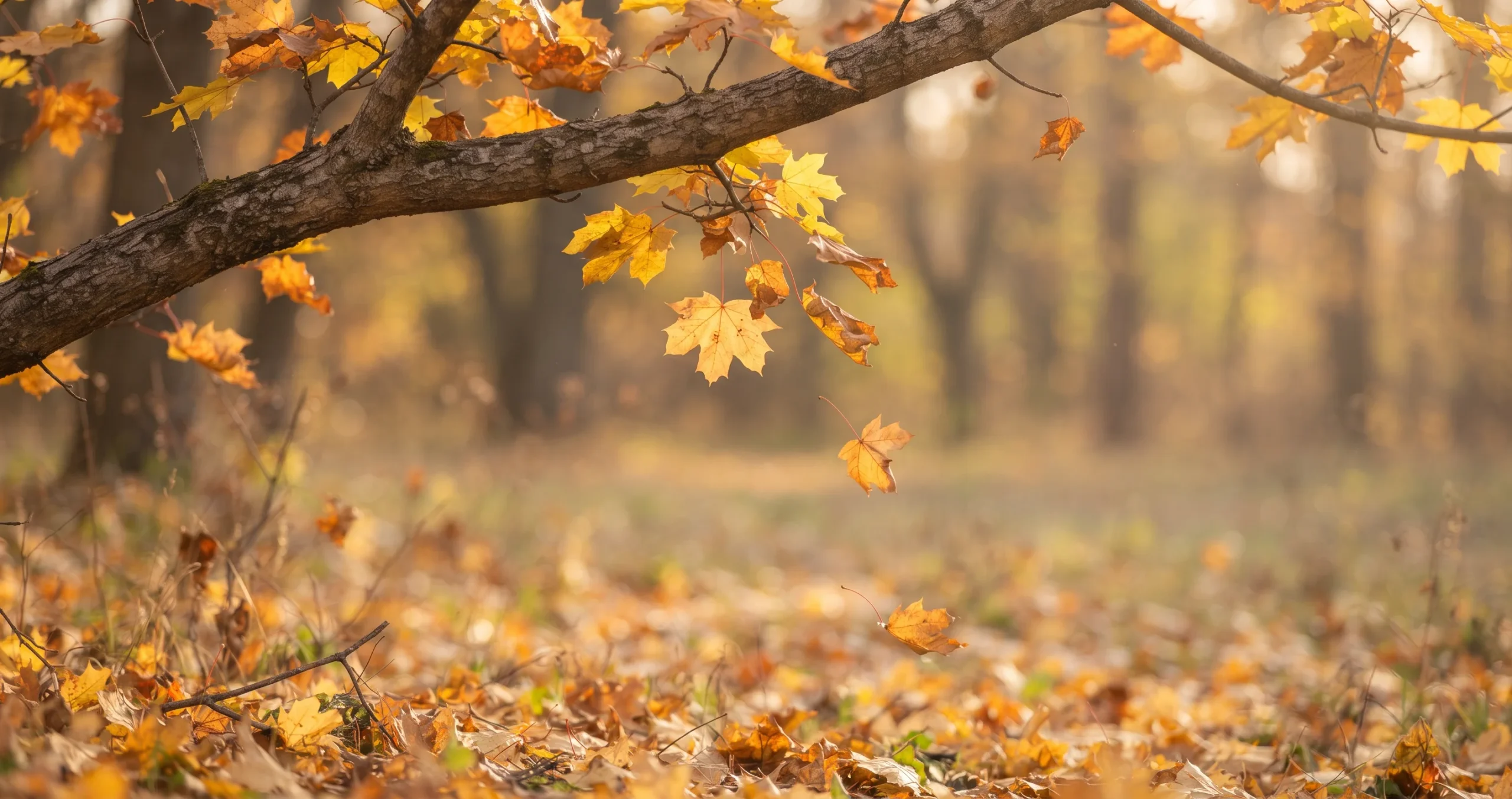
Every fall, deciduous trees perform one of nature’s most remarkable transformations. Green canopies turn gold, orange, and red before thousands of leaves drift toward the ground. The change looks effortless, but a carefully controlled biological process is happening inside each leaf stalk.
Understanding why trees drop their leaves reveals how trees prepare for winter, conserve water, and protect their living tissues from seasonal stress. The secret lies in a tiny region of specialized cells called the abscission zone, where the tree gradually prepares to release each leaf.
Leaf drop is not simply a sign that a tree is dying back. For many species, it is an essential survival strategy that allows the tree to remain alive and healthy through months when growing conditions become difficult.
Table of Contents
- Why Trees Drop Their Leaves in Fall
- What Is the Abscission Layer?
- How Shorter Days and Cooler Temperatures Trigger Leaf Drop
- Why Dropping Leaves Helps Trees Save Water
- Why Some Oaks and Beeches Keep Dead Leaves
- How Evergreen Trees Are Different
- What Happens to Leaves After They Fall?
- How to Use Fallen Leaves in Your Garden
- Common Myths About Autumn Leaf Drop
- Frequently Asked Questions
Why Trees Drop Their Leaves in Fall
Deciduous trees shed their leaves as part of a seasonal adaptation to changing environmental conditions.
In temperate climates, winter brings shorter days, reduced sunlight, colder temperatures, and periods when water becomes difficult for roots to absorb. Broad leaves that are useful during summer can become a disadvantage during winter.
Leaves are productive but expensive
During the growing season, leaves capture sunlight and use photosynthesis to produce sugars.
They also exchange gases with the atmosphere through tiny openings called stomata. This process allows carbon dioxide to enter, but it also causes water vapor to escape.
Maintaining a large canopy requires a dependable water supply and enough light to support photosynthesis.
When temperatures fall and daylight becomes limited, keeping those leaves may cost more resources than they can produce.
Leaf drop is a planned process
Healthy deciduous trees do not normally wait for their leaves to become completely damaged before releasing them.
Instead, they respond to seasonal signals by gradually changing leaf chemistry, recovering useful nutrients, and preparing specialized tissues for separation.
This controlled process is called leaf abscission.
It helps explain why trees drop their leaves at relatively predictable times each year, even though the exact timing varies with species, weather, and location.
What Is the Abscission Layer?
The abscission layer is the key to understanding how a tree releases its leaves.
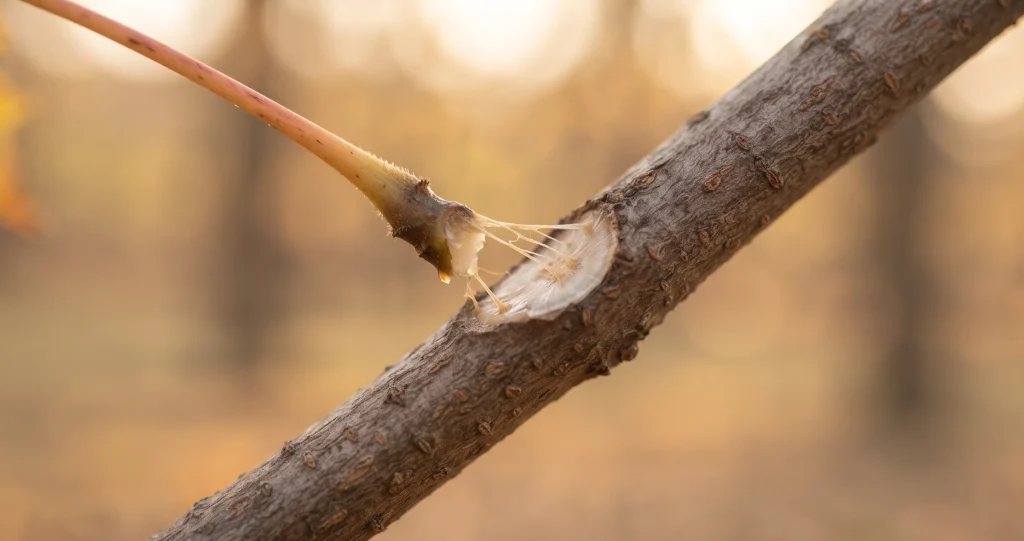
Rather than allowing the wind to tear each leaf away, the tree creates a controlled separation at the base of the leaf stalk, known as the petiole.
A tiny separation zone
Near the point where a leaf attaches to a twig, many deciduous trees develop a specialized region called the abscission zone.
This region contains cells that respond to seasonal changes and plant hormones.
As leaf drop approaches, enzymes weaken the substances holding certain cell walls together.
The leaf attachment gradually loses strength until the leaf can separate.
A light breeze, rainfall, or the leaf’s own weight may then be enough to complete the process.
How the tree seals the wound
The tree does more than release the leaf.
Protective tissues develop near the attachment point, helping seal the exposed area after separation.
This reduces the risk of excessive water loss and creates a barrier against environmental damage and some pathogens.
The small mark left behind on the twig is called a leaf scar.
If you examine a bare deciduous branch during winter, you can often see these scars where the previous season’s leaves were attached.
Plant hormones control the process
Two important plant hormones involved in leaf abscission are auxin and ethylene.
During active growth, auxin produced by healthy leaves helps maintain their attachment and influences how sensitive the abscission zone is to ethylene.
As leaves age and seasonal conditions change, the balance of these hormonal signals shifts.
The abscission zone becomes more responsive, and enzymes begin loosening the connections between cells.
The process is regulated rather than mechanical, which is why trees can shed leaves without tearing away large sections of living branch tissue.
How Shorter Days and Cooler Temperatures Trigger Leaf Drop
The changing seasons provide trees with environmental signals that help coordinate leaf aging and separation.
Two especially important factors are day length and temperature.
Shorter daylight signals seasonal change
As autumn approaches, the number of daylight hours decreases.
Trees can detect changes in the duration of light and darkness through biological systems that regulate seasonal development.
For many temperate deciduous species, shortening days provide a relatively dependable indication that winter is approaching.
This allows trees to begin preparing before freezing conditions become severe.
Day length is particularly useful because it changes predictably from year to year.
Cooler temperatures influence timing
Temperature also affects leaf senescence, color development, and abscission.
Cool autumn weather can encourage some of the changes associated with seasonal leaf aging.
However, the response varies among tree species.
A warm autumn may delay leaf drop in certain trees, while drought, early frost, or other stresses can cause leaves to fall sooner.
Why leaves change color first
During summer, chlorophyll gives most leaves their familiar green appearance.
As leaves age in fall, chlorophyll breaks down and the tree recovers some of the nutrients contained in leaf tissues.
Yellow and orange pigments, including carotenoids, become more visible as green chlorophyll disappears.
Some species also produce red or purple anthocyanin pigments during autumn.
Color development and leaf separation are related seasonal processes, but they are not identical.
A leaf may change color long before it falls, while another may drop with relatively little visible color change.
Why the same species can behave differently
Trees growing in different locations may experience different combinations of sunlight, soil moisture, temperature, and exposure.
Even two trees of the same species can lose their leaves at slightly different times.
Age, genetics, local climate, and tree health may also influence the schedule.
This variation is normal and does not automatically indicate a problem.
Why Dropping Leaves Helps Trees Save Water
One of the most important reasons why trees drop their leaves is water conservation.
Broad leaves provide a large surface area for photosynthesis, but they also expose the tree to substantial water loss through transpiration.
Transpiration becomes a winter challenge
During the growing season, water moves from the roots through the tree’s water-conducting tissues and eventually evaporates from leaf surfaces.
This movement is part of the process known as transpiration.
In winter, cold or frozen soil can greatly reduce the availability of liquid water to roots.
If a tree retained a large canopy of actively transpiring leaves, it could lose water faster than it could replace it.
Shedding leaves dramatically reduces that demand.
Leaf drop also reduces physical stress
Broad leaves can collect snow and ice, increasing the weight carried by branches.
They also create resistance to strong winds.
Losing leaves reduces the surface area exposed to these forces.
Although branches can still break during winter storms, a leafless canopy generally presents less resistance to wind than a fully leafed-out canopy.
Trees store resources before winter
Before leaves fall, many deciduous trees recover valuable nutrients from aging foliage.
Some of these materials are transported into stems, branches, and roots for storage or later use.
The tree does not recover every nutrient, but this recycling improves resource efficiency.
By spring, stored reserves help support the development of new buds, leaves, and shoots.
Why Some Oaks and Beeches Keep Dead Leaves
Not every deciduous tree drops all its leaves in autumn.
Some oaks and beeches retain dry, brown foliage through much of winter.
This phenomenon is called marcescence.
What is marcescence?
Marcescence occurs when dead leaves remain attached to a tree instead of falling promptly.
It is especially noticeable on young oak and beech trees and on lower branches of some mature individuals.
The leaves may become brown, curled, and brittle while remaining firmly attached.
Many eventually fall in late winter or spring as new growth develops.
Why the leaves remain attached
In marcescent leaves, the normal separation process may be delayed or incomplete.
The leaf can die without fully separating at the abscission zone.
Scientists have proposed several possible ecological advantages, including protecting buds from browsing animals or altering when leaf litter reaches the soil.
However, the evolutionary explanation is not fully settled.
It would be inaccurate to claim that every oak or beech retains leaves for one proven reason.
Does marcescence mean a tree is unhealthy?
Usually, marcescence is a normal characteristic of certain species and growth stages.
Young trees may show it more prominently than mature trees.
However, leaves that remain attached after sudden freezing or other injury can resemble marcescence.
The distinction depends on species, season, and the condition of the branches.
How Evergreen Trees Are Different
Evergreen trees also lose leaves, but they generally do so gradually rather than shedding their entire canopy each fall.
Their leaves or needles often remain functional for multiple growing seasons.
Needles reduce water loss
Many conifers have narrow needles with a relatively small surface area and a protective waxy cuticle.
These features help reduce water loss.
Their stomata and internal leaf structure also contribute to surviving cold or dry conditions.
However, evergreens can still experience winter drying, particularly when sunlight and wind increase water loss while roots cannot absorb enough moisture.
Evergreen does not mean permanent foliage
Pines, spruces, and other evergreen conifers periodically shed older needles.
In some species, this seasonal needle loss becomes especially visible in fall.
The inner needles may turn yellow or brown before dropping, while younger foliage remains green.
This can be a normal process rather than a sign of disease.
Some conifers are deciduous
Larches and bald cypresses are examples of conifers that shed their needles seasonally.
Their foliage changes color before falling, much like the leaves of broadleaf deciduous trees.
This illustrates why the distinction between evergreen and deciduous is more useful than simply separating trees into broadleaf and needle-bearing groups.
What Happens to Leaves After They Fall?
Fallen leaves are not waste.
They become part of the forest floor, where fungi, bacteria, earthworms, and other organisms gradually break down organic material.
Nutrients return to the soil
As leaves decompose, nutrients remaining in their tissues are released into the surrounding environment.
The decomposition rate depends on moisture, temperature, leaf chemistry, and the organisms present.
Soft leaves may break down relatively quickly, while tougher, waxier leaves can persist longer.
The resulting organic matter contributes to soil structure and nutrient cycling.
Leaf litter creates habitat
A layer of fallen leaves provides shelter for many small animals.
Insects, spiders, and other invertebrates use leaf litter for protection and overwintering.
These organisms, in turn, support birds and other wildlife.
For gardeners interested in biodiversity, retaining some leaves in suitable areas can provide valuable habitat.
How to Use Fallen Leaves in Your Garden
Understanding why trees drop their leaves makes autumn cleanup feel less like waste disposal and more like an opportunity to recycle useful material.
Use shredded leaves as mulch
Shredded leaves can make an effective mulch around trees, shrubs, and garden beds.
Spread them in a loose layer that allows water and air to reach the soil.
Keep mulch away from direct contact with tree trunks and plant crowns.
A thick, compacted mat of whole leaves may restrict airflow or smother low-growing plants, so shredding is useful where leaves tend to pack together.
Add leaves to compost
Dry leaves provide carbon-rich material for compost piles.
Combine them with nitrogen-rich materials, such as fresh grass clippings or suitable vegetable scraps.
Maintain adequate moisture and airflow to support decomposition.
Chopping or shredding leaves increases the surface area available to decomposers and can help the pile break down more evenly.
Make leaf mold
Leaf mold is produced by allowing leaves to decompose primarily through fungal activity.
Collect fallen leaves in a ventilated bin, wire enclosure, or breathable bag.
Moisten dry material when necessary and allow it to break down gradually.
Depending on the leaf type and conditions, the process can take roughly one to two years.
The finished material can improve soil structure and moisture retention.
Leave some leaves for wildlife
In less frequently used garden areas, a natural layer of leaves can protect soil and provide overwintering habitat.
Keep walkways, drainage openings, and other safety-sensitive areas clear.
On lawns, a light layer of shredded leaves can often be incorporated into the turf, while heavy accumulations should be moved or managed to prevent smothering.
A balanced approach supports both garden maintenance and wildlife habitat.
Common Myths About Autumn Leaf Drop
Myth: Leaves fall because they freeze
Fact: Many deciduous trees begin preparing for leaf separation before freezing weather arrives. Seasonal light changes, temperature, and internal hormonal processes all contribute.
Myth: Every tree loses its leaves in autumn
Fact: Evergreen species retain foliage across seasons, and some deciduous trees grow in climates where leaf drop is associated more closely with drought than winter.
Myth: Brown leaves always indicate disease
Fact: Browning can be part of normal seasonal aging. Some oaks and beeches also retain dead leaves through winter.
Myth: Fallen leaves are bad for gardens
Fact: Properly managed leaves can become mulch, compost, leaf mold, and habitat for beneficial organisms.
Myth: Evergreen needles never fall
Fact: Evergreen needles age and are replaced over time, even when the tree remains green throughout the year.
Frequently Asked Questions
Why do trees drop their leaves before winter?
Many deciduous trees shed their leaves to reduce water loss and avoid maintaining a large canopy during cold, low-light conditions. Shorter days, temperature changes, and internal hormonal signals help coordinate the process.
What causes a leaf to detach from a tree?
A specialized abscission zone forms or becomes active near the base of the leaf stalk. Changes in plant hormones and cell-wall chemistry weaken the attachment, allowing the leaf to separate while protective tissue helps seal the exposed surface.
Why do some trees keep brown leaves until spring?
Certain oaks and beeches exhibit marcescence, in which dead leaves remain attached because separation is delayed or incomplete. These leaves often fall when new spring growth begins.
Conclusion
The answer to why trees drop their leaves lies in a remarkable combination of seasonal sensing, resource conservation, and controlled cellular change.
Shorter days and cooler temperatures help initiate leaf aging, while the abscission zone allows each leaf to separate without unnecessarily damaging the twig.
By shedding foliage, deciduous trees reduce winter water demand, recycle valuable nutrients, and prepare for renewed growth in spring.
And for gardeners, the fallen leaves offer another benefit: they can nourish soil, protect plant roots, and support the small creatures that keep a garden ecosystem functioning.
External Sources
1. University of Illinois Extension — Why Do Tree Leaves Change Color in Autumn?
Explains how shorter days and cooler temperatures initiate leaf senescence, how trees recover nutrients, and how the abscission layer develops at the base of the leaf stalk. Illinois.
2. University of Illinois Extension — The Stubborn Beauty of Oak Leaves: Marcescence Explained
Directly discusses incomplete or delayed abscission and the scientific hypotheses explaining why certain trees keep brown leaves throughout winter. Illinois.
3. University of Illinois Extension — Evergreens Losing Needles: Fall Needle Drop
Explains why evergreen conifers also shed aging needles, even though they retain enough foliage to remain green throughout winter. Illinois