
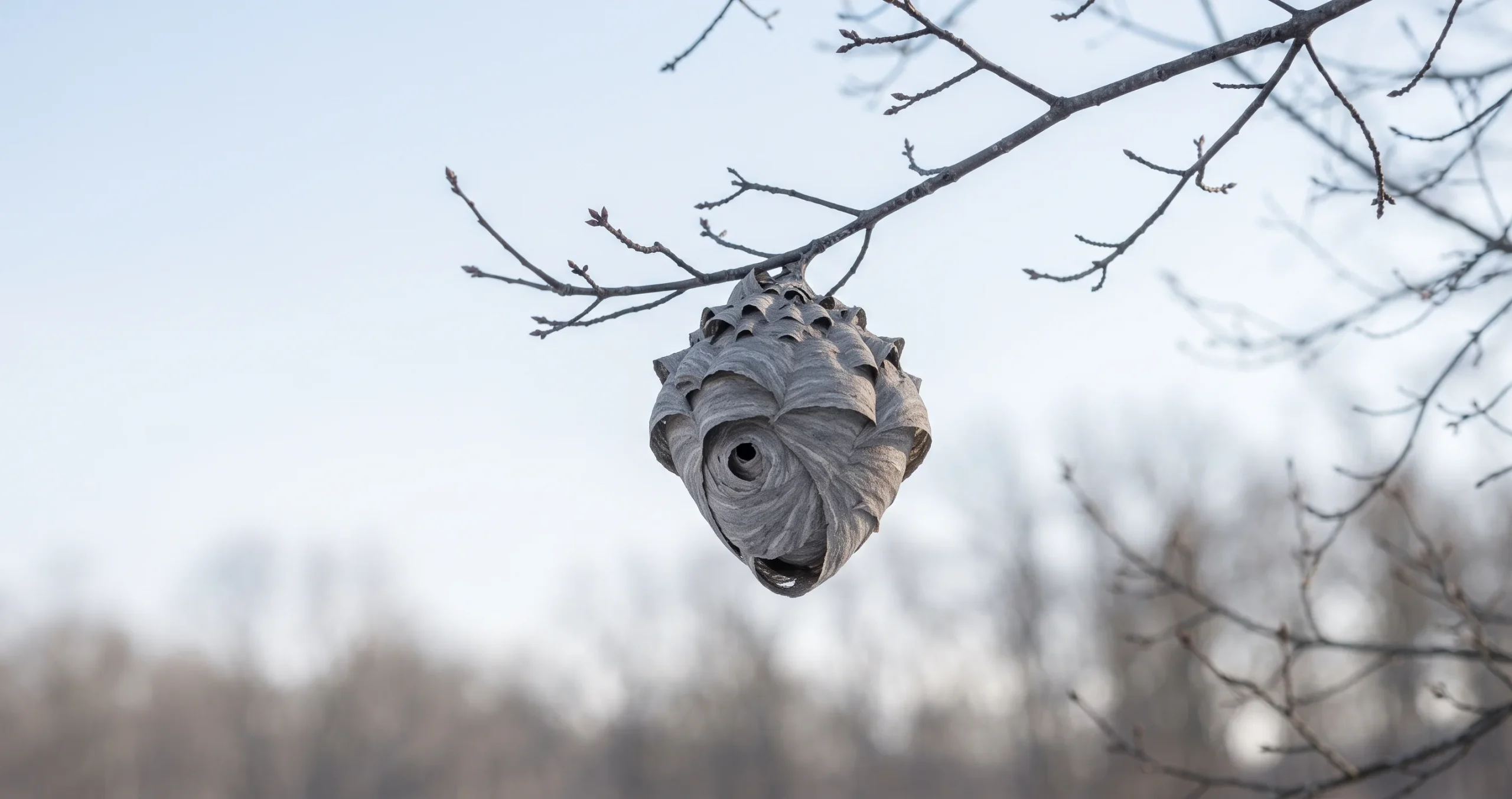
A large gray paper ball hanging from a leafless tree can look like something out of a science-fiction movie. Its layered surface resembles handmade paper, and its hidden interior once housed a busy colony of social wasps. But an abandoned hornet nest is often simply the remains of a remarkable structure built during the previous growing season.
In much of North America, these hanging nests belong to bald-faced hornets, black-and-white social wasps known for building enclosed paper nests. Despite their common name, bald-faced hornets are actually a type of yellowjacket rather than true hornets.
By late fall, the colony’s annual life cycle is usually ending. Workers and males die, while newly mated queens seek protected overwintering sites elsewhere.
Understanding what happens inside these nests, how the colony changes with the seasons, and when removal is appropriate can help homeowners make safer decisions without unnecessarily disturbing beneficial wildlife.
Table of Contents
- What Is an Abandoned Hornet Nest?
- What’s Inside a Bald-Faced Hornet Nest?
- The Bald-Faced Hornet Colony Life Cycle
- Why Old Hornet Nests Are Not Reused
- When Is an Abandoned Hornet Nest Safe to Remove?
- How to Remove an Old Hornet Nest Safely
- Why Hornets Matter in Gardens
- Bald-Faced Hornets vs. Yellowjackets
- Common Myths About Abandoned Hornet Nests
- Frequently Asked Questions
What Is an Abandoned Hornet Nest?
An abandoned hornet nest is a nest that is no longer occupied by an active colony.
For bald-faced hornets, Dolichovespula maculata, this typically happens after the colony completes its seasonal cycle and freezing weather arrives.
These insects construct enclosed aerial nests from wood fibers mixed with saliva. The finished structure may hang from a tree branch, shrub, roof overhang, or another sheltered support.
The nest often resembles a large gray or brown football, although its shape and size vary with colony development.
Why nests become visible in winter
During summer, dense leaves can conceal a large nest high in a tree.
After deciduous trees lose their foliage, the structure suddenly becomes visible against the winter sky.
This creates the impression that the nest appeared overnight.
In reality, the colony may have spent months expanding its paper home while gardeners walked beneath it without noticing.
An abandoned hornet nest can remain hanging for weeks or months, depending on wind, rain, snow, and the strength of its supporting branch.
What’s Inside a Bald-Faced Hornet Nest?
The interior is much more organized than the nest’s rough exterior suggests.
Bald-faced hornets build a protective outer envelope surrounding multiple layers of brood comb.
The outer paper shell
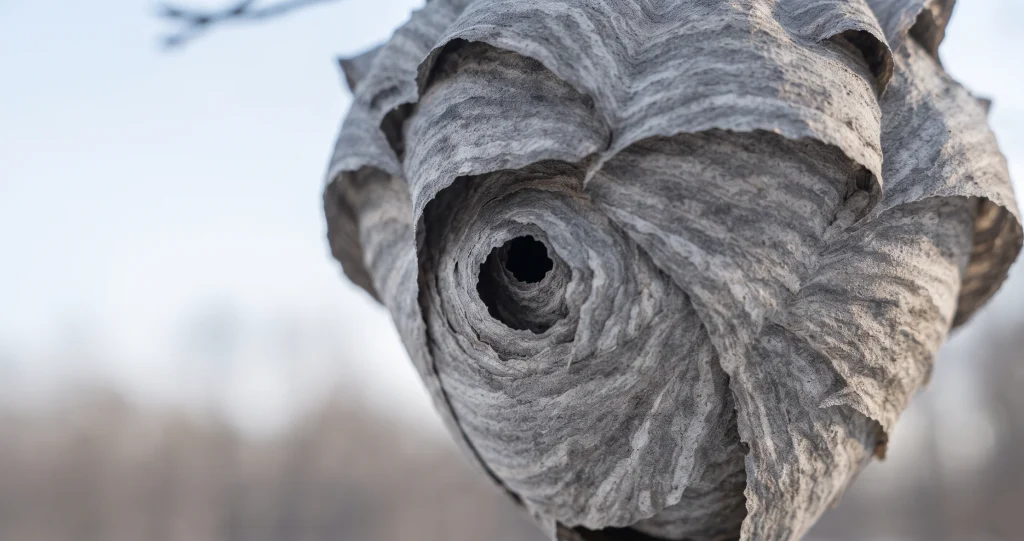
The visible shell consists of overlapping layers of paper-like material.
Workers scrape weathered wood fibers from fences, dead branches, and other suitable surfaces, then combine the fibers with saliva to form a workable pulp.
As the material dries, it becomes a lightweight protective structure.
Different wood sources and weathering conditions can produce the gray, tan, and brown patterns visible on the exterior.
The shell helps protect the developing colony from weather and unwanted intruders.
Layers of comb cells
Inside the envelope are horizontal combs containing many individual cells.
These cells are used to raise developing hornets.
The queen lays eggs in suitable cells, and workers provide food to the larvae as the colony grows.
Unlike the vertical wax combs of honeybees, bald-faced hornet brood combs are constructed from paper and arranged in stacked horizontal layers.
The number of combs and cells depends on how large the colony becomes.
The entrance near the bottom
A mature bald-faced hornet nest generally has an entrance near its lower portion.
Workers travel through this opening while gathering food, collecting building material, and defending the colony.
The entrance is not evidence that a nest is abandoned.
Even a nest that looks weathered may contain active insects during warm weather.
What remains after abandonment
Once the colony has died, the interior may contain empty brood cells, paper fragments, and occasionally dead insects or other biological remains.
Some cells may still contain undeveloped brood that did not survive the end of the season.
The structure gradually deteriorates as moisture, weather, and other organisms break it down.
The Bald-Faced Hornet Colony Life Cycle
The annual colony cycle explains why these nests become empty.
Unlike honeybee colonies, which can survive winter as an organized group, bald-faced hornet colonies are seasonal in cold climates.
Spring: A queen begins a new nest
A newly mated queen survives winter in a protected location, such as a sheltered crevice or another suitable refuge.
When spring conditions become favorable, she emerges and searches for a nesting site.
The queen begins constructing a small paper nest and lays the first eggs.
She initially handles construction, foraging, and brood care herself.
Summer: Workers expand the colony
After the first workers develop, they take over much of the nest-building and food-gathering work.
The queen increasingly concentrates on egg production.
Workers expand the paper envelope and construct additional brood combs as the colony grows.
During this period, the nest may contain hundreds of individuals, although colony size varies considerably.
Late summer and fall: Reproduction begins
As the season progresses, mature colonies produce males and new reproductive females.
After mating, newly mated queens leave to find protected places for winter.
The old queen, workers, and males eventually die as seasonal conditions deteriorate.
Winter: The colony disappears
In regions with freezing winters, sustained cold brings the annual colony cycle to an end.
The nest remains, but the social colony that built it is gone.
The overwintering queens are elsewhere, waiting for suitable spring conditions.
This is why an abandoned hornet nest can hang in a tree long after its builders have disappeared.
Why Old Hornet Nests Are Not Reused
Bald-faced hornets normally establish new nests each year rather than reoccupying the previous season’s structure.
The newly mated queens disperse and begin their own colonies when spring arrives.
The original colony no longer exists
The workers responsible for maintaining and expanding the old nest do not survive the winter.
The surviving reproductive females are not simply waiting inside the structure to restart operations.
Instead, they overwinter separately and initiate new colonies.
Paper nests deteriorate outdoors
The paper envelope is exposed to rain, snow, wind, and temperature changes.
Over time, these conditions weaken the structure.
An old nest may become torn, water-damaged, or partially detached from its support.
Although a new colony could establish a nest in the same general area, it normally builds a new structure rather than repairing and reusing the old one.
Does leaving a nest attract new hornets?
There is no strong evidence that leaving an old bald-faced hornet nest causes another colony to occupy it.
New queens choose nesting locations based on suitable environmental conditions.
Removing an abandoned nest is therefore not a reliable method of preventing future colonies from establishing nearby.
When Is an Abandoned Hornet Nest Safe to Remove?
The safest time to consider removing an old nest is after the local colony season has ended and sustained freezing conditions have occurred.
However, a single cold night does not guarantee that every insect inside a nest is dead or inactive.
Wait until winter conditions are established
In cold-winter regions, late fall or winter is generally the appropriate period for assessing abandoned aerial nests.
By then, bald-faced hornet colonies have usually completed their annual cycle.
Still, the timing varies with climate and seasonal weather.
In areas with mild winters, unusually warm periods, or uncertain species identification, extra caution is necessary.
Look for activity from a safe distance
Observe the nest without approaching, shaking, or touching it.
During suitable weather, repeated insect traffic at the entrance indicates an active colony.
The absence of visible activity during freezing weather is not conclusive evidence of abandonment.
If the nest is near a frequently used doorway, playground, or other high-traffic area and its status is uncertain, consult a licensed pest-management professional.
Removal is often unnecessary
An old nest high in a tree generally presents little reason for intervention once it is truly abandoned.
Leaving it in place avoids unnecessary ladder use and disturbance.
Weather will gradually break down the structure.
For homeowners who simply enjoy observing wildlife, an abandoned hornet nest can be an interesting reminder of the previous summer’s insect activity.
How to Remove an Old Hornet Nest Safely
Removal should be considered only when the nest is confidently identified as abandoned and can be reached safely from the ground.
If there is any uncertainty about occupancy, species, or accessibility, professional assessment is the safer option.
Step 1: Confirm the season and nest identity
Check that the local colony season has ended.
Make sure the structure is consistent with a bald-faced hornet aerial nest rather than an active nest belonging to another wasp species.
Never rely on color, weathering, or the absence of visible movement alone.
Step 2: Wear protective clothing
Wear sturdy gloves, long sleeves, and eye protection when handling a confirmed abandoned nest.
These precautions help protect against splinters, dust, and other physical irritants.
They are not adequate protection for approaching an active colony.
Anyone with a history of serious reactions to stings should avoid handling uncertain nests.
Step 3: Avoid ladders and unstable branches
A nest hanging high above the ground should generally be left alone.
Climbing a ladder to reach it introduces a fall hazard that may be more significant than the abandoned nest itself.
Do not pull on branches or use long tools to knock down an uncertain nest.
Step 4: Remove only a confirmed empty, accessible nest
If a nest has been professionally confirmed inactive and is safely accessible, it may be detached carefully from its support.
Handle the fragile paper structure gently.
Place it in a suitable bag or container if disposal is necessary.
Avoid crushing or opening a nest that has not been confidently assessed.
Step 5: Clean up responsibly
Dispose of the material according to local waste guidance.
Avoid unnecessary insecticide applications to old, inactive nests.
Wash your hands after handling outdoor materials, even when gloves were used.
Why Hornets Matter in Gardens
Bald-faced hornets are predators that capture other insects and help regulate populations of small arthropods.
Although their defensive behavior around active nests deserves respect, they also perform ecological functions.
Natural insect predators
Workers hunt flies, caterpillars, and various other insects.
They often chew captured prey into smaller portions suitable for feeding developing larvae.
This predatory behavior can contribute to natural insect population regulation.
However, bald-faced hornets are generalist predators and may also capture beneficial insects.
They should not be described as exclusively beneficial pest-control specialists.
Part of the garden food web
Hornets themselves can become prey for birds and other animals.
Their interactions with insects, plants, and predators connect them to the wider garden ecosystem.
Adult hornets may also visit flowers or other sugar sources.
Their ecological value does not eliminate the risks associated with disturbing an active nest, but it supports a balanced approach to management.
When coexistence makes sense
An active nest located far from regular human activity may sometimes be left undisturbed.
A nest near a doorway, children’s play area, or heavily used path presents a different situation.
Location, human exposure, and the possibility of allergic reactions should guide decisions.
Bald-Faced Hornets vs. Yellowjackets
The distinction is slightly confusing because bald-faced hornets are themselves a type of yellowjacket.
They belong to the genus Dolichovespula, while many familiar yellow-and-black yellowjackets belong to the genus Vespula.
Appearance
Bald-faced hornets are predominantly black with distinctive ivory-white markings on the face and body.
Many common yellowjackets have contrasting yellow-and-black markings.
Both are social wasps capable of defending their colonies.
Nest location
Bald-faced hornets typically construct enclosed aerial nests in trees, shrubs, or on structures.
Many common yellowjackets nest underground, although some species use cavities or aboveground sites.
Nest placement alone is not sufficient for identification because exceptions exist.
Behavior
Both groups can become defensive when their nests are disturbed.
Bald-faced hornets may aggressively defend the area around an active colony.
They can sting repeatedly, making nest disturbance potentially dangerous.
The practical distinction for gardeners is not that one group is harmless, but that accurate identification helps guide safe management.
Common Myths About Abandoned Hornet Nests
Myth: Every gray paper nest is abandoned
Fact: Active bald-faced hornet nests are also made of gray or brown paper. Appearance alone cannot confirm occupancy.
Myth: One hard freeze makes a nest safe to touch
Fact: Freezing weather contributes to colony decline, but one cold night does not guarantee that every nest is inactive.
Myth: New queens return to the old nest in spring
Fact: Newly mated queens normally overwinter elsewhere and establish new nests the following season.
Myth: All hornets are harmful garden pests
Fact: Bald-faced hornets capture other insects and participate in garden food webs, although active nests can pose legitimate safety concerns.
Frequently Asked Questions
Can an abandoned hornet nest contain living hornets?
A genuinely abandoned nest no longer contains an active colony. However, a nest that appears empty may still be occupied, especially during mild weather or before the colony season has fully ended. Never assume inactivity based only on appearance.
Should I remove an old hornet nest from my tree?
Usually, removal is unnecessary if the nest is high in a tree and no longer active. Bald-faced hornets do not normally reuse old nests, and the paper structure gradually deteriorates outdoors. Leaving it alone is often the simplest choice.
Do bald-faced hornets return to the same location every year?
New queens may select suitable nesting sites in the same general landscape, but they normally construct new nests. The presence of an old nest does not mean the same colony will return.
Conclusion
An abandoned hornet nest is more than an empty paper shell. It is the remains of an intricate seasonal home, built from wood fibers and organized around protected brood combs.
Bald-faced hornet colonies generally die out in fall, while newly mated queens overwinter in sheltered locations and establish new nests the following spring.
Once a nest is truly abandoned, it is not normally reused. In most cases, leaving it undisturbed is preferable to removing it.
For gardeners, the best approach combines curiosity with caution: appreciate the remarkable construction, recognize the ecological role of these predatory wasps, and seek professional help whenever a nest’s status or safe accessibility is uncertain.
External Sources
Explains the layered paper envelope, hexagonal brood combs, wood-fiber construction, colony decline, and winter decomposition. It also notes that nest reuse is uncommon, with exceptions reported in warmer regions. Clemson University.
Describes the horizontal brood combs, reproductive queens, seasonal colony decline, and why old nests are normally abandoned rather than reused. Colorado State University.
Answers a homeowner’s question specifically about removing a dormant nest hanging in a tree. Explains why winter removal is generally unnecessary and why cutting the supporting branch should be avoided. University of Maryland Extension