
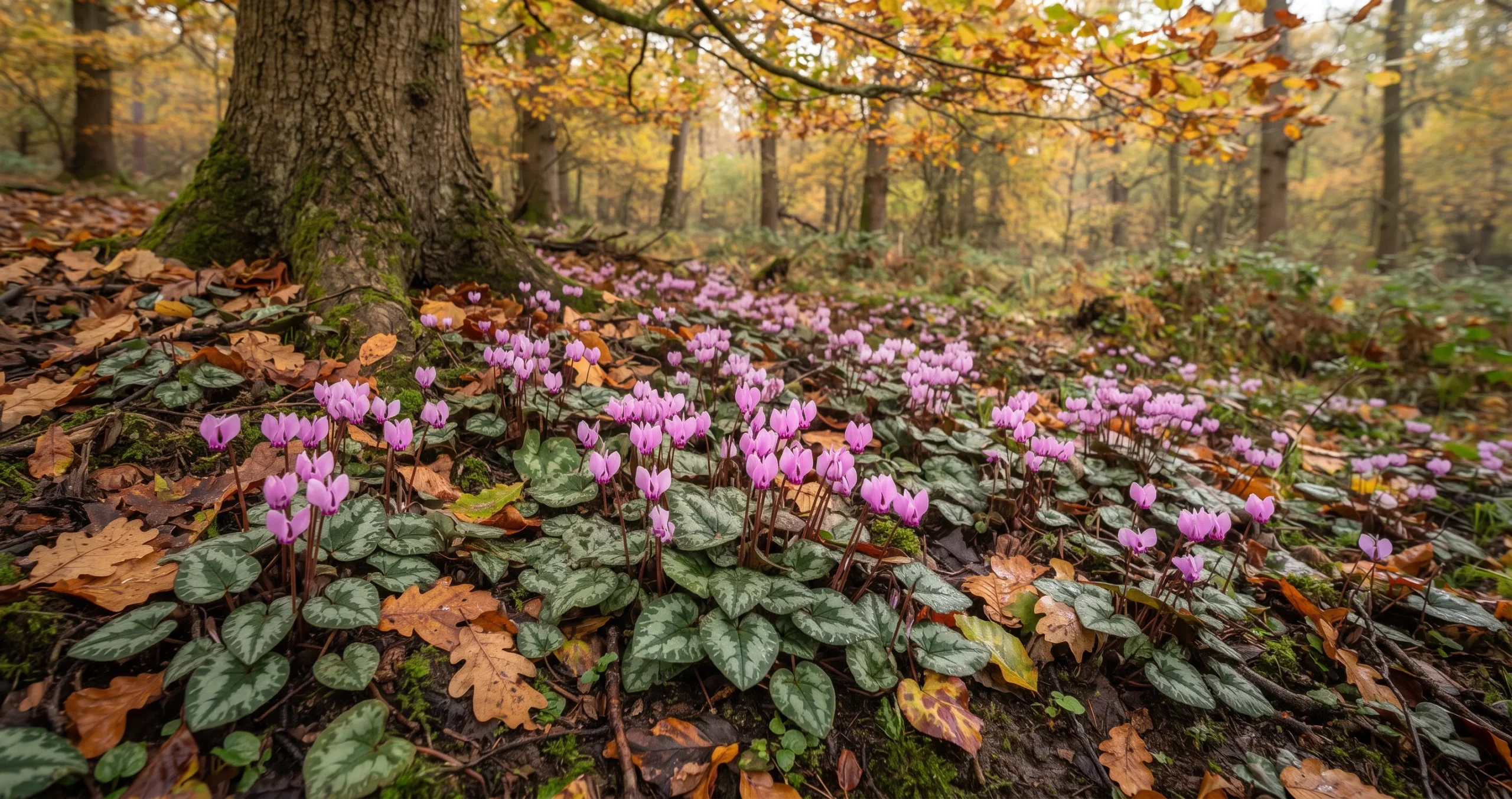
Imagine a woodland garden in early autumn. Most summer flowers are fading, but delicate pink blossoms suddenly appear above the soil, their petals swept backward like tiny butterflies. A few weeks later, something even more unusual happens: the flower stalks begin curling into tight spirals.
This is hardy cyclamen, a remarkable group of perennial plants with an extraordinary method of protecting and dispersing their seeds. Unlike many familiar garden flowers, certain hardy cyclamen bloom as the weather cools, grow beautifully patterned leaves through winter, and disappear underground during summer.
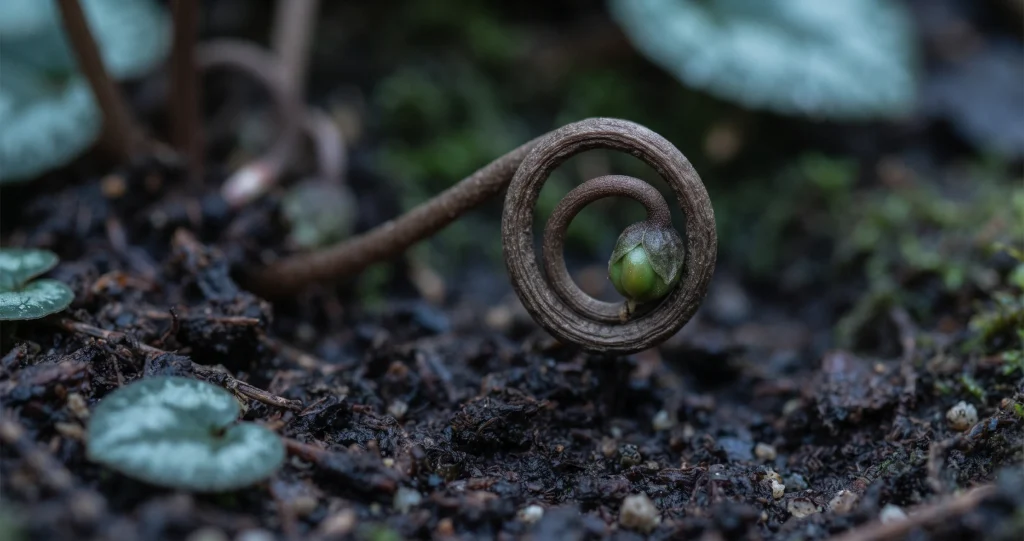
The best-known autumn-flowering species, Cyclamen hederifolium, combines this unusual seasonal rhythm with a fascinating reproductive strategy. After successful pollination, its flower stalk coils, bringing the developing seed capsule close to the soil.
Understanding this behavior reveals how the plant survives changing seasons, spreads naturally, and thrives in shaded gardens where many other flowers struggle.
Table of Contents
- What Is Hardy Cyclamen?
- The Unusual Bloom and Leaf Cycle of Hardy Cyclamen
- Why Hardy Cyclamen Flower Stalks Coil
- How Ants Help Spread Cyclamen Seeds
- Where to Plant Hardy Cyclamen
- How to Plant Hardy Cyclamen Tubers
- Hardy Cyclamen vs. Florist Cyclamen
- How Cold-Hardy Is Hardy Cyclamen?
- Year-Round Hardy Cyclamen Care
- Common Growing Problems
- Frequently Asked Questions
What Is Hardy Cyclamen?
Hardy cyclamen refers to several species of small, tuber-forming perennial plants in the genus Cyclamen. They belong to the primrose family, Primulaceae, and are native mainly to parts of Europe, the Mediterranean region, and western Asia.
These plants are valued for their swept-back flowers, patterned leaves, and ability to grow in sheltered garden locations.
The most familiar autumn-flowering species
Cyclamen hederifolium, commonly called ivy-leaved cyclamen, is one of the most widely grown hardy species.
Its flowers usually appear from late summer into autumn, depending on climate and growing conditions.
They are commonly pink or white, with petals that curve sharply upward and backward.
The leaves often emerge around flowering time or afterward, displaying silver, green, and gray patterns.
Their shape resembles ivy leaves, which explains the species’ common name.
Other hardy species
Cyclamen coum is another popular garden species, but its flowering season is different.
It typically blooms in winter or early spring rather than early autumn.
Its leaves are generally more rounded than those of C. hederifolium.
This distinction matters because not every hardy cyclamen follows exactly the same seasonal schedule.
Underground storage tubers
These plants survive unfavorable seasons using a swollen underground storage structure called a tuber.
The tuber stores resources that support future leaves, flowers, and roots.
During summer dormancy, the visible foliage may disappear while the plant remains alive beneath the soil.
This adaptation is especially useful in climates with relatively dry summers.
The Unusual Bloom and Leaf Cycle of Hardy Cyclamen
The seasonal behavior of Cyclamen hederifolium is one of its most appealing characteristics.
Instead of producing its main display during spring or summer, it often becomes most noticeable as autumn approaches.
Early autumn: flowers emerge
Flower buds rise from the tuber on slender stalks.
The flowers may appear before the leaves are fully developed, creating the impression that blossoms are emerging directly from bare ground.
This timing can make them particularly striking beneath trees and shrubs.
Their flowering season may continue for several weeks when conditions remain suitable.
Autumn and winter: leaves take over
After flowering begins, the plant develops attractive foliage.
The leaves often remain visible throughout winter in climates where conditions allow.
Their silver markings can brighten shaded garden beds even when relatively few other plants are flowering.
The foliage also performs photosynthesis, helping replenish stored resources.
Spring: growth gradually slows
As temperatures rise, the plant approaches the end of its active growing period.
Leaves may begin yellowing naturally.
Seed capsules from successfully pollinated flowers can continue developing during this period.
The exact timing depends on species, local climate, and seasonal weather.
Summer: dormancy begins
During warm, dry summer conditions, C. hederifolium commonly enters dormancy.
Its leaves die back, leaving the underground tuber alive.
This is a normal part of its annual cycle, not necessarily a sign that the plant has failed.
Excessive watering during this resting period can be more damaging than allowing the soil to become moderately dry.
Why Hardy Cyclamen Flower Stalks Coil
The spiral-shaped stalk is one of the most fascinating features of cyclamen reproduction.
After a flower is successfully pollinated, its stalk changes position as the seed capsule develops.
From flower to seed capsule
The flower contains reproductive structures that allow fertilization and seed development.
After successful pollination, the petals eventually fade and the ovary begins enlarging.
Rather than leaving the developing capsule elevated on a straight stalk, the plant gradually changes the stalk’s shape.
In Cyclamen hederifolium, the stalk commonly coils into a spring-like spiral.
This movement brings the developing fruit closer to the ground.
How the spiral forms
The coiling results from changes in growth along the flower stalk.
Different parts of the stalk grow or elongate unevenly, causing it to curve and eventually form a spiral.
This is a growth response, not a muscular movement.
Plants do not need muscles to change the positions of their stems and other structures.
Differences in cellular expansion can produce surprisingly complex shapes.
Why the seed capsule moves downward
The coiled stalk positions the developing capsule near the soil surface.
This may help protect the fruit from exposure and place the seeds in a favorable location for eventual dispersal.
When the capsule matures, it opens and makes the seeds available near the ground.
This arrangement is particularly useful because cyclamen seeds are often dispersed by ants.
The stalk does not deliberately search for ants or move in response to individual insects.
Instead, its growth pattern places the fruit where ground-dwelling seed dispersers can encounter it.
Not all cyclamen coil identically
Coiling patterns vary among species.
Some form tight spirals, while others bend or curve their stalks differently.
For the classic tightly coiled stalk associated with autumn-flowering garden cyclamen, C. hederifolium is an excellent species to observe.
How Ants Help Spread Cyclamen Seeds
Cyclamen has another fascinating adaptation: many species rely on ants to move their seeds.
This relationship is an example of myrmecochory, the dispersal of seeds by ants.
Seeds with a special food reward
Cyclamen seeds carry a fleshy, nutrient-rich attachment called an elaiosome.
The elaiosome can attract certain ants because it contains compounds they can use as food.
An ant may carry a seed toward its nest or another sheltered location.
After consuming or removing the attractive attachment, the ant may discard the seed.
The seed can then remain in a location where germination is possible.
Why ant dispersal matters
Ants can move seeds away from the parent plant.
This may reduce competition between young seedlings and the established tuber.
It can also help cyclamen spread gradually through suitable garden habitats.
However, the distance and effectiveness of dispersal depend on local ant species and environmental conditions.
Not every ant will collect cyclamen seeds, and not every transported seed will germinate.
A quiet woodland partnership
The relationship between cyclamen and ants is an example of how plants interact with animals without producing showy fruits.
Instead of relying mainly on birds or mammals, cyclamen can use small ground-dwelling insects to help distribute its offspring.
For gardeners, this means that established plants may eventually produce seedlings in nearby areas.
Natural spreading is usually gradual rather than immediate.
Where to Plant Hardy Cyclamen
Choosing the right location is one of the most important steps in successful cultivation.
Hardy cyclamen generally performs best where its seasonal moisture requirements are respected.
Light shade beneath deciduous trees
Cyclamen hederifolium is particularly well suited to light woodland conditions.
Beneath deciduous trees, it can receive more light during autumn and winter when branches have fewer leaves.
As the canopy develops in spring and summer, increasing shade helps protect the soil from excessive heat.
This seasonal arrangement closely resembles the conditions found in many natural habitats.
Well-drained soil is essential
Although cyclamen benefits from moisture during active growth, its tuber is vulnerable to prolonged waterlogging.
Choose soil that drains reasonably well.
Heavy clay may need improvement through careful site preparation, or the plant may perform better in a raised, freely draining planting area.
Adding organic matter can improve soil structure, but it should not create a permanently wet planting pocket.
Suitable companion plants
Hardy cyclamen can grow alongside other shade-tolerant plants with compatible moisture needs.
Ferns, hellebores, and suitable woodland groundcovers can create an attractive planting scheme.
Avoid aggressive neighbors that may overwhelm the small flowers or compete heavily around the tubers.
The goal is a layered garden where cyclamen has enough space to develop.
How to Plant Hardy Cyclamen Tubers
Planting correctly helps prevent rot and supports long-term establishment.
The ideal planting method depends on the species and whether the tuber is dormant or already growing.
Step 1: Choose healthy tubers
Select firm tubers from a reputable nursery.
Avoid specimens that feel soft, show extensive decay, or have obvious fungal growth.
Nursery-propagated plants are preferable to specimens collected from wild populations.
Some cyclamen species have experienced pressure from habitat loss and unsustainable collection.
Step 2: Identify the growing surface
Cyclamen tubers can be confusing because they do not resemble ordinary flower bulbs.
In C. hederifolium, leaves and flowers generally emerge from the upper surface.
If the tuber has visible growing points, use them to help determine orientation.
When orientation is unclear, consult the nursery’s species-specific instructions rather than guessing.
Step 3: Plant at the appropriate depth
For C. hederifolium, a common recommendation is to cover the tuber with roughly 1–2 inches of soil, adjusted for tuber size and local growing conditions.
Other cyclamen species may require different planting depths.
Avoid planting every species according to one universal rule.
The tuber should be protected without being buried excessively deeply.
Step 4: Water to establish
After planting, water gently to settle the soil around the tuber.
During active autumn growth, maintain modest, consistent moisture without saturating the ground.
Dormant tubers generally require less water.
Avoid creating a constantly wet environment around the storage organ.
Step 5: Allow time for establishment
Newly planted tubers may not produce an impressive display immediately.
Some require a growing season to establish before flowering strongly.
Mark the planting location so dormant plants are not accidentally disturbed during summer gardening.
Patience is especially valuable with long-lived perennial tubers.
Hardy Cyclamen vs. Florist Cyclamen
Gardeners sometimes confuse hardy outdoor cyclamen with the brightly colored plants sold as winter houseplants.
These are often different species with different cold tolerances.
Florist cyclamen
Florist cyclamen is generally derived from Cyclamen persicum.
It is commonly sold as a potted flowering plant for cool indoor environments.
Although it prefers relatively cool temperatures, it is not reliably winter-hardy in regions with significant freezing weather.
Planting florist cyclamen outdoors in a cold-winter climate can lead to frost damage.
Hardy garden species
Cyclamen hederifolium and Cyclamen coum are among the species commonly grown outdoors in temperate gardens.
They can survive winter conditions that would damage florist cyclamen.
However, hardiness varies with species, drainage, snow cover, and exposure.
The word hardy should not be interpreted as meaning that every cyclamen can tolerate every winter climate.
How to tell them apart
Plant labels are the most reliable starting point.
Florist cyclamen often has larger, showier flowers and is sold in decorative indoor pots.
Hardy garden cyclamen typically has smaller flowers and is marketed for woodland planting or outdoor naturalizing.
Check the botanical name before purchasing.
How Cold-Hardy Is Hardy Cyclamen?
Cold tolerance depends on the species and growing conditions.
Cyclamen hederifolium is commonly grown in approximately USDA hardiness zones 5–9, although local performance varies.
Cyclamen coum is also considered suitable for many cold-winter gardens.
Drainage matters as much as temperature
A tuber in cold, saturated soil may be more vulnerable than one growing in a well-drained location.
Winter wetness can contribute to decay.
In suitable climates, a light layer of leaf litter may provide some insulation.
Avoid piling thick, wet mulch directly over the crown.
Protecting plants in exposed gardens
In colder or windier locations, a sheltered planting site can improve survival.
Planting beneath deciduous shrubs or trees may moderate temperature extremes.
Snow cover can sometimes provide insulation, but it should not be relied upon as guaranteed protection.
Gardeners near the edge of a species’ hardiness range should prioritize local experience and species-specific recommendations.
Year-Round Hardy Cyclamen Care
Once established in a suitable location, hardy cyclamen can be relatively low-maintenance.
Its care schedule should follow its natural seasonal growth cycle.
Autumn care
As flowers and leaves emerge, ensure the soil is not excessively dry.
Remove heavy accumulations of debris that might bury the small flowers.
Avoid disturbing emerging shoots while carrying out other garden work.
Winter care
Allow healthy foliage to remain in place.
The leaves support photosynthesis and help replenish stored reserves.
Watering is rarely necessary in consistently moist outdoor soil, but unusually dry conditions may require attention.
Avoid excessive fertilization.
Spring care
As the growing season progresses, allow the foliage to complete its natural cycle.
Do not cut leaves away simply because flowering has ended.
The leaves continue supporting the tuber until they naturally begin senescing.
Summer care
When foliage disappears, reduce watering in accordance with the plant’s dormant state.
Avoid digging or dividing tubers unnecessarily.
Mark their locations and keep the soil reasonably free-draining.
For general seasonal planting principles, the Royal Horticultural Society cyclamen growing guide provides useful species-specific cultivation information.
Common Growing Problems
Most problems arise when growing conditions do not match the plant’s natural cycle.
Tubers become soft or rot
Prolonged waterlogging is a common concern.
Improve drainage and avoid excessive watering during dormancy.
Remove severely decayed material rather than leaving it in contact with healthy plants.
Leaves disappear in summer
This is usually normal for autumn-flowering hardy species.
The plant is entering dormancy.
Do not assume the tuber has died simply because no foliage remains aboveground.
Flowers are sparse
Newly planted tubers may need time to establish.
Excessive shade, poor drainage, or competition from neighboring plants may also affect performance.
Review growing conditions before applying fertilizer.
Seedlings appear away from the parent
Ant dispersal may help explain small cyclamen seedlings appearing in nearby suitable locations.
These seedlings can be left undisturbed if they are growing well.
Young plants may take several seasons to reach flowering size.
Frequently Asked Questions
Why does hardy cyclamen curl its flower stalk?
After successful pollination, the flower stalk of Cyclamen hederifolium commonly coils as the seed capsule develops. The spiral brings the capsule close to the soil, where ants may encounter and disperse the seeds.
Does hardy cyclamen flower before its leaves appear?
Cyclamen hederifolium often produces flowers before or alongside the emergence of its autumn foliage. The leaves usually remain through winter and die back as summer dormancy approaches. Other cyclamen species follow different flowering schedules.
Can hardy cyclamen survive freezing temperatures?
Some species, including Cyclamen hederifolium and Cyclamen coum, tolerate freezing conditions when planted in suitable locations. Survival depends on species, soil drainage, exposure, and local winter conditions.
Conclusion
Hardy cyclamen offers far more than delicate flowers and beautifully patterned leaves.
Its unusual seasonal rhythm allows it to bloom as autumn approaches, maintain foliage during cooler months, and rest underground through summer.
The coiling flower stalk reveals an especially fascinating adaptation: a growth movement that positions developing seeds near the ground, where ants may help disperse them.
With a well-drained planting site, appropriate shade, and an understanding of its dormant season, this remarkable perennial can become a long-lasting feature of a woodland garden.
External Sources
1. Hardy Cyclamen Growing Guide
The RHS recommends well-drained, humus-rich soil in partial shade and explains how coiling stalks bring ripening seed capsules toward the ground. Royal Horticultural Society.
This species profile directly describes the downward coiling of the flower stalk after pollination, along with planting conditions and potential toxicity to people and pets. North Carolina Extension Gardener Plant Toolbox.
3. Cyclamen for Winter Gardens
Explains how ripening cyclamen seed stalks curl toward the ground and how ants and other small invertebrates can move seeds to new locations. Royal Horticultural Society.