
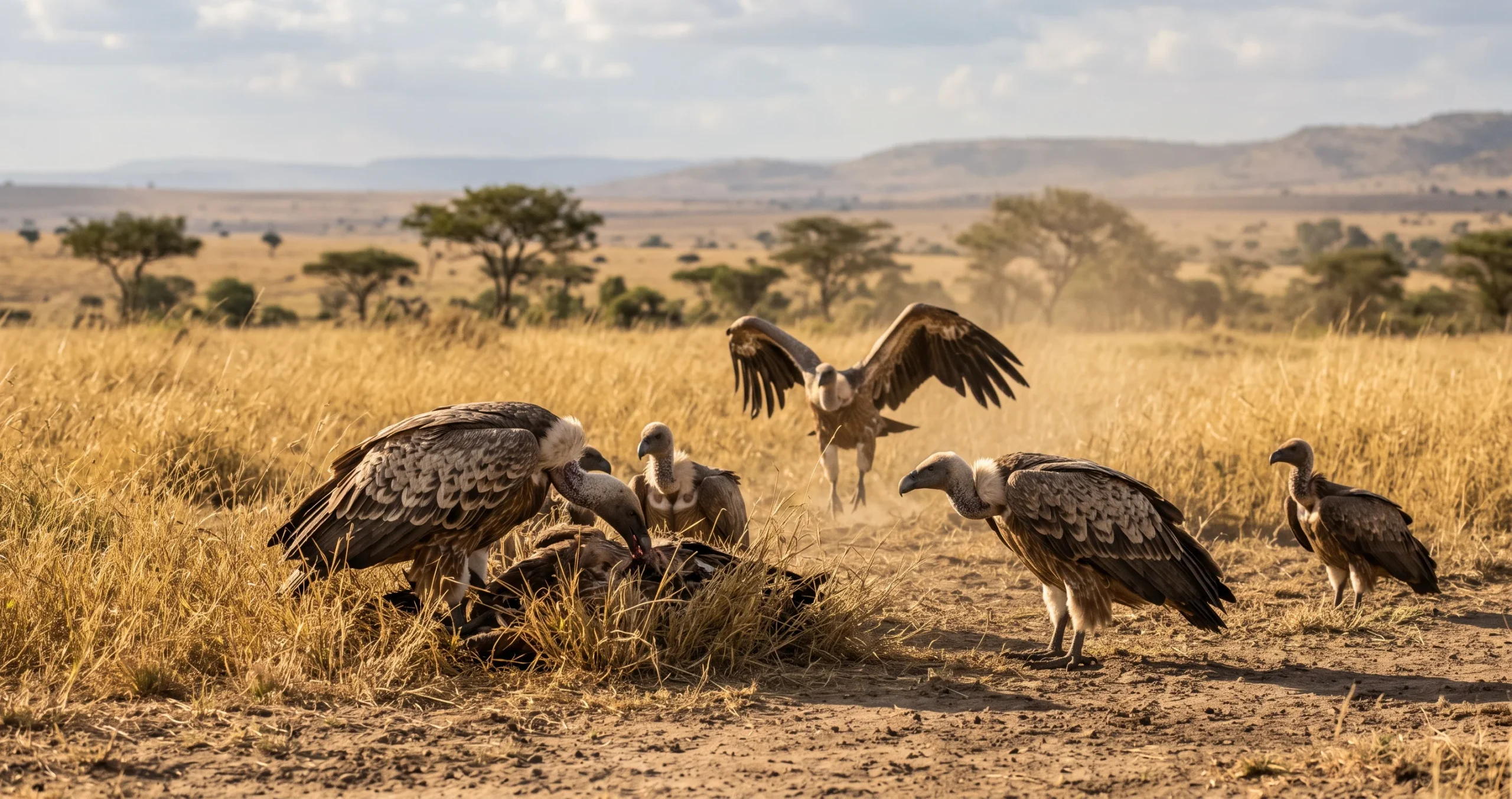
A vulture drops from a wide circle in the sky and lands beside the remains of a dead animal. To us, the meal may look like something to avoid. As a carcass decomposes, its tissues can become associated with large communities of microorganisms, some of which can pose serious risks to animals that consume them.
Yet vultures routinely make carrion the center of their diet.
One important reason is vulture stomach acid. Their gastrointestinal system can create remarkably harsh chemical conditions that act as a powerful filter against many microorganisms swallowed with carrion. Research on vultures has found strong selection between the diverse microbes encountered around food and the much less diverse community that survives farther along the digestive tract.
But there is an important catch: vultures are not immune to every pathogen or toxin. Their stomach is not a perfect sterilizer. Instead, acidic digestion works alongside the gut microbiome, immune defenses, physiology, and behavior to make an extraordinary scavenging lifestyle possible.
Table of Contents
- Why Vulture Stomach Acid Matters
- Inside the Stomach of Nature’s Cleanup Crew
- How Acidic Is a Vulture’s Stomach?
- What Happens to the Microbes in Carrion?
- The Vulture Gut Is Not Sterile
- Stomach Acid Is Only the First Line of Defense
- Can Vultures Still Get Sick?
- How Evolution Built a Specialist Scavenger
- Why This Strange Digestive System Matters to an Entire Ecosystem
- Frequently Asked Questions About Vulture Stomach Acid
- Conclusion
Why Vulture Stomach Acid Matters
Death transforms an animal into an entirely new biological environment.
Microorganisms already present in and around the body participate in decomposition. As tissues break down, the carcass can become a rich microbial habitat, and some microbes can produce substances harmful to other animals.
For an animal that specializes in carrion, this creates an obvious problem.
A vulture needs to obtain the protein, fat, and other nutrients contained in dead tissue without being overwhelmed by the biological hazards that may accompany the meal.
That is where the vulture digestive system becomes fascinating.
Research on black vultures and turkey vultures found a striking contrast between the microbial diversity on their faces—where they contact carrion—and the diversity found in their hindguts. The gastrointestinal tract appeared to act as an extremely strong selective filter.
The first major barrier encountered by a swallowed meal is the harsh chemical environment of digestion.
Inside the Stomach of Nature’s Cleanup Crew
Imagine following a piece of carrion after a vulture swallows it.
The food travels through the esophagus and enters the upper digestive system, where mechanical and chemical digestion begin preparing it for further processing.
Here, gastric secretions create highly acidic conditions.
Acidity assists in breaking down food, but it has another important consequence: many microorganisms entering with carrion suddenly encounter an environment in which survival becomes much more difficult.
The effect is better imagined as a biological filter than as a disinfectant.
Microbes arrive with the food, but only organisms capable of tolerating the conditions of the digestive tract have a chance of continuing farther through the system. Research on New World vultures found evidence of dramatic microbial selection between the face and hindgut.
How Acidic Is a Vulture’s Stomach?
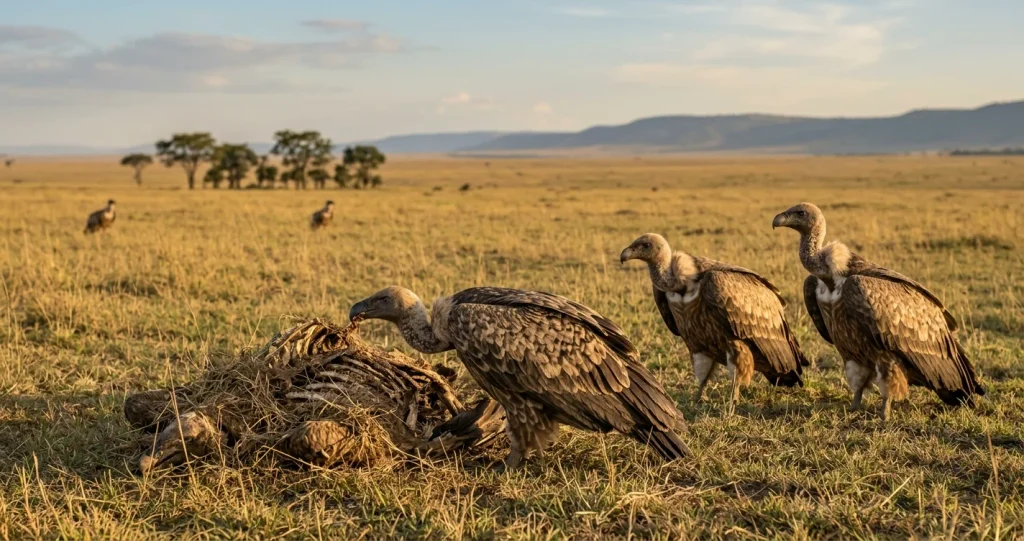
Descriptions of vulture stomach pH often produce dramatic headlines, but the science deserves more careful treatment.
The pH scale measures how acidic or alkaline a solution is. Lower numbers indicate greater acidity, and because pH is logarithmic, a change of one pH unit represents a tenfold change in hydrogen-ion activity under standard interpretations of the scale.
Vultures are associated with remarkably harsh gastric conditions, but it is misleading to assign every vulture a single permanent stomach-pH number.
Gastric conditions can vary among species, individuals, feeding states, and methods used to make measurements. What matters biologically is that the digestive tract creates a highly selective environment capable of eliminating or greatly reducing many organisms swallowed with carrion.
Research into the molecular adaptations of vultures also points toward selection involving genes associated with gastric acid secretion as well as immune function, supporting the idea that scavenging specialization extends beyond one simple stomach measurement.
What Happens to the Microbes in Carrion?
Now shrink the scene down to the microscopic scale.
A mouthful of carrion can introduce a complicated collection of biological material into the digestive tract. Alongside animal tissue may come bacteria and other microorganisms associated with the carcass and surrounding environment.
Then they encounter gastric conditions.
Many microbes are poorly equipped to tolerate such a harsh acidic passage. Research on New World vultures concluded that the acidic gastrointestinal tract acts as a strong filter on microorganisms ingested from decaying carcasses.
Evidence of this filtering was striking.
Researchers reported an average of only 76 microbial operational taxonomic units in gut samples compared with 528 on facial skin. More than 85% of microbial OTUs recovered at comparable sequencing depth were unique to the face rather than shared with the hindgut.
But this does not mean every microorganism is destroyed.
Some organisms are much better suited to surviving the journey.
That is why vulture stomach acid should be thought of as a powerful biological bottleneck rather than a perfect sterilization chamber.
The Vulture Gut Is Not Sterile
Here the story becomes even stranger.
If a vulture’s digestive environment is so harsh, we might expect its intestines to be almost empty of microbial life.
They are not.
A landmark study of 50 black and turkey vultures found a distinctive, relatively low-diversity hindgut microbiome. Two bacterial groups—Clostridia and Fusobacteria—were particularly prominent.
Members of these groups include organisms that can be associated with disease in other vertebrates. Yet vultures apparently tolerate a gut community heavily shaped by these bacteria.
Researchers found that the microbiomes of wild vultures were also quite similar to those of captive turkey vultures despite differences in environment, suggesting that vulture digestive physiology plays a strong role in determining which microorganisms establish themselves in the gut.
This produces a fascinating contrast.
The vulture gut is not sterile. It is selective.
Some microorganisms disappear during passage through the digestive system, while others are unusually successful there.
Stomach Acid Is Only the First Line of Defense
The spectacular chemistry of vulture stomach acid can easily overshadow the rest of the animal’s biology.
That would be a mistake.
Vultures survive on carrion through multiple adaptations working together. These include gastric chemistry, specialized digestive physiology, a distinctive gastrointestinal microbiome, immune defenses, and behaviors associated with finding and processing carrion.
Genomic research reinforces this broader picture. A review of molecular adaptations in vultures identified evidence involving genes connected to both gastric acid secretion and immunity, highlighting the multiple biological systems associated with their dietary specialization.
The microbiome may add another layer.
Researchers studying New World vultures proposed that the birds and some of their gut microbes may have developed a specialized relationship. Certain microbes tolerate conditions that exclude many competitors, while the birds tolerate microorganisms and microbial products that would be problematic for many other vertebrates. Some details of this relationship remain hypotheses requiring further experimental testing.
The important lesson is therefore not that vultures possess one miraculous stomach.
They possess an entire biological toolkit for scavenging.
Can Vultures Still Get Sick?
Yes.
Their impressive adaptations should never be confused with universal immunity.
Some microbes or their resistant stages can survive passage through a vulture. The New World vulture microbiome study notes earlier evidence that spore-forming Bacillus anthracis could be recovered from vulture feces, illustrating why an acidic digestive tract should not be portrayed as destroying every pathogen.
Microbial toxins present another complication.
A digestive system may destroy or suppress an organism without necessarily neutralizing every biologically active substance associated with it.
Vultures can also face poisons and other hazards unrelated to the ordinary microbes involved in decomposition.
Their remarkable biology represents resistance and specialization, not invulnerability.
That distinction makes their adaptation more interesting, not less.
How Evolution Built a Specialist Scavenger
Carrion is both an opportunity and a challenge.
A carcass contains valuable nutrients. An animal capable of exploiting that resource has access to food that many other species cannot use as effectively.
But specializing in carrion repeatedly exposes an animal to the biological consequences of decomposition.
Over evolutionary time, natural selection can favor traits that help scavengers locate carcasses, consume them efficiently, digest the tissue, and tolerate many of the biological hazards encountered along the way.
Vultures show adaptations across several biological systems rather than one isolated trait. Modern research has examined their sensory systems, facial and intestinal microbiomes, immune-related genes, and genes associated with gastric acid secretion.
The famous acidity of the stomach therefore belongs within a much larger evolutionary story.
A vulture is not simply a bird with unusually strong stomach acid.
It is an animal whose body has become highly specialized around scavenging.
Why This Strange Digestive System Matters to an Entire Ecosystem
The story does not end inside the vulture.
By consuming dead animals, vultures participate directly in the decomposition process and in the movement of nutrients through ecosystems.
A carcass is a temporary biological resource. If vultures consume it rapidly, less of that resource remains available to other vertebrate scavengers, insects, and microorganisms.
That means the ability to digest carrion influences interactions among many organisms.
It is tempting to simplify this ecological role by saying that vultures “remove disease.” Reality is more complicated. Their consumption of carcasses can alter the duration and pathways of exposure to carrion, but the effects depend on the pathogen, ecosystem, scavenger community, and circumstances.
What is clear is that their extraordinary digestive adaptations allow vultures to occupy a specialized ecological niche.
The chemistry occurring inside one bird can therefore influence what happens to an entire carcass outside it.
Frequently Asked Questions About Vulture Stomach Acid
How acidic is a vulture’s stomach?
Vultures can maintain remarkably acidic gastric conditions, but one pH measurement should not be applied universally to all vultures. Gastric conditions can vary with species, individual physiology, feeding state, and measurement method.
Why is vulture stomach acid so strong?
Strong acidity helps with digestion while also creating hostile conditions for many microorganisms swallowed with carrion. Research indicates that the gastrointestinal tract acts as a powerful microbial filter.
Does vulture stomach acid kill all bacteria?
No. Some microorganisms survive passage through the digestive system, and vultures themselves maintain distinctive gut microbial communities. Their stomach should be understood as a strong selective filter, not a perfect sterilizer.
How do vultures eat carrion without getting sick?
There is no single defense. Gastric acidity works alongside digestive physiology, immune defenses, microbial communities, and other adaptations associated with scavenging.
Can vultures get sick from carrion?
Yes. Vultures are not universally resistant to pathogens, toxins, or poisons. Their adaptations make them unusually well suited to scavenging, but they do not make them biologically invincible.
Is the vulture digestive system sterile?
No. Studies have found a distinctive gut microbiome in vultures, including high representation of Clostridia and Fusobacteria in black and turkey vultures.
Why are vultures important to nature?
Vultures are specialized carrion consumers. By consuming dead animals, they participate in scavenger communities, decomposition pathways, and nutrient cycling.
Conclusion
Return to that vulture standing beside a carcass.
To us, the meal may appear contaminated and dangerous. To the vulture, it is an important source of energy that its body is extraordinarily well adapted to process.
A major part of the explanation is vulture stomach acid.
The harsh gastric environment creates a powerful biological filter through which many ingested microorganisms struggle to pass. Yet the gut is not sterile, every pathogen is not destroyed, and acidity alone does not explain the vulture’s success.
Instead, the bird relies on multiple defenses: gastric chemistry, digestive physiology, its unusual microbiome, immune mechanisms, and other adaptations associated with scavenging. Research on New World vultures demonstrates just how strongly the digestive tract can select the microbial community that survives inside it.
That is what makes vultures so extraordinary.
They are not immune to the hazards of decay. They are highly specialized for living with them.
And that specialization allows vultures to turn one of nature’s most challenging food sources into fuel while filling an important place in the ecological recycling of animal remains.