
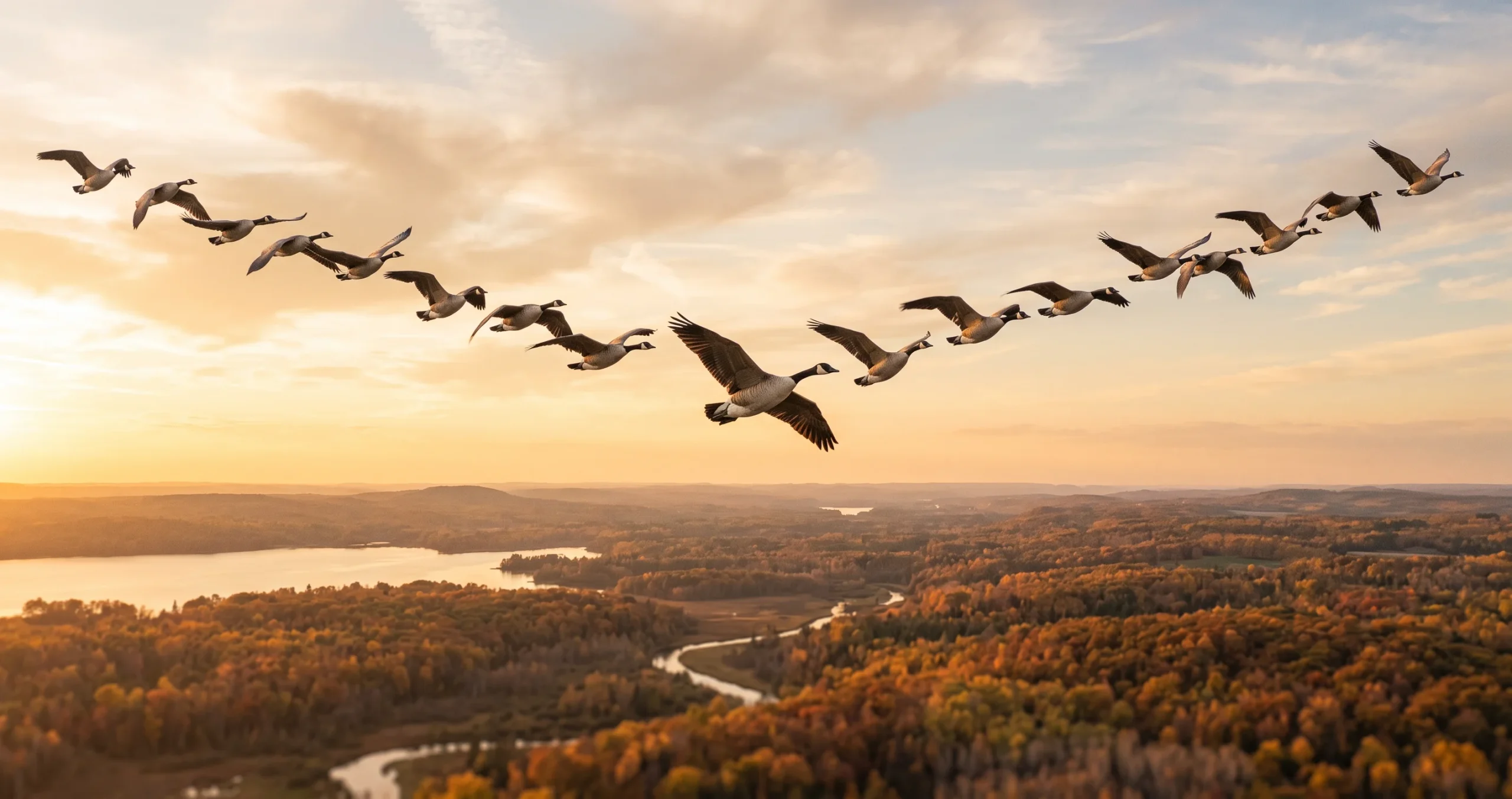
The reason why birds fly in a V formation is much stranger than simply staying together. Every bird creates an invisible trail of swirling air behind its wings. A bird flying in the right position can interact with that moving air and potentially make flight more efficient.
Even more surprisingly, research suggests that some birds do not merely find the correct place in the formation. They can adjust the timing of their wingbeats to the aerodynamic wake produced by the bird ahead.
A simple V in the sky is actually a moving system of wings, vortices, rising air, precise positioning, and cooperation.
Table of Contents
- Why Birds Fly in a V Formation
- The Invisible Air Highway Behind Every Bird
- What Are Wingtip Vortices?
- Upwash and Downwash Explain the Shape of the V
- Why Birds Do Not Fly Directly Behind One Another
- The Strange Precision Hidden Inside the V
- Birds Can Time Their Wingbeats
- Does Flying in a V Save Energy?
- Why the Lead Bird Has a Harder Job
- Birds Can Exchange the Lead
- The V May Help Birds Coordinate Visually
- Which Birds Fly in V Formations?
- Why Small Birds Often Fly Differently
- Frequently Asked Questions
- Conclusion
Why Birds Fly in a V Formation
The basic explanation for why birds fly in a V formation comes from aerodynamics.
Flying requires considerable energy. Wings must continuously generate enough lift to support the bird while the animal also produces thrust and overcomes drag.
But a flying bird does something else: it changes the air around itself.
That disturbed air does not immediately disappear once the bird passes. Instead, a complex aerodynamic wake stretches behind it.
For another bird, that wake can be helpful or unfavorable depending on exactly where it flies.
This is where the V begins to make sense.
The Invisible Air Highway Behind Every Bird
Imagine a large goose flying through still air.
As its wings generate lift, they redirect the surrounding air. Pressure differences and the resulting airflow around the wings contribute to powerful rotating structures in the wake.
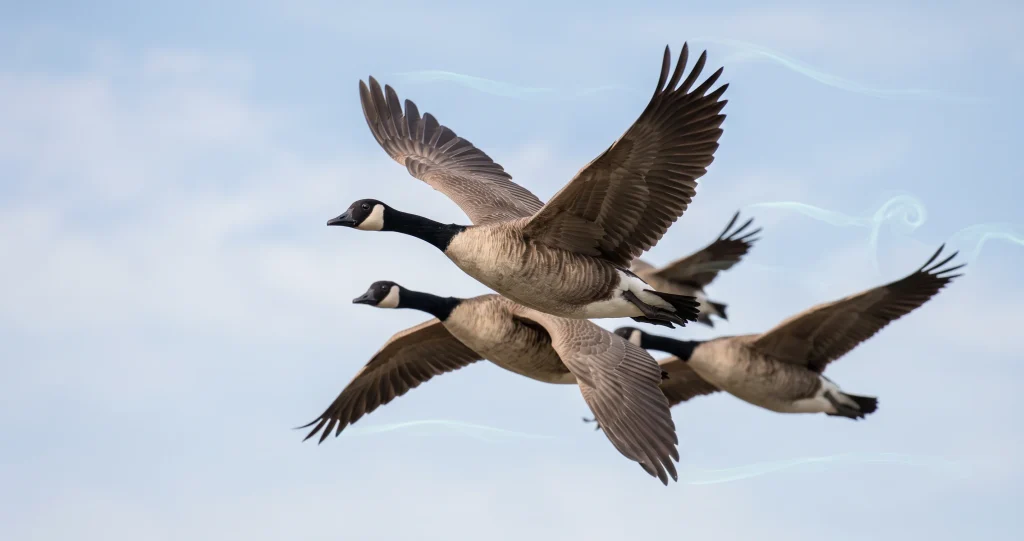
These invisible spirals are known as wingtip vortices.
From the ground, you cannot see them. To a bird following behind, however, they dramatically change the aerodynamic environment.
Some regions of the wake contain air moving downward. Around other portions of the vortices, air moves upward.
That upward-moving air is especially important.
A following bird that positions itself correctly can interact with this favorable airflow. Instead of every member of the flock flying through completely undisturbed air, followers can make use of aerodynamic conditions created by the birds ahead.
The sky effectively becomes an invisible highway built by wings.
What Are Wingtip Vortices?
A wing produces lift by changing the pressure and momentum of the air around it. Near the tips, airflow contributes to rotating masses of air that trail behind the flying bird.
These structures are called wingtip vortices.
Aircraft create them too, but a bird adds another level of complexity because its wings are constantly moving.
They rise, fall, twist, and flex.
Consequently, the aerodynamic wake is not stationary. Its structure changes throughout each wingbeat cycle.
For a following bird, finding the correct place is therefore only part of the challenge.
Timing can matter too.
Upwash and Downwash Explain the Shape of the V
Two concepts are especially important for understanding why birds fly in a V formation: upwash and downwash.
As wings generate lift, the overall wake contains air directed downward. This downward component is called downwash.
A follower does not want to remain in the least favorable part of that airflow.
Around the outer regions of the wake, however, rotating vortices create areas where the air is moving upward.
This is upwash.
A bird positioned slightly behind and to one side of another bird can place its wings closer to this rising airflow.
The follower is not simply being pushed forward. Instead, the moving air can assist its wings aerodynamically.
That small difference in position helps explain the geometry of the entire flock.
Why Birds Do Not Fly Directly Behind One Another
If the only purpose of formation flight were to follow a leader, the flock could simply form a straight line.
Instead, large migratory birds frequently arrange themselves diagonally.
A follower stays somewhat behind and to the side of the bird ahead. This position can bring its wings closer to useful upwash while keeping it away from less favorable airflow directly behind the preceding bird.
Repeat that arrangement across several birds and a diagonal line develops.
When similar lines extend behind both sides of the leading bird, the famous V appears.
The V is therefore not simply a shape birds have somehow decided to copy. Its geometry is closely connected to the physics of the air generated by the flock itself.
The Strange Precision Hidden Inside the V
For decades, scientists could use aerodynamic models to predict where birds should fly to take advantage of another bird’s wake.
Proving what free-flying birds actually did was much harder.
Northern bald ibises provided researchers with an unusual opportunity to investigate the question.
Scientists equipped 14 juvenile northern bald ibises with lightweight data loggers during a human-guided migration.
The devices allowed the researchers to reconstruct the birds’ relative positions and wingbeat movements with impressive precision.
The results revealed that birds occupying V positions tended to fly where aerodynamic theory predicted useful airflow should occur.
But the researchers discovered something even more remarkable.
Position was not the whole story.
The birds were also coordinating their wingbeats with the aerodynamic wake ahead.
Birds Can Time Their Wingbeats
A bird’s wake is not a fixed ramp of rising air.
Because the wings are flapping, favorable and unfavorable regions of the wake shift through space.
The northern bald ibises appeared capable of responding to this changing aerodynamic landscape.
When flying behind and to the side of another ibis, the birds showed spatial coordination between their wingtip paths. This relationship could help the follower interact with favorable portions of the wake.
That means the answer to why birds fly in a V formation involves more than finding the correct position.
The timing of the wings matters too.
Researchers observed a different relationship when an ibis flew more directly behind another bird. In this position, the follower shifted toward an opposite, or anti-phase, wingbeat relationship.
The researchers proposed that this could help the bird deal with less favorable airflow.
From hundreds of feet below, a flock may appear to be gliding peacefully across the sky.
Aerodynamically, something far more complicated is happening.
Every wingbeat modifies the air.
The following bird encounters that modified air and adjusts its own flight accordingly.
Does Flying in a V Save Energy?
Energy efficiency is one of the major reasons scientists investigate why birds fly in a V formation.
The basic principle is straightforward: if a follower can use favorable airflow generated by another bird, it may reduce the mechanical effort required to remain airborne.
However, there is no single energy-saving percentage that applies to every bird.
The benefit depends on species, wing shape, flight speed, spacing, weather conditions, position within the flock, and how accurately the formation is maintained.
Evidence for a real energetic advantage comes from several kinds of research.
In one famous experiment, researchers studied great white pelicans trained to fly alongside a motorized aircraft. Measurements of the birds’ heart rates supported the conclusion that formation flight can reduce energetic expenditure.
For a migrating bird, even a moderate improvement in efficiency can matter.
Migration may involve traveling hundreds or thousands of miles. Birds must manage limited energy reserves while dealing with winds, weather, feeding opportunities, and long stretches between suitable resting places.
A small aerodynamic advantage repeated over millions of wingbeats can therefore become biologically significant.
Why the Lead Bird Has a Harder Job
There is one obvious problem with this aerodynamic system.
The first bird has nobody ahead of it.
The leader flies into relatively undisturbed air and cannot exploit the wake of a flock mate in the same way as a properly positioned follower.
That means the aerodynamic advantages associated with following are not distributed equally throughout the V.
If following can be beneficial, however, why would one bird accept the front position for an entire migration?
It does not have to.
Birds Can Exchange the Lead
A V formation is not a permanent hierarchy with one bird serving as the leader for the entire journey.
Individuals can change positions.
Research on northern bald ibises found evidence of reciprocal relationships between leading and following.
Scientists compared how much time particular birds spent following one another with how much time they later spent leading those same individuals.
Birds that spent time benefiting from another individual’s wake also tended to spend time leading it.
The formation can therefore function as a dynamic cooperative system.
A bird may occupy a following position for a period and later move forward, while another bird takes advantage of the position behind it.
The V May Help Birds Coordinate Visually
Aerodynamics is an important part of the explanation, but airflow may not be the V’s only useful feature.
The formation may also assist visual coordination.
Because the birds are staggered rather than positioned directly behind one another, individuals may be better able to maintain useful visual relationships with nearby flock members.
That could help them detect changes in direction, speed, and spacing.
Visual coordination and aerodynamic efficiency are not mutually exclusive explanations.
The same arrangement that places birds near favorable airflow can also create an organized structure in which flock mates can monitor nearby individuals.
Which Birds Fly in V Formations?
Geese are the classic example.
Canada geese are particularly famous for traveling in organized formations, but similar behavior occurs in many other large birds.
Cranes, swans, pelicans, ibises, and cormorants can use V-shaped or diagonal echelon formations during coordinated travel.
The shape is not always a perfect, symmetrical letter V.
One side can become considerably longer than the other. At other times, the birds may form a single diagonal echelon rather than two equal arms.
Birds also change positions continuously as the flock responds to flight conditions.
The V should therefore be thought of as a flexible aerodynamic arrangement rather than a rigid geometric shape.
Why Small Birds Often Fly Differently
If formation flight offers aerodynamic benefits, it might seem strange that every migrating species does not use a V.
Birds, however, have very different bodies and lifestyles.
Small species may have different wingbeat frequencies, flight speeds, wing shapes, predator pressures, social behaviors, and migration strategies.
Many small birds travel in loose groups rather than orderly lines.
Others form compact, constantly changing three-dimensional flocks.
Starlings provide a dramatic example. Their murmurations twist, compress, expand, and change direction rapidly, producing a completely different form of collective flight.
Some shorebirds show intermediate patterns, combining aspects of compact flocking with more organized formation flight.
There is no single perfect flock shape.
The V is one evolutionary solution to the challenges of traveling through the air as a group.
Frequently Asked Questions About Why Birds Fly in a V Formation
Why do birds fly in a V formation?
Many large birds use V formations because properly positioned followers can interact with favorable airflow created by birds ahead. This can reduce flight effort under suitable conditions and may also help maintain flock coordination.
Why do geese fly in a V instead of directly behind one another?
A bird directly behind another may encounter unfavorable portions of its wake. Flying slightly behind and to the side places the follower closer to useful upwash around the wake.
Does flying in a V really save energy?
Research supports an energetic advantage for properly positioned followers. The exact benefit varies with species, spacing, position, flight conditions, and formation accuracy.
Why is the lead bird’s position more demanding?
The leader has no bird immediately ahead producing a wake it can exploit. It therefore lacks the same aerodynamic opportunity available to followers.
Do birds take turns leading?
They can. Research on northern bald ibises found reciprocal relationships in which individuals alternated between leading and following flock mates.
Do birds synchronize their wingbeats?
Research on northern bald ibises found sophisticated spatial wingbeat coordination associated with the wake produced by birds ahead.
Do all migrating birds fly in a V?
No. Many birds migrate in loose groups, dense flocks, lines, or other formations. V and echelon formations are especially conspicuous among certain large traveling birds.
Conclusion
The familiar V crossing an autumn sky looks simple only because its most fascinating component is invisible.
The real explanation for why birds fly in a V formation exists in the moving air between the birds.
Every wing creates a wake. Wingtip vortices produce regions of rising and descending air, and a follower can position itself behind and to the side of another bird to interact with favorable upwash.
Research on northern bald ibises has revealed an even more remarkable level of control. Birds can coordinate their positions and aspects of their wingbeat timing with the aerodynamic wake produced ahead.
Formation flight can provide energetic advantages, while exchanging positions allows different flock members to alternate between leading and following. The arrangement may also contribute to visual coordination during long journeys.
So when a V of geese passes overhead, you are not simply watching birds following a leader.
You are watching wings continuously reshape the atmosphere around them.
Each bird flies through air altered by another, and that striking V visible from the ground is the result of an invisible, constantly changing architecture built from wings and air.