
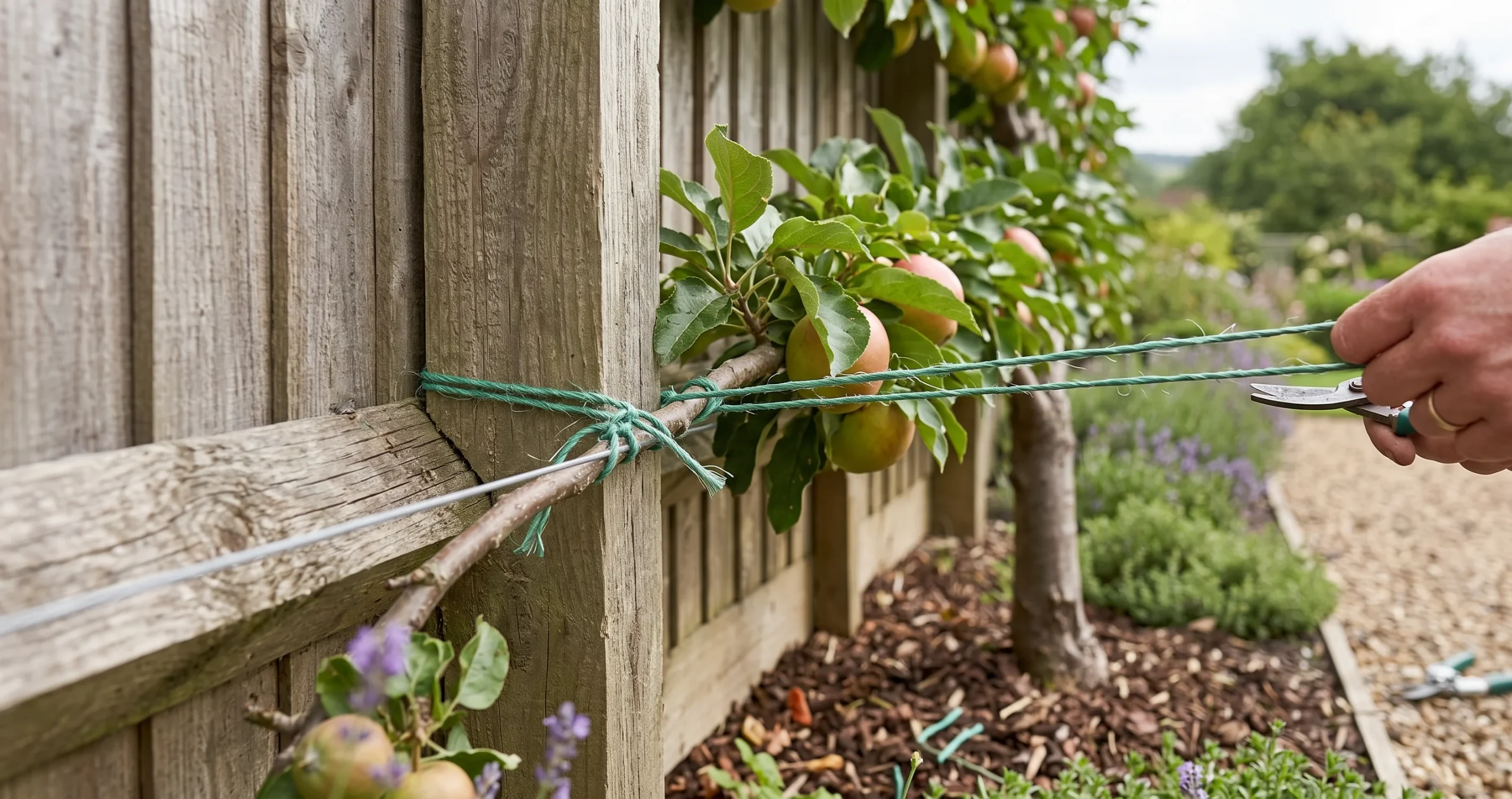
A fruit tree does not have to spread into a broad, rounded canopy. With careful pruning and training, you can persuade its branches to grow in an almost two-dimensional pattern along a wall, fence, or sturdy framework.
This technique is called espalier fruit tree training, and it combines fruit production with garden design. Instead of allowing branches to grow wherever they naturally point, you select a small number of shoots and gradually guide them into deliberate horizontal tiers.
The result can be striking: spring blossoms arranged across a wall, summer foliage forming a living pattern, and fruit hanging from branches that occupy remarkably little depth.
But espalier is not instant landscaping. Creating a mature structure usually takes several growing seasons, and keeping it attractive requires regular pruning for the life of the tree.
Table of Contents
- What Is Espalier?
- Where Did Espalier Come From?
- Why Grow a Fruit Tree Flat?
- The Best Fruit Trees for Espalier
- Choosing the Right Location
- Building the Support Structure
- Espalier Fruit Tree Training Step by Step
- How and When to Prune an Espalier
- How to Tie Branches Without Damaging Them
- How Long Does Espalier Take?
- Common Espalier Myths
- Frequently Asked Questions
- Conclusion
What Is Espalier?
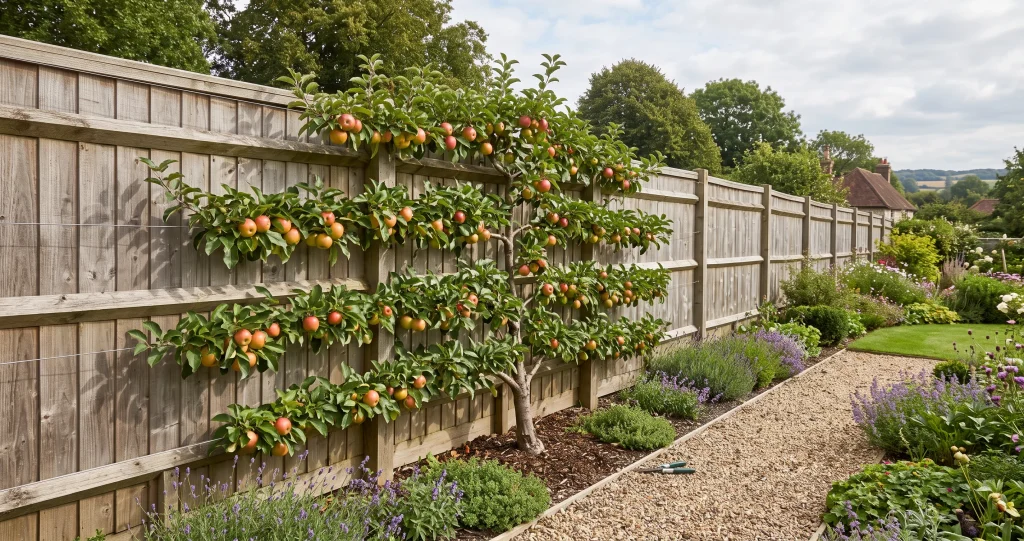
Espalier is both a training technique and the name commonly given to a tree trained using that technique.
Instead of developing a conventional three-dimensional canopy, selected branches are directed along a support to create a relatively flat structure.
One of the classic forms has a central vertical trunk with pairs of horizontal branches extending in opposite directions. These pairs are arranged in tiers, giving the mature tree an appearance somewhat like a living ladder.
The Royal Horticultural Society’s espalier guide describes traditional apple and pear espaliers as having a central stem and several tiers of horizontal arms. Established trees require annual summer pruning to preserve that structure.
Espalier does not genetically change the tree.
You are continually influencing where it directs its growth through branch selection, pruning, positioning, and tying.
Where Did Espalier Come From?
Training woody plants into restricted forms has a long horticultural tradition, especially in European gardens where productive plants and formal garden design often occupied the same limited spaces.
Over time, espalier became particularly associated with fruit growing against walls.
Walls offered more than decoration. They allowed gardeners to use vertical space efficiently, and favorable exposures could provide sheltered growing positions for fruit trees.
Modern espalier retains those practical advantages, but today the method is equally useful in suburban gardens where a full-sized spreading fruit tree may occupy too much room.
It turns an otherwise empty fence or wall into productive growing space.
Why Grow a Fruit Tree Flat?
The most obvious benefit is space.
An espalier remains narrow compared with a conventional tree because branches projecting strongly forward and backward are continually controlled.
That makes the technique useful beside walkways, along fences, at the edges of vegetable gardens, or in other locations where a broad canopy would be inconvenient.
Espalier can also make routine care easier. Much of the fruiting wood remains accessible rather than disappearing high inside a large canopy.
Then there is appearance.
A carefully maintained espalier can become a permanent architectural feature. Bare branches reveal the geometry in winter, blossoms soften the structure in spring, and developing fruit becomes part of the display later in the season.
Restricted training can be an effective way to maximize fruit growing in small spaces; Utah State University Extension similarly describes espalier as training a tree into a two-dimensional form.
The Best Fruit Trees for Espalier
Not every fruit tree responds equally well to the classic horizontal-tier system.
Apples and pears are the standard choices.
The RHS recommends spur-bearing apple and pear cultivars for traditional espalier because they produce fruit on short side shoots called spurs. Partial tip-bearers can sometimes be trained successfully, but strongly tip-bearing cultivars are more difficult to manage in this form.
Rootstock matters too.
Fruit trees are usually grafted, and the rootstock strongly influences overall vigor and eventual size. Choose one appropriate for the amount of wall or fence space available rather than assuming espalier pruning alone will control an excessively vigorous tree.
Stone fruits require more caution.
Peaches, nectarines, cherries, apricots, and plums are generally better suited to fan training than to a traditional horizontal espalier. The RHS specifically notes that fan systems fit the growth habits of many stone fruits better.
That does not mean every tree trained flat must look identical. Espalier can include decorative patterns, but beginners will usually find a simple horizontal form easier to establish and maintain.
Choosing the Right Location
Start with light.
Most fruit trees perform best with plenty of direct sun, so avoid choosing a wall simply because it is empty. The tree still needs conditions suitable for flowering, fruit development, and healthy foliage.
Allow enough width as well.
A traditional espalier may eventually become much wider than the small nursery tree you bring home. The RHS notes that typical espaliers may reach roughly 10 to 14½ feet wide and around 6 feet tall, although final dimensions depend on the tree, rootstock, and training plan.
Air circulation matters.
Do not crush the branches directly against masonry or solid fencing. Leaving space between the support wires and wall improves airflow and gives you room to tie and manage branches.
Before planting, decide how many tiers you ultimately want.
That decision determines where your support wires need to go.
Build the Support Before Planting
A mature espalier carries branches, foliage, and potentially a substantial crop of fruit. Its support system should therefore be permanent rather than improvised after the tree starts growing.
Horizontal galvanized wires are a common solution.
For a wall or fence, install strong fixings and tension the wires horizontally. The RHS recommends spacing wires about 14–18 inches apart and holding them about 4 inches away from a wall or fence for air circulation.
For a freestanding espalier, sturdy posts can support the wires.
The important word is sturdy.
A lightweight decorative trellis may look adequate beside a young tree but can become increasingly unsuitable as the branches lengthen and crops become heavier.
Install the framework first.
Then plant the tree in relation to the support rather than trying to force the support around an established tree later.
Espalier Fruit Tree Training Step by Step
The easiest way to understand espalier fruit tree training is to think in years rather than days.
You are building a permanent framework one tier at a time.
Step 1: Start With a Young Tree
A young, flexible tree is much easier to shape than an established specimen with thick branches pointing in unsuitable directions.
For a classic espalier, a one-year-old apple or pear is a practical starting point. Choose an appropriate spur-bearing cultivar and suitable rootstock.
Plant it correctly without burying the graft union.
The small tree may initially look unimpressive against a large support. That empty framework represents future growth, not a problem that needs to be filled immediately.
Step 2: Establish the First Tier
Initial dormant-season pruning is used to encourage shoots in useful positions.
For a young tree being trained from scratch, the central stem is cut above the level where the first tier will form. New shoots emerging below the cut can then provide candidates for the horizontal arms.
Select one strong shoot for the left side and another for the right.
Do not immediately force very young shoots into a perfectly horizontal position.
The RHS recommends initially training selected shoots upward at about a 40-degree angle to encourage vigorous extension. Once growth slows in late summer, they can be lowered toward the horizontal wires.
This is one of the details that separates successful training from simply tying branches flat.
Step 3: Keep a New Central Leader
You still need upward growth to produce the next tier.
Select an appropriate upright shoot as the continuation of the central stem and secure it to a vertical cane or support.
The following dormant season, that leader can be pruned near the next wire to stimulate another set of shoots.
Again, select a left arm, a right arm, and a continuation of the central leader.
The architecture develops upward one level at a time.
Step 4: Repeat the Process
Continue adding tiers until the tree reaches the planned height.
Do not rush to create five levels in a single season simply because the support has five wires.
Each tier needs sufficiently strong branches.
A balanced three-tier espalier is far more attractive and manageable than a rushed structure filled with weak, badly positioned wood.
Step 5: Control Unwanted Growth
Once the basic framework exists, the tree will continue attempting to behave like a tree.
Shoots will grow vertically from horizontal arms. Others will point toward or away from the wall.
These shoots cannot all remain.
Regular summer pruning restricts excess growth and helps preserve the flat form while maintaining fruiting wood.
If you’re planning other compact food-growing areas around your tree, our guide to Secrets of the Green Garden offers more practical gardening ideas for making productive use of limited space.
How and When to Prune an Espalier
Espalier requires two different ways of thinking about pruning.
During establishment, dormant-season pruning helps create the framework and additional tiers.
Once the framework is established, summer pruning becomes essential for controlling new growth.
The RHS recommends annual late-summer pruning for established apple and pear espaliers, generally once current growth has begun to mature and terminal buds are forming.
New side shoots arising from horizontal arms are shortened rather than allowed to become long branches.
This helps preserve the narrow profile and encourages a compact fruiting structure.
Timing matters.
Pruning too early can stimulate another flush of growth, meaning you may have to prune again. Neglecting summer pruning altogether allows vigorous upright growth to increasingly dominate the carefully trained form.
Winter pruning is therefore not a substitute for summer maintenance.
They serve different purposes.
How to Tie Branches Without Damaging Them
Branches need guidance, not strangulation.
Use soft garden ties or twine rather than thin wire directly around living bark.
A tie should hold the branch in position while leaving room for thickening.
Check ties regularly.
Something loose enough in spring may become restrictive as the shoot expands during summer. A forgotten tie can eventually cut into bark.
Young shoots should also be repositioned gradually.
If a branch strongly resists bending, forcing it flat in one movement can split or snap it. Training it first at an angle and lowering it later is safer and can also maintain stronger extension growth.
The support should carry the strain.
The branch should simply be guided along it.
How Long Does Espalier Take?
One of the biggest misconceptions about espalier is that it is a weekend garden project.
Installing the wires may take a weekend.
Growing the tree does not.
When starting with a young untrained tree, expect the basic architecture to develop over several growing seasons. Each new tier requires suitable shoots to grow, strengthen, and be positioned before the next level is completed.
A partly trained nursery espalier can shorten the process because one or two tiers may already exist, but it still requires further training and ongoing pruning. The RHS explicitly describes espalier training as a long-term commitment.
A useful expectation is that the tree will look increasingly intentional each year rather than suddenly becoming “finished.”
Even a mature espalier is never truly finished.
Annual pruning remains part of maintaining the design.
Common Myths About Espalier
Myth: Any Fruit Tree Can Be Espaliered the Same Way
Many woody plants can be trained against supports, but that does not make every species equally suited to a classic horizontal espalier.
Apples and pears—especially spur-bearing cultivars—are particularly appropriate. Many stone fruits are better grown as fans.
Myth: Espalier Naturally Makes a Tree Dwarf
The flat shape does not magically change the tree’s genetics.
Rootstock, cultivar vigor, soil, climate, and pruning all influence size. Selecting an appropriate rootstock remains important.
Myth: Once the Shape Is Finished, You Can Stop Pruning
This is one of the fastest ways to lose the design.
Established espaliers require regular summer pruning. Without it, vigorous shoots can extend outward and upward, with the top of the tree becoming increasingly dominant.
Myth: Branches Should Be Forced Horizontal Immediately
Young branches are flexible, but they are not indestructible.
Gradual positioning reduces the chance of damage, and initially keeping developing arms somewhat raised can encourage stronger extension before they are lowered.
Myth: Espalier Means Less Work
Espalier saves space, not necessarily labor.
The reward is control, accessibility, fruit production, and a beautiful living structure. The price is regular attention.
Frequently Asked Questions
What is the easiest fruit tree to espalier?
Apples and pears are among the best choices for classic horizontal espalier training. Spur-bearing cultivars are particularly suitable because their fruiting habit works well with regular restricted pruning.
Can I espalier a tree against a fence?
Yes, provided the fence receives appropriate light and can support a permanent wire system. Leave some space between the tree and solid fencing to improve airflow and provide room for maintenance.
How far should espalier wires be apart?
A common recommendation for apple and pear espaliers is roughly 14–18 inches between horizontal wires. Exact spacing can be adjusted for the design and tree, but plan the complete framework before training begins.
How long does espalier fruit tree training take?
Building a mature framework generally takes several growing seasons when starting with a young untrained tree. Buying a partially trained espalier can save time, but the tree will still require further development and lifelong maintenance.
Can I espalier peaches or cherries?
They can be trained flat, but a traditional horizontal espalier usually isn’t the best system. Peaches, cherries, apricots, nectarines, and similar stone fruits generally respond better to fan training.
Does espalier reduce fruit production?
Espalier is not simply about reducing a tree. A properly selected and maintained apple or pear can remain productive for many years, and the open, accessible framework makes the crop easier to manage.
Can I espalier an existing mature fruit tree?
Technically, some established trees can be reshaped, but converting a mature conventional tree into a clean formal espalier is much harder than starting with young flexible growth.
For a predictable geometric design, starting young is usually the better approach.
Does an espalier need a wall?
No.
A freestanding framework of firmly anchored posts and horizontal wires can support an espalier. The essential element is a strong permanent structure capable of supporting the trained branches.
Conclusion
Espalier looks complicated because the finished tree can be remarkably precise. The underlying process, however, is mostly patience applied consistently.
Successful espalier fruit tree training starts with the right tree, a permanent support, and a realistic plan. Apples and pears—particularly appropriate spur-bearing cultivars—are among the best choices for the traditional horizontal form.
Build the framework before planting. Develop one tier at a time, guide young branches gradually, and use dormant pruning to establish structure while relying on regular summer pruning to maintain it.
Most importantly, give the tree time.
A beautiful espalier is not created by forcing a young tree into its final shape in one afternoon. It emerges season by season as each branch is selected, positioned, pruned, and allowed to mature.
After several years, an ordinary wall or fence can carry something very different: a living geometric structure covered with spring flowers, summer leaves, and ripening fruit.
That combination of productivity, patience, and design is why espalier has remained useful long after gardeners first began training trees flat.
External Sources :