

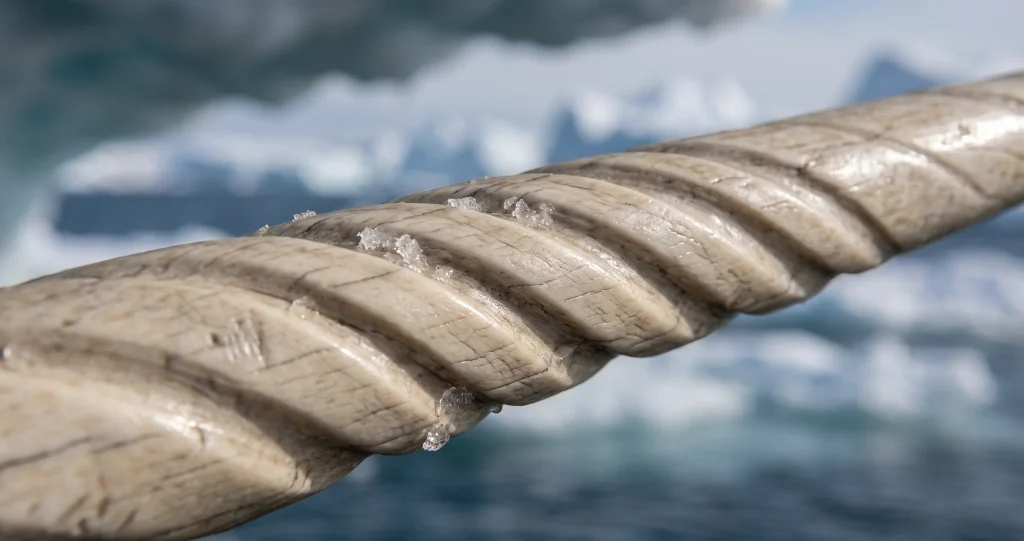
At first glance, a narwhal seems to be carrying a horn straight out of mythology. But that long spiral structure is neither a horn nor an antler. It is an extraordinary tooth. Research into the narwhal tusk sensory tooth has revealed open microscopic pathways, living pulp tissue, and nerves capable of responding to changes in the surrounding seawater.
That makes the narwhal (Monodon monoceros) one of the strangest examples of dental specialization among mammals.
Yet sensing the environment may not be the tusk’s only job. Evidence also strongly supports a role in sexual selection, while observations have documented narwhals using tusks during interactions with fish.
The real story is therefore more interesting than the familiar “unicorn of the sea” nickname suggests.
Table of Contents
- The Narwhal’s Tusk Is Actually a Tooth
- How a Tooth Becomes a Giant Tusk
- Inside the Narwhal Tusk Sensory Tooth
- What Can the Tusk Detect?
- Why Do Mostly Males Have Tusks?
- Sensory Organ or Sexual Display?
- Do Narwhals Use Their Tusks for Feeding?
- Life in the Arctic
- Conservation and a Changing Arctic
- Common Narwhal Tusk Myths
- Frequently Asked Questions
- Conclusion
The Narwhal’s Tusk Is Actually a Tooth
For centuries, narwhal tusks inspired fantastic explanations.
During medieval and Renaissance times, tusks reaching Europe were famously associated with the legendary unicorn. Their true biological origin is much less magical—but scientifically far more remarkable.
The tusk is an enormously elongated tooth.
An anatomical investigation involving 131 narwhal skull samples concluded that the erupted tusk is best described as a caniniform, or canine, tooth. Its position and relationship with the surrounding maxillary bone support this classification.
Most adult males develop a prominent tusk from the left side of the upper jaw. The tooth grows outward through the lip and develops its characteristic spiral.
NOAA notes that male narwhals typically possess this conspicuous erupted tooth, producing the appearance responsible for the animal’s famous “unicorn” profile.
Females usually lack a fully erupted tusk, although exceptions occur. Occasionally, males can even develop two tusks.
This variation provides an important clue to what the structure may actually do.
How a Tooth Becomes a Giant Tusk
A mature narwhal tusk can extend for several feet beyond the animal’s head.
Unlike ordinary human teeth, which have a hard protective enamel layer exposed in the mouth, the narwhal tusk has unusual structural properties suited to its marine environment.
Its exterior includes cementum, while beneath it lies dentin surrounding the living pulp. Microscopic channels connect the outer surface with structures deeper inside the tooth.
Recent structural research has also examined how the tusk’s famous spiral forms. The organization of mineralized collagen contributes to its complex helical architecture, demonstrating that the spiral is built into the tooth from microscopic structural levels upward.
The result is not simply an oversized spike.
It is a highly specialized biological structure that continues to record information about an individual narwhal as it grows.
Scientists can even analyze chemical signatures preserved in tusk layers to investigate long-term changes in diet and environmental exposure.
Inside the Narwhal Tusk Sensory Tooth
Perhaps the most extraordinary discovery about the narwhal tusk sensory tooth is that it appears capable of detecting changes in its surroundings.
Researchers led by Martin Nweeia investigated the anatomy and physiology of the tusk in detail.
They identified a pathway beginning at the exterior of the tusk. Seawater can communicate through channels in its porous cementum with a network of open dentinal tubules.
These tubules extend toward the internal pulp.
Within the pulp are living tissues associated with sensory nerves. Neural information can ultimately travel through the maxillary division of the trigeminal nerve—the fifth cranial nerve—toward the brain.
That anatomy provides a plausible pathway from the Arctic Ocean outside the animal to its nervous system.
Researchers also found neuronal markers in pulp tissue, providing additional evidence that the tusk functions as a sensory organ rather than simply as an inert display structure.
The full peer-reviewed study is available through the National Library of Medicine’s PubMed database.
What Can the Narwhal Tusk Sensory Tooth Detect?
Finding nerves inside a tooth does not automatically prove what those nerves detect.
Researchers therefore performed physiological experiments.
They exposed narwhal tusks to solutions with different salt concentrations while monitoring the animals’ heart rates.
The narwhals showed significant changes in heart rate when the exterior of the tusk was alternately exposed to high-salt and fresh water. This provided experimental evidence that changes at the tusk’s surface could produce a physiological response.
Salinity is particularly interesting in an Arctic environment.
Differences in salinity can accompany melting ice, freshwater input, currents and other oceanographic conditions. Detecting these changes could potentially provide useful environmental information.
Scientists have also discussed whether the tusk might respond to other chemical or physical variables.
However, it is important not to exaggerate the evidence.
Research supports sensory ability and experimentally demonstrates responses associated with changing salinity. That does not mean scientists have established that narwhals use the tusk as an all-purpose underwater detector for temperature, pressure, prey, ice thickness and every other environmental variable sometimes claimed online.
The sensory system is real. Its complete ecological role remains under investigation.
Why Do Mostly Males Have Tusks?
If environmental sensing were the tusk’s only essential purpose, an obvious question arises.
Why do most females live successfully without a long erupted tusk?
That difference between the sexes is one reason researchers have investigated sexual selection.
Sexual selection occurs when a characteristic becomes favored because it influences reproductive competition or mate choice. Familiar examples include deer antlers, peacock feathers and the enlarged structures of many male insects.
Narwhal tusks fit several predictions associated with sexually selected traits.
A study analyzing measurements from 245 adult male narwhals collected across approximately 35 years found disproportionate tusk growth and substantial variation in tusk length among males.
The researchers concluded that these patterns provide strong evidence that the tusk is sexually selected. They proposed that it could act as a signal of male characteristics during competition.
A large tusk may therefore communicate information about an individual male to other narwhals.
Sensing Versus Display: Which Theory Is Correct?
The most scientifically accurate answer may be: both functions can exist at the same time.
Evolution does not require a biological structure to perform only one job.
The narwhal tusk sensory tooth has anatomical and experimental evidence supporting sensory ability. Seawater can interact with microscopic pathways leading toward sensory tissues, and experiments have demonstrated physiological responses to changing salt concentrations.
At the same time, the tusk’s strong sexual dimorphism—its much greater development in males—points toward reproductive significance.
Its unusual scaling provides additional support for sexual selection.
These explanations are not mutually exclusive.
A structure may originally evolve under one selective pressure and later acquire additional functions, or several advantages may influence its evolution simultaneously.
Researchers themselves have suggested that multiple functions could have contributed to the evolution and persistence of the narwhal tooth system.
So describing the tusk exclusively as a “sensor” is an oversimplification.
Calling it merely a “weapon” is also incomplete.
Do Narwhals Use Their Tusks for Feeding?
Modern aerial technology has revealed another fascinating behavior.
Drone footage collected in Canada’s Arctic documented narwhals using their tusks to strike fish before attempting to eat them.
Fisheries and Oceans Canada reported observations of narwhals hitting and apparently stunning fish with their tusks.
That does not necessarily mean stunning fish is the primary evolutionary purpose of the tusk.
Animals frequently use anatomical structures opportunistically for tasks beyond the main selective pressures that shaped them.
The observation does, however, reinforce an important point: the narwhal tusk is multifunctional.
It can participate in sensory processes, social or reproductive interactions, and at least occasionally feeding behavior.
Life in the Arctic
Narwhals are true Arctic specialists.
Their main distribution lies in the Arctic Ocean, particularly the Atlantic sector. Important areas include waters around northern Canada, Greenland and parts of the Russian Arctic.
Their lives are closely connected with seasonal sea ice.
During winter, narwhals occupy offshore areas associated with pack ice, breathing through cracks and openings. Seasonal migration takes them toward inshore and coastal waters as conditions change through spring and summer.
Narwhals are also extraordinary divers.
NOAA reports dives approaching 3,937 feet, or roughly 1,200 meters, and lasting as long as about 25 minutes. They feed on Arctic prey including Greenland halibut, Arctic and polar cod, squid and shrimp.
Instead of grabbing prey with rows of functional teeth, narwhals can create suction with their mouths to capture food.
This unusual feeding system makes more sense when we remember how specialized their dentition has become.
One tooth has effectively evolved into one of the most extraordinary structures possessed by any living whale.
Readers interested in other remarkable marine adaptations can explore the wildlife and animal biology stories at Secrets of the Green Garden.
Conservation and a Changing Arctic
Understanding narwhal biology is increasingly important because the Arctic environment is changing rapidly.
NOAA identifies climate change, hunting and loss of sea ice among threats facing narwhals. The species is protected in U.S. waters under the Marine Mammal Protection Act and is included in CITES Appendix II, which regulates international trade.
Narwhals depend heavily on particular ice conditions and seasonal migration routes.
A warming Arctic can alter the timing and distribution of sea ice as well as the oceanographic conditions influencing prey such as Greenland halibut.
Noise is another concern.
Like other toothed whales, narwhals depend heavily on sound for navigation, communication and finding prey. Canadian assessments describe them as sensitive to underwater noise and note that shipping and industrial activity can influence their behavior.
Conservation status can also differ depending on whether scientists are discussing the species globally or individual regional populations and management stocks.
For example, NOAA’s 2026 assessment of the unidentified Alaska stock states that reliable estimates of abundance and population trend are unavailable for that stock. It is not designated as depleted under the U.S. Marine Mammal Protection Act or listed as threatened or endangered under the U.S. Endangered Species Act.
That uncertainty matters.
A species does not need to be on the edge of extinction before changes in habitat, prey distribution, hunting pressure or human activity deserve careful monitoring.
Common Myths About the Narwhal Tusk
Myth 1: The tusk is a horn
It is a tooth.
Detailed anatomical research supports describing the erupted tusk as a canine or caniniform tooth arising from the upper jaw.
Myth 2: Narwhals use the tusk only as a weapon
Narwhals may use tusks during social interactions, and sexual-selection evidence is strong.
But research also demonstrates sensory ability, while observations have recorded tusks being used to strike fish. No single-purpose explanation captures everything currently known.
Myth 3: Every narwhal has a huge tusk
No.
The prominent tusk is typical of adult males. Most females do not develop a comparable erupted tusk, although tusked females occur, and some males can develop two tusks.
Myth 4: The tusk is basically a solid spear
The internal anatomy is much more sophisticated.
It contains dentin, living pulp tissue and sensory nerve structures. Microscopic pathways connect the surrounding marine environment with tissues deeper inside the tooth.
Myth 5: Scientists know exactly why the tusk evolved
They do not.
Sensory ability is experimentally supported, and morphological evidence strongly supports sexual selection. Determining exactly how these functions contributed to the tusk’s evolutionary history remains an active scientific question.
Frequently Asked Questions
Is a narwhal tusk really a tooth?
Yes.
Anatomical evidence indicates that the erupted narwhal tusk is a highly elongated canine or caniniform tooth associated with the upper jaw.
Which tooth becomes the narwhal’s tusk?
In the typical adult male, the left upper tooth develops into the prominent spiral tusk.
The other tooth usually remains embedded rather than developing into another full tusk.
Does a narwhal tusk contain nerves?
Yes.
Researchers have documented living pulp and sensory neural structures associated with the tusk. The pathway ultimately connects through the maxillary branch of the trigeminal nerve toward the brain.
Can the narwhal tusk taste the ocean?
“Feeling” or sensing is more accurate than saying it literally tastes the ocean.
Experiments showed physiological responses when researchers exposed the tusk to water with different salt concentrations, demonstrating sensory capability associated with its external environment.
Can the tusk detect salinity?
Research provides experimental evidence that narwhals can respond to differences in salt concentration through the tusk.
Exactly how this information is used during normal life in the Arctic remains less certain.
Why don’t most female narwhals have tusks?
This is one of the strongest clues that the structure has a reproductive or social function.
Research on tusk size and body size supports sexual selection, suggesting that the tusk may serve as a signal involved in competition among males.
Do narwhals fight with their tusks?
Tusks are associated with male social behavior, and scars and broken tusks have contributed to ideas about male competition.
However, the simple image of males routinely fencing violently with tusks should not replace the broader evidence for signaling and other functions.
Do narwhals rub their tusks together?
Narwhals have been observed bringing and rubbing tusks together in behavior sometimes called “tusking.”
Scientists have proposed social functions for this behavior, but its complete meaning remains uncertain.
Do narwhals hunt with their tusks?
At least sometimes they use them during feeding.
Canadian drone footage documented narwhals striking fish with their tusks before consuming them. Researchers cautioned that this observation does not establish feeding as the tusk’s primary evolutionary function.
How long can a narwhal tusk grow?
Exceptional tusks can exceed 3 meters, or roughly 10 feet.
Fisheries and Oceans Canada notes that the left tooth of adult males can extend more than three meters.
Where do narwhals live?
Narwhals inhabit Arctic waters, especially around Canada and Greenland, with their wider distribution extending through portions of the Arctic Ocean toward eastern Russia.
Conclusion
The famous “horn” of the narwhal is much stranger than the legends surrounding it.
It is a giant erupted tooth containing living tissue and a sophisticated sensory pathway. Research on the narwhal tusk sensory tooth demonstrates communication between the surrounding seawater, microscopic channels in the tusk and nerves connected toward the brain. Experiments further show physiological responses to changes in salt concentration.
But sensation is only part of the story.
The fact that large tusks occur predominantly in males, combined with the way tusk size scales among adult males, provides strong evidence for sexual selection. Narwhals have also been filmed striking fish with their tusks.
Rather than searching for a single explanation, scientists increasingly have reason to consider the tusk as a multifunctional structure.
It may gather information from the Arctic Ocean, communicate information about the male carrying it, participate in social interactions and occasionally assist during feeding.
The mythical unicorn horn turns out to be something arguably more remarkable: a living tooth extending into the Arctic Ocean, connected to the nervous system of one of the planet’s most specialized marine mammals.
External Sources:
- Nweeia et al., The Anatomical Record — “Sensory ability in the narwhal tooth organ system.” Experimental and anatomical evidence for the sensory function of the tusk.
PubMed research paper - NOAA Fisheries — Narwhal (Monodon monoceros). Authoritative information on anatomy, habitat, behavior, diet, protection and threats.
NOAA Fisheries Narwhal Species Profile - Dines et al. — “The longer the better: evidence that narwhal tusks are sexually selected.” Study of 245 adult males supporting a sexual-selection function for the tusk.
PubMed research paper on narwhal tusk sexual selection