
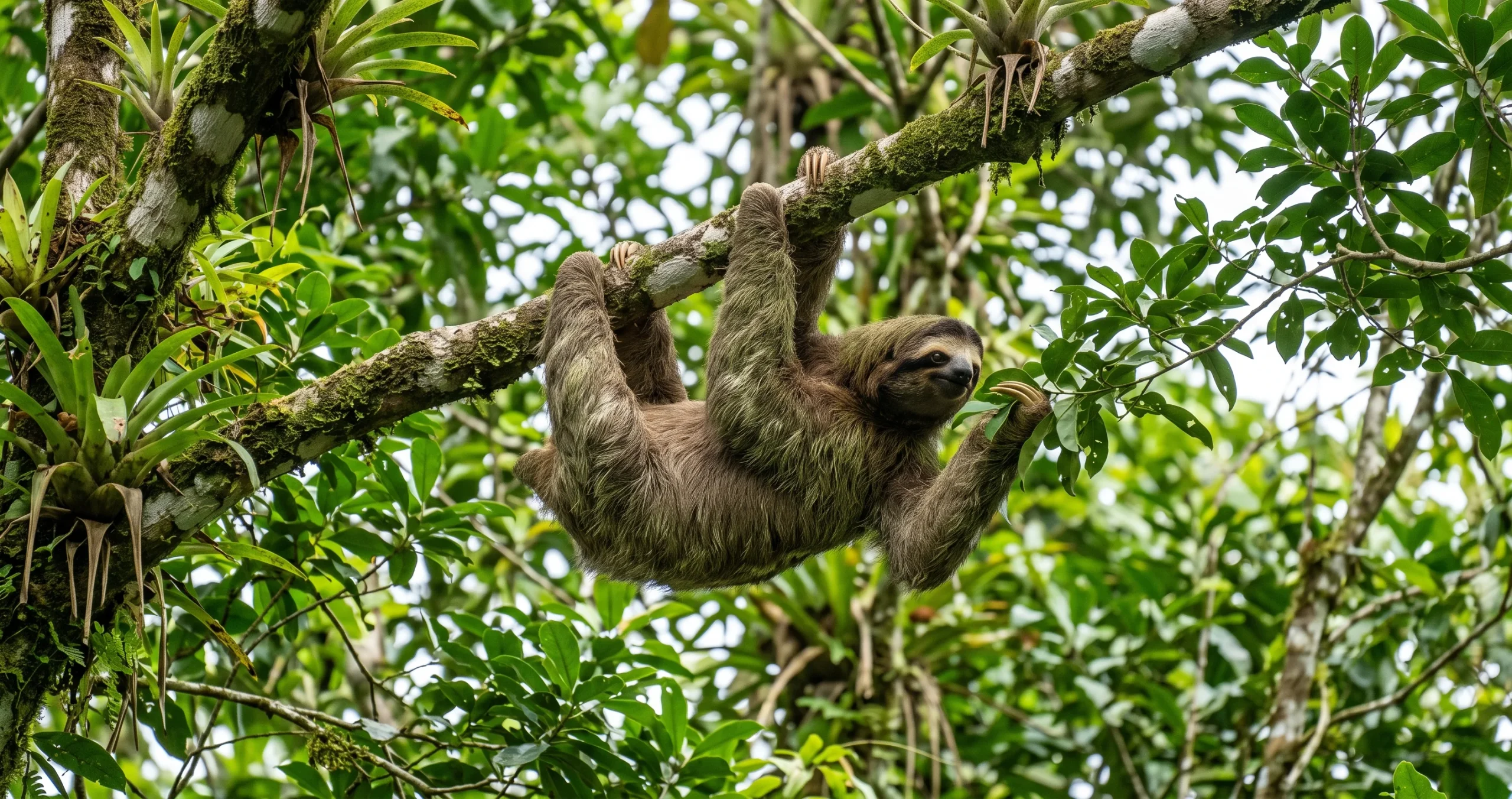
A sloth may look like a solitary animal hanging quietly in the rainforest canopy, but its coat tells a very different story. Scientists studying the sloth fur ecosystem algae community have found that sloth hair can support green algae, fungi, bacteria, moths, and other tiny organisms. In effect, a wild sloth can carry a miniature biological community everywhere it goes.
This living coat is more than a curious rainforest fact. It offers scientists a fascinating example of how organisms can share a habitat, exchange possible benefits, and create ecological relationships on the body of a moving animal.
Table of Contents
- A Living Habitat Hidden in Sloth Fur
- Why Sloth Hair Is So Good at Supporting Life
- The Algae Growing on Sloths
- Fungi Hidden Inside the Fur
- The Famous Sloth Moths
- How the Fur Ecosystem Works
- Does Green Fur Camouflage a Sloth?
- Why Slow Movement Helps the Ecosystem
- Mutualism or Commensalism?
- Common Myths About Sloth Fur
- Frequently Asked Questions
- Conclusion
A Living Habitat Hidden in Sloth Fur
Sloth fur is not simply mammalian hair with a little dirt or moss stuck to it. Research has revealed a surprisingly diverse community of organisms living on and among the hairs.
Scientists often call organisms that live on the exterior surface of another organism epibionts. Sloths carry numerous epibionts, including algae, fungi and arthropods.
Researchers have even described sloths as “mobile ecosystems” because these communities travel through the forest with their host.
The community varies among individual sloths, locations and species. Two-toed and three-toed sloths do not necessarily carry identical microbial communities.
This distinction is important because there is no single universal sloth-fur ecosystem.
Why Sloth Hair Is So Good at Supporting Life
The unusual structure of sloth hair helps explain why microorganisms can establish themselves there.
The coarse outer hairs can develop cracks and grooves capable of retaining moisture. In a humid tropical forest, these tiny structures provide favorable surfaces where microscopic organisms can persist and grow.
Rain, humidity and long periods in the canopy further contribute to the unusual microhabitat.
Instead of behaving like a smooth, dry mammalian coat, sloth fur can therefore function somewhat like a miniature landscape.
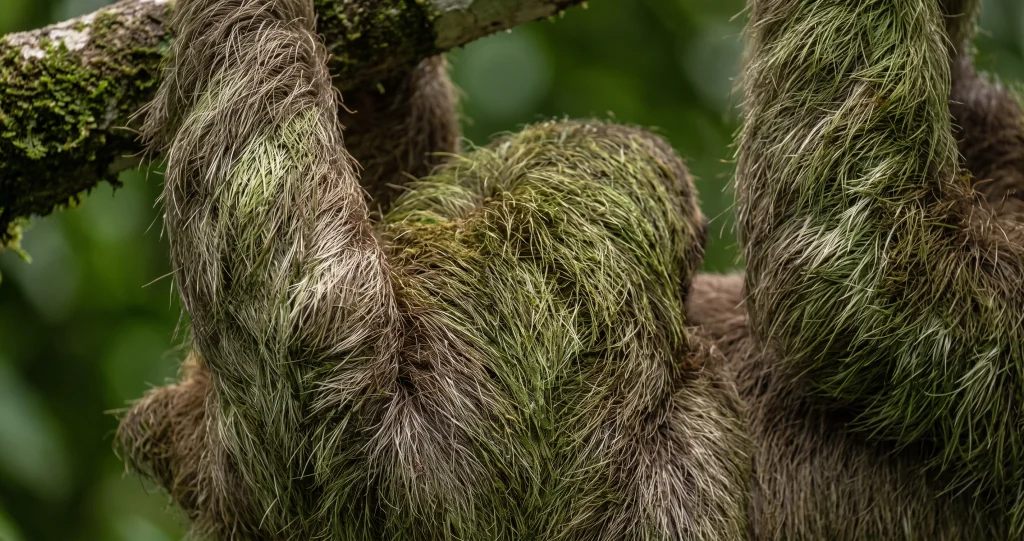
Sloth Fur Ecosystem Algae: The Green Residents
The green coloration sometimes visible on wild sloths comes primarily from organisms growing on their hair rather than from green pigmentation produced by the sloth itself.
One of the best-known organisms associated with this phenomenon is the green alga Trichophilus welckeri.
A molecular study examining hair from all six living sloth species found a diverse community of green algae. Trichophilus was especially notable because researchers found evidence suggesting a particularly close association with sloths.
Other algae detected in sloth fur have included representatives related to Trentepohlia, Myrmecia, Trebouxia, Prinzina, and Chlorella-like algae. Their presence can differ considerably among sloth species and environments.
This variation makes the sloth fur ecosystem algae relationship more complex than the familiar statement that “sloths grow algae.”
In one study involving 71 sloths, researchers detected algae in approximately 73 percent of the individuals examined. Young sloths clinging to their mothers were disproportionately represented among animals without detectable algae, raising interesting questions about when and how these organisms colonize the coat.
Fungi Hidden Inside the Fur
Algae are only one microscopic component of this ecosystem.
Scientists have discovered surprisingly diverse fungal communities in sloth fur as well.
Research on brown-throated three-toed sloths (Bradypus variegatus) has cultured dozens of fungi from their hair. Identified fungi have included members of Ascomycota, while other studies have detected both Ascomycota and Basidiomycota.
More recent DNA-based work comparing Bradypus variegatus with Hoffmann’s two-toed sloth (Choloepus hoffmanni) found notable differences between their fungal communities.
The order Capnodiales was particularly abundant. Cladosporium was among the dominant genera in Bradypus, while Neodevriesia was especially abundant in Choloepus.
Researchers have even suggested that some fungi may interact with the algae in lichen-like associations. That possibility is intriguing, but scientists have not yet established the precise ecological role of most fungi living in sloth fur.
For readers interested in the underlying research, the peer-reviewed study on fungal communities in sloth fur provides a detailed analysis of these organisms.
The Famous Sloth Moths
The largest and perhaps strangest residents of the sloth fur ecosystem are moths.
Several moth species are associated with sloths, but Cryptoses choloepi is particularly well studied in brown-throated three-toed sloths.
Adult moths spend much of their lives inside the sloth’s fur. Their life cycle is linked to an unusual sloth behavior.
Three-toed sloths periodically descend from the canopy to defecate on the forest floor. Female Cryptoses choloepi can leave the fur during these visits and lay eggs in the fresh dung.
The larvae develop in the dung and feed there. After metamorphosis, the newly emerged adult moths must find sloths and return to the canopy ecosystem.
Living on a sloth appears to give adult moths transportation and habitat. Researchers have proposed additional ecological connections between the moths and the microorganisms in the fur.
How the Sloth Fur Ecosystem May Work
One influential hypothesis connects sloths, moths, fungi, nutrients and algae into a biological cycle.
Researchers studying two-toed and three-toed sloths found that three-toed sloths carried more moths, higher concentrations of inorganic nitrogen and greater algal biomass.
Moth abundance was associated with nitrogen levels, while nitrogen was associated with algal biomass.
One proposed explanation is that organic material associated with moths is broken down within the fur, potentially with help from decomposers such as fungi. Released nutrients could then support algal growth.
Researchers also detected algae in sloth stomach contents and demonstrated that fur algae can be digestible and rich in lipids and carbohydrates. This led to the hypothesis that sloths occasionally consume their own algae during grooming.
It is an appealing ecological cycle, but an important scientific caution is necessary.
A later review of the evidence concluded that several components of this proposed three-way mutualism remain uncertain. In particular, there is not yet strong evidence showing that sloths descend specifically to maintain moth populations or that eating fur algae provides a major nutritional advantage.
The sloth fur ecosystem algae story is therefore a good example of science evolving as researchers test attractive hypotheses against additional evidence.
Does Green Fur Camouflage a Sloth?
The most familiar explanation for sloth algae is camouflage.
A greenish coat certainly seems well suited to an animal spending much of its life surrounded by leaves, vines, mosses and branches.
Researchers have consequently proposed that algae could make sloths less conspicuous to predators.
However, camouflage should be described as a plausible benefit rather than a completely proven function.
Demonstrating camouflage scientifically requires showing that predators actually have greater difficulty detecting algae-covered sloths and that this translates into improved survival.
Those connections remain difficult to test in wild rainforest canopies.
So the statement that algae may contribute to camouflage is better supported than the stronger claim that sloths deliberately cultivate algae specifically to hide from predators.
Why Slow Movement Helps the Ecosystem
Sloths have exceptionally low-energy lifestyles compared with many similarly sized mammals.
Their leaf-heavy diets provide relatively little readily available energy, and their physiology and behavior reflect those limitations. Long periods of rest and extremely deliberate movement are central features of sloth biology.
Those characteristics may indirectly help organisms establish themselves on the fur.
A sloth is essentially a slow-moving, relatively stable habitat traveling through a warm, humid forest.
Its coat is repeatedly exposed to moisture, vegetation, fungal spores, algae and tiny arthropods without experiencing the constant high-speed movement associated with many other mammals.
But slow movement should not be treated as the only reason algae grow on sloths.
Hair structure, rainforest humidity, host species, microbial exposure and behavior all contribute to the conditions that shape the community.
The result is an unusual ecological habitat in which movement occurs slowly enough that entire communities of organisms can persist on a mobile mammal.
For another example of remarkable wildlife adaptation, readers can explore more animal biology at Secrets of the Green Garden.
Mutualism or Commensalism?
The ecological terminology surrounding the sloth fur ecosystem algae relationship requires some nuance.
Mutualism describes an interaction in which both participating organisms benefit.
Commensalism describes a relationship in which one organism benefits while the other experiences neither a meaningful benefit nor significant harm.
The moth-sloth relationship has traditionally been considered largely commensal. Adult moths gain a place to live and transportation, while the direct advantage to the sloth is uncertain.
The algae-sloth relationship could potentially be mutualistic if algae gain habitat while sloths receive camouflage or nutrition.
Yet those sloth benefits remain incompletely demonstrated.
It is therefore more accurate to describe the fur as containing several symbiotic associations whose exact ecological outcomes are still being investigated, rather than declaring the entire system a perfectly balanced mutualism.
Common Myths About Sloth Fur
One common myth is that sloths are simply covered in moss.
The green material is primarily associated with microscopic algae, not a miniature carpet of ordinary forest moss.
Another misconception is that every sloth is bright green. Algal abundance varies considerably, and some individuals have little or no visible green coloration.
It is also misleading to say that sloths intentionally “farm” algae in the same sense that humans cultivate crops.
Researchers have proposed nutritional benefits from algae, but evidence for deliberate cultivation is lacking.
Finally, moths do not simply appear because the sloth is dirty.
At least some sloth-associated moths have specialized life cycles closely connected to sloths and their dung. Their presence is part of an ecological relationship rather than evidence of poor hygiene.
Frequently Asked Questions
Is a sloth’s fur really an ecosystem?
Yes, in an ecological sense. Sloth fur can support primary producers such as algae, decomposers including fungi, bacteria, arthropods and other microscopic organisms.
Researchers have consequently described sloths as mobile ecosystems.
What algae live in sloth fur?
The most famous is Trichophilus welckeri, a green alga strongly associated with sloths.
Researchers have also detected algae related to Trentepohlia, Myrmecia, Trebouxia, and other groups, depending on the host species and environment.
What fungi live on sloths?
Sloth fur contains diverse fungi, particularly members of Ascomycota.
Studies have identified numerous genera, with Cladosporium and Neodevriesia among abundant genera detected in particular sloth species.
What moth lives in sloth fur?
Cryptoses choloepi is one of the best-studied sloth moths, especially in association with the brown-throated three-toed sloth.
Adult moths inhabit sloth fur, while their larvae develop in sloth dung.
Does algae make a sloth green?
Algal growth can create the greenish coloration visible on the coats of some wild sloths.
The amount varies among animals, species and environmental conditions.
Does algae camouflage sloths?
Possibly. Green coloration could make sloths less conspicuous against rainforest vegetation, and camouflage has long been proposed as a benefit of the relationship.
However, direct evidence demonstrating a substantial survival advantage remains limited.
Do sloths eat the algae growing on them?
Researchers have found algal material in the stomach contents of some sloths, and experiments indicate that fur algae can be digestible.
The importance of algae as a regular nutritional resource remains debated.
Are the moths harmful to sloths?
The best-known sloth moths are generally regarded as fur-dwelling associates rather than conventional blood-feeding parasites.
Their exact contribution to the wider fur ecosystem remains an active research topic.
Conclusion
A sloth’s coat demonstrates how much biodiversity can exist in an unexpectedly small space.
The sloth fur ecosystem algae community includes specialized green algae such as Trichophilus welckeri, diverse fungi and remarkable insects such as Cryptoses choloepi. Together with bacteria and other microorganisms, they transform sloth fur into a complex living habitat.
Some relationships are reasonably well documented, while others remain hypotheses. Algae clearly gain a habitat, moths use sloths during their adult life cycle, and fungi form diverse communities within the coat. Possible benefits to the sloth—including camouflage and nutritional supplementation—are scientifically plausible but not equally well established.
That uncertainty makes the story more interesting rather than less.
A sloth is not simply moving slowly through a rainforest. It can also be carrying a tiny, constantly changing piece of that rainforest along with it.
External Sources:
- Biological Reviews / PubMed Central — On the move: sloths and their epibionts as model mobile ecosystems
https://pmc.ncbi.nlm.nih.gov/articles/PMC9290738/ - BMC Evolutionary Biology / PubMed Central — Molecular evidence for a diverse green algal community growing in the hair of sloths and a specific association with Trichophilus welckeri
https://pmc.ncbi.nlm.nih.gov/articles/PMC2858742/ - Proceedings of the Royal Society B / PubMed Central — A syndrome of mutualism reinforces the lifestyle of a sloth
https://pmc.ncbi.nlm.nih.gov/articles/PMC3906947/