
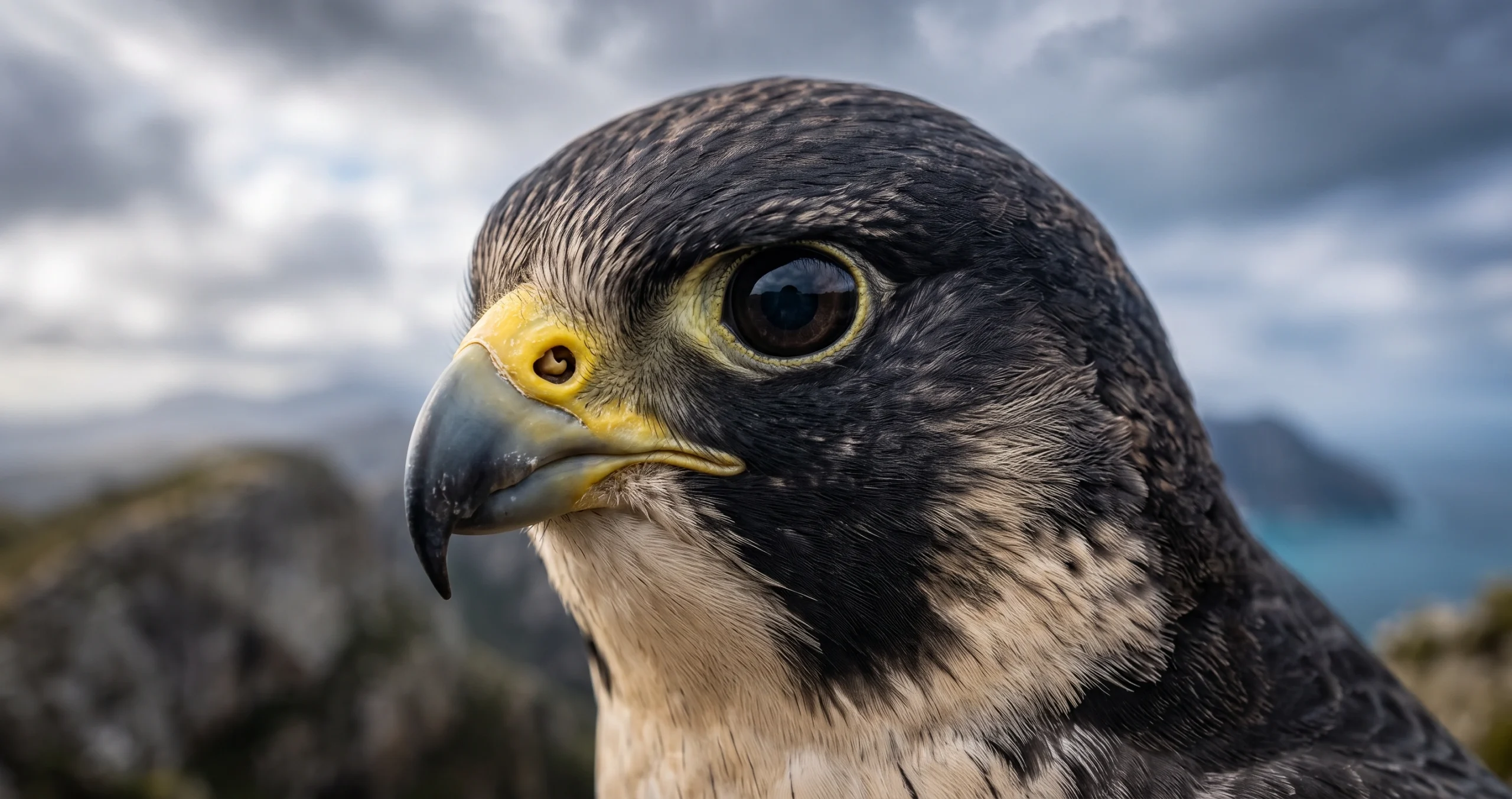
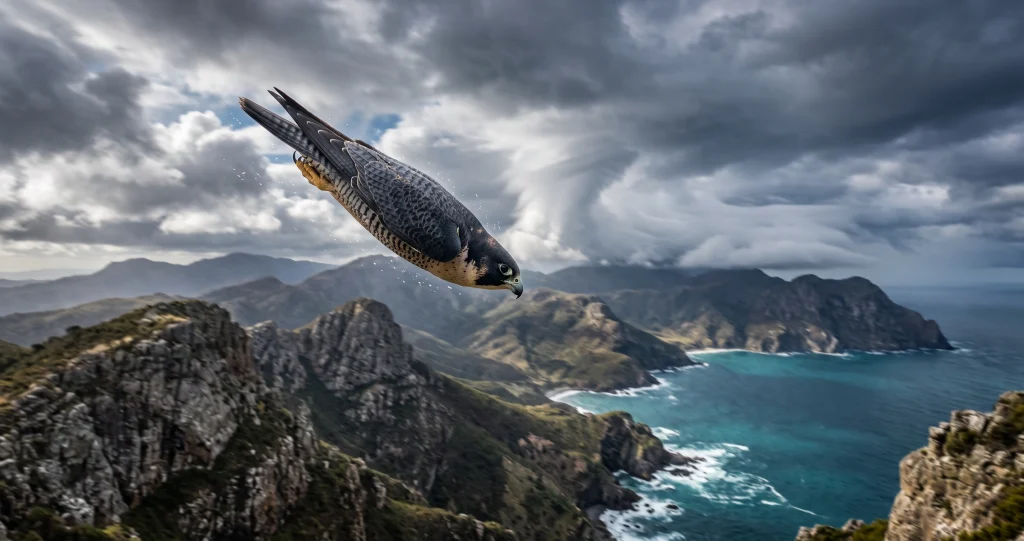
A peregrine falcon high above the landscape can transform from a soaring bird into one of nature’s most extraordinary high-speed predators in seconds. During its specialized hunting dive, known as a stoop, recorded and calculated peregrine falcon speed can approach 240 mph, with Cornell Lab reporting calculations of about 238 mph during extreme dives.
That figure is astonishing for an animal weighing only a few pounds. Yet the falcon does not simply fall uncontrollably toward the ground. Its body, wings, respiratory passages, eyes, and flight behavior work together to make high-speed pursuit possible while allowing the bird to maintain control.
Understanding how it does this requires looking at both physics and biology.
Table of Contents
- What Makes the Peregrine Falcon So Fast
- Peregrine Falcon Speed and the Physics of the Stoop
- How Body Shape Reduces Drag
- How Peregrine Falcons Breathe at High Speed
- How Their Eyes Function During a Dive
- How Falcons Keep Their Prey in Sight
- Why a 240 MPH Dive Does Not Automatically Injure the Falcon
- Peregrine Falcon vs. Cheetah
- Why Animal Speed Records Can Be Misleading
- Common Peregrine Falcon Speed Myths
- Frequently Asked Questions
- Conclusion
What Makes the Peregrine Falcon So Fast
The peregrine falcon (Falco peregrinus) is a medium-to-large raptor with long, pointed wings and a streamlined body. It occurs on every continent except Antarctica and hunts primarily other birds.
Its famous top speed does not occur during ordinary level flight.
According to the Cornell Lab of Ornithology, peregrines typically travel at roughly 24–33 mph during cruising flight and can reach around 67 mph while actively pursuing prey. During a steep stoop, however, calculated speeds can reach approximately 238 mph.
That difference is essential.
The peregrine is not flapping its wings hard enough to propel itself horizontally at 240 mph. Instead, it climbs or positions itself high above its target and converts gravitational potential energy into speed as it descends.
Peregrine Falcon Speed and the Physics of the Stoop
A stoop usually begins with altitude.
Cornell reports that hunting stoops may start roughly 300 to 3,000 feet above the prey. The falcon then folds its wings closer to its body and accelerates downward.
Gravity provides much of the acceleration.
As the falcon descends, gravitational potential energy is converted into kinetic energy. But the bird does not accelerate forever. Increasing speed produces increasing aerodynamic drag, and eventually drag becomes powerful enough to greatly limit further acceleration.
The falcon’s solution is an exceptionally streamlined diving posture.
Instead of presenting broad, fully extended wings to the airflow, it reduces its frontal area. The wings are swept backward and partially folded, while the body becomes compact and aerodynamic.
Even small changes in posture can influence drag considerably at very high speeds.
The result is less like a bird casually flying downward and more like a living aerodynamic projectile that remains capable of adjusting its trajectory.
A Body Built to Reduce Drag
Peregrine falcons have long, pointed wings that support both efficient flight and rapid aerial pursuit. Cornell describes the species as having a powerful flight style with sharply pointed wings.
During the fastest portion of a stoop, however, the wings are pulled much closer to the body.
This decreases aerodynamic resistance.
The feathers must also remain organized under intense airflow. A badly disrupted wing or tail surface would create unnecessary drag and could interfere with control.
The tail becomes especially important when the bird needs to alter its trajectory or begin slowing.
Rather than remaining in the tightest possible configuration throughout the entire attack, the peregrine can progressively alter its wings and tail as circumstances change.
That gives the bird something raw speed alone cannot provide: control.
How Peregrine Falcons Breathe at High Speed
One of the most recognizable features of a falcon’s face is easy to overlook.
Inside each nostril is a small raised structure called a tubercle.
It is often claimed online that these structures work exactly like devices in jet-engine air intakes or that a peregrine’s lungs would otherwise “explode.” Those descriptions go beyond what the evidence establishes.
Research using micro-CT-based models, wind-tunnel measurements, and computational fluid dynamics has investigated how the nasal tubercle affects airflow. Results provide evidence that the structure can damp airflow and reduce pressure fluctuations inside the nasal system, potentially helping respiratory function during rapid flight.
The distinction matters.
The tubercle is not simply an emergency plug preventing catastrophic pressure damage. It appears to be part of a complex nasal geometry that modifies incoming airflow.
That could be especially valuable during a stoop, when air is moving past the falcon’s face at extraordinary speed.
Efficient respiration is important because a peregrine still needs oxygen for its muscles, nervous system, and sensory organs while maneuvering.
The small structures inside its nostrils therefore illustrate an important principle of peregrine anatomy: high-speed survival comes from many adaptations working together rather than one miraculous feature.
How Their Eyes Function During a Dive
Breathing is only part of the challenge.
Imagine exposing an unprotected eye to airflow approaching highway speeds, then increasing that airflow several times over. Drying, particles, and disruption of the tear film could quickly interfere with vision.
Peregrine falcons have another layer of protection: a nictitating membrane, often described as a third eyelid.
This membrane can move rapidly across the eye. In falcons, specialized secretions associated with the eye help maintain the corneal surface, while the nictitating membrane contributes to cleaning and protecting it.
A scientific discussion published in the British Journal of Ophthalmology notes that the rush of air during a falcon’s stoop creates a significant challenge for the tear film and describes specialized ocular structures that help maintain the corneal surface.
That protection matters because peregrines depend heavily on exceptional vision.
A review of raptor vision found that diurnal birds of prey possess extremely high visual acuity, with the peregrine among the most extensively studied species.
High-speed hunting therefore involves more than protecting the eyeball physically. The visual system must continue supplying useful information while the scenery and prey position change extremely rapidly.
The Falcon Does Not Always Fly Straight at Its Target
There is another fascinating aspect of peregrine vision.
Researchers studying wild peregrines found that the birds sometimes approach prey along curved paths rather than simply pointing their heads directly at the target and diving along a perfectly straight line.
Why take a longer route?
Falcon eyes contain specialized retinal regions for high-acuity vision. To use one of these areas effectively, the bird may view distant prey somewhat sideways rather than directly ahead.
Turning the head sideways during a high-speed dive would increase aerodynamic drag.
Research published in the Journal of Experimental Biology found that peregrines could solve this conflict by keeping the head relatively straight while following curved flight paths that resembled logarithmic spirals, allowing the high-acuity region of the eye to remain directed toward prey.
This is an excellent example of how peregrine falcon speed cannot be separated from sensory biology.
The fastest possible straight line is not necessarily the most useful hunting trajectory.
The bird needs to arrive at the right place, at the right angle, while accurately tracking another animal that is also moving.
Why a 240 MPH Dive Does Not Automatically Injure the Falcon
The number 240 mph sounds dangerous because humans naturally compare it with automobile crashes.
But speed itself is not what causes impact injury.
Rapid changes in velocity are the greater danger.
A passenger traveling smoothly in an airplane at several hundred miles per hour is not injured simply because the airplane is moving quickly. Problems occur when velocity changes too abruptly.
The same principle applies to a peregrine.
The falcon does not normally go from approximately 240 mph to zero instantaneously. It changes its body configuration and flight path to manage acceleration and deceleration.
Its wings and tail provide aerodynamic control surfaces.
When the falcon needs to slow or maneuver, increasing wing area dramatically increases drag. Instead of striking the ground at maximum velocity, the bird converts a controlled dive into an interception, pullout, or other maneuver.
Peregrines commonly attack birds in flight. Cornell notes that a stoop may end with the falcon grabbing prey or striking it with its feet before subsequently securing it.
The entire sequence is therefore a controlled aerial hunting maneuver rather than a simple high-speed collision.
Peregrine Falcon vs. Cheetah
Comparisons between peregrine falcons and cheetahs appear frequently because both animals are famous for speed.
But they achieve speed in fundamentally different ways.
The cheetah is the fastest land mammal. Smithsonian’s National Zoo reports top speeds around 60–70 mph, supported by adaptations including a flexible spine, long limbs, specialized paw pads, semi-retractable claws, large respiratory passages, and a tail that helps with maneuvering.
A cheetah generates its speed through muscular running across the ground.
A peregrine’s maximum recorded or calculated speed occurs during a gravity-assisted aerial descent.
That means saying a peregrine is “four times faster than a cheetah” may be numerically tempting, but it ignores the very different physical conditions involved.
A more meaningful comparison is that each animal represents an extreme specialization for its own form of locomotion.
The cheetah excels at powered terrestrial sprinting.
The peregrine excels at controlled, gravity-assisted aerial attack.
For more remarkable examples of specialized animal anatomy and behavior, explore the wildlife features at Secrets of the Green Garden.
Why the Speed Record Is Measured Differently From Land-Speed Records
The phrase “fastest animal on Earth” requires some context.
A land animal such as a cheetah must generate forward motion through muscular force transmitted to the ground. Researchers can measure its velocity over a horizontal course.
A diving peregrine receives substantial acceleration from gravity.
Researchers studying peregrine stoops have used observations, tracking techniques, calculations, and experiments with trained birds to investigate these extreme velocities. Cornell specifically cites work involving trained peregrines accompanying a skydiving researcher and reports a calculated stooping speed of 238 mph.
Consequently, different “speed records” should not always be treated as identical categories.
Powered horizontal flight, running, swimming, and gravity-assisted diving involve different physical constraints.
The peregrine remains extraordinary regardless of terminology.
What makes the animal remarkable is not simply a number on a speedometer, but its ability to convert altitude into velocity and then use that velocity accurately during a hunt.
Common Myths About Peregrine Falcon Speed
Myth: Every peregrine reaches 240 mph during normal flight
False.
Peregrines normally travel far more slowly. Cornell lists cruising speeds around 24–33 mph and pursuit speeds up to approximately 67 mph. The extreme figures are associated with specialized diving stoops.
Myth: Peregrines flap their wings until they reach 240 mph
Not in the way the claim implies.
Their extraordinary maximum speed occurs during a steep descent in which gravity supplies much of the acceleration. Streamlining reduces drag and allows the bird to retain more of that speed.
Myth: Air pressure would make the falcon’s lungs explode without its nostril tubercles
This popular explanation is overstated.
Experimental work supports the idea that nasal tubercles influence airflow and can reduce pressure fluctuations, but describing them as devices preventing the lungs from exploding is not supported by the available evidence.
Myth: The falcon closes its eyes while diving
Peregrines possess a nictitating membrane that protects and maintains the eye surface while supporting continued visual function.
Vision remains crucial throughout the attack.
Myth: The falcon simply crashes into prey at maximum speed
A stoop is a controlled interception.
The peregrine continually adjusts its wings, tail, posture, and trajectory. It may strike or seize prey, but its attack should not be imagined as an uncontrolled collision at maximum measured velocity.
Frequently Asked Questions
How fast can a peregrine falcon actually fly?
During ordinary traveling flight, peregrines typically fly around 24–33 mph, according to Cornell Lab. Pursuit speeds can rise to approximately 67 mph, while extreme stoops have been calculated at roughly 238 mph.
Is 240 mph the peregrine’s normal hunting speed?
No.
It represents the extreme end of reported stooping performance rather than the speed of every hunt. Dive speed depends on altitude, trajectory, posture, wind conditions, and other variables.
Is the peregrine falcon faster than a cheetah?
In terms of maximum measured velocity during a dive, a peregrine can reach a much higher speed.
The comparison requires context because a cheetah produces its 60–70 mph sprint through powered running, while a peregrine’s extreme velocity occurs during a gravity-assisted descent.
How do peregrine falcons breathe during a high-speed dive?
Falcons have specialized nasal anatomy, including tubercle-like structures inside their nostrils.
Experimental and computational research suggests these structures can modify airflow and reduce pressure fluctuations in the nasal passages.
How do their eyes survive the airflow?
Peregrines have a nictitating membrane and specialized mechanisms for maintaining the corneal surface.
These help protect and lubricate the eyes during rapid flight, when airflow could otherwise disrupt the tear film and introduce debris.
How can a peregrine see prey while moving so quickly?
Raptors have exceptionally developed visual systems. Peregrines also appear to use flight paths that help keep prey aligned with high-acuity regions of their eyes while maintaining an aerodynamically efficient head position.
Does a peregrine reach terminal velocity?
Not in the simplistic sense of a passive object falling through the atmosphere.
A peregrine continuously changes its aerodynamic configuration. Wing position, tail position, dive angle, body posture, wind, and maneuvering all affect its acceleration and speed.
Conclusion
The extraordinary peregrine falcon speed recorded during a hunting stoop is possible because the bird does much more than fall.
It converts altitude into speed while reducing aerodynamic drag, controlling its body with specialized wings and tail feathers, managing airflow through complex nasal structures, protecting its eyes, and using an exceptionally capable visual system to track moving prey.
Even the famous 240 mph figure needs context. It represents extreme diving performance rather than ordinary flight, and it cannot be compared directly with a cheetah’s powered sprint without explaining how the speeds are produced and measured.
That context makes the peregrine more impressive, not less.
Its real achievement is the combination of speed, vision, aerodynamics, respiratory anatomy, and precise control that allows a living bird to turn a high-altitude descent into one of nature’s most specialized hunting maneuvers.
External Sources:
- Cornell Lab of Ornithology — Peregrine Falcon Life History: https://www.allaboutbirds.org/guide/Peregrine_Falcon/lifehistory
- PubMed / Journal of Experimental Biology — Curved Flight Paths and Sideways Vision in Peregrine Falcons: https://pubmed.ncbi.nlm.nih.gov/11076739/
- Smithsonian’s National Zoo & Conservation Biology Institute — Cheetah: https://nationalzoo.si.edu/animals/cheetah