

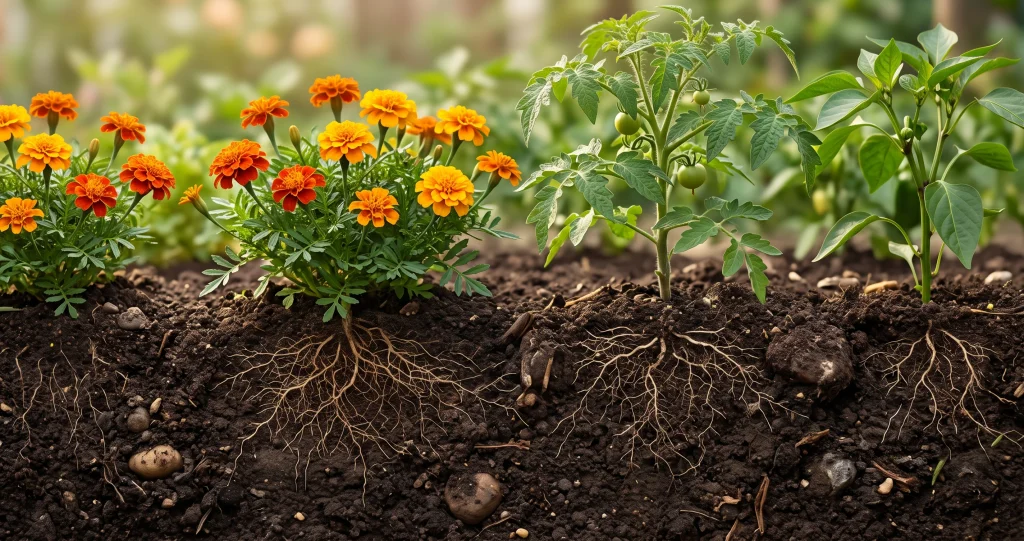
Marigolds are usually treated as the colorful border around the “real” vegetable garden. But their value can go beyond appearance. When used correctly, companion planting marigolds can add plant diversity, support beneficial insects, and, in specific situations, help suppress certain plant-parasitic nematodes.
The important phrase is “used correctly.” Marigolds are surrounded by companion-planting claims that range from well-supported horticultural practices to garden folklore. They are useful plants, but they are not a magical shield that automatically protects every tomato, pepper, cucumber, or squash growing nearby.
Understanding what happens above and below the soil makes marigolds much more useful.
Table of Contents
- What Marigolds Actually Do in a Vegetable Garden
- How Marigold Roots Affect Root-Knot Nematodes
- Companion Planting Marigolds for Nematode Management
- Do Marigolds Really Repel Insect Pests?
- The Benefit Gardeners Often Overlook
- Best Marigold Types for Vegetable Gardens
- Where to Plant Marigolds
- Other Useful Companion-Planting Pairings
- Common Marigold Companion-Planting Myths
- FAQ
- Conclusion
What Marigolds Actually Do in a Vegetable Garden
True marigolds belong to the genus Tagetes. Common garden types include French marigolds (Tagetes patula), African marigolds (Tagetes erecta), and signet marigolds (Tagetes tenuifolia).
Their usefulness comes from several different mechanisms rather than one universal pest-repelling property.
Certain marigolds can interact with plant-parasitic nematodes through their living root systems. Their flowers can provide resources for some beneficial insects, while their foliage adds another scent, shape, and texture to a vegetable bed.
That extra diversity can matter.
A vegetable garden containing nothing but rows of one crop creates a relatively simple environment. Mixing compatible flowers, herbs, and vegetables can make the planting structurally and chemically more complex, potentially interfering with the way some pests locate host plants.
However, gardeners should separate this general biodiversity benefit from claims that marigolds repel virtually every garden pest.
They do not.
How Marigold Roots Affect Root-Knot Nematodes
This is where the strongest scientific case for marigolds begins.
Root-knot nematodes are microscopic roundworms belonging primarily to the genus Meloidogyne. They attack plant roots and can cause characteristic swollen areas called galls.
Affected vegetables may become stunted, wilt despite adequate soil moisture, or produce poorly. Because the damage occurs underground, gardeners sometimes do not recognize the problem until they pull up a struggling plant.
Certain Tagetes species and cultivars can suppress particular nematode populations.
University of Florida IFAS Extension explains that marigolds produce a compound called alpha-terthienyl associated with suppression of root-knot nematodes and other organisms. Importantly, the interaction involves actively growing marigold roots.
This is very different from the common idea that simply placing one marigold beside a tomato somehow sterilizes the surrounding garden.
Research-based nematode management generally uses marigolds much more intensively.
For additional technical information, see the University of Florida IFAS Extension guide on marigolds for nematode management: UF/IFAS — Marigolds for Nematode Management.
Companion Planting Marigolds for Nematode Management
For nematode suppression, companion planting marigolds should not be confused with simply scattering flowers between vegetables.
University of California IPM notes that French marigolds such as Nemagold, Petite Blanc, Queen Sophia, and Tangerine are among the more effective options for suppressing certain root-knot and lesion nematodes. It also warns that effectiveness varies with nematode species and marigold type.
The biggest surprise is how marigolds are most effectively used.
Growing marigolds as a dense stand or rotation crop can be considerably more useful for nematode management than planting isolated flowers next to susceptible vegetables. UF/IFAS similarly recommends growing marigolds before the susceptible vegetable crop and notes that intercropping results have been inconsistent.
That distinction changes how gardeners should think about marigolds.
If you simply want flowers, biodiversity, and beneficial-insect activity, individual marigolds throughout the vegetable garden are perfectly reasonable.
If you are trying to manage a diagnosed root-knot nematode problem, however, cultivar selection, nematode identification, planting density, and crop rotation become much more important.
Marigolds also do not eliminate nematodes permanently. Once susceptible crops return, damaging populations can build again.
Do Marigolds Really Repel Insect Pests?
This is where companion planting marigolds becomes more complicated.
Garden advice often claims marigolds repel aphids, whiteflies, cabbage moths, tomato hornworms, mosquitoes, beetles, rabbits, deer, and practically anything else gardeners would rather not see.
The evidence is much less universal.
Plants can release volatile compounds that influence insect behavior. Aromatic non-host plants may sometimes make it more difficult for certain insects to locate their preferred host.
The University of Minnesota Extension explains that companion plants may influence insects through odors, by attracting predators and parasitoids, or by visually disrupting the environment pests use to locate crops. But that does not mean one plant provides reliable protection against every pest.
Research also varies according to the pest, crop, marigold species, planting arrangement, and growing conditions.
Washington State University Extension, for example, notes that French marigolds can affect insect behavior but also emphasizes that repellent plants can influence beneficial insects as well as pests.
So avoid treating marigolds like a botanical pesticide.
Think of them as one component of a diverse garden.
The Benefit Gardeners Often Overlook
The flowers themselves may be as important to the garden ecosystem as their reputation for repelling pests.
Marigolds can contribute nectar and pollen and increase floral diversity around vegetable crops. Extension sources also note their ability to attract beneficial insects such as hoverflies.
That matters because adult beneficial insects often have different dietary requirements from their larvae.
Some hoverfly larvae, for example, are predators of soft-bodied insects, while adults visit flowers. A garden containing flowering plants throughout the growing season can therefore provide resources that a vegetable-only garden lacks.
This doesn’t guarantee pest control.
Research on diversified plantings shows that increased numbers of predators and parasitoids do not always translate directly into reduced crop damage. Still, creating habitat for beneficial organisms is a sound ecological reason for incorporating flowers into vegetable gardens.
For more ways to build healthier vegetable beds, explore the gardening guides at Secrets of the Green Garden.
Best Marigold Types for Vegetable Gardens
Not every plant sold as a marigold behaves identically.
French Marigolds
French marigolds (Tagetes patula) are one of the most practical choices for companion planting marigolds.
They usually stay compact, making them easy to fit along vegetable-bed edges or between larger plants without creating excessive shade.
Certain French marigold cultivars are also among those most frequently recommended by extension sources for suppression of particular nematodes.
UC IPM specifically lists cultivars including Nemagold, Petite Blanc, Queen Sophia, and Tangerine.
African Marigolds
African marigolds (Tagetes erecta) grow much larger.
Their height and large flowers can make them useful around garden borders or in locations where they will not shade shorter vegetables.
University of Maryland Extension includes African marigolds among plants that can contribute to diversified companion plantings and beneficial-insect habitat.
Signet Marigolds
Signet marigolds are attractive, compact plants with smaller flowers.
But gardeners dealing specifically with nematodes should not assume they provide the same benefits as recommended French marigold cultivars. UC IPM cautions that signet marigolds can serve as hosts for certain nematodes.
This is an important reminder that “marigold” is not a single biological treatment.
Species and cultivar matter.
Where to Plant Marigolds
Placement should depend on your goal.
For general garden diversity, French marigolds work well around raised-bed edges, at row ends, and in sunny openings between larger vegetables.
Avoid packing them so tightly around vegetables that airflow becomes poor.
Marigolds prefer full sun and well-drained soil. Once established, many varieties flower for a long period if spent flowers are removed regularly.
When planting beside tomatoes or peppers, shorter French marigolds are usually easier to manage than tall African types.
Around cucumbers, squash, and melons, place marigolds where spreading vines will not bury them.
For nematode management, the strategy changes. A dense stand grown before the susceptible vegetable crop is generally more consistent with extension recommendations than a decorative border.
Other Useful Companion-Planting Pairings
Marigolds are only one way to diversify a vegetable garden.
Aromatic herbs such as basil, dill, cilantro, thyme, rosemary, and chives can add flowers, scents, and structural diversity. Some plant volatiles have demonstrated effects on insect behavior, although results depend heavily on the particular crop-pest combination.
Nasturtiums are another popular option. Their sprawling growth can cover exposed soil, while their flowers add another resource for visiting insects.
Dill and cilantro are particularly interesting when allowed to flower. Their small blossoms can be accessible to numerous small beneficial insects.
Legumes can also play a different role by associating with nitrogen-fixing bacteria, although this should not be interpreted to mean that planting a bean beside a tomato automatically “feeds” the tomato.
The broader lesson is more useful than memorizing dozens of supposedly perfect pairs.
Build diversity deliberately.
Combine plants with different heights, flowering periods, root structures, and ecological functions while still giving each crop the light, water, nutrients, airflow, and spacing it needs.
Common Marigold Companion-Planting Myths
Myth: One Marigold Protects an Entire Tomato Plant
There is no invisible protective bubble around a marigold.
A flower growing beside a tomato may increase diversity and provide insect resources, but it does not make the tomato immune to hornworms, aphids, whiteflies, or disease.
Myth: All Marigolds Kill Root-Knot Nematodes
Different Tagetes species and cultivars interact differently with different nematodes.
Some marigolds suppress particular nematodes, while others may be poor choices for a specific nematode problem.
Myth: Planting Marigolds Beside Vegetables Is the Best Nematode Treatment
This oversimplifies the research.
For serious nematode management, dense cover cropping or rotation with an appropriate marigold cultivar can be more effective than scattered interplanting.
Myth: Marigolds Repel Every Harmful Insect
No companion plant does this.
Some plant odors can influence insect behavior, but results vary widely between species and growing systems.
Myth: More Marigolds Are Always Better
Vegetables still need sufficient sunlight, root space, nutrients, water, and airflow.
Companion planting should increase useful diversity without creating unnecessary competition.
Frequently Asked Questions
Are marigolds good companion plants for tomatoes?
They can be.
Marigolds add flowers and plant diversity around tomatoes and may influence certain insects, but gardeners should not expect them to prevent every tomato pest or disease.
Which marigold is best for companion planting?
Compact French marigolds are particularly convenient in vegetable beds because they fit beneath or beside taller vegetables.
Certain French cultivars are also well documented for suppressing particular nematodes when grown using appropriate management methods.
Do marigolds kill root-knot nematodes?
Certain marigolds can suppress populations of particular root-knot nematodes.
However, effectiveness depends on the Tagetes species or cultivar, nematode species, planting density, duration, and management strategy. Marigolds should not be expected to eradicate nematodes completely.
Should marigolds be planted between every vegetable?
No.
Use them where they fit without reducing vegetable spacing, airflow, or sunlight.
Do marigolds repel aphids?
Claims of broad aphid repellency should be treated cautiously.
Plant diversity and volatile compounds can affect how insects locate host plants, but a few marigolds should not replace monitoring and integrated pest management.
Do marigolds attract beneficial insects?
They can provide floral resources and are associated with beneficial visitors including hoverflies. Their value increases when they are part of a garden containing several flower types and overlapping bloom periods.
Can marigolds replace pesticides?
No.
Companion planting marigolds is better viewed as one cultural or ecological tool within an integrated garden-management strategy.
Conclusion
Marigolds deserve space in vegetable gardens, but not because they possess mysterious powers.
Their real value is more interesting.
Certain Tagetes cultivars can suppress specific plant-parasitic nematodes when grown under the right conditions. Their flowers add diversity and resources for visiting insects, while their foliage and scent can contribute to the complex visual and chemical environment created by mixed plantings.
At the same time, companion planting marigolds should not be presented as guaranteed protection against every insect or soil pest.
Use compact French marigolds throughout vegetable beds when you want long-lasting flowers and greater plant diversity. When managing a confirmed nematode problem, treat marigolds more seriously: identify the pest, choose an appropriate cultivar, and consider dense cover cropping or rotation rather than relying on a few decorative plants.
That approach keeps the beauty of marigolds while putting the science underneath them to work.
3 External Sources:
- University of Florida IFAS — Marigolds for Nematode Management — Detailed extension guidance on Tagetes, alpha-terthienyl, root-knot nematodes, cultivar selection, and cover cropping.
- UC Statewide IPM — Nematodes — University of California guidance on nematode-suppressive marigolds and the limitations of intercropping.
- University of Minnesota Extension — Companion Planting in Home Gardens — Research-based overview of companion planting, insect behavior, plant odors, beneficial insects, and pest management.