
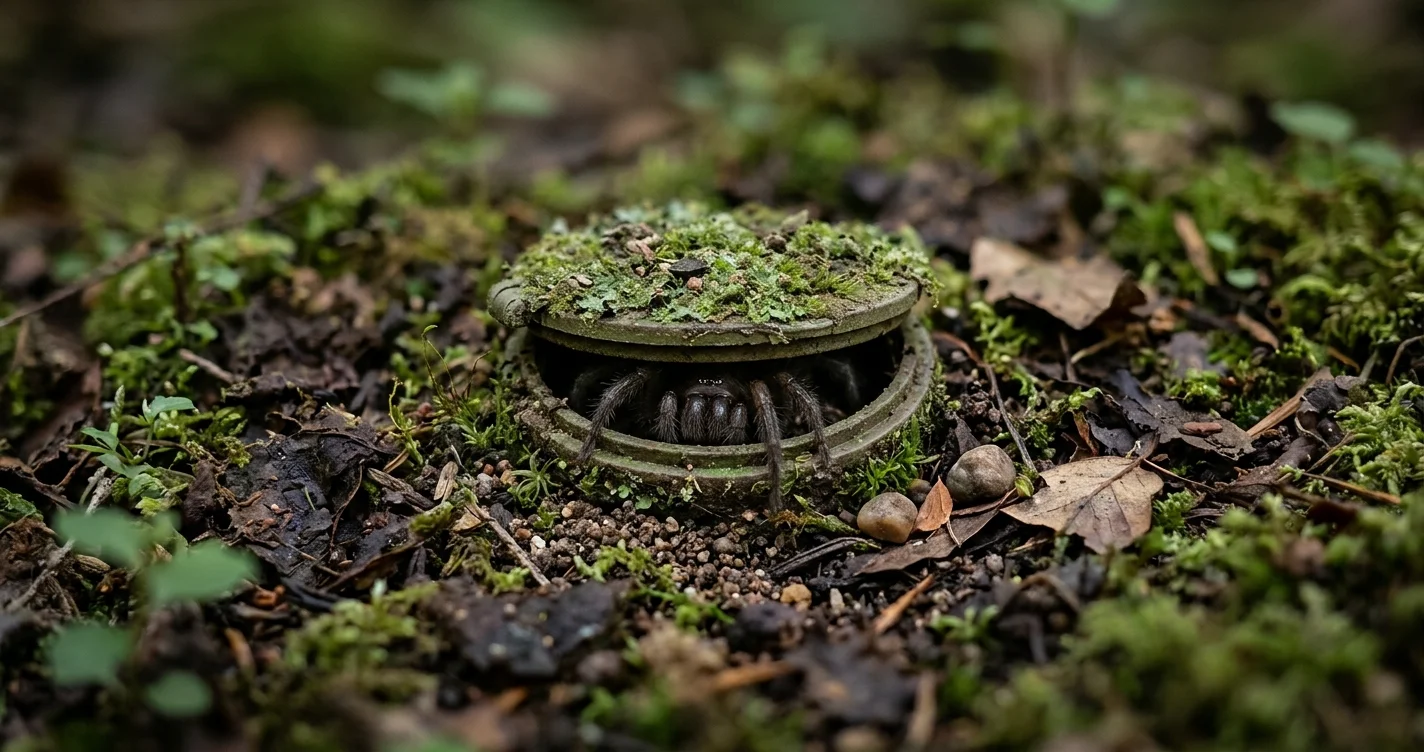
A patch of ordinary soil can conceal one of nature’s most remarkable hunting devices. Beneath a nearly invisible lid made from silk and earth, a spider waits in darkness. When an unsuspecting insect passes nearby, the hidden entrance opens, the spider lunges, and the prey disappears underground.
This is the extraordinary hunting strategy of a trapdoor spider, a secretive arachnid that relies on camouflage, patience, and carefully constructed burrows rather than the familiar aerial webs of garden spiders.
These spiders are fascinating examples of animal engineering. Some build hinged doors that blend into the surrounding ground, while others construct silk-lined retreats with less elaborate entrances.
Understanding how they live reveals a hidden world beneath forests, grasslands, and even some backyard gardens.
Table of Contents
- What Is a Trapdoor Spider?
- Where Trapdoor Spiders Live
- How a Trapdoor Spider Builds Its Hidden Burrow
- How Trapdoor Spiders Ambush Their Prey
- What Trapdoor Spiders Eat
- The Trapdoor Spider Life Cycle
- Are Trapdoor Spiders Dangerous?
- Trapdoor Spiders vs. Other Burrowing Spiders
- Why Trapdoor Spiders Matter to Ecosystems
- Threats and Conservation
- In Your Own Yard: Protecting Burrowing Spiders
- Frequently Asked Questions
What Is a Trapdoor Spider?
Trapdoor spiders are a diverse group of mostly ground-dwelling spiders known for constructing silk-lined burrows. Many species build concealed entrances that function like hinged doors.
They belong to the order Araneae, the scientific group containing all spiders.
Many familiar trapdoor spiders are mygalomorphs, a major spider lineage that also includes tarantulas and several other burrowing groups.
Unlike most spiders that construct elaborate aerial capture webs, trapdoor spiders often remain close to their underground retreats.
Physical Appearance
Trapdoor spiders generally have compact, sturdy bodies, powerful legs, and prominent jaws called chelicerae.
Their coloration often includes shades of brown, black, reddish brown, or dark gray.
These earthy colors help them blend into soil, leaf litter, and other ground-level surroundings.
Body size varies considerably among species. Some are relatively small, while others are noticeably larger and more robust.
Their strong front legs and mouthparts help them excavate burrows, manipulate soil, and capture prey.
Not Every Species Builds the Same Door
The name “trapdoor spider” describes a hunting lifestyle rather than one uniform type of burrow.
Some species construct thick, tightly fitting doors. Others make thinner, flexible lids, and some related burrowing spiders have open or less conspicuous entrances.
The exact construction depends on the spider’s species, habitat, and available materials.
This diversity makes trapdoor spiders especially interesting to scientists studying animal behavior and evolutionary adaptations.
Where Trapdoor Spiders Live
Trapdoor spiders occur in many parts of the world, particularly in regions with suitable soils and relatively stable microhabitats.
They can inhabit forests, scrublands, grasslands, and other environments where burrows provide shelter.
Trapdoor Spiders in the United States
Several trapdoor-building spider groups occur in the United States, especially in warmer regions.
California, the Southwest, and portions of the southeastern United States support various burrowing mygalomorph spiders.
Their distribution depends on species-specific requirements, including soil characteristics, moisture, temperature, and vegetation.
Not every state or backyard supports the same species.
Why Soil Conditions Matter
A suitable burrow must remain stable enough to protect the spider.
Soil texture, moisture, and the presence of roots or stones can influence construction.
Some spiders occupy relatively firm soils that support stable tunnels, while others use different substrates.
Heavy disturbance, erosion, or prolonged flooding may make particular sites unsuitable.
A Lifetime in One Small Territory
Many female trapdoor spiders spend much of their lives in or near a single burrow.
This relatively stationary lifestyle allows them to invest considerable effort in constructing and maintaining a secure retreat.
Adult males of some species become more mobile when searching for mates.
As a result, a spider seen wandering across a path may be behaving very differently from a female waiting inside her burrow.
How a Trapdoor Spider Builds Its Hidden Burrow
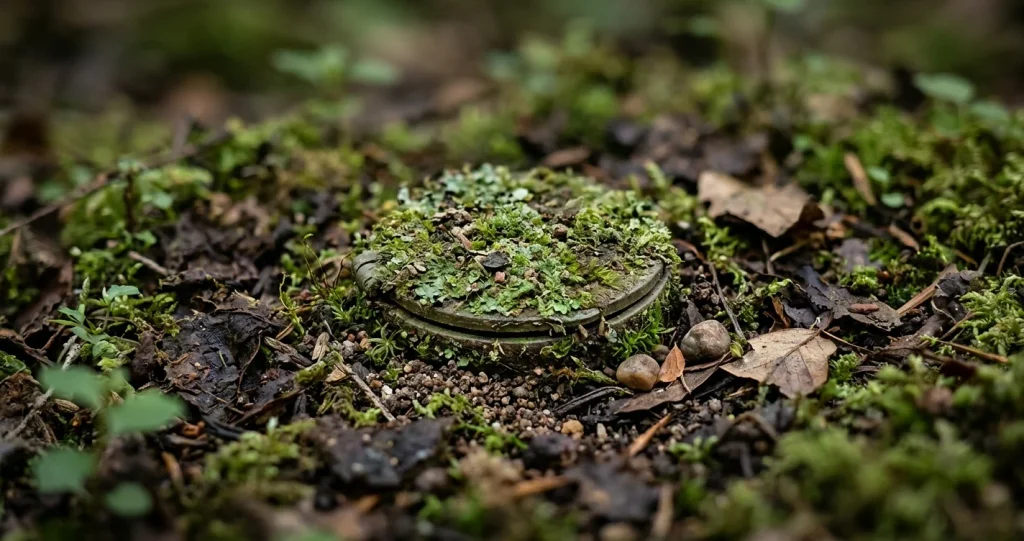
The most impressive feature of a trapdoor spider is often not the spider itself, but the structure it creates.
A well-camouflaged burrow can be difficult to distinguish from the surrounding ground.
Step 1: Excavating the Tunnel
The spider begins by digging into suitable soil.
It uses its mouthparts and legs to loosen and move small particles.
Depending on the species, the resulting tunnel may be relatively straight or have a more complex shape.
Burrow depth varies with spider size, soil conditions, and local environmental factors.
Step 2: Lining the Walls With Silk
Many trapdoor spiders reinforce their burrows with silk.
The lining helps stabilize the tunnel and provides a surface through which the spider can detect vibrations.
Silk may also help the animal move efficiently within its retreat.
This structure is different from the sticky aerial webs used by many other spiders.
Instead of trapping flying insects in an exposed web, the silk supports an underground hunting station.
Step 3: Constructing the Door
In species that build hinged doors, the spider combines silk with surrounding materials.
Soil particles, plant fragments, and other debris may be incorporated into the lid.
The outside surface often resembles the nearby ground.
A silk hinge allows the door to open while remaining attached to the burrow.
Some doors fit closely against the entrance, making the opening remarkably difficult to notice.
Step 4: Maintaining the Entrance
The spider may repair damaged silk, reinforce the tunnel, or adjust the entrance as conditions change.
In some species, growing individuals enlarge their burrows over time.
The finished structure provides both a shelter and a concealed position from which to hunt.
How Trapdoor Spiders Ambush Their Prey: The Science Explained
Trapdoor spiders use a combination of sensory information, camouflage, and rapid movement to capture passing animals.
Their hunting system is a remarkable example of how a predator can exploit a small, carefully selected location.
Detecting Vibrations Without Seeing Prey
Many trapdoor spiders rely heavily on vibrations transmitted through soil, silk, and nearby surfaces.
When an insect walks close to the entrance, its movements can create mechanical signals.
Sensitive structures on the spider’s body help it detect these disturbances.
Some species extend silk trip lines around their entrances, increasing the area from which they can receive information.
Others respond to vibrations near the burrow without using obvious external trip lines.
The spider must distinguish potential prey from irrelevant movement, such as wind-driven debris or other environmental disturbances.
Waiting Behind a Camouflaged Door
A trapdoor provides concealment and protection.
In some species, the spider holds the lid shut using specialized structures or its legs.
This behavior can help keep the entrance closed when threatened.
During hunting, the spider may remain immediately beneath the door, positioned to respond quickly to movement outside.
The exact posture and behavior differ among species.
The Sudden Ambush
When suitable prey approaches, the spider may open the entrance rapidly and seize the animal with its front legs and chelicerae.
Its fangs deliver venom that helps immobilize prey.
The spider then retreats into its burrow to feed.
The movement can happen quickly enough that an observer notices little more than a brief opening in the ground.
However, not every passing insect triggers an attack.
Prey size, distance, vibration patterns, and the spider’s condition may influence its response.
Why Ambush Hunting Can Be Effective
Remaining in a burrow reduces the need to search continuously for food.
It also allows the spider to hunt while retaining access to a protected retreat.
This strategy can be advantageous in environments where suitable prey regularly moves across the ground.
However, a stationary predator depends on prey passing within reach.
Hunting success therefore varies with local insect activity, weather, season, and habitat conditions.
The Role of Venom
Trapdoor spiders, like most spiders, use venom as part of prey capture.
Venom composition and potency vary among species.
It would be inaccurate to assume that all trapdoor spiders have identical venom or present the same risk to humans.
For most commonly encountered North American trapdoor spiders, serious human envenomation is not a typical concern, but identification and medical evaluation remain important after a concerning bite.
What Trapdoor Spiders Eat
Trapdoor spiders are predators that feed mainly on small animals moving near their burrows.
Their diets vary according to species, body size, and local prey availability.
Ground-Dwelling Insects
Beetles, crickets, cockroaches, and other insects may become prey when they approach the burrow.
The spider typically captures animals that can be subdued and transported into its retreat.
Other Small Arthropods
Some trapdoor spiders may also capture other spiders and small arthropods.
Larger species may occasionally take relatively substantial prey, although insects and other invertebrates are generally important food sources.
Feeding Underground
After capturing prey, the spider usually returns to the shelter of its burrow.
Like other spiders, it uses digestive fluids to break down food externally before consuming the liquefied material.
This feeding process is adapted to its anatomy and differs from the chewing behavior of many insects.
The Trapdoor Spider Life Cycle
Trapdoor spiders often have relatively slow life histories compared with many short-lived insects.
Their development includes several molts before adulthood.
Mating and Male Movement
In many species, mature males leave their burrows to search for females.
This wandering behavior may increase the likelihood of finding a mate but can also expose males to predators and other hazards.
Courtship involves species-specific signals that help the spiders recognize suitable partners.
Eggs and Spiderlings
Females generally produce eggs that develop within a protected silk egg sac.
In some species, the female keeps the egg sac inside her burrow.
After hatching, spiderlings may remain near the mother for a period before dispersing.
The timing and number of offspring vary among species.
Long-Lived Females
Some trapdoor spiders can live for many years.
A famous Australian trapdoor spider studied in the wild was documented living for approximately 43 years.
That remarkable case demonstrates the potential longevity of certain burrowing spiders, but it should not be treated as the typical lifespan of every trapdoor spider species.
Are Trapdoor Spiders Dangerous?
Trapdoor spiders can look intimidating because of their sturdy bodies and prominent fangs.
However, appearance alone does not indicate medical danger.
Do Trapdoor Spiders Bite Humans?
A trapdoor spider may bite if handled, trapped, or threatened.
Most prefer to remain concealed rather than interact with people.
Bites from many North American species are uncommon and generally are not associated with the severe medical effects caused by some other spiders.
Nevertheless, symptoms and risks depend on the species and individual circumstances.
Why Identification Matters
The term “trapdoor spider” includes diverse groups.
Some medically important mygalomorph spiders occur elsewhere in the world, and their risks should not be generalized to all trapdoor spiders.
If a bite causes severe pain, spreading symptoms, breathing difficulties, or other concerning reactions, seek medical care promptly.
Safe Observation
Avoid inserting fingers or tools into suspected burrows.
Do not attempt to force open a trapdoor.
Observing from a respectful distance protects both the spider and the observer.
Trapdoor Spiders vs. Other Burrowing Spiders
Not every spider found in a hole is a trapdoor spider.
Several unrelated or distantly related spiders use underground shelters.
Trapdoor Spiders vs. Wolf Spiders
Some wolf spiders dig burrows or occupy existing ground cavities.
Unlike many trapdoor spiders, wolf spiders generally do not construct the same type of hinged, camouflaged silk-and-soil door.
Wolf spiders also differ in eye arrangement, anatomy, and reproductive behavior.
Trapdoor Spiders vs. Tarantulas
Tarantulas and many trapdoor spiders belong to the mygalomorph lineage.
Both groups may have robust bodies and ground-dwelling habits.
However, tarantulas are generally recognized by their distinctive body form and often hairy appearance.
Their burrows and hunting strategies vary by species.
Why the Differences Matter
Identifying a spider requires more than observing its habitat.
Body structure, eye arrangement, geographic location, and burrow construction can all provide clues.
For accurate identification, photographs and regional arachnological resources are often more useful than relying on common names alone.
Why Trapdoor Spiders Matter to Ecosystems
Trapdoor spiders are part of the complex communities living within and above soil.
Their ecological roles extend beyond capturing insects.
Predators in the Soil Food Web
By consuming insects and other arthropods, trapdoor spiders participate in local predator-prey relationships.
Their influence varies with population density, prey availability, and environmental conditions.
They contribute to biodiversity rather than acting as a universal solution to garden pests.
Small-Scale Soil Engineering
Excavating burrows changes the physical structure of small areas of soil.
These activities may influence local soil movement and create tiny spaces used by other organisms.
However, the ecological significance of burrowing differs among species and habitats.
Indicators of Habitat Continuity
Some trapdoor spiders have limited dispersal abilities and strong associations with particular microhabitats.
Their presence can reflect suitable soil conditions and relatively undisturbed habitat.
However, a single observation cannot establish overall ecosystem health.
Scientists consider multiple species and environmental measurements when evaluating habitat condition.
Threats and Conservation
Many trapdoor spiders depend on stable ground conditions.
Their relatively stationary habits can make some species vulnerable to habitat disturbance.
Habitat Loss
Urban development, intensive land clearing, and major changes in vegetation can remove suitable burrow sites.
Species with small geographic ranges may be especially vulnerable.
Soil Disturbance
Repeated digging, heavy machinery, and changes in drainage can destroy burrows.
For long-lived females, losing an established retreat may represent a substantial ecological cost.
Climate and Moisture Changes
Temperature and soil moisture influence spider activity and habitat suitability.
Changes in rainfall patterns, drought frequency, or extreme weather may affect some populations.
The consequences vary by species and region, making local research important.
In Your Own Yard: Protecting Burrowing Spiders
A healthy garden supports many organisms that live beneath the soil surface.
Even if trapdoor spiders are absent from your region, thoughtful habitat management can benefit native ground-dwelling wildlife.
Preserve Small Undisturbed Areas
Where practical, maintain patches of soil that are not repeatedly cultivated.
Native vegetation, leaf litter, and natural ground cover can create varied microhabitats.
Avoid unnecessary disturbance around suspected spider burrows.
Use Pesticides Carefully
Broad-spectrum insecticides can affect non-target arthropods.
Reducing unnecessary applications helps conserve beneficial predators and other garden organisms.
Integrated pest management emphasizes monitoring, prevention, and targeted responses when needed.
Observe Without Excavating
If you discover a small, silk-lined opening in the ground, photograph it from a distance.
Avoid lifting a suspected trapdoor or digging into the tunnel.
A local natural history organization or arachnologist may be able to help identify the structure.
Encourage Native Habitat
Native plants support diverse insect communities and provide shelter for many ground-dwelling animals.
Maintain appropriate soil moisture and minimize unnecessary disturbance.
These practices can contribute to a more complex and resilient backyard ecosystem.
Frequently Asked Questions
1. How does a trapdoor spider know when prey is nearby?
Many trapdoor spiders detect vibrations traveling through soil, silk, or nearby surfaces. These signals help them recognize movement close to the burrow entrance and respond when suitable prey approaches.
2. Do all trapdoor spiders build doors?
No. The common name covers several groups with different burrow designs. Many construct hinged silk-and-soil lids, while some related spiders have simpler or open entrances.
3. Can trapdoor spiders live in American gardens?
Yes, some species occur in suitable habitats in parts of the United States. Their presence depends on regional distribution, soil conditions, vegetation, and disturbance levels. They are not equally common in every state.
Conclusion
A trapdoor spider transforms a small patch of soil into a carefully engineered hunting station.
Its hidden entrance, silk-lined tunnel, vibration-sensitive behavior, and rapid ambush technique demonstrate how specialized predators can thrive without roaming far from home.
These spiders also remind us that much of nature’s activity occurs beyond ordinary sight.
Protecting undisturbed soil, native vegetation, and the smaller creatures that share our landscapes helps preserve this hidden biodiversity.
The next time you walk through a quiet woodland or garden, remember that an apparently ordinary patch of earth may conceal an extraordinary hunter, waiting patiently behind a door almost impossible to see.
External Sources
1. Trapdoor Spiders: Explain scientific classification, habitat, burrow construction, reproduction, hunting behavior, and lifespan.
Australian Museum — Natural History Research and Education. https://australian.museum/learn/animals/spiders/trapdoor-spiders-group
2. Prey Capture and Feeding: Explain how trapdoor spiders use camouflaged entrances, silk, and vibration-sensitive hunting strategies to capture prey.
Australian Museum. https://australian.museum/learn/animals/spiders/prey-capture-and-feeding