
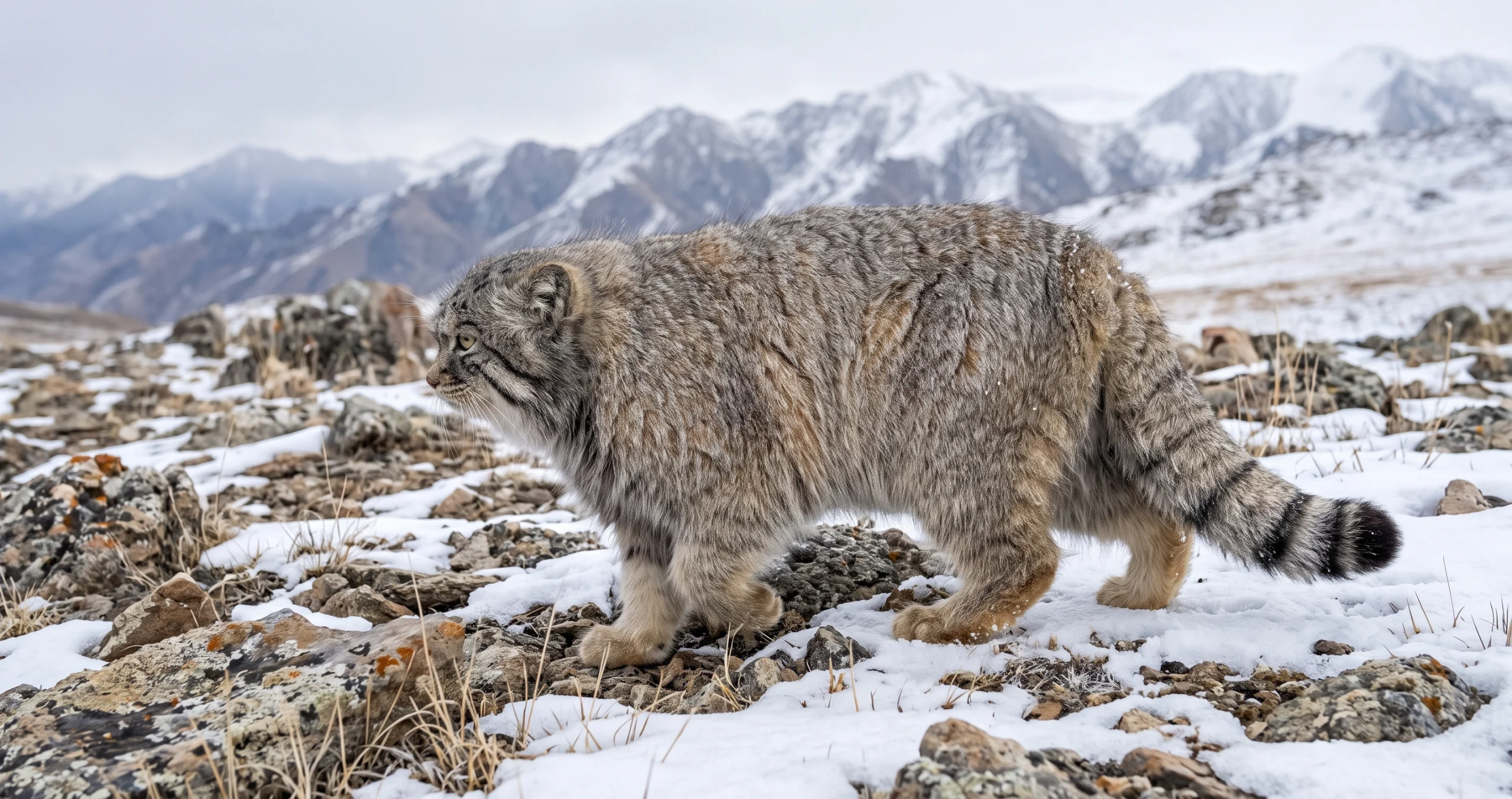
Among the wind-scoured rocks of Central Asia, a Pallas’s cat can appear almost motionless against the winter landscape. Snow collects between boulders, temperatures fall far below freezing, and vegetation offers little protection from the wind. Yet the small wild cat remains remarkably well equipped for this severe environment.
The secret behind Pallas’s cat cold adaptations is not one extraordinary feature but a combination of anatomy and behavior. Exceptionally dense fur provides insulation, sheltered dens reduce exposure to severe weather, and compact resting postures can limit the amount of body surface directly exposed to cold air. Even the animal’s famously thick tail can provide additional furry coverage when positioned against the body.
Table of Contents
- Meet the Pallas’s Cat
- Life in a Cold Central Asian Landscape
- An Exceptionally Dense Coat
- Why Pallas’s Cats Look So Round
- The Remarkably Thick Tail
- Wrapping the Tail Around the Body
- Curling Up to Conserve Heat
- Shelter From Wind and Extreme Weather
- Seasonal Changes in the Coat
- More Than a Cold-Weather Coat
- Hunting in a Harsh Environment
- Conservation of the Pallas’s Cat
- Frequently Asked Questions
- Conclusion
Meet the Pallas’s Cat
The Pallas’s cat (Otocolobus manul), also known as the manul, is a small wild felid native to Central Asia. Despite its bulky appearance, it is roughly comparable in size to a domestic cat, generally measuring about 20–24 inches in body length, with an additional tail approximately 8–10 inches long.
Its range extends across a vast but fragmented region from Iran through Central Asia to Mongolia, China, and parts of southern Russia, with populations also occurring in high mountain regions farther south. Mongolia and China contain important portions of its range.
Pallas’s cats typically occupy rocky steppe, montane grassland, shrubland, and cold semi-arid environments. They are strongly associated with terrain that provides hiding places such as rocks, ravines, slopes, and burrows.
Their unusual appearance reflects this lifestyle. They have short legs, low-set rounded ears, a flattened-looking face, a long dense coat, and a heavily furred tail marked with dark rings.
Life in a Cold Central Asian Landscape
Pallas’s cats inhabit some of Asia’s most demanding terrestrial environments. Their range includes landscapes characterized by low precipitation, low humidity, strong winds, and large differences between seasonal temperatures.
These are not uniformly deep-snow habitats. In fact, deep continuous snow can restrict Pallas’s cat movement and habitat use. The species is more characteristic of cold, relatively dry steppe and rocky mountain environments where suitable cover remains accessible.
Winter temperatures can nevertheless become extreme. In parts of the Central Asian steppe and mountain system, temperatures can fall far below freezing, while summers may become surprisingly warm.
The result is an environment in which an animal must cope not only with cold but also with wind exposure, limited vegetation, patchily distributed prey, and relatively few places to hide.
Image 1 placement — 1200 × 630 px, photorealistic, no text or graphic overlays
Alt text: Pallas’s cat cold adaptations in a snowy Central Asian habitat
An Exceptionally Dense Coat
The most visually obvious of the manul adaptations is its extraordinary fur.
Pallas’s cats possess exceptionally long and dense coats. Smithsonian’s National Zoo describes them as having the densest fur of any cat, an important feature for an animal occupying cold continental environments.
Dense fur works by trapping layers of relatively still air close to the body. Because trapped air conducts heat poorly, this insulating layer slows the transfer of body heat into the colder surroundings.
The coat covers the cat so thoroughly that it dramatically changes the animal’s visible outline. Long hairs extend over the sides and underside, giving the manul its characteristic low, broad appearance.
Insulation does not generate heat by itself. Instead, it helps conserve the metabolic heat already produced by the animal’s body.
Why Pallas’s Cats Look So Round
Photographs often make a Pallas’s cat appear much larger and heavier than a similarly sized domestic cat.
Much of that impression comes from fur.
Underneath its winter coat is a relatively small wild cat. The extraordinary depth of the pelage expands the apparent outline of the torso, neck, cheeks, and underside.
This visual distinction matters because descriptions sometimes imply that Pallas’s cats survive winter simply because they have exceptionally massive bodies. Their stocky build contributes to their appearance, but their remarkable coat accounts for much of their famous round silhouette.
The effect becomes particularly noticeable in winter, when the pelage is at its fullest.
The Remarkably Thick Tail
The Pallas’s cat tail is another conspicuous part of its cold-weather appearance.
It is relatively long, extremely furry, and usually patterned with several dark rings toward the tip. The dense covering means that relatively little exposed skin is present along this appendage.
A thickly furred tail fits into the animal’s overall heavily insulated exterior. However, it is important to separate observation from evolutionary storytelling.
Popular descriptions sometimes call the tail a specially evolved “blanket.” That goes beyond what current evidence can firmly demonstrate.
A more defensible interpretation is that the tail is heavily insulated and, when positioned against the paws or body during rest, can add another layer of furry coverage.
Wrapping the Tail Around the Body
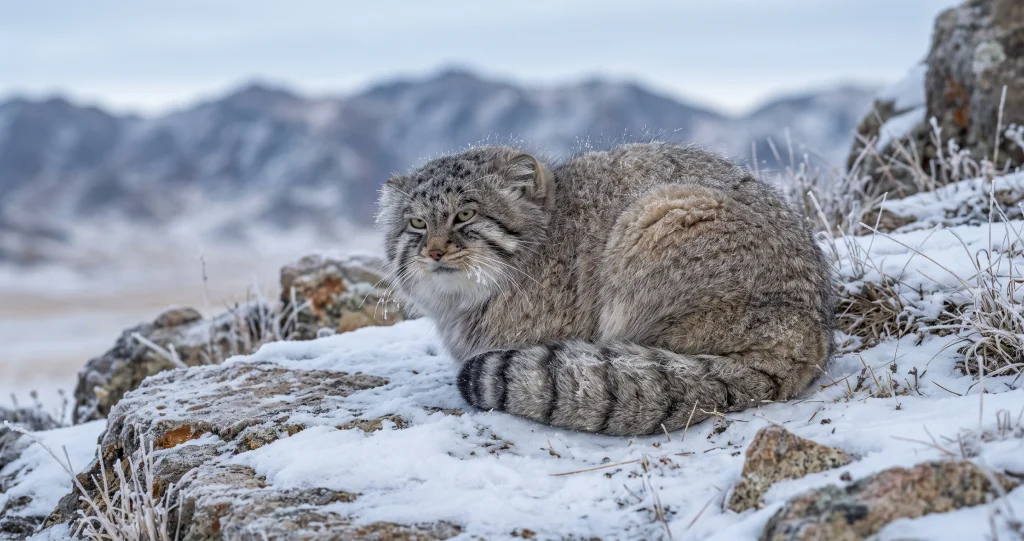
Resting Pallas’s cats can position their thick tails around or against their bodies and paws.
This behavior is particularly striking in winter photographs. The tail may lie across the front feet or curve around the animal as it settles into a compact posture.
Placing an insulated appendage against another part of the body can reduce direct exposure of that surface to cold air. Smithsonian observers also report Pallas’s cats sitting on their bushy tails during cold conditions.
That does not prove that the tail evolved specifically to function as a winter covering. Evolutionary traits often serve multiple functions, and tails in cats are involved in movement, posture, signaling, and other aspects of behavior.
The safest conclusion is therefore simple: a Pallas’s cat’s densely furred tail can provide additional coverage when positioned against its body.
Image 2 placement — 1200 × 630 px, photorealistic, no text or graphic overlays
Alt text: Pallas’s cat curled up with its thick furry tail in winter
Curling Up to Conserve Heat
Body posture can complement insulation.
When an animal stretches out, more of its body surface is directly exposed to the surrounding air. Curling into a compact resting position brings the limbs closer to the torso and can reduce exposed surface area.
For a Pallas’s cat, this posture also allows its exceptionally dense coat to form a more continuous insulating exterior around much of the body.
The paws can be tucked underneath or close to the torso, while the furry tail can rest alongside or over exposed areas.
This should be understood as a general thermoregulatory advantage of compact resting rather than evidence of a uniquely specialized manul behavior.
Shelter From Wind and Extreme Weather
Fur alone does not solve every thermal challenge.
Pallas’s cats make extensive use of protected refuges, including rock cavities, crevices, caves, and burrows created by other animals. Marmot burrows can be particularly important in some parts of their range.
Research has shown that refuges are critical resources for Pallas’s cats. They provide protection from predators, places for females to raise kittens, and shelter from environmental extremes.
Winter behavior appears especially relevant. Research associated with the Pallas’s Cat International Conservation Alliance has reported greater winter use of marmot burrows and noted that winter dens can have smaller entrances than summer refuges, potentially reducing air circulation and improving heat retention.
Seeking shelter also reduces exposure to wind.
Wind can increase convective heat loss by continually replacing relatively warmer air close to an animal with colder moving air. Retreating into a deep rock cavity or burrow can therefore dramatically change the microclimate experienced by the cat.
Seasonal Changes in the Coat
A Pallas’s cat does not look exactly the same throughout the year.
Its winter pelage becomes particularly long, thick, and pale. The result is the familiar extremely fluffy gray or silver-gray animal commonly shown in snowy photographs.
During warmer months, the coat is less massive and can appear darker or warmer in tone. Seasonal shedding reduces the amount of insulation the animal carries when temperatures rise.
Color variation also contributes to camouflage.
Grayish winter pelage can blend remarkably well with pale rocks, dry vegetation, frost, and snow-dusted terrain, while seasonal changes help maintain concealment as the landscape changes.
More Than a Cold-Weather Coat
The coat is only part of the Pallas’s cat survival strategy.
Its ears are small, rounded, and positioned low on the sides of the head. Combined with the animal’s flattened posture and short legs, this gives the cat an unusually low profile.
That profile is valuable in open terrain.
Pallas’s cats frequently depend on concealment rather than prolonged high-speed pursuit. Their mottled gray, buff, and brown coloration can make a stationary individual extremely difficult to distinguish from rocks and dry vegetation.
Remaining low also helps the cat move behind limited cover.
These traits therefore should not be interpreted exclusively as Pallas’s cat winter survival adaptations. Many simultaneously contribute to hunting and predator avoidance.
Readers interested in how other wild felids combine anatomy, habitat, and hunting behavior can also explore Secrets of the Green Garden’s guide to the wild cats of the Americas.
Hunting in a Harsh Environment
Staying warm is only useful if an animal can obtain enough energy to survive.
Pallas’s cats are carnivores specializing heavily on small mammals. Pikas are particularly important prey across significant parts of their range, along with voles, gerbils, hamsters, and other rodents. Birds, reptiles, and insects may also be eaten.
Rather than pursuing prey across long distances, Pallas’s cats commonly use ambush tactics.
A cat may stalk through low vegetation and rocks, wait near a burrow entrance, or use terrain to approach prey while remaining concealed. Its low body, camouflage, and short legs suit this close-to-the-ground hunting style.
Pikas are especially valuable because they can provide a comparatively substantial meal relative to smaller rodents.
Prey availability therefore connects directly to winter survival. Maintaining body temperature in cold environments requires energy, making access to productive hunting habitat an essential part of the Pallas’s cat’s ecology.
Conservation of the Pallas’s Cat
The Pallas’s cat is currently classified as Least Concern on the IUCN Red List. The current global assessment was published in 2020 after improved information about the species’ distribution and habitat suggested that its global situation was more stable than earlier estimates indicated.
Least Concern does not mean free from conservation problems.
Populations occur at generally low densities and are widely fragmented. Threats vary geographically and include habitat degradation and fragmentation, predation by domestic dogs, illegal killing or accidental capture, and reductions in important prey populations.
Rodent and pika poisoning programs can create an additional problem. Reducing these mammals removes prey, while poisoned animals may also expose predators to toxic substances.
Loss of burrowing mammals can have another indirect effect. Because Pallas’s cats frequently depend on abandoned burrows as refuges, declining populations of animals such as marmots can reduce the availability of shelter.
The IUCN Red List assessment for the Pallas’s cat estimates roughly 58,000 mature individuals while emphasizing substantial uncertainty. More recent scientific reviews continue to describe the species as widely distributed but fragmented, with conservation conditions varying considerably among regions.
Protecting the manul therefore involves more than protecting the cat itself. Healthy steppe habitat, abundant prey, suitable rocky refuges, burrowing mammals, and reduced human-caused mortality all contribute to its long-term persistence.
Frequently Asked Questions
How thick is a Pallas’s cat’s fur?
The Pallas’s cat has an exceptionally long and dense coat, described by Smithsonian’s National Zoo as the densest fur among cats. The thick pelage traps insulating air and reduces heat loss in cold conditions.
Does a Pallas’s cat use its tail as a blanket?
A resting Pallas’s cat can position its heavily furred tail around its paws or against its body, providing additional coverage. However, describing the tail as having specifically evolved to be a “blanket” goes beyond the available evidence.
Where do Pallas’s cats live?
They inhabit a broad but fragmented range across Central Asia, including Mongolia, China, Russia, Kazakhstan, Kyrgyzstan, Iran, and several other countries. Typical habitats include rocky steppe, montane grassland, shrubland, and cold semi-arid terrain.
Can Pallas’s cats survive deep snow?
They tolerate severe cold, but deep snow can actually create difficulties. The species tends to avoid areas with prolonged, deep snow cover because its relatively short legs make movement through deep snow inefficient.
Where do Pallas’s cats sleep during winter?
They use protected sites including rock crevices, caves, cavities, and burrows. Abandoned marmot and other mammal burrows can provide particularly valuable refuges from predators and severe weather.
What do Pallas’s cats eat?
Pikas are among their most important prey, although they also consume voles, gerbils, hamsters, other small mammals, birds, reptiles, and insects depending on local availability.
Are Pallas’s cats endangered?
Globally, the IUCN currently classifies the Pallas’s cat as Least Concern. However, populations are fragmented and several regional populations face significant pressures from habitat change, prey loss, poisoning, domestic dogs, and human-caused mortality.
Conclusion
The Pallas’s cat survives Central Asia’s harsh climate through a combination of physical insulation, behavior, and careful use of its environment.
Its exceptionally dense fur slows heat loss, while its thickly furred tail can provide additional coverage when positioned against the paws or body. Compact resting postures reduce exposure, and rock cavities and abandoned burrows provide valuable shelter from wind, predators, and severe weather.
These Pallas’s cat cold adaptations work together rather than independently. The same low profile and dense coat that help the cat cope with its environment also contribute to concealment, while rocky refuges serve simultaneously as thermal shelters, predator protection, and breeding sites.
The manul’s famously round winter appearance is therefore more than an unusual visual characteristic. Beneath that dense coat is a small predator whose survival depends on the interaction of fur, posture, shelter, prey, camouflage, and behavior across one of the world’s most demanding landscapes.