
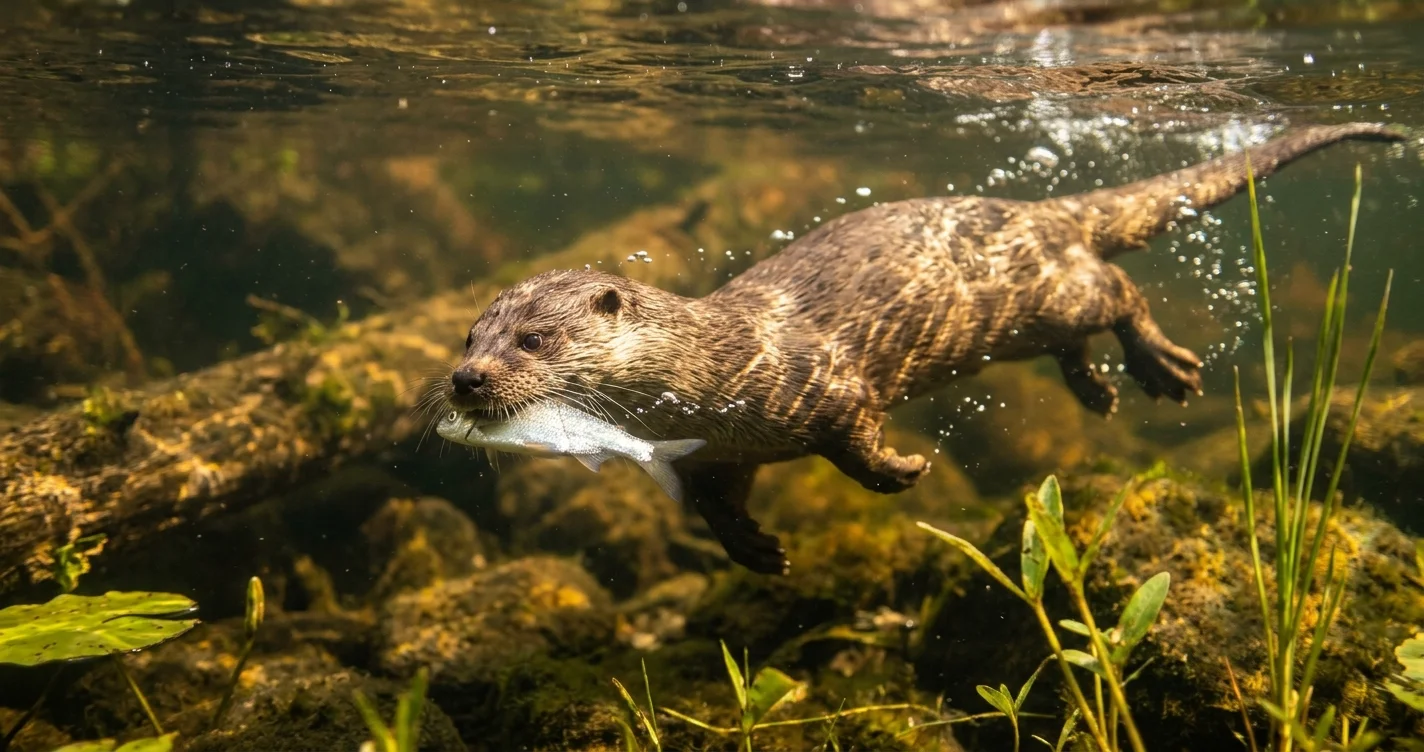
Imagine a small, furry creature swimming through a freshwater lake 165 million years ago, long before the first humans appeared. Its broad tail helped it navigate the water, while its unusual anatomy held clues to one of the most important developments in mammalian evolution.
This ancient swimmer was Megacauda sungei, a newly discovered Jurassic mammaliaform from what is now Inner Mongolia, China. Described in Nature in October 2026, the fossil reveals remarkable adaptations for life in and around water, including specialized hind limbs, distinctive teeth, and exceptionally informative throat bones.
What makes the megacauda mammaliaform particularly fascinating is the evidence preserved in its hyoid and pharyngeal anatomy. These structures suggest that sophisticated mechanisms associated with mammalian swallowing, suckling, and airway coordination were already evolving during the Jurassic.
The discovery offers a rare glimpse into the early history of mammalian biology, revealing how an ancient aquatic animal may have possessed anatomical capabilities once associated primarily with later mammals.
Table of Contents
- What Is Megacauda sungei?
- Where and When Did Megacauda Live?
- Megacauda Mammaliaform: How Its Anatomy Reveals a Jurassic Swimmer
- The Most Remarkable Discovery: Megacauda’s Throat Anatomy
- How Megacauda May Have Swallowed and Breathed: The Science Explained
- What Did Megacauda Eat?
- Megacauda and Castorocauda: Two Jurassic Aquatic Mammaliaforms
- How Scientists Study a 165-Million-Year-Old Fossil
- Why Megacauda Changes Our Understanding of Mammal Evolution
- In Your Own Yard: Discovering Evolution Through Living Wildlife
- Frequently Asked Questions
What Is Megacauda sungei?
Megacauda sungei is an extinct mammaliaform described from Middle Jurassic deposits in Inner Mongolia, China.
The fossil is approximately 165 million years old, placing the animal in a world where dinosaurs dominated many terrestrial ecosystems and early mammal relatives were diversifying into different ecological roles.
The discovery was formally reported in a scientific paper titled A Jurassic mammaliaform swimmer and transformation of the mammalian pharynx, published in Nature.
A Newly Identified Jurassic Species
The fossil preserves anatomical characteristics that allow researchers to recognize Megacauda sungei as a distinct species.
Its scientific description provides evidence for a semiaquatic lifestyle and important features of the feeding and throat apparatus.
Rather than representing a hypothetical evolutionary stage, Megacauda is now part of the documented fossil record.
How Large Was Megacauda?
Researchers estimate that Megacauda weighed approximately 1–2 kilograms, or about 2.2–4.4 pounds.
That makes it substantially larger than many people imagine when thinking about early mammal relatives.
Its estimated body mass suggests an animal capable of exploiting ecological opportunities beyond those available to very small insect-eating species.
However, body size alone cannot establish its diet, swimming ability, or behavior.
Was Megacauda a True Mammal?
Megacauda is described as a mammaliaform, a member of the broader evolutionary lineage that includes mammals and their closest extinct relatives.
The term does not automatically mean that the species belonged within the crown group containing all living mammals.
This distinction helps scientists trace when different mammalian features evolved.
Where and When Did Megacauda Live?
Megacauda sungei lived during the Middle Jurassic, approximately 165 million years ago.
Its remains were discovered in what is now Inner Mongolia, northern China.
The region’s Jurassic fossil deposits provide evidence of ancient ecosystems containing diverse vertebrates and invertebrates.
A Different World From Modern China
During the Jurassic, Earth’s continents, climates, and ecosystems differed considerably from those of today.
Freshwater habitats supported fish, amphibians, aquatic invertebrates, and other organisms.
Small vertebrates could exploit opportunities along shorelines and within aquatic environments.
Megacauda appears to have been one of the mammaliaforms adapted to this ecological setting.

Why the Fossil’s Location Matters
The geological context of a fossil helps researchers interpret its age and environment.
Sedimentary layers preserve information about ancient landscapes and the conditions under which organisms were buried.
By combining geological evidence with skeletal anatomy, paleontologists can develop stronger reconstructions of extinct lifestyles.
The presence of aquatic adaptations in Megacauda supports the interpretation that it spent substantial time in or around water.
Megacauda Mammaliaform: How Its Anatomy Reveals a Jurassic Swimmer
The most immediately recognizable adaptations of Megacauda involve its tail and hind limbs.
These structures provide important evidence about how the animal moved.
A Broad Tail Adapted for Water
The fossil shows a broad tail that researchers interpret as relevant to aquatic locomotion.
A broad tail can increase the surface area available for generating forces against water.
However, the exact swimming motion cannot be observed directly.
Researchers must infer its function from the preserved skeletal structures and comparisons with living animals.
Specialized Hind Limbs
Megacauda also possessed hind-limb features associated with its inferred semiaquatic lifestyle.
Limb proportions and joint structures can help scientists estimate how an extinct animal moved.
In aquatic environments, limbs may contribute to propulsion, steering, or stability.
The relative importance of these functions in Megacauda remains a subject for anatomical interpretation.
An Animal Adapted to Two Environments
The term semiaquatic describes animals that use both aquatic and terrestrial environments.
Modern examples include otters, beavers, and some water-dwelling rodents.
These comparisons help illustrate the ecological possibilities available to an ancient swimmer.
However, Megacauda was not a prehistoric otter or beaver, and similar adaptations do not establish identical behavior.
The Most Remarkable Discovery: Megacauda’s Throat Anatomy
The discovery’s greatest scientific significance may lie in anatomical structures that are much less visually dramatic than its broad tail.
Researchers identified informative fossilized elements associated with the hyoid apparatus and pharyngeal region.
These structures offer rare evidence relevant to the evolution of mammalian feeding and airway coordination.
What Is the Hyoid Apparatus?
In living mammals, the hyoid apparatus helps support structures associated with the tongue and throat.
It participates in a complex anatomical system involved in swallowing and other functions.
Unlike the jaw or teeth, some components of this region are delicate and are not commonly preserved in fossils.
A specimen preserving useful throat-related anatomy can therefore provide unusually valuable evolutionary information.
Why the Pharynx Matters
The pharynx is a passage involved in moving food toward the esophagus while also forming part of the respiratory pathway.
In living mammals, swallowing requires coordinated movements that help direct food away from the airway.
This coordination allows feeding and breathing functions to share anatomical space while reducing the risk of material entering the lungs.
The system depends on several structures working together.
What Megacauda’s Fossil Reveals
The preserved hyoid bones and associated anatomical evidence support an interpretation of mammal-like pharyngeal function.
Researchers infer that aspects of the feeding apparatus may have supported sophisticated swallowing and suckling-related capabilities.
This is significant because it provides evidence about the evolutionary development of structures central to mammalian biology.
However, the fossil does not preserve the animal’s complete tongue, throat muscles, or the movements of its soft tissues.
Its exact swallowing sequence therefore cannot be reconstructed with certainty.
How Megacauda May Have Swallowed and Breathed: The Science Explained
One of the central evolutionary questions raised by Megacauda concerns how mammaliaforms developed increasingly specialized feeding and respiratory anatomy.
The discovery offers anatomical evidence relevant to that question, but it is important to distinguish possible function from directly observed behavior.
Step 1: Capturing Food
An aquatic or semiaquatic animal must first locate and capture food.
The jaws and teeth of Megacauda provide clues about its feeding capabilities.
Its distinctive dental anatomy is part of the evidence scientists use to understand its ecological specialization.
However, the fossil does not provide a complete record of every food item the animal consumed.
Step 2: Moving Food Toward the Throat
In living mammals, the tongue and associated muscles help transport food through the mouth.
The hyoid apparatus contributes to the mechanical support and movement of structures involved in this process.
The anatomical evidence from Megacauda suggests that some components of a mammal-like feeding system had already developed in this Jurassic lineage.
Scientists cannot directly observe how quickly or precisely the animal moved food.
Step 3: Coordinating Swallowing
Swallowing requires the movement of food from the oral cavity through the pharynx and toward the esophagus.
In living mammals, this involves coordinated muscular actions.
The preserved throat-related structures of Megacauda offer evidence that its feeding apparatus may have possessed important functional similarities to mammalian systems.
This interpretation is based on comparative anatomy rather than preserved movement.
Step 4: Protecting the Respiratory Passage
Food and air pass through closely associated regions of the throat.
In living mammals, airway protection involves coordinated movements of the larynx and surrounding tissues.
The anatomical transformations identified in Megacauda are relevant to understanding how this coordination evolved.
However, the fossil does not demonstrate that the animal possessed every respiratory specialization found in modern mammals.
Step 5: Breathing at the Water’s Surface
Megacauda was a mammaliaform with an inferred semiaquatic lifestyle, not an animal known to extract oxygen from water.
There is no evidence that it possessed gills or could breathe underwater.
Like other air-breathing mammaliaforms, it would have needed atmospheric oxygen.
The discovery concerns the evolutionary relationship between swallowing and breathing anatomy, not the ability to breathe while submerged.
Step 6: Understanding Possible Suckling Abilities
Suckling is closely associated with mammalian development and feeding.
In living mammals, it involves coordinated oral and pharyngeal movements.
The anatomical evidence from Megacauda supports discussion of suckling-related capabilities within the evolution of mammaliaforms.
Nevertheless, researchers have not directly observed suckling behavior in this extinct species.
The distinction between anatomical capacity and demonstrated behavior remains important.
Why This Discovery Matters
The fossil provides evidence that important elements of mammalian throat anatomy existed in a Jurassic mammaliaform.
It contributes to a broader understanding of how feeding and respiratory systems changed during mammalian evolution.
Rather than proving that Megacauda behaved exactly like a living mammal, the discovery reveals that some complex anatomical foundations were already present deep in evolutionary history.
What Did Megacauda Eat?
The diet of Megacauda must be reconstructed from anatomical and environmental evidence.
Its teeth are particularly important because dental structures can reflect feeding specialization.
Distinctive Teeth
The scientific description identifies distinctive dental characteristics.
Tooth shape and arrangement can provide information about how an animal captured or processed food.
However, dental anatomy alone does not always identify specific prey.
Possible Aquatic Food Sources
Jurassic freshwater ecosystems contained fish, aquatic invertebrates, and other potential food resources.
A semiaquatic mammaliaform might have exploited organisms associated with these habitats.
The exact diet of Megacauda should be described cautiously unless supported by direct evidence from the original study.
Why Feeding Anatomy Is Important
The combination of specialized teeth and informative throat structures makes Megacauda particularly valuable for studying feeding evolution.
It allows researchers to investigate more than the mechanical action of the jaws.
The fossil also contributes evidence about anatomical structures associated with transporting and swallowing food.
Megacauda and Castorocauda: Two Jurassic Aquatic Mammaliaforms
Megacauda was not the only Jurassic mammaliaform associated with aquatic environments.
Another important discovery, Castorocauda lutrasimilis, demonstrates that semiaquatic specialization appeared in other extinct mammaliaform lineages.
Castorocauda’s Aquatic Adaptations
Castorocauda was described from Middle Jurassic deposits in China.
Its fossil preserves evidence of fur and anatomical features interpreted as adaptations for semiaquatic life.
These include a broad, flattened tail.
The discovery helped demonstrate that mammaliaforms had already diversified into specialized ecological roles during the Jurassic.
What Makes Megacauda Different?
The distinctive contribution of Megacauda lies not only in its swimming-related anatomy but also in its informative hyoid and pharyngeal structures.
These features make it particularly relevant to questions about swallowing, suckling, and respiratory coordination.
The two fossils illustrate different aspects of early mammaliaform evolution.
Evidence of Early Ecological Diversity
Together, these discoveries challenge the assumption that Jurassic mammaliaforms were all small, unspecialized terrestrial animals.
They show that aquatic adaptations and varied feeding strategies had emerged long before the appearance of modern aquatic mammals.
How Scientists Study a 165-Million-Year-Old Fossil
Paleontologists use multiple methods to investigate extinct animals.
Each method contributes a different kind of evidence.
Detailed Anatomical Examination
Researchers study the shape, position, and relationships of preserved bones.
These observations help establish the animal’s identity and possible functions.
Comparisons With Living Animals
Comparative anatomy allows scientists to examine how similar structures function in living vertebrates.
This can suggest possible mechanical capabilities.
However, evolutionary relationships and anatomical differences must be considered carefully.
Evolutionary Analysis
Researchers compare anatomical characters across fossil and living species to investigate evolutionary relationships.
Such analyses help determine where a newly described species fits within the mammaliaform evolutionary tree.
Reconstructing Soft-Tissue Functions
The greatest uncertainty often involves structures that rarely fossilize.
Muscles, cartilage, and other soft tissues may leave indirect evidence through their skeletal attachments.
Scientists can propose functional interpretations, but those interpretations remain subject to revision as new fossils are discovered.
Why Megacauda Changes Our Understanding of Mammal Evolution
The importance of Megacauda sungei extends beyond the discovery of an unusual Jurassic swimmer.
Its anatomy contributes to understanding how characteristics associated with modern mammals developed.
Mammalian Features Evolved Gradually
Modern mammals possess specialized teeth, jaws, ears, respiratory systems, and feeding mechanisms.
These characteristics did not necessarily evolve simultaneously.
Fossils such as Megacauda help reveal different stages in that evolutionary history.
The Evolution of Swallowing and Suckling
Swallowing and suckling require coordinated anatomical structures.
The hyoid and pharyngeal evidence from Megacauda provides clues about the antiquity of some components of these systems.
This contributes to research on the evolutionary origins of mammalian feeding biology.
Evolution Is Not a Straight Line
Megacauda should not automatically be described as a direct ancestor of modern mammals.
Evolution produces branching lineages, many of which eventually become extinct.
An extinct species can preserve important evolutionary information without occupying a direct ancestral position.
In Your Own Yard: Discovering Evolution Through Living Wildlife
You cannot observe Megacauda in a modern garden, but living wildlife offers opportunities to explore similar biological principles.
Watch How Animals Use Their Tails
Squirrels use their tails during climbing and balancing.
Other animals use tails for swimming, communication, or maneuvering.
Observing these differences helps illustrate how similar body structures can perform different functions.
Observe Wildlife Near Water
At a local pond, watch native waterbirds, turtles, or mammals from a respectful distance.
Notice how their limbs and bodies move through water.
These observations can help explain the physical challenges faced by aquatic vertebrates.
Explore Feeding Adaptations
Birds use specialized beaks, while mammals possess varied teeth and jaw structures.
Comparing feeding strategies reveals the relationship between anatomy and ecological function.
Visit a Natural History Museum
Fossil exhibits can help connect living anatomy with evolutionary history.
Look for displays about Jurassic ecosystems, early mammals, and the evolution of vertebrate jaws and ears.
These comparisons make the ancient world easier to understand without assuming that extinct species behaved exactly like living ones.
Frequently Asked Questions
1. Is Megacauda sungei a real fossil species?
Yes. Megacauda sungei is a formally described Jurassic mammaliaform reported in Nature on October 7, 2026. The fossil comes from approximately 165-million-year-old deposits in Inner Mongolia, China.
2. Could Megacauda breathe underwater?
There is no evidence that Megacauda could extract oxygen from water. Its significance lies partly in fossilized structures associated with swallowing and respiratory coordination. It would have needed access to atmospheric air.
3. Did Megacauda swallow and suckle like modern mammals?
The preserved hyoid and pharyngeal anatomy supports interpretations of mammal-like swallowing and suckling-related capabilities. However, the fossil does not directly preserve the soft-tissue movements required to demonstrate these behaviors in detail.
Conclusion
About 165 million years ago, Megacauda sungei occupied an aquatic or semiaquatic environment in what is now northern China.
Its broad tail, specialized hind limbs, distinctive teeth, and informative throat anatomy reveal an animal with a remarkable combination of adaptations.
The megacauda mammaliaform is especially significant because its fossil preserves evidence relevant to the evolution of mammalian swallowing, suckling, and respiratory coordination.
These discoveries do not establish that the animal could breathe underwater or that its feeding movements were identical to those of living mammals.
Instead, they show that important anatomical foundations of mammalian biology were already developing during the Jurassic.
The story of Megacauda reminds us that evolution is rarely simple.
Long before modern otters, beavers, and other aquatic mammals appeared, extinct mammaliaforms were already exploring diverse ways of moving, feeding, and surviving.
And beneath the ancient waters of Jurassic China, one of those evolutionary experiments left behind a fossil that would reveal its secrets 165 million years later.
External Sources
1. A Jurassic mammaliaform swimmer and transformation of the mammalian pharynx
Support the discovery of Megacauda sungei, its swimming adaptations, fossilized throat anatomy, and evidence for mammal-like swallowing and suckling capabilities. Li and colleagues — Nature (2026)
https://doi.org/10.1038/s41586-026-11107-0
2. A swimming mammaliaform from the Middle Jurassic and ecomorphological diversification of early mammals
Compare Megacauda with Castorocauda and explain how aquatic adaptations evolved among Jurassic mammaliaforms. Qiang Ji and colleagues — Science (2006)
https://doi.org/10.1126/science.1123026
3. New Jurassic mammaliaform sheds light on early evolution of mammal-like hyoid bones
Explain the evolutionary importance of hyoid bones and their relationship to mammalian swallowing and throat function. Chang-Fu Zhou and colleagues — Science (2019)