
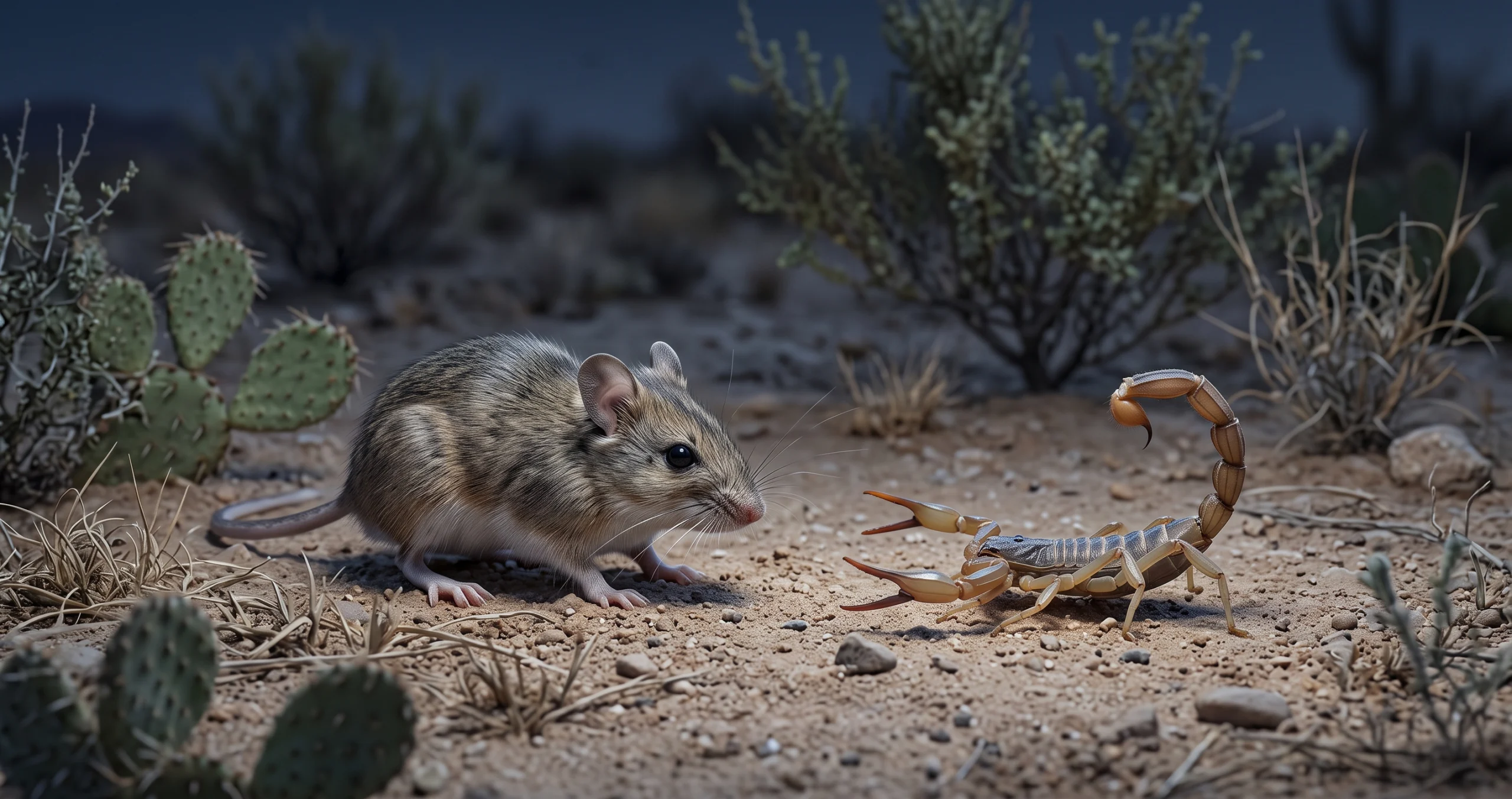
Night has settled over the desert of the American Southwest. Between scattered rocks and dry vegetation, a southern grasshopper mouse moves toward a bark scorpion—dangerous prey armed with a venomous stinger capable of producing intense pain in many mammals.
Yet the encounter does not necessarily end when the scorpion strikes. Research into grasshopper mouse scorpion venom interactions has revealed an extraordinary physiological adaptation: in this small predator, components of bark scorpion venom interact with pain-sensing nerve cells in a way that can actually suppress transmission of the pain signal the venom would normally help trigger.
The mouse is not simply “immune to venom.” The real biology is more precise—and considerably more interesting.
Table of Contents
- Meet the Southern Grasshopper Mouse
- A Mouse That Behaves Like a Tiny Predator
- Why Scorpions Are Dangerous Prey
- The Hunt
- Getting Stung Does Not End the Hunt
- The Science Behind Reduced Pain
- Voltage-Gated Sodium Channels
- How Venom Can Suppress Pain Signaling
- Resistance Is Not the Same as Invulnerability
- Predator and Prey in an Evolutionary Arms Race
- Other Remarkable Grasshopper Mouse Behaviors
- Why Scientists Study This Mouse
- Frequently Asked Questions
- Conclusion
Meet the Southern Grasshopper Mouse
The southern grasshopper mouse (Onychomys torridus) is a small predatory rodent native to arid and semi-arid regions of southwestern North America.
Its range includes portions of the southwestern United States and northern Mexico, where it occupies deserts, shrublands, grasslands, and other relatively dry environments.
Adults generally weigh only around 40–60 grams. Despite their small size and superficially ordinary mouse-like appearance, grasshopper mice occupy a very different ecological niche from many familiar seed-eating rodents.
Animal prey makes up an important part of their diet.
Grasshopper mice consume insects, spiders, scorpions, and other arthropods. They can also attack small vertebrates when suitable opportunities arise.
This predatory lifestyle has exposed Onychomys to defensive chemicals and venom systems that most similarly sized rodents would have little reason to confront regularly.
Image 1 placement — 1200 × 630 px, photorealistic, no text or graphic overlays
Alt text: Grasshopper mouse confronting a venomous scorpion in the desert
A Mouse That Behaves Like a Tiny Predator
Calling the southern grasshopper mouse a carnivorous rodent is not an exaggeration.
Unlike rodents that obtain most of their calories from seeds and other plant material, grasshopper mice actively hunt animal prey. Their feeding ecology includes beetles, grasshoppers and other insects, arachnids, and sometimes small vertebrates.
They search their surroundings for prey and attack animals capable of defending themselves.
That creates a very different set of evolutionary pressures.
An insectivorous predator must overcome prey defenses rather than simply locate edible plant material. For a grasshopper mouse, those defenses can include biting, struggling, chemical secretions—and venomous stings.
Among the most remarkable examples is its interaction with bark scorpions.
Why Scorpions Are Dangerous Prey
Scorpions possess a segmented tail ending in a venom-delivery structure called the telson, which carries the venom glands and stinger.
When threatened or attempting to subdue prey, a scorpion can curve its tail forward and deliver a rapid sting.
Bark scorpions in the genus Centruroides are particularly relevant to grasshopper mouse biology. Research on southern grasshopper mice has focused especially on the Arizona bark scorpion, Centruroides sculpturatus.
Its venom contains neuroactive components capable of interacting with ion channels in nerve cells.
For many mammals, bark scorpion venom produces intense pain. This immediate sensory effect can be a powerful defensive mechanism because a predator that experiences severe pain may interrupt its attack long enough for the scorpion to escape.
Grasshopper mice present an unusual exception.
The Hunt
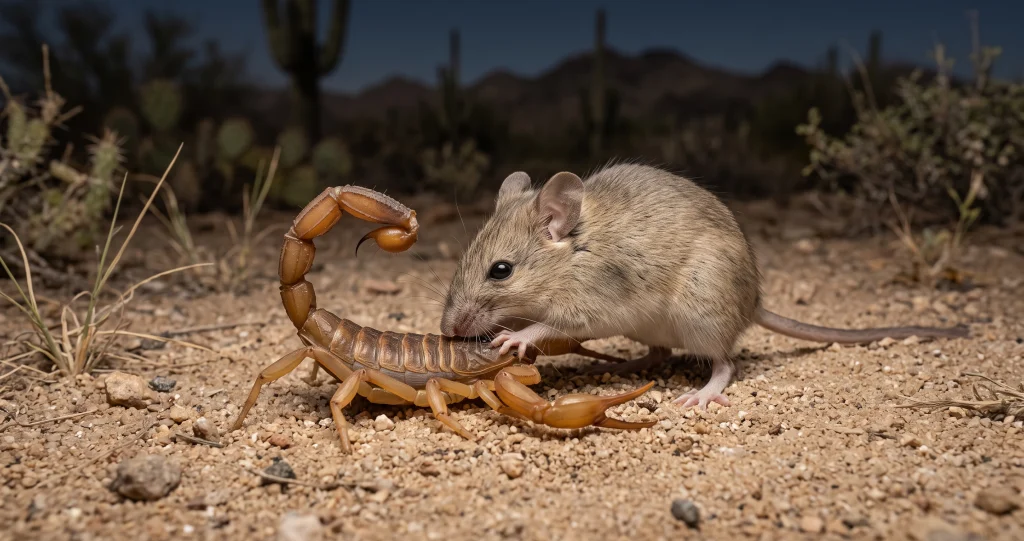
When a southern grasshopper mouse encounters a bark scorpion, the confrontation can become a close-range struggle.
The mouse approaches and attacks the scorpion, attempting to bite and control it while the scorpion uses its pincers and flexible tail defensively.
A successful mouse eventually kills and consumes the scorpion.
Laboratory feeding observations reported by researchers have shown that grasshopper mice continue attacking even after being stung. Instead of abandoning the encounter, a mouse may briefly groom the affected area and then resume the attack.
That behavior provided researchers with an important clue.
If a bark scorpion sting produces prolonged intense pain in other mammals, why does a grasshopper mouse return to the fight after only a short interruption?
The answer turned out to involve the electrical machinery of pain-sensing neurons.
Image 2 placement — 1200 × 630 px, photorealistic, no text or graphic overlays
Alt text: Grasshopper mouse hunting a bark scorpion at night
Getting Stung Does Not End the Hunt
It is tempting to summarize the interaction by saying that grasshopper mice are “immune” to scorpion venom.
That description is too broad.
Experiments show that southern grasshopper mice have dramatically reduced behavioral sensitivity to the pain-inducing effects of Arizona bark scorpion venom compared with ordinary laboratory mice. Earlier work also found resistance to lethal effects of Centruroides toxins.
But those observations do not establish universal immunity to every component of every scorpion venom.
Scorpion venoms are chemically complex and vary among species. Resistance to one important physiological effect cannot automatically be extended to all venom components, doses, scorpion species, or biological consequences.
What researchers have demonstrated in exceptional molecular detail is how the mouse reduces the pain response produced by bark scorpion venom.
The Science Behind Reduced Pain
Pain begins with specialized sensory neurons called nociceptors.
These neurons respond to potentially damaging stimuli. When sufficiently activated, they generate electrical impulses that travel toward the spinal cord and ultimately contribute to the perception of pain.
Bark scorpion venom interferes with this system.
In many mammals, components of the venom activate a voltage-gated sodium channel called Nav1.7 in pain-sensing neurons. This helps initiate electrical activity associated with the painful response.
Researchers initially had good reason to suspect that grasshopper mice might possess a modified version of Nav1.7 that simply prevented the venom from working.
The experiments revealed something more unusual.
The crucial difference involved another sodium channel: Nav1.8.
Voltage-Gated Sodium Channels
Nerve cells communicate partly through rapid electrical changes across their cell membranes.
Voltage-gated sodium channels are proteins embedded in those membranes. When conditions are appropriate, they open and allow positively charged sodium ions to move across the membrane.
That movement contributes to an electrical event called an action potential.
Nav1.7 Helps Initiate the Signal
Nav1.7 is strongly associated with peripheral pain signaling.
In sensory neurons, it helps amplify small electrical changes and contributes to bringing the cell toward the threshold at which an action potential is generated.
Its importance extends well beyond scorpion biology. Human mutations affecting Nav1.7 can dramatically alter pain perception, making the channel an important target in pain research.
Nav1.8 Helps Carry the Signal
Nav1.8 is another voltage-gated sodium channel found prominently in pain-sensing sensory neurons.
It contributes strongly to the action potentials that carry nociceptive information along peripheral nerves.
A simplified way to picture the process is that Nav1.7 helps initiate and amplify the electrical response, while Nav1.8 contributes substantially to maintaining and propagating the resulting pain-related impulses.
In an ordinary mouse exposed to bark scorpion venom, activation of the pain pathway can therefore generate intense nociceptive signaling.
The southern grasshopper mouse changes the outcome at Nav1.8.
How Venom Can Suppress Pain Signaling
The landmark experiments published in Science in 2013 compared southern grasshopper mice with laboratory house mice.
Researchers found that bark scorpion venom activates Nav1.7 associated with the pain pathway, but the grasshopper mouse possesses amino-acid differences in Nav1.8 that fundamentally change the venom’s downstream effect.
Instead of allowing the pain signal to propagate normally, venom peptides can bind to the grasshopper mouse version of Nav1.8 and inhibit sodium current through the channel.
That inhibition suppresses action-potential propagation.
In other words, the venom can help initiate pain-related activity through Nav1.7 while simultaneously interfering with the mouse’s ability to transmit that activity through Nav1.8.
The result is a striking form of venom-induced analgesia.
Experiments on sensory neurons supported this mechanism. Bark scorpion venom strongly stimulated electrical activity in sensory neurons from ordinary mice but inhibited firing in neurons from grasshopper mice.
Behavioral experiments pointed in the same direction.
Grasshopper mice showed much less paw-licking after venom injection than house mice. Remarkably, when venom was combined with another painful chemical stimulus, it reduced the grasshopper mice’s pain-related response.
The original peer-reviewed study, “Voltage-Gated Sodium Channel in Grasshopper Mice Defends Against Bark Scorpion Toxin,” is available through the National Library of Medicine’s PubMed Central archive.
The finding is particularly fascinating because the mouse does not simply prevent the venom from contacting the pain pathway. Molecular changes allow a venom component to interact with a second channel in a way that suppresses signaling.
Resistance Is Not the Same as Invulnerability
The distinction between pain resistance and complete venom immunity is essential.
Pain is a sensory experience generated by nervous-system activity. Toxicity refers more broadly to harmful physiological effects produced by a substance.
An animal could therefore experience relatively little pain from a venom while still being vulnerable to some of its other effects.
Research has demonstrated that southern grasshopper mice are resistant to important effects of bark scorpion venom, including its pain-producing action. But that does not mean a grasshopper mouse cannot be harmed by venom under any circumstances.
Dose matters. Venom composition matters. The scorpion species matters.
Nor does the adaptation mean that grasshopper mice are generally insensitive to pain.
That would be dangerous. Pain alerts an animal to tissue damage, extreme temperatures, injury, and other threats.
The grasshopper mouse adaptation is remarkable partly because it changes the response to particular venom components without simply eliminating the animal’s entire pain system.
Predator and Prey in an Evolutionary Arms Race
The grasshopper mouse and bark scorpion provide a useful example of what evolutionary biologists call an arms race.
Scorpion venom can discourage predators by producing intense pain and other physiological effects. Individuals possessing effective defensive venom may gain a survival advantage when confronted by predators.
Predators, however, experience their own selection pressures.
If venomous scorpions represent a valuable food resource, genetic variants that allow a predator to tolerate their defenses may increase access to prey.
Neither species consciously develops a strategy.
Natural selection acts across generations on heritable variation. The result can nevertheless look remarkably strategic: one lineage evolves an effective defense while another accumulates counter-adaptations that reduce its effectiveness.
The grasshopper mouse’s modified Nav1.8 channel is a particularly elegant example because it does not simply ignore the venom. The interaction between toxin and altered channel helps suppress the very sensory pathway the scorpion’s defense would normally exploit.
Similar evolutionary principles can produce completely different adaptations in other environments. For example, this Secrets of the Green Garden article on echidna electroreception explores how specialized sensory physiology can influence the way another mammal finds animal prey.
Other Remarkable Grasshopper Mouse Behaviors
Scorpion hunting is only one unusual feature of grasshopper mouse biology.
These rodents are territorial and highly predatory compared with many other small rodents. Animal prey forms a substantial part of their feeding ecology, giving them a functional role more reminiscent of a tiny mammalian carnivore.
Grasshopper mice are also famous for their vocalizations.
Individuals can produce conspicuous long-distance calls while standing with the head raised. These calls are sometimes popularly described as “howls” because of their sustained quality.
The comparison is memorable, but grasshopper mice are not literally behaving like miniature wolves. Their vocalizations function within their own species-specific communication system and can be associated with territorial behavior.
Together, predatory feeding, territoriality, and long-range vocal communication make Onychomys unusually distinctive among North American rodents.
Why Scientists Study This Mouse
Understanding grasshopper mouse scorpion venom resistance matters beyond natural history.
Voltage-gated sodium channels are central components of pain signaling in mammals, including humans.
Nav1.7 has attracted enormous scientific interest because changes in its function can produce dramatic differences in human pain sensitivity. Nav1.8 is likewise an important component of peripheral nociception.
The grasshopper mouse provides researchers with a natural biological experiment.
Evolution has modified a pain-signaling protein in a living mammal without simply eliminating the entire pain pathway. Studying how those molecular changes alter toxin-channel interactions can reveal principles that might otherwise be difficult to discover.
This does not mean scorpion venom itself is automatically a practical human painkiller.
Turning a biological mechanism into a safe medication requires extensive research into selectivity, dosage, delivery, side effects, and many other factors.
Instead, the mouse demonstrates that Nav1.8 can be manipulated in ways capable of suppressing nociceptive signaling—an observation that has helped strengthen scientific interest in sodium channels as targets for pain research.
Frequently Asked Questions
Is the grasshopper mouse immune to scorpion venom?
Not in the simple, universal sense. Southern grasshopper mice show resistance to important effects of bark scorpion venom, and research has demonstrated strongly reduced pain signaling. This should not be interpreted as complete invulnerability to every scorpion venom or every possible venom effect.
How does a grasshopper mouse survive a scorpion sting?
One important mechanism involves its altered Nav1.8 sodium channel. Bark scorpion venom can inhibit this channel in the mouse’s sensory neurons, suppressing propagation of pain-related electrical signals.
Does scorpion venom actually act like a painkiller in grasshopper mice?
Experimental evidence indicates that bark scorpion venom can produce an analgesic effect in southern grasshopper mice by inhibiting Nav1.8-dependent signaling. Researchers even found that venom reduced behavioral responses to another painful stimulus under experimental conditions.
What kind of scorpion was used in the famous research?
The landmark work examined southern grasshopper mice and the Arizona bark scorpion, Centruroides sculpturatus, historically also referred to under Centruroides exilicauda in some literature.
What are Nav1.7 and Nav1.8?
They are voltage-gated sodium channels expressed in sensory neurons. Both contribute to electrical signaling involved in pain, although they perform different roles in initiating and propagating nerve impulses.
Do grasshopper mice eat other animals besides scorpions?
Yes. Their diet includes insects and other arthropods, and they can also prey on small vertebrates. Scorpions represent only one part of their carnivorous feeding ecology.
Do grasshopper mice really howl?
They produce distinctive sustained vocalizations that are often described as howls. These long-distance calls are associated with communication and territorial behavior, although they are biologically distinct from wolf howling.
Conclusion
A southern grasshopper mouse attacking a venomous scorpion illustrates how much biological complexity can be hidden inside a small desert predator.
Its success depends partly on behavior: the mouse actively approaches, attacks, controls, and consumes dangerous prey. But the most extraordinary part of the interaction occurs at a microscopic level inside its sensory neurons.
Bark scorpion venom normally exploits mammalian pain pathways. In the grasshopper mouse, amino-acid differences in Nav1.8 change that interaction, allowing venom components to inhibit the electrical transmission of pain signals rather than producing the same response observed in ordinary mice.
That does not make the mouse universally immune to venom or incapable of feeling pain. Instead, it represents a much more specific example of physiological resistance.
The grasshopper mouse scorpion venom relationship therefore demonstrates how natural selection can reshape an existing sensory system when predator and prey repeatedly challenge one another across generations.
For the tiny hunter moving through the desert at night, that altered pain physiology can make the difference between abandoning dangerous prey and finishing the hunt.