
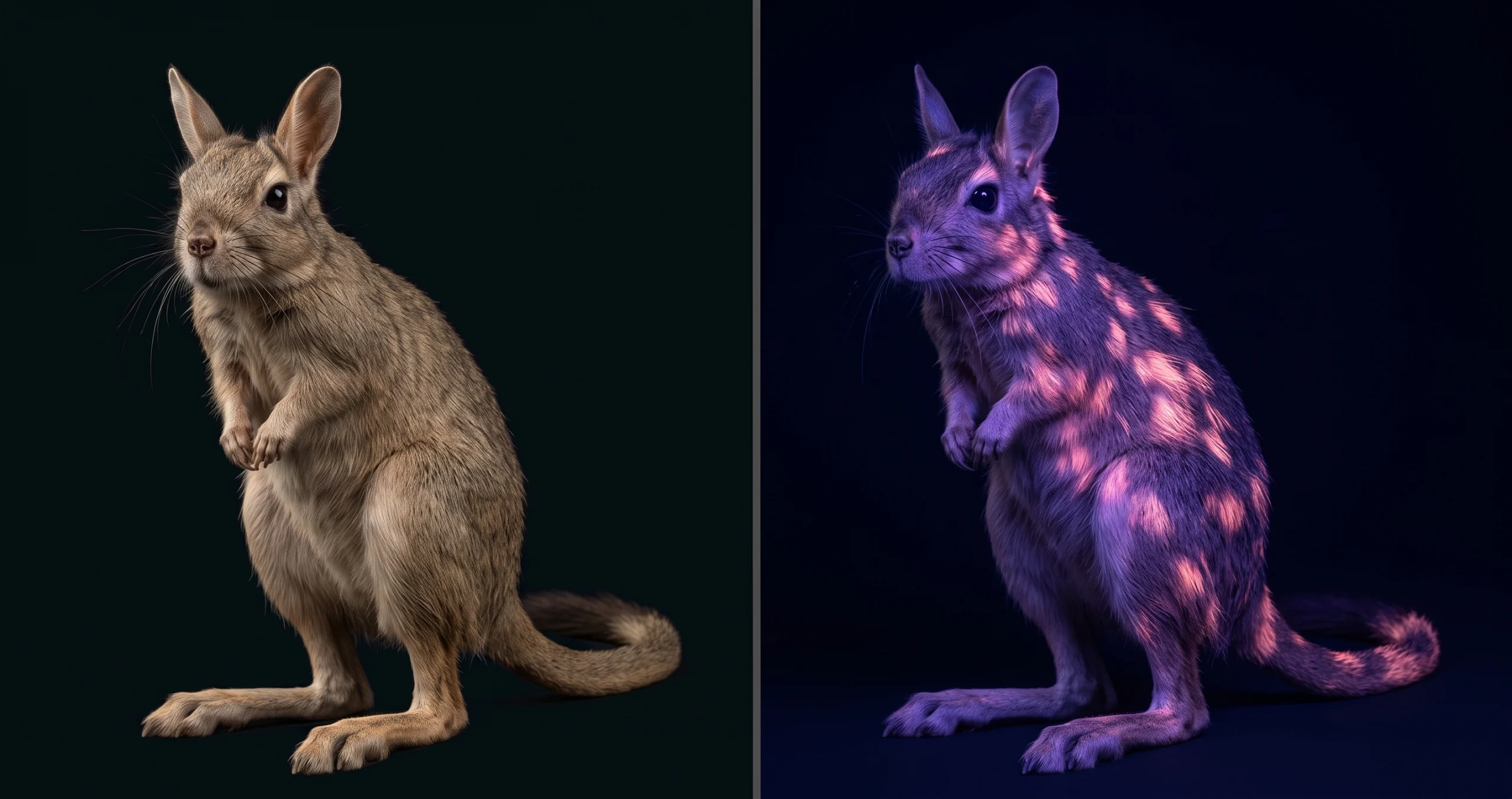
Under ordinary visible light, a springhare looks much like an animal built to disappear into an African grassland: earthy brown fur, a pale underside, enormous hind legs, and a long tail. Illuminate that same fur with ultraviolet light under controlled conditions, however, and something unexpected appears.
Parts of the coat can emit vivid orange, reddish, and pinkish fluorescence.
Researchers formally documented this phenomenon in springhares in a 2021 study published in Scientific Reports. They observed it in both museum specimens and living captive animals, showing that the effect was not simply an artifact of one old preserved skin. Chemical analysis subsequently identified several fluorescent porphyrins in the fur.
The discovery is visually striking, but its interpretation requires care. Springhares do not manufacture visible light like fireflies. They do not glow continuously in ordinary darkness. Scientists also have not demonstrated that their fluorescence evolved for camouflage, communication, mate choice, or any other particular ecological function.
What researchers have established is fascinating enough: springhare fur contains compounds capable of absorbing certain wavelengths of light and re-emitting some of that energy at longer, visible wavelengths.
Meet the Springhare
Despite the name, a springhare is neither a true hare nor a rabbit.
Springhares belong to the rodent family Pedetidae. Their unusual body plan makes the name understandable. They possess powerful elongated hind limbs, much shorter forelimbs, large eyes, prominent ears, and a long tail.
When moving rapidly, they can travel with dramatic bipedal leaps that give them a superficial resemblance to small kangaroos.
Two living species are recognized: the southern African springhare (Pedetes capensis) and East African springhare (Pedetes surdaster). The former occurs in southern Africa, while the latter inhabits portions of East Africa, including Kenya and Tanzania.
Springhares are primarily nocturnal. During daylight they shelter in burrows, emerging after dark to forage. They are associated especially with relatively open, dry habitats and short-grass environments.
That lifestyle creates an interesting ecological balance.
Open ground leaves relatively little vegetation in which to hide, but it can also provide an unobstructed view of approaching predators and room for a springhare to escape with its powerful leaps.
Their nighttime activity later became particularly interesting to researchers studying mammalian fluorescence.
The Unexpected UV Discovery
The springhare discovery grew out of research on biofluorescence in other mammals.
Researchers examining specimens at the Field Museum of Natural History in Chicago noticed the unusual response while investigating fluorescent mammals. They subsequently examined 14 museum springhare specimens representing both Pedetes capensis and Pedetes surdaster. The specimens had been collected from Angola, Botswana, Kenya, and Tanzania over several decades.
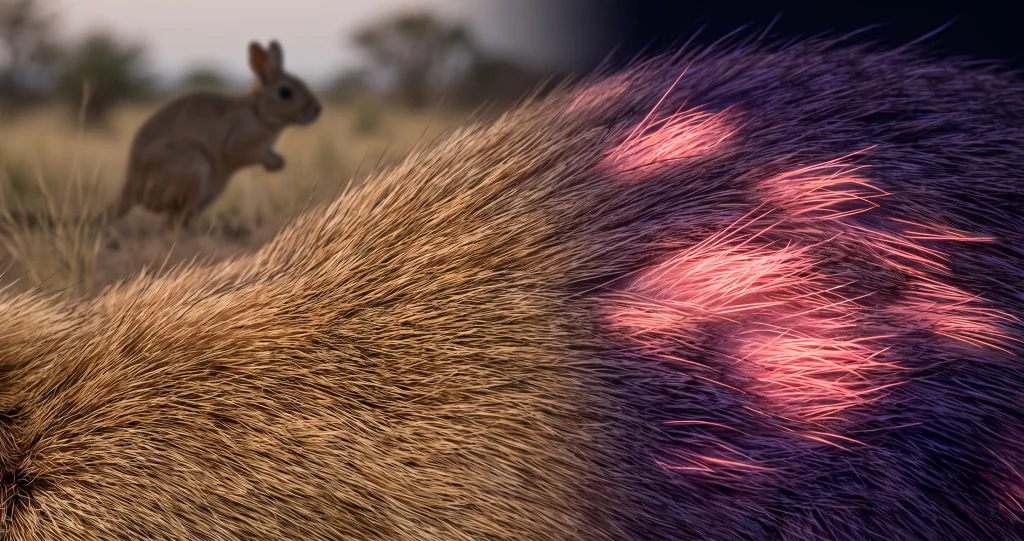
The researchers illuminated the specimens using ultraviolet light centered around 395 nanometers.
The result was striking.
Instead of simply reflecting the incoming illumination, portions of the springhare fur emitted orange-to-red visible fluorescence.
The team then examined captive springhares to determine whether the phenomenon occurred in living animals rather than only in preserved museum material. Five living captive-bred P. capensis and one recently deceased captive animal were included.
They fluoresced too.
That observation was important because museum preparation, storage chemicals, aging, and contamination can potentially alter biological specimens. Detecting the phenomenon in living animals provided much stronger evidence that fluorescence is an inherent property of springhare fur.
What Biofluorescence Means
Biofluorescence is a physical interaction between biological material and incoming light.
A fluorescent substance absorbs electromagnetic radiation at one wavelength or range of wavelengths. Some of the absorbed energy is then emitted as light at a longer wavelength.
In simplified terms:
UV or shorter-wavelength light reaches the fur → fluorescent molecules absorb energy → some energy is lost internally → the molecules emit lower-energy, longer-wavelength light.
If that emitted wavelength falls within the human-visible spectrum, people can see a color that was not present in the incoming ultraviolet radiation itself.
This differs from ordinary reflection.
When brown fur looks brown in daylight, much of what reaches the eye is visible light from the environment that has interacted with the fur and been selectively reflected or scattered.
Fluorescence involves absorption followed by re-emission.
That distinction is why UV illumination can reveal patterns that are inconspicuous under ordinary visible light.
Fluorescence vs Bioluminescence
Biofluorescence is frequently confused with bioluminescence, but the two phenomena are fundamentally different.
A bioluminescent organism generates light through a biochemical reaction. Fireflies are a familiar example. Their light does not require an ultraviolet flashlight shining on them first.
A fluorescent organism requires an external source of suitable excitation light.
Once that source disappears, the fluorescence effectively disappears with it.
A springhare therefore does not generate its own visible glow.
Place one in complete darkness without an appropriate source of excitation light and its fluorescent fur does not continue shining like a firefly.
The familiar photographs of brightly glowing springhares were produced under artificial UV illumination and photographic conditions designed to reveal fluorescence.
That context is essential when interpreting the discovery.
What Springhare Fur Looks Like Under UV
The springhare fluorescence documented by researchers was unusually vivid compared with several previously reported fluorescent mammals.
Under the study’s UV illumination, the fur produced orange-to-red fluorescence, with a strong emission component around the red portion of the visible spectrum. Spectroscopic measurements detected fluorescence peaks around 500 and 650 nanometers in examined material.
The effect was not distributed as a perfectly uniform glowing coat.
It was distinctly patchy.
Fluorescence occurred on both dorsal and ventral surfaces. On the back, fluorescence could be particularly prominent around the head and posterior regions. On the underside, fluorescent areas were especially noticeable around portions of the inner thighs and tail.
Individual animals also differed in fluorescence intensity.
Both male and female specimens showed the phenomenon, and the original researchers did not find evidence sufficient to characterize the trait as sexually dimorphic.
Microscopic examination added another important clue.
Individual springhare hairs fluoresced, and the pattern appeared associated with the hair fiber itself. The researchers concluded that the fluorescence likely originated within the cuticle of the hair.
Washing samples with dish soap did not eliminate the fluorescence or transfer it away from the fur, arguing against a simple removable surface contaminant.
What Produces the Color
The next question was chemical.
Researchers extracted fluorescent material from springhare hair and separated its components before analyzing them using high-performance liquid chromatography.
Several porphyrins were identified.
The study reported uroporphyrin-I, uroporphyrin-III, heptacarboxylporphyrin, hexacarboxylporphyrin, and coproporphyrin-I. The analysis also revealed an additional component that could not be assigned to one of the porphyrins in the reference mixture used by the researchers.
Porphyrins are ring-shaped organic molecules related to important biochemical pathways. Porphyrinogens occur as intermediates in the biosynthesis of heme, and oxidation can produce fluorescent porphyrins.
Uroporphyrins and coproporphyrins are known to fluoresce under suitable excitation conditions, making them plausible contributors to the springhare’s reddish fluorescence. Their fluorescence can vary with chemical conditions, including factors such as pH and ionic environment.
The safest scientific conclusion is therefore not that one single pigment completely explains the effect.
Rather, several fluorescent porphyrins were detected in springhare fur and appear to account for at least part of the observed fluorescence, with the original researchers acknowledging that another unidentified compound could also contribute.
Can Springhares See the Fluorescence
This is where observation ends and a much harder biological question begins.
Demonstrating that an animal fluoresces does not demonstrate that the animal can perceive that fluorescence.
Visual perception depends on the wavelengths reaching an animal’s eyes, the spectral sensitivity of its photoreceptors, the lighting environment, neural processing, and the visual contrast between the signal and its background.
A camera can also reveal fluorescence differently from an animal eye.
The 2021 study noted the potential ecological importance of ultraviolet wavelengths to nocturnal mammals, but it did not establish that springhares themselves perceive their fluorescent markings as humans see them in UV photographs.
There is another complication.
The natural nighttime environment is dramatically different from shining a powerful UV lamp directly onto an animal.
For fluorescence to matter visually in nature, sufficient excitation wavelengths must reach the fur, enough visible fluorescent emission must then be produced, and a relevant observer must possess a visual system capable of detecting the resulting contrast.
Those conditions cannot simply be assumed from a laboratory photograph.
Possible Biological Functions
The unusual patchiness of springhare fluorescence naturally invites evolutionary explanations.
One possibility proposed by the original researchers involved camouflage.
Springhares frequently forage alone in relatively open habitats, where vegetation provides limited concealment from predators. Patchy fluorescence might theoretically alter the animal’s appearance under particular nighttime lighting conditions and make its outline less obvious to a predator.
The researchers specifically presented this as a hypothesis dependent, among other things, on predator UV sensitivity.
Communication is another broad possibility often considered when conspicuous coloration occurs in animals.
If springhares can perceive relevant wavelengths, fluorescent areas could hypothetically provide information to other springhares.
Yet there is currently no convincing evidence demonstrating that they use fluorescence as a social signal.
The distribution of the fluorescence also generated questions about grooming and social contact because some strongly fluorescent areas overlap parts of the body affected by grooming or interactions. However, washing did not remove the fluorescence, and the researchers did not find fluorescent material transferred around captive enclosures.
These observations make the story interesting, but they do not establish an adaptive function.
Why Scientists Remain Cautious
Evolutionary biology contains an important distinction between a trait that exists and a trait that evolved because it provides a particular benefit.
Fluorescence can be biologically real without being an adaptation for fluorescence.
Porphyrins are products associated with biochemical processes. If they accumulate in hair for reasons unrelated to visual signaling, their ability to fluoresce may simply be a physical consequence of their molecular structure.
In that scenario, the spectacular response to a UV flashlight could be incidental.
The original researchers themselves discussed this possibility and noted that future studies would be needed to determine whether springhare fluorescence is advantageous, neutral, or associated with some other physiological process.
This caution becomes especially important because fluorescence photographs are visually persuasive.
A brightly colored UV image can make a biological signal appear obvious to humans even when nobody has demonstrated that the relevant colors are conspicuous under natural conditions.
Artificial UV illumination can be much more intense and spectrally different from environmental illumination. Camera sensors, long-pass filters, exposure settings, white balance, image processing, and display screens can further influence the final appearance.
In the original springhare work, researchers used controlled UV illumination, photographic filters, spectroscopy, microscopy, and chemical analysis rather than relying on photographs alone.
That combination is what transformed an unusual visual observation into scientific evidence for genuine fluorescence.
It still did not establish an ecological function.
Other Fluorescent Mammals
Springhares are part of a growing and increasingly complicated story about fluorescence in mammals.
Before the springhare study, biofluorescence had already been reported in several mammalian lineages.
Flying squirrels of the genus Glaucomys show striking pink fluorescence under UV illumination. Opossums have long been associated with fluorescent pelage, and researchers also documented blue-green fluorescence in platypus fur.
The 2021 springhare paper described Pedetes as the first well-documented example of biofluorescence in an Old World placental mammal.
Subsequent work has expanded investigation of UV reflectance and fluorescence across rodents and other mammals. A 2022 Scientific Reports study examining multiple rodent genera reinforced how much remains to be learned about the distribution and physical basis of these traits.
The emerging picture is therefore more nuanced than the idea that scientists suddenly discovered a handful of “glowing mammals.”
Different species can fluoresce through different structures and compounds. Colors and intensity differ. Ecological contexts differ. In some species the effect may eventually prove functional; in others it may simply accompany pigments or structural properties that evolved for unrelated reasons.
Fluorescence itself is a physical phenomenon. Its evolutionary meaning must be investigated separately.
What This Discovery Teaches Us
Springhare fluorescence demonstrates how familiar animals can contain biological properties invisible under the conditions in which humans normally observe them.
It also illustrates the importance of museum collections.
The researchers were able to examine specimens collected across different African locations and spanning decades. Fluorescence was detected even in specimens dating to the early twentieth century, while observations of living captive animals confirmed that the effect was not limited to old preserved material.
The discovery also highlights a broader lesson about animal coloration.
Humans experience wildlife through the narrow window of our own sensory biology.
Other species may perceive wavelengths differently. Some markings that appear obvious to us may be irrelevant to another animal, while signals invisible to human eyes can be important to species equipped with different photoreceptors.
Scientific imaging can reveal those hidden physical properties.
But revealing them is only the first step.
Understanding whether natural selection actually uses them requires behavioral experiments, measurements of natural illumination, knowledge of predator and springhare visual systems, chemical research, and observations under ecologically realistic conditions.
FAQ
Do springhares really glow
Springhare fur genuinely biofluoresces under suitable excitation light. Researchers documented orange-to-red fluorescence under ultraviolet illumination and confirmed the effect through spectroscopy and chemical analysis. This does not mean springhares continuously glow in normal darkness.
Do springhares make their own light
No. Biofluorescence requires external light. Fluorescent compounds in the fur absorb shorter-wavelength radiation and re-emit part of that energy at longer wavelengths.
What color are fluorescent springhares
Under the experimental UV conditions used in the original study, portions of their fur appeared orange, reddish, or pinkish, with notable variation and patchiness across the coat.
What chemicals make springhare fur fluoresce
Researchers identified several porphyrins, including forms of uroporphyrin and coproporphyrin, along with other porphyrins. They also detected an unidentified component that may contribute to the effect. The evidence therefore supports a partly porphyrin-based explanation rather than attributing the entire phenomenon to a single molecule.
Is springhare fluorescence camouflage
That has been proposed as a hypothesis, but it has not been demonstrated. Establishing camouflage would require evidence showing that fluorescence changes detection by ecologically relevant predators under realistic natural lighting.
Can springhares see their own fluorescent fur
Current evidence does not establish that they perceive their fluorescence in the way UV photographs display it. Demonstrating that would require appropriate information about springhare vision, natural excitation light, and behavioral responses.
Is fluorescence the same as bioluminescence
No. Bioluminescent organisms generate light through biochemical reactions. Fluorescent materials absorb incoming radiation and re-emit some of its energy at longer wavelengths.
Why is UV photography alone not enough to prove a biological function
UV lamps, filters, cameras, exposure settings, and image processing can make fluorescence highly conspicuous. A photograph demonstrates an optical effect under those conditions, but it cannot by itself establish how the animal or its predators perceive the fur under natural nighttime illumination.
Conclusion
The fluorescent springhare is remarkable not because it is a mammalian version of a firefly, but because its apparently ordinary fur hides an optical property that becomes visible under the right illumination.
When ultraviolet light reaches springhare fur, fluorescent compounds can absorb that radiation and re-emit some of the energy at longer visible wavelengths. Under controlled UV illumination, the result can be vivid, patchy orange-to-red fluorescence across portions of the body.
Chemical analysis has provided part of the explanation. Several porphyrins occur in the fur and contribute to its fluorescent properties, while an additional unidentified compound may also be involved.
The evolutionary explanation remains much less certain.
Camouflage and other biological functions are scientifically interesting hypotheses, but none should yet be treated as established. The fluorescence could have an ecological role, or it could be an incidental consequence of molecules present in springhare hair for entirely different reasons.
That uncertainty is part of what makes the discovery valuable. It reveals a hidden characteristic of a nocturnal African mammal while demonstrating an equally important principle of wildlife science: discovering an extraordinary trait and explaining why evolution produced it are two different scientific achievements.
Internal Linking Opportunities
- Pond Ecosystem at Night: What Changes After Dark — a relevant contextual link from the discussion of nocturnal activity and how animals operate under changing nighttime light conditions.
- The Colugo: The Mammal With the Most Extreme Gliding Membrane — a strong related-reading link for another unusual nocturnal mammal and specialized mammalian adaptation.
- Why the Fennec Fox’s Ears Are So Disproportionately Large — useful from the section introducing nocturnal mammals and African adaptations.
- How Light Pollution Changed the Night Sky — relevant to discussion of natural darkness, artificial illumination, and nighttime wildlife.
- Animal Heart Rate: Hummingbird to Blue Whale — suitable as broader related reading about unusual animal physiology.
These URLs were located on Secrets of the Green Garden rather than constructed from assumed article titles.Scientific Sources
Olson, E. R., Carlson, M. R., Ramanujam, V. M. S., et al. (2021). “Vivid biofluorescence discovered in the nocturnal Springhare (Pedetidae).” Scientific Reports, 11, 4125. This is the primary study documenting fluorescence in museum and captive springhares and identifying fluorescent porphyrins in their fur.
Sobral, G., & Souza-Gudinho, F. (2022). “Fluorescence and UV–visible reflectance in the fur of several Rodentia genera.” Scientific Reports, 12, 12293. Provides broader comparative context for fluorescence and UV-visible properties in rodents.
Polo, C. F., Frisardi, A. L., Resnik, E. R., Schoua, A. E., & Batlle, A. M. (1988). “Factors influencing fluorescence spectra of free porphyrins.” Clinical Chemistry, 34(4), 757–760. Provides supporting biochemical context for fluorescence in uroporphyrins and coproporphyrins.