
Introduction
The hands of a monkey are usually imagined as grasping tools: flexible fingers tipped with flat nails, wrapping around branches much as a human hand might. Pygmy marmosets complicate that familiar picture.
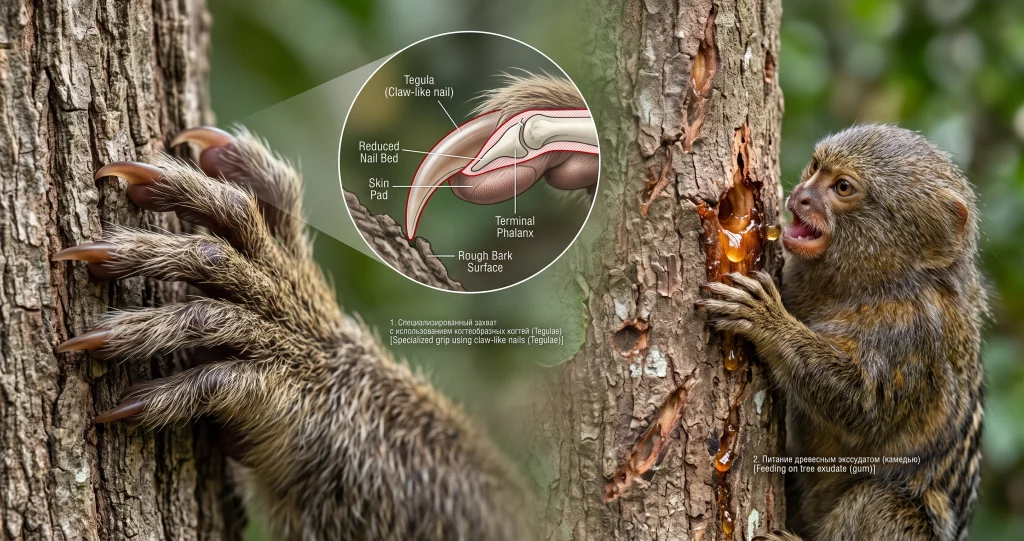
These tiny South American primates belong to the callitrichid lineage, whose members possess specialized claw-like nails called tegulae on most digits. Rather than being ordinary mammalian claws like those of a cat, tegulae are modified primate nail structures associated with distinctive terminal finger and toe anatomy. They give marmosets an effective way to cling to rough vertical surfaces.
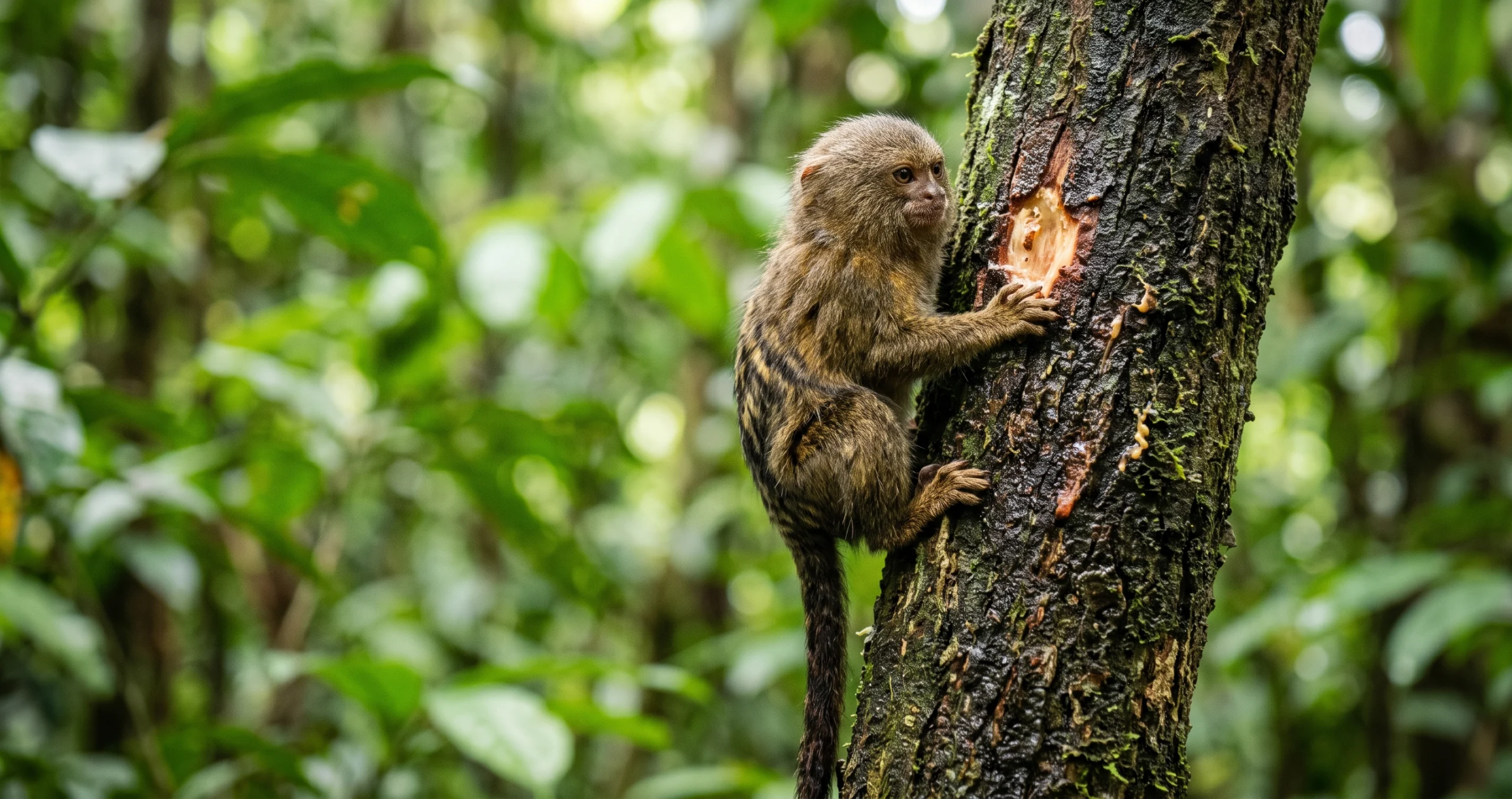
For pygmy marmosets, this climbing system is closely connected to feeding. They routinely cling to trunks and branches while using specialized anterior teeth to gouge bark and obtain gums and other plant exudates. Their small body size, digits, locomotion and feeding anatomy therefore work together as an ecological package rather than as isolated adaptations.
Meet the Pygmy Marmoset
Pygmy marmosets belong to the genus Cebuella, part of the callitrichid radiation of New World monkeys. Modern taxonomy recognizes geographic differentiation within pygmy marmosets, so older sources may use Cebuella pygmaea or the former combination Callithrix pygmaea more broadly than current treatments.
They inhabit western portions of the Amazon Basin, where their lives are closely tied to wooded habitats and the vertical architecture of trees.
Their body mass is only a little over 100 grams in typical adults, placing them at the very small end of the anthropoid primate size range. Callitrichids as a whole represent an unusually small-bodied primate lineage, with evolutionary changes in body size associated with several distinctive anatomical and reproductive characteristics.
Small size is not simply a miniature version of a larger monkey’s design. It changes the mechanical possibilities of arboreal life. A light animal can use relatively narrow supports and maneuver through portions of vegetation that would be unsuitable for a much heavier primate.
Life in the Amazon Canopy
Pygmy marmosets live in structurally complex tropical forests where movement rarely occurs across a simple horizontal surface.
Tree trunks, vines, branches and smaller supports form a three-dimensional network. An animal moving through this environment must continually manage gravity while accelerating, stopping, turning and transferring between surfaces.
Pygmy marmosets can move quadrupedally along branches and leap between supports, but vertical trunks are particularly important because they can also be feeding stations.
This is where locomotion and diet intersect. A pygmy marmoset may need to remain attached to a nearly vertical trunk while repeatedly bringing its mouth against bark and applying its incisors to the wood.
A hand or foot adapted only for wrapping around narrow branches would not necessarily be ideal for this task.
Why Most Primates Have Flat Nails
Flat nails are one of the anatomical features traditionally associated with primates.
In many primates, the terminal portions of the fingers and toes have broad tactile pads. Flat nails leave these pads exposed, supporting sensitive contact with substrates and helping the digits conform around branches and other objects.
Grasping hands and feet are especially valuable in an arboreal environment. The hallux, or big toe, is particularly important in many primates because it contributes to pedal grasping.
Callitrichids followed a somewhat different evolutionary route.
Instead of retaining typical flat nails on every digit, they evolved pointed, claw-like tegulae on most fingers and toes. Comparative anatomical work describes these structures as secondarily modified rather than simply treating them as ordinary non-primate claws.
The Pygmy Marmoset Difference
The distinction becomes obvious when a marmoset is positioned against a broad tree trunk.
Wrapping the fingers completely around such a surface is impossible. The animal instead needs to maintain contact against the bark itself.
Pointed tegulae are well suited to this situation. Their shape allows the digits to engage irregularities in bark while the limbs keep the body close to the support.
Importantly, the modification does not apply identically to every digit.
What Tegulae Are
Tegulae are claw-like nail structures found in callitrichids. They are narrower and more curved than the broad, flattened nails typical of many other anthropoid primates.
Calling them simply “claws” is convenient in everyday language, but it can obscure their evolutionary and anatomical context. Research distinguishing primate nails, tegulae and grooming claws notes that callitrichid tegulae retain features associated with primate terminal digits and are not identical to the claws of typical non-primate mammals.
Callitrichids generally possess tegulae on the digits except the hallux. The big toe retains a flatter nail.
That exception matters. It demonstrates why statements claiming that pygmy marmosets have identical “claws on every finger and toe” are anatomically inaccurate.
How Claw-Like Digits Grip Bark
On rough bark, the pointed ends of the tegulae can engage small surface irregularities.
The limbs then distribute the animal’s weight across multiple contact points. Rather than relying entirely on friction from broad pads or on wrapping a hand around the support, the animal can maintain attachment to a surface far wider than its hand.
Researchers examining callitrichid locomotion have found relationships among foot proportions, tegula curvature and use of vertical supports. Palmar and plantar surface structures also contribute to interaction with the substrate.
The tegulae should therefore be understood as part of a larger locomotor system involving the digits, limbs, body orientation and behavior.
Vertical Clinging and Climbing
Vertical clinging is especially characteristic of marmoset locomotion.
Imagine a pygmy marmoset positioned against a trunk with its body approximately upright. Its four limbs contact the bark, and the pointed tegulae help stabilize those contacts. From this posture the animal can move upward, downward or sideways, or launch toward another support.
Vertical clinging also provides a stable working position during feeding.
Comparative studies of callitrichids have linked vertical-support use with locomotor evolution and feeding ecology. Marmosets are particularly associated with vertical clinging because tree trunks are not merely pathways through their habitat. They contain an important food resource.
The Role of the Tail
A pygmy marmoset’s long tail is conspicuous, but it should not be mistaken for the strongly prehensile tail found in some other New World monkeys.
It does not function as an additional grasping hand.
Instead, the tail contributes to balance and body control as the animal runs, leaps and changes position on narrow or steep supports. Rapid arboreal movement continually shifts the body’s center of mass. A long tail can help manage those changes, particularly during leaps and quick changes in orientation.
The actual attachment to a vertical trunk is produced primarily by the limbs and digits, not by wrapping the tail around the tree.
Why Pygmy Marmosets Gouge Trees
The connection between climbing and feeding becomes clearest when pygmy marmosets reach a favored feeding tree.
They are specialized exudate feeders.
Plant exudates are substances released from plant tissues naturally or following damage. Depending on the plant and circumstances, these materials may include gums and other secretions. Calling everything a marmoset consumes “tree sap” is therefore too imprecise.
Marmosets do something especially important: they actively damage bark with their anterior teeth to stimulate or gain access to exudates.
This behavior is known as gouging.
Research comparing callitrichids shows that marmosets in Callithrix and Cebuella possess specialized anterior dentition associated with gouging, whereas closely related tamarins may consume exudates opportunistically without creating feeding holes in the same specialized manner.
Tree Exudates as Food
Tree gums can provide an important and relatively dependable carbohydrate resource.
Unlike ripe fruit, which may occur unpredictably in space and time, an established exudate tree can be revisited. A marmoset can maintain multiple gouges and return to productive feeding sites.
Observations of pygmy marmosets indicate that they repeatedly exploit selected trees rather than simply feeding from whatever exudate-producing plant happens to be nearby.
Their ability to cling vertically is crucial here.
Gouging requires an animal to remain stable while its mouth repeatedly contacts a resistant substrate. The feet and hands maintain the body against the trunk while the jaw and anterior teeth perform the feeding work.
In this sense, tegulae and incisors solve two parts of the same ecological problem: one keeps the animal attached to the feeding surface; the other helps open that surface.
Teeth and Feeding Specialization
Marmoset teeth provide some of the strongest anatomical evidence for adaptation to exudate feeding.
The lower incisors are especially important during bark gouging. Research on marmoset anterior dentition has identified features associated with resisting the unusual mechanical stresses created when teeth are repeatedly driven against woody substrates.
A recent broad comparative analysis found that gouging callitrichids have lower incisors that are relatively thicker in the labiolingual dimension than those of non-gouging relatives, a feature consistent with increased resistance to bending.
Earlier anatomical work also documented specialized enamel organization, incisor form and tooth-root characteristics associated with gouging.
The skull and jaw system show additional specialization.
Gouging involves relatively wide jaw openings. Studies of marmoset craniofacial anatomy and jaw muscles suggest a mosaic of adaptations that allows effective muscle performance at large gapes while accommodating the unusual loading produced during gouging.
This is more accurate than simply saying that pygmy marmosets evolved exceptionally powerful jaws. The mechanical problem involves gape, tooth loading, stability and repeated substrate processing—not raw bite force alone.
Other Foods in the Diet
Pygmy marmosets are specialized exudate feeders, but they are not restricted to gums.
Insects provide another important component of their diet. They may hunt arthropods among vegetation and around feeding sites, supplementing carbohydrate-rich plant exudates with protein and other nutrients.
Reported foods also include spiders, small amounts of fruit, flowers and occasionally small vertebrate prey.
This dietary flexibility matters because rainforest food supplies change over time.
Exudate feeding provides access to a resource that many competing primates cannot exploit as effectively, while insect hunting and other foods broaden the animals’ nutritional options.
Social Life
Pygmy marmosets are social primates rather than solitary tree specialists.
They typically live in small family-based groups. Callitrichids are notable for cooperative infant care: fathers and other group members can participate substantially in carrying and caring for young.
Group living influences how feeding territories are used and defended. Productive exudate trees can represent valuable, repeatedly exploitable resources rather than one-time feeding opportunities.
Communication helps maintain cohesion among small animals moving through visually complicated vegetation, where foliage and branches can quickly hide one group member from another.
Their ecology is therefore social as well as mechanical. A feeding tree exists within a group’s territory, movement routes and network of social relationships.
Why Small Body Size Works in an Arboreal Niche
Extreme miniaturization changes how an animal interacts with trees.
A small primate can move on supports unavailable to larger monkeys. Its relatively low mass also reduces the forces that its hands and feet must resist while clinging vertically.
Callitrichid small body size has been linked evolutionarily with a collection of unusual traits, including claw-like tegulae and specialized exudate feeding in marmosets.
For pygmy marmosets, being small therefore complements their locomotor system.
Low body mass, pointed tegulae and a diet accessible directly from tree surfaces together make vertical space economically useful. Large trunks that would provide little grasping opportunity for a conventional branch-grasping primate become feeding platforms.
Evolutionary Significance
The pygmy marmoset is a useful reminder that evolution does not produce a single ideal design for being a primate.
Flat nails and grasping extremities were enormously important in primate evolution. Yet within callitrichids, natural selection modified that ancestral pattern.
Tegulae improved interaction with vertical supports. In marmosets, vertical clinging became tightly associated with tree gouging and exudate feeding. Dental and craniofacial anatomy changed as well.
Comparative research even finds evolutionary signals in the postcranial skeleton associated with different locomotor demands among marmosets and tamarins.
The result is best viewed as an integrated adaptive complex.
The animal’s small body determines what supports it can use. Its digits help hold it against those supports. Its jaw opens widely enough for gouging. Its incisors withstand repeated contact with bark. Its feeding behavior releases a resource unavailable to many competitors.
An unusual nail makes the most biological sense when viewed as one piece of that larger system.
Common Misconceptions
One common mistake is saying pygmy marmosets have cat-like claws. Their tegulae are claw-like primate nail structures, not anatomically identical to feline claws.
Another is claiming every digit has the same pointed nail. The hallux retains a flatter nail rather than the typical callitrichid tegula.
The tail is also sometimes described as prehensile. It is important for balance and locomotor control but does not function like the grasping tail of a spider monkey.
Likewise, the material obtained from gouged trees should not universally be labeled “sap.” Gums and other plant exudates are more accurate terms depending on the substance involved.
Finally, pygmy marmosets do not survive exclusively on tree gum. Their feeding ecology also includes insects and additional foods.
FAQ
Do pygmy marmosets really have claws?
They have pointed structures called tegulae on most digits. These are commonly described as claw-like nails. Anatomically and evolutionarily, they should not be treated as identical to the claws of cats or other typical claw-bearing mammals.
Do pygmy marmosets have claw-like nails on every digit?
No. As in other callitrichids, the hallux, or big toe, retains a flatter nail while the other digits generally possess tegulae.
Why are tegulae useful?
Their pointed, curved form helps pygmy marmosets maintain contact with rough bark and other steep supports, facilitating vertical clinging and climbing.
Why do pygmy marmosets bite holes in trees?
They gouge bark to gain access to or stimulate the production of plant exudates, especially gums. This feeding strategy provides an important resource that can be revisited repeatedly.
Are their teeth specialized for tree gouging?
Yes. Marmosets possess specialized anterior dentition, and studies have identified modifications in the incisors, enamel, jaw muscles and craniofacial system associated with the mechanical demands of gouging.
Do pygmy marmosets eat only tree exudates?
No. Exudates are particularly important, but pygmy marmosets also consume insects and may eat spiders, fruit, flowers and occasional small vertebrate prey.
Conclusion
The claw-like nails of pygmy marmosets make sense only when considered alongside the rest of the animal.
Tegulae help these tiny primates cling to broad, vertical tree surfaces where conventional branch grasping would be less effective. Their low body mass makes such locomotion practical, their long tail contributes to balance, and their specialized anterior teeth allow them to turn those same vertical surfaces into feeding sites.
By gouging bark and exploiting gums and other tree exudates, pygmy marmosets occupy a feeding niche closely connected to their climbing anatomy.
Their hands, feet, teeth, jaws, body size and behavior tell one evolutionary story: adaptation can modify even some of the most familiar characteristics of primates when a different ecological problem demands a different solution.
Internal-Link Opportunities
For contextual internal linking on Secrets of the Green Garden, these existing articles provide useful connections:
- “The Colugo: The Mammal With the Most Extreme Gliding Membrane” — link from the evolutionary-significance or arboreal-adaptations section as a comparison with another highly specialized tree-dwelling mammal.
- “Wild Cats of the Americas: 12 Incredible Native Feline Species” — useful from the discussion explaining why marmoset tegulae should not be equated anatomically with feline claws.
- “How Spotted Hyenas Crush and Digest Bones” — link from the teeth section as another example of feeding behavior, mechanical loading and dental anatomy evolving together.
- “How Archerfish Use Physics to Shoot Insects Out of the Air” — useful from the evolutionary-significance section as another example of anatomy and behavior forming an integrated feeding specialization.
- “What Happens During Cicada Emergence” — useful from the vertical-clinging discussion as a contrasting example of another animal using claws to secure itself to tree bark and other vertical surfaces.