
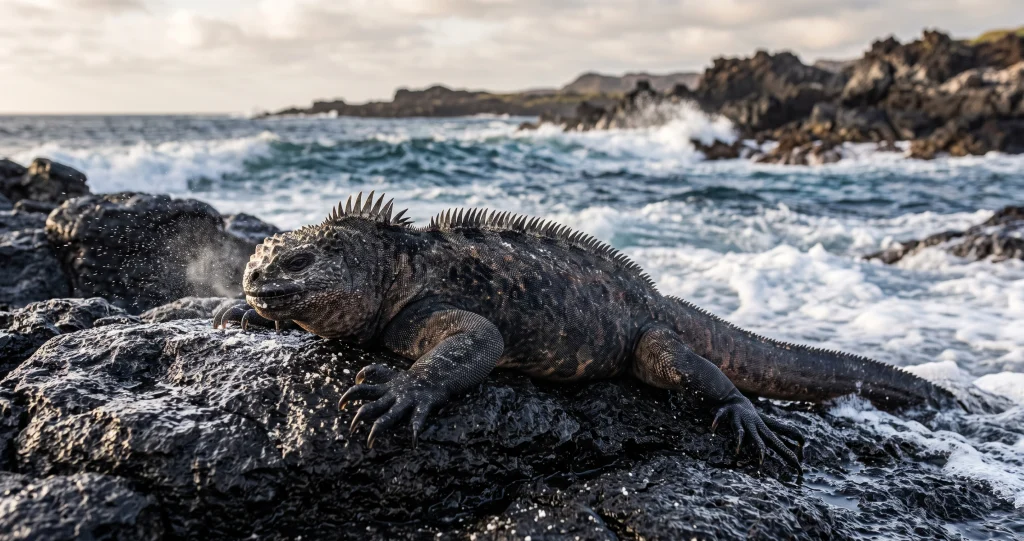
A marine iguana emerging from the Pacific can look as though it has just sneezed a cloud of seawater from its nose. Moments later, pale crystals may begin accumulating around its nostrils and snout.
This behavior is not simply a consequence of getting water in the nose. It is part of a specialized physiological system that allows the Galápagos marine iguana (Amblyrhynchus cristatus) to exploit a food source that almost no other living lizard can use.
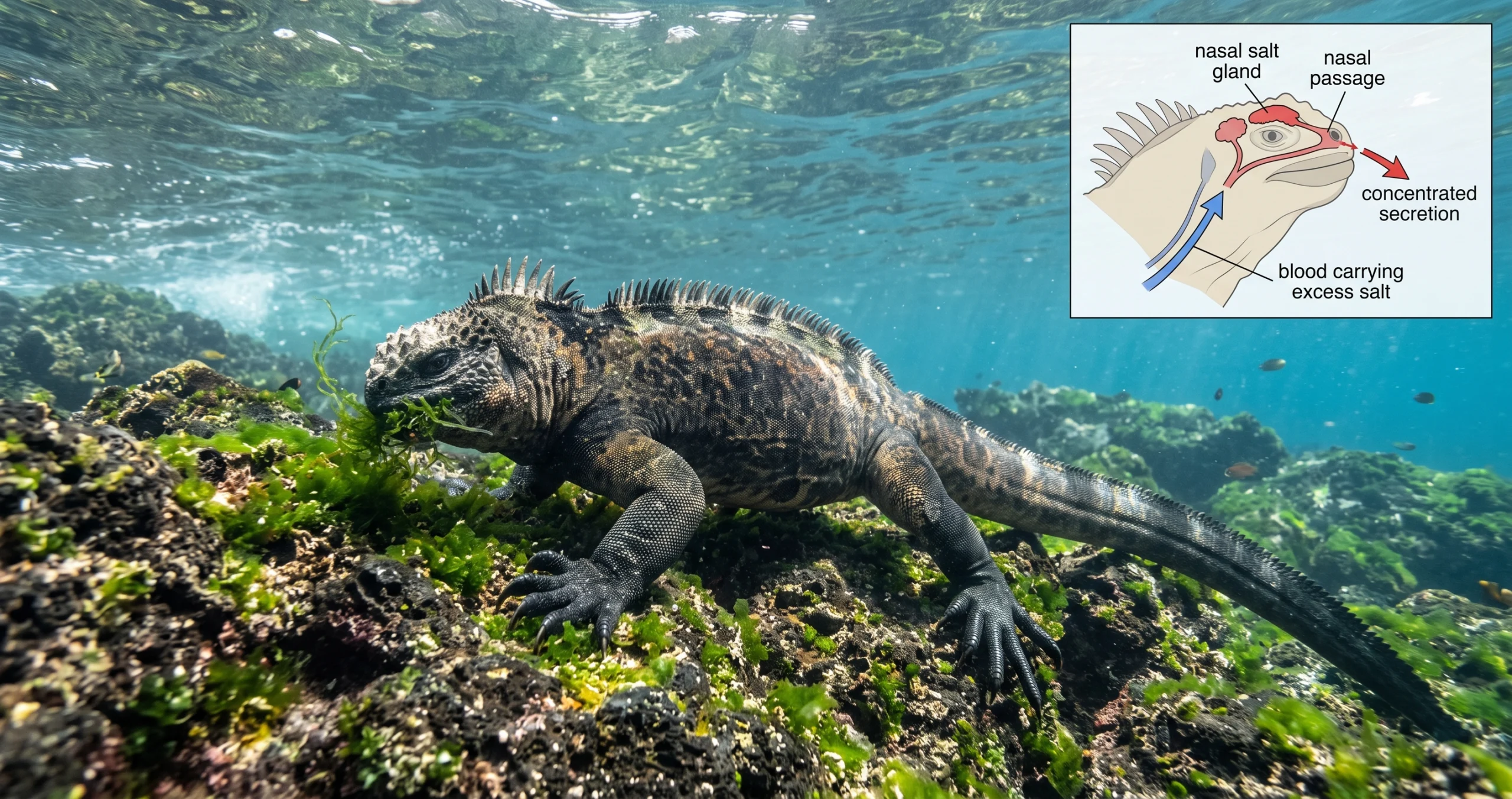
Marine iguanas feed primarily on marine algae growing along rocky shores and beneath the water. That diet exposes them to unusually large quantities of sodium, chloride, and other ions. Their kidneys alone are poorly suited to eliminating such a salt load while conserving water. Instead, marine iguanas possess highly developed nasal salt glands that actively remove excess ions from the bloodstream and discharge a concentrated secretion into the nasal passages.
The familiar “salt sneeze” is therefore the visible end of a remarkable osmoregulatory process.
Meet the World’s Marine Iguana
Marine iguanas are endemic to the Galápagos Archipelago, meaning wild populations occur naturally nowhere else. They occupy rocky coastal habitats across much of the island chain, although populations differ substantially among islands in body size, appearance, ecology, and genetics. Galápagos conservation organizations describe them as characteristic inhabitants of rocky shorelines throughout the archipelago.
Despite their marine name, these reptiles are not permanently aquatic. Marine iguanas spend most of their lives on land. They rest, bask, reproduce, nest, and regulate their body temperature ashore, but obtain most of their food from the intertidal or subtidal marine environment.
Their primary food consists of macroalgae growing on rocks. Some individuals graze algae exposed during low tide, while larger animals can enter the ocean and forage underwater. This marine food supply opened an ecological opportunity unavailable to the ancestral terrestrial iguanas from which the marine lineage evolved.
Genetic research supports a close evolutionary relationship between Amblyrhynchus, the marine iguana lineage, and the Galápagos land iguanas of the genus Conolophus. The two represent separate evolutionary lineages descended from terrestrial iguanid ancestors that colonized the Galápagos.
Why Ocean Feeding Creates a Salt Problem
Living beside the sea is physiologically very different from feeding in it.
Animal cells function properly only when concentrations of water and dissolved ions remain within appropriate ranges. Sodium and chloride are essential electrolytes, but excessive accumulation can disrupt fluid balance and cellular function.
Marine algae contain salts derived from their seawater environment. Iguanas feeding on these algae therefore ingest substantial amounts of sodium and chloride. Seawater associated with wet algae and feeding surfaces can add to this salt exposure.
Studies of marine iguana physiology have documented unusually high sodium concentrations in their blood compared with many other reptiles, while earlier physiological work demonstrated the importance of their salt glands in eliminating ingested electrolytes.
The challenge is especially important for reptiles because their kidneys do not solve the problem in the same way that highly concentrating mammalian kidneys can.
Marine iguanas therefore use an additional route of salt excretion: specialized extrarenal salt glands.
These glands complement the kidneys rather than replacing them.
Where the Salt Comes From
The marine iguana’s salt burden comes primarily from its marine feeding ecology.
When an iguana scrapes algae from a wave-washed rock, its meal contains far more than plant tissue. Dissolved salts occur within and around the algae, and seawater coats the feeding surface.
The principal ions involved include sodium and chloride, with potassium also contributing to the electrolyte load.
This distinction matters because simplified descriptions sometimes imply that marine iguanas survive by freely drinking seawater whenever they become thirsty. Their physiology should not be interpreted that way.
The important point is that feeding in a saline environment inevitably introduces salts into the body. Marine iguanas have evolved mechanisms capable of handling this exposure, but seawater still presents an osmoregulatory challenge rather than an unlimited source of consequence-free drinking water.
Inside the Nasal Salt Glands
The marine iguana’s most important adaptation for dealing with excess dietary salt lies in its head.
Large paired salt glands are associated with the nasal region and have ducts that deliver their secretion into the nasal passages. Classic physiological studies identified these glands as exceptionally well developed in marine iguanas, reflecting the unusual electrolyte demands created by their diet.
They are not modified kidneys.
They are specialized secretory organs operating outside the renal system, which is why physiologists describe them as extrarenal salt glands.
Their job is to transfer selected ions from the blood into a glandular fluid that can subsequently be expelled from the body.
Marine iguana salt-gland secretions contain sodium, chloride, and potassium. Comparative work on lizard salt glands has shown that their ion composition can vary among species according to diet and physiology. Marine species exposed to sodium-rich food tend to rely heavily on sodium chloride secretion, while terrestrial herbivorous lizards may produce secretions richer in potassium.
How Salt Travels Out of the Body
Salt removal is an active physiological process.
After salts from food enter the digestive system, ions are absorbed into the body’s internal fluids. Circulation transports these ions throughout the animal, including to the tissues supplying the nasal salt glands.
Cells within the glands then transport ions from the blood into the glandular secretion.
Water follows the movement of dissolved substances, producing a salt-rich fluid. That fluid passes through ducts leading toward the nasal cavity.
This system allows the animal to eliminate substantial quantities of electrolytes without depending exclusively on urinary excretion.
The important sequence is therefore:
marine feeding → salt absorption → transport in the blood → glandular ion secretion → movement into the nasal passages → expulsion through the nostrils.
Popular descriptions sometimes compress this into the phrase “marine iguanas sneeze out seawater.” That is useful as a visual shorthand, but physiologically it is incomplete. Much of what is expelled has first been processed by specialized salt glands.
Why Marine Iguanas “Sneeze”
Once salt-gland fluid enters the nasal passages, it still needs to leave the animal.
Marine iguanas accomplish this with forceful expiratory movements through the nostrils. The result resembles a sneeze or snort and can send a fine spray of salty droplets into the air.
Classic studies of iguana salt glands identified this forceful expulsion as the mechanism behind the characteristic snorting behavior.
The behavior should not automatically be interpreted as coughing, a cold, or respiratory disease.
A healthy marine iguana may repeatedly expel salt because its glands are performing an essential osmoregulatory function.
The animal is effectively completing the final mechanical stage of salt excretion.
The White Crust Around the Nose
The salt-removal process also explains one of the marine iguana’s most recognizable facial features.
Not all expelled glandular fluid travels far from the animal. Some droplets remain on the skin around the nostrils and snout.
Water subsequently evaporates.
Dissolved salts do not.
As the fluid dries, salts can crystallize and leave pale or white deposits around the nose and head. The coating can make an iguana appear as though its face has been dusted with powder.
The crust is therefore largely a visible residue of salt excretion rather than evidence that the animal has been coated in dried mucus from a respiratory infection.
Swimming and Underwater Feeding
Salt glands solve only one part of the problem of marine feeding. Reaching underwater algae requires an entirely different suite of functional traits.
The marine iguana’s laterally compressed, flattened tail provides propulsion in the water. During swimming, the body and tail move from side to side, while the limbs contribute far less to propulsion than they do during movement on land.
Strong limbs and long claws become particularly valuable once the animal reaches wave-battered rocks.
The claws help marine iguanas grip irregular volcanic surfaces while feeding in surge and currents. Their relatively blunt snout is also suited to cropping algae close to the substrate.
Foraging behavior varies with body size.
Research indicates that most marine iguanas obtain food in intertidal areas, whereas offshore or deeper subtidal foraging is concentrated among larger individuals, particularly large males. Smaller animals can exploit exposed intertidal algae and make relatively short feeding trips before returning to warmer terrestrial sites.
Body size also varies greatly among island populations, demonstrating that there is no single marine iguana body plan expressed identically throughout the archipelago. Ecological conditions, food availability, thermal constraints, natural selection, and sexual selection all contribute to these differences.
Returning to Land and Warming Up
Entering the ocean creates another major physiological problem: heat loss.
Marine iguanas are ectothermic reptiles. They depend heavily on environmental heat rather than internally maintaining the high, stable body temperatures characteristic of birds and mammals.
Galápagos waters can be surprisingly cool because of ocean currents and upwelling. An iguana entering this water can therefore lose body heat rapidly. Research has shown that the body temperatures of subtidally feeding animals can move toward surrounding water temperature during prolonged immersion.
This creates a tradeoff.
Remaining underwater provides access to food, but prolonged cooling eventually reduces muscular and physiological performance.
Marine iguanas compensate behaviorally by warming themselves on sun-heated volcanic rocks. Before entering the water they can bask, and after a feeding trip they return ashore and absorb heat from solar radiation and warm surfaces.
Body size influences this thermal equation. Larger iguanas cool and warm differently from smaller individuals, helping explain why feeding strategies vary according to size.
The marine lifestyle is therefore not based on a single extraordinary adaptation. Salt secretion, swimming ability, gripping morphology, feeding behavior, digestion, circulation, and behavioral thermoregulation operate together.
Evolution of a Marine Lifestyle
The ancestors of marine iguanas were terrestrial reptiles.
Over evolutionary time, access to coastal algae offered an unusual food resource. Individuals capable of exploiting the intertidal zone would have encountered new selective pressures: high salt intake, waves, currents, cold water, slippery rocks, and the need to return repeatedly to land.
The modern marine iguana represents the accumulated result of adaptation to these conditions.
Its flattened tail improves aquatic propulsion. Powerful claws assist attachment to rocks. Its feeding morphology facilitates grazing. Physiological mechanisms permit activity across dramatic temperature changes, while its enlarged nasal salt glands provide a route for eliminating the electrolytes acquired from a marine diet.
Genomic and phylogenetic studies also show that marine iguanas are closely related to Galápagos land iguanas while representing their own distinct lineage.
Marine feeding consequently represents one of the most striking ecological transitions among living lizards.
Conservation Challenges
Extreme specialization has allowed marine iguanas to occupy a remarkable niche, but it also ties their survival closely to the health of Galápagos coastal ecosystems.
Changes in ocean conditions can strongly affect their algal food.
El Niño events are particularly important. Warmer surface waters can reduce the availability or nutritional quality of algae normally consumed by marine iguanas, producing severe food shortages and substantial mortality in affected populations. Research has shown that large individuals can be especially vulnerable when environmental conditions deteriorate.
Climate change adds concern because changes in ocean temperature, marine productivity, extreme climatic events, and ecosystem structure may alter the conditions on which marine iguanas depend.
Introduced predators are another problem. Feral cats and other non-native animals can prey on iguanas or vulnerable life stages. Pollution and marine debris also threaten Galápagos coastal ecosystems. Conservation organizations consequently combine population research, invasive-species control, biosecurity, marine protection, and long-term ecosystem monitoring.
Protecting marine iguanas requires protecting both sides of their existence: the volcanic coastline where they bask and reproduce and the marine ecosystem where they feed.
Common Misconceptions
Salt glands are not kidneys
Marine iguanas have ordinary reptilian kidneys as well as specialized nasal salt glands. The glands provide an additional pathway for eliminating excess electrolytes.
The “sneeze” is not simply seawater trapped in the nose
The expelled fluid includes concentrated secretion produced by salt glands and delivered into the nasal passages.
Snorting does not automatically indicate illness
Forceful nasal expulsion is a normal part of salt regulation in marine iguanas.
Marine iguanas do not live permanently underwater
They feed in marine environments but spend most of their time on land, where they bask, rest, reproduce, and nest.
Not every marine iguana is a deep diver
Intertidal grazing is extremely important. Larger individuals, particularly males, are disproportionately represented among animals that undertake offshore or deeper underwater foraging.
FAQ
What do marine iguanas eat?
Their diet consists primarily of marine macroalgae growing on rocky shores and underwater substrates. Feeding strategy varies with body size and local environmental conditions.
How do marine iguanas get excess salt in their bodies?
Salt enters primarily in association with marine algae and the seawater surrounding their food. Sodium, chloride, potassium, and other ions are absorbed through the digestive system.
How do marine iguanas remove salt?
Specialized nasal salt glands extract excess ions from the blood and produce a concentrated secretion. The fluid enters the nasal passages and is forcefully expelled through the nostrils.
Are marine iguana salt glands part of the kidneys?
No. They are separate extrarenal glands. The kidneys continue performing their normal roles while the nasal glands provide an additional mechanism for electrolyte regulation.
Why do marine iguanas have white noses?
Salt-rich droplets expelled from the nostrils can remain on the skin. When the water evaporates, crystallized salts leave pale deposits around the snout.
Why do marine iguanas bask after swimming?
Cold seawater removes heat from their bodies. Because marine iguanas are ectothermic, returning to sun-warmed rocks helps restore body temperature and physiological performance.
Do all marine iguanas dive for algae?
No. Intertidal feeding is common, particularly among smaller individuals. Larger animals are better represented among subtidal divers, and feeding patterns can differ among islands and populations.
Conclusion
Marine iguanas demonstrate how evolution can solve several interconnected physiological and ecological problems at once.
Feeding on marine algae gives these Galápagos reptiles access to a valuable coastal resource, but it also exposes them to large quantities of salt. Their kidneys alone are not the entire solution. Specialized nasal salt glands remove excess ions from the bloodstream, concentrate them into glandular fluid, and deliver that secretion into the nasal passages. Forceful expiration then ejects the salty fluid through the nostrils, sometimes leaving a conspicuous white crust after the remaining water evaporates.
That mechanism works alongside a much broader set of adaptations. A flattened tail propels the animal through water, powerful claws secure it against volcanic rocks, feeding behavior changes with body size and environmental conditions, and repeated basking compensates for the heat lost during immersion.
The result is an animal occupying an ecological niche unlike that of any other living lizard.
Protecting this unusual physiology ultimately means protecting the ecological system that made it possible: productive coastal waters, healthy algal communities, predator-controlled nesting areas, and the interconnected terrestrial and marine habitats of the Galápagos.
Suggested Internal Links
These existing articles from Secrets of the Green Garden are relevant for expanding the marine-ecology context:
Coral Polyps Explained: Why Coral Reefs Come Alive at Night — useful as a related article about specialized feeding adaptations and marine ecosystems.
Secrets of the Green Garden — use the site’s existing wildlife and marine-life content for additional contextual links as relevant. No unverified article URLs have been invented.
Category: Wildlife
Tags: Marine Iguana, Galápagos Islands, Amblyrhynchus cristatus, Reptiles, Salt Glands, Osmoregulation, Marine Adaptations, Galápagos Wildlife, Animal Physiology, Marine Ecology, Evolution, Algae, Reptile Adaptations, Wildlife Conservation, Ocean Wildlife
Scientific Sources
The physiological explanation is based primarily on classic and modern research into reptilian salt glands, marine iguana blood chemistry, thermal physiology, foraging ecology, and evolutionary biology. Peer-reviewed sources include research summarized through PubMed, PMC, Evolution, and comparative physiological literature.
Conservation and distribution information is supported by Galápagos Conservancy material covering marine iguanas, invasive species, marine ecosystem protection, and the effects of El Niño on Galápagos wildlife.