
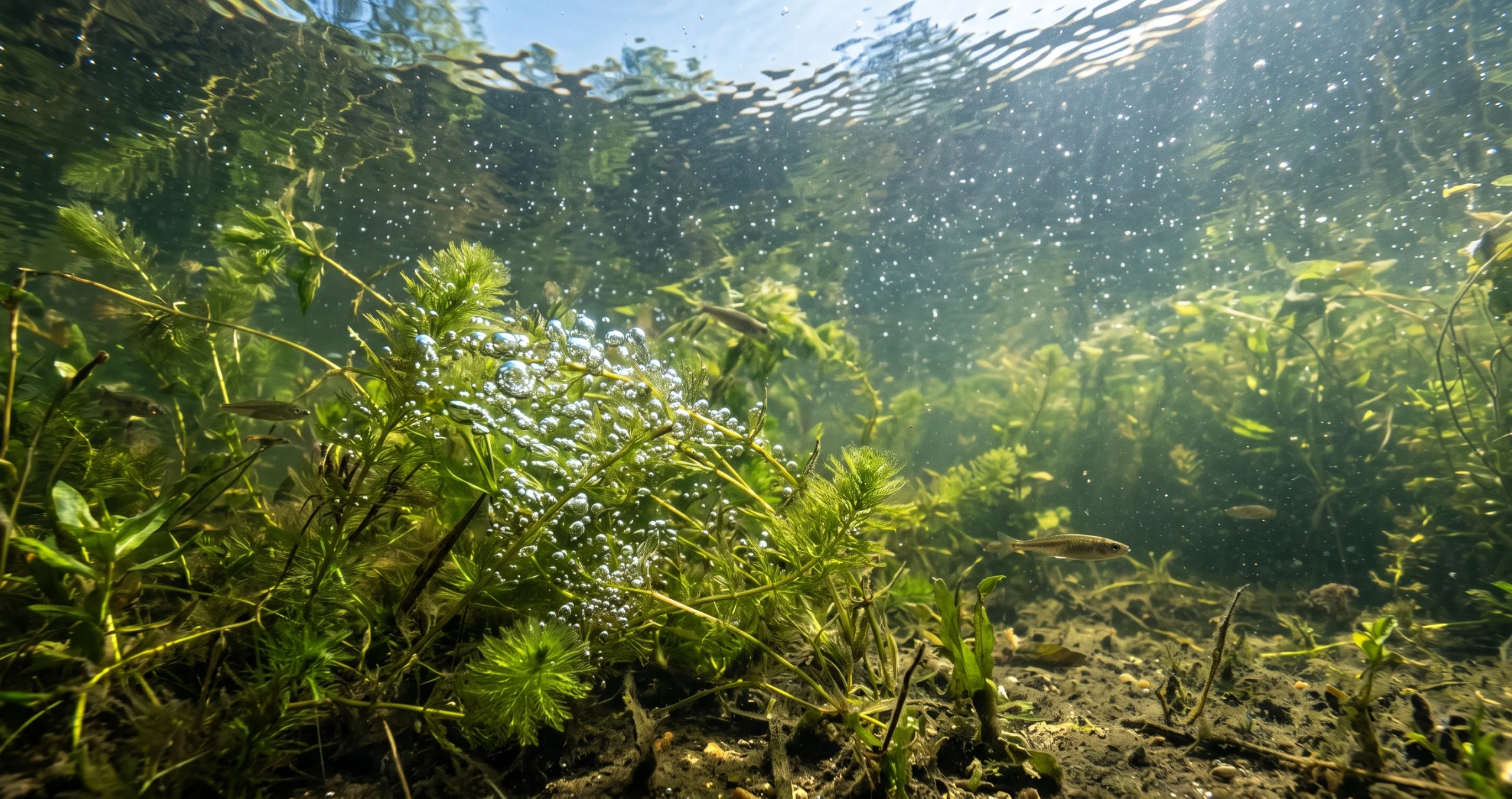
Spiders have colonized forests, deserts, caves, gardens, and even the edges of freshwater ponds, but one species has taken aquatic life much further. The diving bell spider (Argyroneta aquatica) spends almost its entire life underwater, breathing air stored inside a remarkable submerged silk structure. The diving bell spider air bubble is more than a temporary oxygen tank: research has shown that it can function partly like a physical gill, drawing dissolved oxygen from the surrounding water.
This unusual adaptation allows the spider to hunt, rest, digest prey, molt, mate, and reproduce beneath the surface. It still depends on atmospheric oxygen and occasionally visits the surface, but its daily life is more completely aquatic than that of any other known spider.
Understanding how it accomplishes this requires a closer look at silk, water chemistry, spider anatomy, and one exceptionally clever solution to the problem of breathing underwater.
Table of Contents
- What Is a Diving Bell Spider?
- Where Diving Bell Spiders Live
- How the Diving Bell Spider Air Bubble Is Built
- How the Spider Carries Air Underwater
- Why the Diving Bell Works Like a Physical Gill
- Why the Air Bubble Eventually Shrinks
- How Often the Spider Must Visit the Surface
- How Diving Bell Spiders Hunt
- Life Inside the Diving Bell
- Mating and Reproduction Underwater
- Males and Females Live Differently
- Common Myths About Diving Bell Spiders
- FAQ
- Conclusion
What Is a Diving Bell Spider?
The diving bell spider, Argyroneta aquatica, is a freshwater spider belonging to the family Dictynidae. It is also commonly called the water spider.
Unlike spiders that occasionally dive to escape predators or capture aquatic prey, Argyroneta has shifted nearly its entire active life below the surface.
It inhabits calm or slow-moving freshwater environments containing abundant submerged vegetation. Plants are essential because they provide anchoring points for the silk structures that make its underwater lifestyle possible.
The spider itself still breathes atmospheric oxygen.
It has not evolved gills like a fish.
Instead, it brings the atmosphere underwater with it.
Where Diving Bell Spiders Live
The species occurs across a broad Palearctic distribution, including much of Europe and parts of northern and central Asia. It is particularly associated with ponds, marshes, canals, slow-moving streams, and other freshwater habitats rich in aquatic vegetation.
Clean, relatively calm water is especially useful.
Strong currents would make maintaining a delicate silk-and-air structure considerably more difficult, while submerged plants provide the framework on which the spider builds.
The species can remain surprisingly inconspicuous even where it occurs.
Most people looking at a vegetated pond would never realize that a spider might be living beneath the surface nearby.
Its underwater appearance can also be deceptive. Air trapped around the spider’s abdomen and body hairs can create a silvery appearance, which contributed to the genus name Argyroneta, referring to a “silver spinner.”
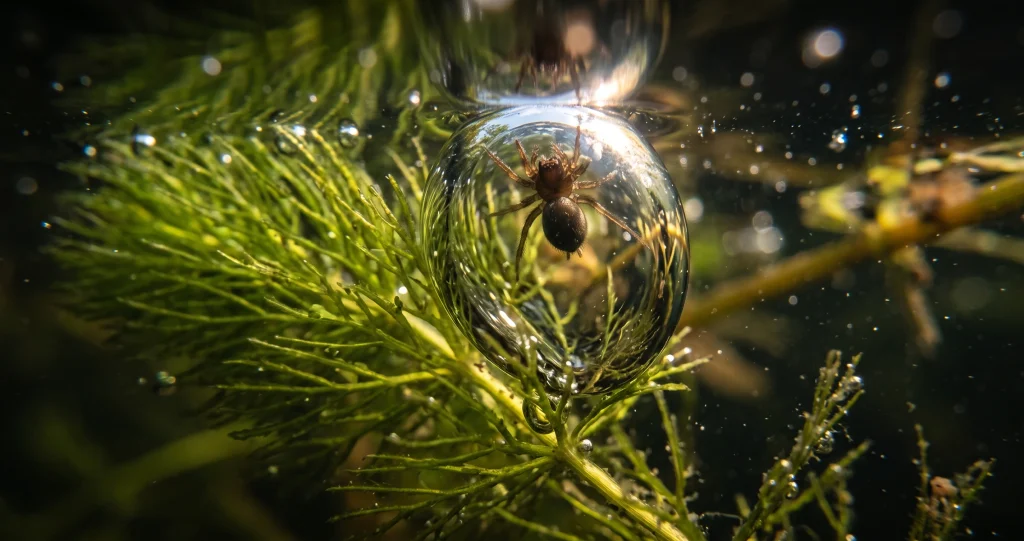
[Image placement: Macro underwater photograph or scientifically accurate illustration of a diving bell spider beneath aquatic vegetation beside its silk air chamber. Alt text: “diving bell spider air bubble anchored to underwater vegetation”]
How the Diving Bell Spider Air Bubble Is Built
The spider’s underwater home begins with silk.
It spins a sheet or dome-shaped web among submerged plants, creating a framework capable of trapping air.
At first, however, the structure contains little or no useful air.
The spider must fill it.
It swims to the surface, where it captures atmospheric air against its body. It then dives back to the submerged web carrying that air with it.
Once underneath the silk canopy, the spider releases the air into the structure.
One trip is not necessarily enough.
It repeatedly travels between the bell and the surface, transporting additional air until the submerged chamber expands into a usable bubble.
The silk helps stabilize the interface between the trapped gas and surrounding water.
The result resembles a tiny underwater diving bell—hence the spider’s common name.
How the Spider Carries Air Underwater
Transporting a useful quantity of air underwater requires specialized anatomy.
The spider’s abdomen is covered with water-repellent, or hydrophobic, hairs. Air adheres to these hairs when the spider contacts the atmosphere.
An air film also forms around parts of the body.
As the spider descends, this layer gives it a striking silvery appearance.
The transported gas can then be transferred into its silk chamber.
This ability is crucial because the spider breathes using book lungs rather than aquatic gills. Its respiratory system therefore needs access to gas-phase oxygen.
The diving bell spider air bubble creates precisely that environment.
Instead of fundamentally changing how a spider breathes, evolution changed where it can obtain the air needed to breathe.
Why the Diving Bell Spider Air Bubble Works Like a Physical Gill
For many years, it was easy to imagine the diving bell as little more than a stored tank of atmospheric air.
The real system is more sophisticated.
Researchers Roger Seymour and Stefan Hetz investigated gas exchange in diving bell spiders and demonstrated that the bell can act as a physical gill.
Their work, published in the Journal of Experimental Biology, examined oxygen concentrations around occupied diving bells and measured how gases moved between the water and trapped air.
The research is available through the Journal of Experimental Biology study on the diving bell and gas exchange.
The principle depends on differences in gas concentration and partial pressure.
A resting spider consumes oxygen from the bell. As the oxygen concentration inside decreases, oxygen dissolved in the surrounding water can diffuse across the air-water boundary and enter the bubble.
In suitable oxygenated water, this process replenishes some of what the spider consumes.
That is why calling the structure an “air tank” alone misses an important part of the story.
The bell interacts continuously with its aquatic environment.
Oxygen Moves In, but Nitrogen Moves Out
If oxygen can enter the bell from surrounding water, it might seem as though the bubble should last indefinitely.
It does not.
The problem involves nitrogen.
Atmospheric air is mostly nitrogen, and the spider does not consume that nitrogen for respiration. Nevertheless, nitrogen inside the bubble can gradually diffuse into the surrounding water.
As gas is lost, the bell shrinks.
The spider therefore faces two simultaneous processes.
Oxygen consumed through respiration can be partially replaced by oxygen diffusing from the water, helping extend the useful life of the bell.
At the same time, nitrogen loss gradually reduces the total gas volume.
Eventually the spider needs to return to the surface and add fresh atmospheric air.
This balance between oxygen replenishment and nitrogen loss is central to understanding the diving bell spider air bubble.
Why the Bubble Lasts Longer Than Expected
The physical-gill effect dramatically changes how often the spider needs to surface.
If the bell were merely a sealed oxygen reservoir, the spider would have to refill it whenever its stored oxygen became depleted.
Instead, dissolved oxygen entering from the water can supply a significant portion of the spider’s respiratory requirements while it rests.
Seymour and Hetz found that under their experimental conditions, spiders could potentially remain below the surface for more than a day before needing to replenish their bells.
That does not mean every wild diving bell spider always surfaces on a fixed 24-hour schedule.
Water temperature, oxygen concentration, activity level, bell size, spider size, and other environmental conditions can influence gas exchange and oxygen demand.
A spider chasing prey uses more energy than one sitting quietly inside its bell.
The important finding is that the bell can extend underwater residence far beyond what would be expected from a simple sealed pocket of air.
A Stealth Advantage of Staying Underwater
Long periods between surface visits may provide another benefit: avoiding detection.
Every trip to the surface creates movement.
That movement can potentially expose the spider to predators or reveal its location to prey.
A physical gill that extracts oxygen from the water reduces the need for frequent surfacing.
Researchers have suggested that this could provide an ecological advantage by allowing the spider to remain concealed underwater for extended periods.
The diving bell spider air bubble is therefore not only a respiratory adaptation.
It may also support the spider’s secretive hunting lifestyle.
How Diving Bell Spiders Hunt
The diving bell is both a respiratory chamber and a base of operations.
The spider is a predator, feeding on small aquatic animals such as insect larvae and crustaceans.
It can detect vibrations transmitted through nearby silk and water.
When potential prey approaches, the spider can leave its bell, capture the animal, and bring it back.
The bell provides an air-filled location where feeding can take place.
This is especially useful because many spider feeding processes evolved for terrestrial conditions rather than complete immersion.
Like other spiders, Argyroneta aquatica uses venom to subdue prey and digestive enzymes to liquefy tissues before consuming them.
Its aquatic adaptation therefore combines familiar spider biology with a radically unusual habitat.
For another example of an arachnid adapting its hunting behavior to unusual environmental conditions, readers can explore our article about how giant huntsman spiders use speed and ambush rather than capture webs.
Life Inside the Diving Bell
Calling the structure a “home” is unusually appropriate.
The spider spends substantial periods inside it.
Different bells can serve different purposes, including resting, feeding, molting, mating, and reproduction.
The chamber provides a gas-filled environment around the spider while remaining submerged and concealed among vegetation.
This has an important consequence.
The diving bell spider does not merely visit underwater habitat to hunt.
Its fundamental life processes have become integrated into an underwater existence.
Even molting—a vulnerable period when an arthropod sheds its old exoskeleton—can occur within an air-filled submerged chamber.
That is why Argyroneta aquatica is generally regarded as the only spider that lives almost entirely underwater.
Hunting Still Requires Leaving the Bell
Despite the security of its silk chamber, the spider cannot simply remain inside permanently.
It must interact with the surrounding aquatic environment.
When hunting, it moves through submerged vegetation and water, carrying an air film on its body.
The water-repellent hairs that facilitate air transport also help maintain access to air around its respiratory openings during excursions.
This allows the spider to operate underwater while searching for prey.
Once a suitable animal is captured, the diving bell can provide a protected location for handling and consuming it.
The system effectively gives a terrestrial air-breathing predator a functioning underwater base.
Mating and Reproduction Underwater
The diving bell is also central to reproduction.
Both sexes construct bells, although their size and use can differ.
During mating, a male may construct a bell close to that of a female. The two structures can be connected, allowing mating to take place in an air-filled underwater environment.
Females later construct specialized reproductive chambers.
A female lays eggs inside a silk egg sac associated with her bell and guards the developing young.
The offspring therefore begin life in the same unusual boundary between terrestrial and aquatic biology that defines the adults.
They are spiders breathing atmospheric oxygen while physically surrounded by freshwater.
Males and Females Are Unusual for Spiders
Diving bell spiders also challenge another familiar spider pattern.
In many spider species, females are substantially larger than males.
In Argyroneta aquatica, males are unusually large relative to females and may be larger on average.
One proposed explanation involves locomotion.
Research has examined whether larger males may move more efficiently through water because their longer legs can improve underwater movement, potentially helping them travel in search of females.
Males tend to spend more time moving outside their bells, while females are more closely associated with their chambers, especially during reproduction.
This creates different energetic and ecological pressures on the sexes.
The underwater environment has therefore influenced more than respiration.
It appears to have shaped movement, reproduction, and possibly even the species’ unusual pattern of sexual size differences.
Is the Diving Bell Really a Bubble?
The word “bubble” is convenient but slightly misleading.
A free bubble released underwater naturally rises toward the surface.
The spider’s air supply remains submerged because silk attaches and stabilizes the gas against aquatic vegetation.
It is better imagined as an air-filled silk chamber than as a loose bubble.
The silk structure holds the gas in a useful location while still leaving an interface through which gases can diffuse between water and air.
That combination is what makes the system so effective.
Common Myths About Diving Bell Spiders
Myth 1: The Spider Has Gills
It does not possess biological gills like a fish.
The term “physical gill” describes the gas-exchange behavior of the air bubble, not a specialized respiratory organ growing from the spider.
The spider itself still breathes atmospheric oxygen.
Myth 2: It Never Needs to Surface
The diving bell greatly reduces the need for surface trips, but it cannot eliminate them forever.
Nitrogen gradually diffuses out, causing the bell to shrink. The spider eventually replenishes it with atmospheric air.
Myth 3: The Bubble Contains a Permanent Supply of Oxygen
The diving bell spider air bubble is dynamic.
Oxygen is consumed by the spider, oxygen can enter from surrounding water, and nitrogen is gradually lost.
Its composition changes over time.
Myth 4: The Spider Simply Traps One Bubble and Lives in It Forever
Building and maintaining a bell requires work.
The spider transports air from the surface and can add more when the chamber shrinks or needs maintenance.
Myth 5: It Can Breathe Water Directly
The spider is not extracting dissolved oxygen through ordinary spider lungs while those organs are flooded with water.
Instead, dissolved oxygen diffuses from the water into the gas phase of the bell, where it becomes available to the spider’s air-breathing respiratory system.
Myth 6: Diving Bell Spiders Live in the Ocean
They are freshwater spiders.
They inhabit ponds, marshes, canals, and slow-moving freshwater habitats rather than marine environments.
Myth 7: They Spend Every Second Underwater
“Full-time underwater” refers to their extraordinary aquatic lifestyle, not a literal prohibition against reaching the surface.
They still make surface trips, particularly when collecting fresh air for their bells.
FAQ
What is a diving bell spider?
The diving bell spider, Argyroneta aquatica, is a freshwater spider that spends almost its entire life underwater.
It constructs a silk air chamber that allows it to breathe, rest, feed, molt, mate, and reproduce beneath the surface.
How does a diving bell spider breathe underwater?
It breathes atmospheric oxygen stored in an underwater silk chamber.
As the spider consumes oxygen, additional dissolved oxygen can diffuse from the surrounding water into the bell, allowing the structure to function partly as a physical gill.
How does the spider get air into its bell?
The spider travels to the surface and traps atmospheric air against water-repellent hairs on its body.
It carries that air underwater and releases it beneath a silk canopy attached to aquatic vegetation. Repeated trips enlarge the chamber.
How long does the diving bell spider air bubble last?
There is no single fixed duration under all natural conditions.
Laboratory research indicates that physical-gill action can allow a resting spider to remain submerged for more than a day under favorable conditions, but temperature, dissolved oxygen, activity, and other factors affect how quickly replenishment becomes necessary.
Why doesn’t the bubble float away?
Silk anchors and stabilizes the air chamber among submerged plants.
Without that structure, an ordinary free air bubble would rise toward the surface.
Why does the diving bell eventually shrink?
Nitrogen inside the chamber gradually diffuses into the surrounding water.
Although oxygen can enter from oxygenated water, the loss of nitrogen reduces total gas volume, eventually requiring the spider to bring down fresh air.
What do diving bell spiders eat?
They prey on small aquatic animals, particularly aquatic insect larvae and small crustaceans.
They can capture prey outside the bell and return to the chamber to feed.
Where are diving bell spiders found?
Argyroneta aquatica has a broad distribution across Europe and parts of northern and central Asia.
It favors freshwater habitats with calm or slow-moving water and abundant submerged vegetation.
Are diving bell spiders dangerous to humans?
They are predators capable of biting, but they are not regarded as a major danger to humans.
They are generally secretive aquatic animals with little reason to interact with people.
Is the diving bell spider the only fully aquatic spider?
It is widely recognized as the only spider species that spends virtually its entire life underwater.
Other spiders can swim, dive, hunt aquatic prey, or remain submerged temporarily, but they do not reproduce and conduct nearly their entire life cycle underwater in the same way.
Conclusion
The diving bell spider air bubble is one of the most elegant solutions to an evolutionary problem that seems almost impossible at first.
Spiders evolved as air-breathing animals. Yet Argyroneta aquatica has managed to shift nearly its entire existence beneath freshwater without replacing its basic respiratory system with true aquatic gills.
Instead, it takes the atmosphere with it.
Hydrophobic hairs allow the spider to capture air at the surface. Silk anchored among underwater plants provides a framework in which that air can accumulate into a stable chamber.
But the bell is much more than a stored oxygen tank.
As the spider consumes oxygen, dissolved oxygen in the surrounding water can diffuse into the chamber. That physical-gill effect dramatically extends the period the animal can remain underwater without returning to the surface.
At the same time, nitrogen slowly escapes into the water, causing the bell to shrink.
The spider therefore maintains a constantly changing respiratory system made from silk, atmospheric gas, and the chemistry of the surrounding pond.
Inside and around this chamber, nearly everything happens.
The spider rests there. It handles and digests prey there. It molts underwater, mates underwater, constructs egg sacs underwater, and raises the next generation within the same submerged environment.
The result is not a spider that merely learned how to hold its breath.
It is an air-breathing terrestrial arthropod that transformed a silk web into an underwater respiratory habitat.
And that makes the diving bell spider one of the most remarkable examples of how evolution can solve the same fundamental challenge—obtaining oxygen—in completely different ways.
Related Reading
Explore other remarkable animal adaptations, hunting strategies, and unusual interactions with the environment:
- How Giant Huntsman Spiders Use Speed and Ambush Rather Than Capture Webs — Discover how one of the world’s largest spiders relies on speed, mobility, and ambush hunting instead of building traditional prey-capture webs.
- How Basilisk Lizards Use Physics to Run Across Water — See how basilisk lizards combine specialized anatomy and rapid movements to travel across the water’s surface.
References and Further Reading
For additional scientific information about the diving bell spider, its aquatic lifestyle, respiration, and remarkable underwater adaptations:
- Journal of Experimental Biology — The Diving Bell and the Spider: The Physical Gill of Argyroneta aquatica — Peer-reviewed research examining oxygen exchange, nitrogen loss, and how the spider’s diving bell functions as a physical gill.
- Encyclopaedia Britannica — Water Spider — Authoritative reference information on Argyroneta aquatica, including its diving bell, aquatic lifestyle, and general natural history.
- The Company of Biologists — Journal of Experimental Biology — Scientific journal publishing peer-reviewed research on comparative physiology, biomechanics, respiration, and animal adaptations.