
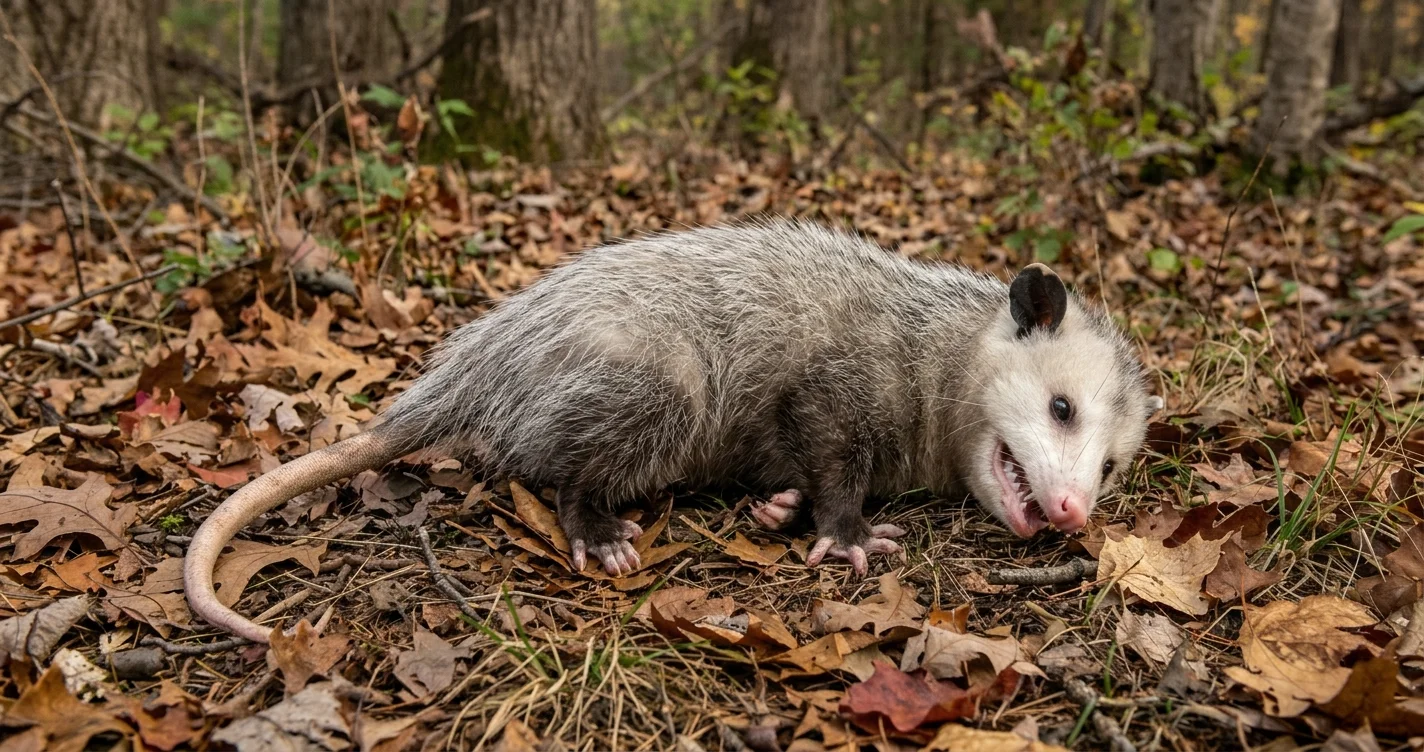
A Virginia opossum confronted by an overwhelming threat may suddenly collapse, become motionless, and appear dead. Its body can go limp, its mouth may remain open, and it may seem completely unresponsive to the world around it. Yet the animal may still be alive.
Understanding why opossums play dead reveals one of the most unusual defensive behaviors among North American mammals. Despite the familiar expression “playing possum,” this response is generally considered involuntary rather than a deliberate trick.
For the Virginia opossum (Didelphis virginiana), appearing dead can be a last-resort defense when escaping or frightening away a predator has failed.
This remarkable behavior also explains why homeowners occasionally discover apparently lifeless opossums in gardens, beneath decks, or near backyard fences, only to find that the animals have disappeared later.
Table of Contents
- Why Opossums Play Dead
- What Happens Before an Opossum Plays Dead?
- What Happens During the Motionless State?
- Is Playing Dead a Conscious Choice?
- How Long Can an Opossum Remain Motionless?
- How This Behavior May Discourage Predators
- What Happens When the Opossum Recovers?
- Do Other Animals Play Dead?
- What to Do If You Find a Motionless Opossum
- Common Opossum Myths
- Frequently Asked Questions
- Conclusion
Why Opossums Play Dead
The Virginia opossum is North America’s only native marsupial found north of Mexico. Although it has sharp teeth and a formidable defensive display, it usually prefers avoiding confrontation.
When escape becomes difficult, an opossum may enter a state of profound defensive immobility.
A Last-Resort Survival Response
Biologists often describe death-feigning behavior using the term thanatosis. Related states of defensive immobility are also studied under the term tonic immobility.
In opossums, the familiar deathlike state typically occurs under intense threat.
The animal may stop moving, lose its normal posture, and appear unresponsive.
This behavior differs from simply freezing momentarily when a potential predator approaches.
Why the Response Is Generally Involuntary
An opossum is not thought to consciously decide to imitate a dead animal in the way a human actor performs a role.
Instead, the response is generally understood as an automatic defensive reaction triggered by severe stress or fear.
The precise neural and physiological mechanisms responsible for this state are not completely understood.
Nevertheless, the distinction is important: the animal should not be treated as though it can voluntarily begin or end the behavior whenever it chooses.
What Happens Before an Opossum Plays Dead?
Opossums do not necessarily collapse at the first sign of danger.
They often display several defensive behaviors before entering a deathlike state.
Attempting to Escape
When confronted by a possible predator, an opossum may initially try to retreat.
It might move toward dense vegetation, climb a tree, or seek shelter beneath a structure.
Avoiding confrontation is generally safer than fighting.
Hissing and Showing Teeth
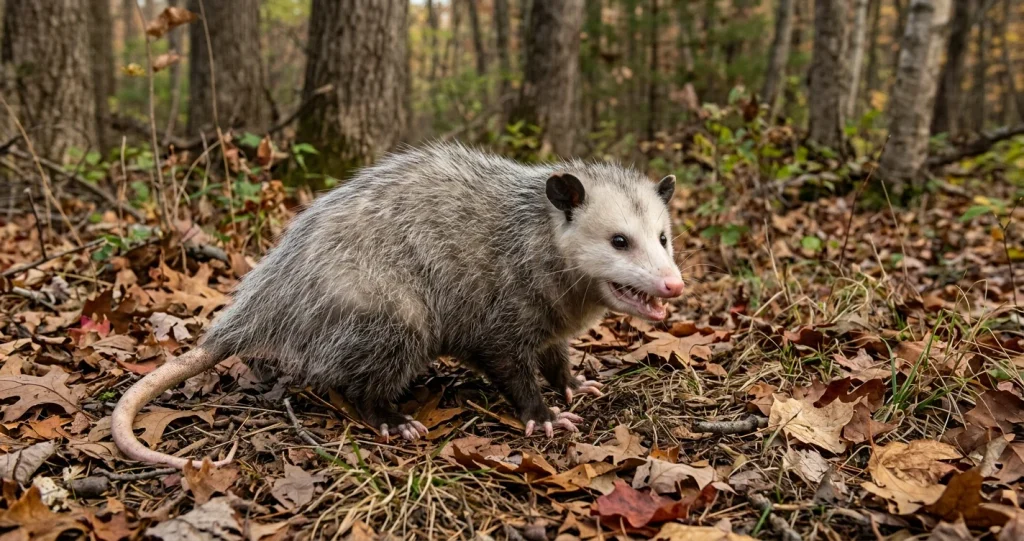
If escape is blocked, an opossum may open its mouth widely, expose its numerous teeth, and hiss.
This display can make the animal appear more threatening.
Opossums have 50 teeth, more than any other native North American land mammal.
Although their defensive appearance can be intimidating, displaying teeth does not necessarily mean the animal intends to attack.
Escalating Defensive Behavior
An opossum may also growl, remain stationary, or attempt to discourage an approaching animal.
If the perceived threat becomes overwhelming, the animal may enter its characteristic deathlike state.
Not every opossum follows the same sequence, and individual responses depend on circumstances.
What Happens During the Motionless State?
When an opossum enters a deathlike defensive state, its appearance can change dramatically.
A Limp Body
The animal may collapse onto its side and remain motionless.
Its normal muscular posture becomes relaxed, creating the appearance of a lifeless body.
The limbs may appear loosely positioned rather than prepared for running or climbing.
Open Mouth and Reduced Responsiveness
An opossum in this state may have its mouth partly open, sometimes with the tongue visible.
Its eyes may remain open or partly closed.
It may show little obvious response to nearby activity.
These signs can resemble serious illness, unconsciousness, or death, making visual identification difficult.
Defensive Odors
Opossums may also release unpleasant-smelling secretions from their anal glands during intense defensive responses.
The odor can contribute to the impression of an animal that is dead or decomposing.
However, the strength and presence of this odor vary, and it should not be treated as a reliable diagnostic sign.
Is Playing Dead a Conscious Choice?
The phrase “playing possum” suggests intentional deception.
However, the scientific understanding of this behavior is more complicated.
Automatic Defensive Responses
In many animals, extreme threats can trigger involuntary changes in movement and responsiveness.
The opossum’s deathlike state is generally described as one of these defensive responses.
The animal is not believed to be consciously planning a performance for a predator.
What Scientists Still Do Not Know
Researchers have not fully established every neurological process involved in opossum death-feigning.
The relationship between stress responses, muscle control, awareness, and recovery remains an area where caution is appropriate.
It is therefore more accurate to describe the behavior as generally involuntary than to make absolute claims about the animal’s conscious experience.
Why This Distinction Matters
An opossum that appears motionless may be experiencing an intense defensive state rather than calmly pretending.
Handling, shaking, or repeatedly approaching the animal may increase stress or create additional danger.
The safest response is to allow the animal space whenever circumstances permit.
How Long Can an Opossum Remain Motionless?
The duration of death-feigning behavior varies.
Some episodes may last only several minutes, while others can continue considerably longer.
Wildlife educational sources commonly describe episodes lasting up to several hours.
Why Duration Varies
The length of the response may depend on the individual animal, the intensity of the threat, and surrounding conditions.
There is no dependable countdown that determines when an opossum will recover.
Why Timing Alone Is Misleading
A motionless opossum should not automatically be considered dead because it has remained still for an extended period.
Likewise, prolonged immobility should not automatically be dismissed as harmless defensive behavior.
Injury, poisoning, severe illness, and other medical emergencies can produce similar appearances.
Observing the animal’s circumstances is more useful than relying on a fixed number of minutes.
How This Behavior May Discourage Predators
Death-feigning is generally interpreted as a defensive adaptation that may reduce the likelihood of an attack continuing.
Reduced Interest in Motionless Prey
Some predators respond strongly to movement.
An animal that suddenly becomes motionless may no longer trigger the same pursuit or attack response.
For certain predators, an apparently dead animal may also be less attractive than active prey.
The Possible Role of Odor
Unpleasant defensive secretions may reinforce the appearance of an unsuitable food source.
However, researchers should not assume that every predator interprets the odor in the same way.
Why the Strategy Is Not Foolproof
Some predators readily consume carrion and may investigate or eat an apparently dead opossum.
Others may continue attacking despite the lack of movement.
Therefore, playing dead does not guarantee survival.
Its potential effectiveness depends on predator behavior and the particular circumstances of the encounter.
What Happens When the Opossum Recovers?
When the defensive state ends, the opossum gradually resumes normal activity.
Returning to Movement
Recovery may begin with subtle movements of the ears, head, or limbs.
The animal may then lift its head, assess its surroundings, and eventually stand or move away.
The exact sequence is not identical in every individual.
Recovery After the Threat Subsides
An opossum is more likely to recover undisturbed when the immediate danger has passed.
Remaining nearby, repeatedly approaching, or attempting to touch the animal can create additional stress.
Returning to Normal Behavior
After recovering, an otherwise healthy opossum may resume walking, climbing, or searching for food.
Virginia opossums are primarily nocturnal omnivores. They consume insects, fruit, small animals, and carrion, among other foods.
Their ability to use both natural and suburban habitats makes them familiar visitors to many American backyards.
Do Other Animals Play Dead?
Death-feigning behavior is not unique to opossums.
Scientists have documented defensive immobility in several animal groups, although the underlying mechanisms and circumstances differ.
Tonic Immobility
Tonic immobility is a state of reduced movement and responsiveness that can occur in response to restraint or extreme threat.
It has been studied in birds, reptiles, mammals, and other animals.
However, not every example of remaining motionless represents the same physiological process.
Insects That Become Motionless
Some beetles and other insects stop moving when disturbed.
Certain species fold their legs against their bodies or remain still after being touched.
This behavior may make them harder for predators to detect or encourage predators to lose interest.
Reptiles That Feign Death
Some snakes display elaborate defensive behaviors involving immobility, unusual body positions, and the release of unpleasant odors.
North American hognose snakes are particularly well known for such displays.
Similar Appearance, Different Mechanisms
The term thanatosis describes death-feigning behavior, but it does not necessarily identify one universal neurological mechanism.
A beetle becoming motionless and an opossum entering a prolonged defensive state may look superficially similar while involving different biological processes.
What to Do If You Find a Motionless Opossum
Discovering an apparently lifeless opossum in the yard can be confusing.
Because defensive immobility can resemble injury or death, a cautious approach is essential.
Observe From a Safe Distance
Avoid approaching closely or touching the animal.
If it is in a safe location, allow time for it to recover without disturbance.
Do not attempt to provoke movement by poking, shaking, or spraying it with water.
Keep Pets and Children Away
Dogs may investigate or attack a motionless opossum, potentially causing serious injury.
Keep pets indoors or restrained until the situation is resolved.
Watch for Signs of Injury
Visible wounds, bleeding, abnormal movement, or a recent vehicle collision may indicate that the animal needs professional help.
However, the absence of obvious injuries does not guarantee that an opossum is healthy.
Contact a Licensed Wildlife Rehabilitator
If injury is suspected, the animal is in immediate danger, or its condition remains uncertain, contact a licensed wildlife rehabilitator or appropriate local wildlife agency.
Do not attempt to feed, medicate, or relocate an unresponsive opossum without professional guidance.
Common Opossum Myths
Myth 1: Opossums Deliberately Pretend to Be Dead
The behavior is generally involuntary and associated with an intense defensive response.
It should not be understood as a consciously planned performance.
Myth 2: Every Opossum Plays Dead When Frightened
Opossums may flee, hiss, show their teeth, or display other defensive behaviors.
Death-feigning is not guaranteed in every threatening encounter.
Myth 3: A Motionless Opossum Is Definitely Dead
A death-feigning opossum can remain remarkably unresponsive.
Nevertheless, injury and actual death are also possible explanations.
Myth 4: Playing Dead Always Protects Opossums
Some predators may abandon motionless prey, but others continue attacking or consume carrion.
The strategy does not guarantee survival.
Myth 5: Opossums Are Naturally Aggressive
Virginia opossums generally avoid confrontation when possible.
Hissing and showing teeth are commonly defensive responses rather than evidence of an animal actively seeking conflict.
Frequently Asked Questions
1. Why do opossums play dead when frightened?
Virginia opossums may enter an involuntary defensive state during overwhelming threats. Remaining motionless and appearing dead may discourage some predators from continuing an attack.
2. Can an opossum control when it plays dead?
The response is generally considered involuntary. An opossum is not believed to consciously activate or stop the state at will.
3. How long can an opossum play dead?
Episodes vary from minutes to several hours. The duration depends on the animal and circumstances, so no exact recovery time can be guaranteed.
4. Do opossums release an odor when playing dead?
They may release foul-smelling anal gland secretions during intense defensive responses. This odor can contribute to their deathlike appearance.
5. Can a sleeping opossum look like it is playing dead?
Yes. A resting opossum may be mistaken for one in a defensive state, but ordinary sleep differs from prolonged, reduced responsiveness. Injury or illness can also cause immobility.
6. Should I touch an opossum that appears dead?
No. Avoid unnecessary handling and keep pets away. If injury is suspected or the animal is in danger, contact a licensed wildlife rehabilitator for guidance.
Conclusion
Understanding why opossums play dead reveals a remarkable survival response that is far more complicated than a simple act of deception.
When confronted with overwhelming danger, a Virginia opossum may enter an involuntary state of defensive immobility, becoming limp or unusually unresponsive while appearing lifeless.
This response may discourage certain predators, particularly when combined with the animal’s motionless posture and unpleasant defensive secretions.
However, it does not guarantee safety, and not every opossum responds to threats in the same way.
For homeowners and wildlife enthusiasts, the most important lesson is to respect the animal’s space.
A motionless opossum may simply need an undisturbed opportunity to recover, while an injured animal may require professional wildlife care.
Behind the familiar expression “playing possum” lies one of North America’s most fascinating examples of mammalian defensive behavior.
External Sources
1. Smithsonian’s National Zoo — Virginia Opossum https://www.nationalzoo.si.edu/animals/virginia-opossum Species biology, defensive behavior, habitat, and natural history.
2. Washington Department of Fish and Wildlife — Opossums https://wdfw.wa.gov/species-habitats/species/didelphis-virginianus Defensive displays, death-feigning behavior, recovery, and wildlife management.
3. North Carolina Wildlife Resources Commission — Virginia Opossum https://www.ncwildlife.gov/species/virginia-opossum Opossum behavior, signs of illness, and guidance for injured wildlife.