
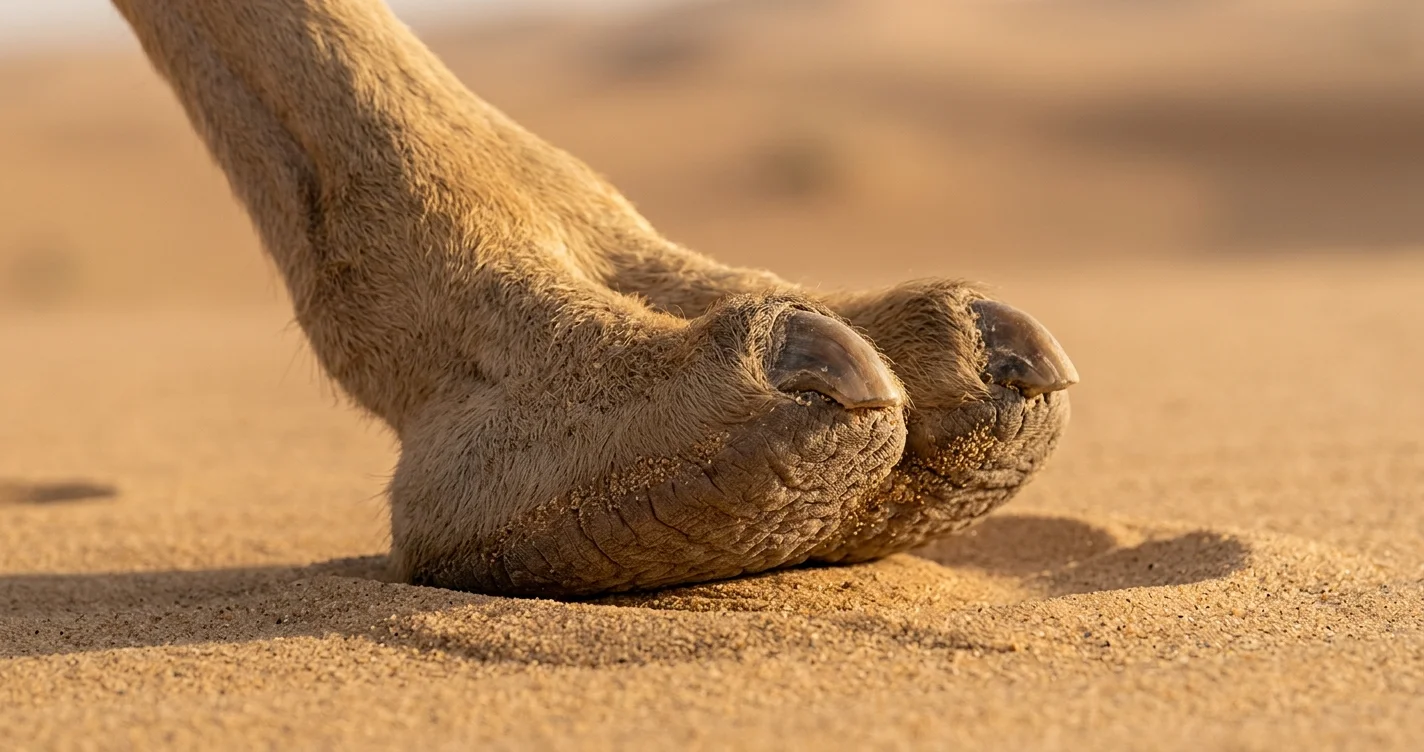
Camels do not walk on hard, horse-like hooves. Instead, their feet have two toes supported by broad, cushioned pads that help distribute their weight across soft ground. This unusual anatomy is one of the reasons camels can travel across sandy deserts more effectively than many other large mammals.
The structure of camel feet combines flexible toes, tough skin, and specialized cushioning tissues. Together, these features help camels maintain stability, absorb impact, and move across challenging terrain.
Although camels are famous for their humps and ability to conserve water, their feet are equally fascinating examples of adaptation to demanding environments.
Understanding how these structures work reveals the relationship between animal anatomy, movement, and survival in desert landscapes.
Table of Contents
- Camel Feet Anatomy Explained
- The Hidden Cushion Inside a Camel’s Foot
- How Camel Feet Reduce Sinking Into Sand
- Why Camel Footprints Look Different
- Camel Feet Compared With Horse Hooves
- Do All Camel Species Have Similar Feet?
- How Camel Feet Handle Desert Temperatures
- How Camels Move Across Different Terrain
- Other Camel Desert Adaptations
- Common Camel Foot Myths
- Frequently Asked Questions
- Conclusion
Camel Feet Anatomy Explained
Camel feet are specialized structures that differ considerably from the hooves of horses, cattle, and many other hoofed mammals.
Camels belong to the family Camelidae, a group characterized by distinctive limb and foot anatomy.
Two Toes on Each Foot
Each camel foot has two weight-bearing toes.
These toes are positioned side by side and can spread somewhat when the foot contacts the ground.
This arrangement contributes to the broad contact area that makes camel feet well suited to yielding surfaces.
Unlike horses, which primarily bear weight through a single hoof on each limb, camels distribute their weight through a paired-toe system supported by a substantial pad.
Nails Instead of Large Hooves
Camel toes end in hard, nail-like structures.
These nails protect the tips of the toes but do not form the large, weight-bearing hoof capsule seen in horses.
Most of the camel’s weight is supported by the padded underside of the foot rather than the nails alone.
This distinction is essential for understanding camel locomotion.
Broad Footpads
The underside of each foot contains a wide, resilient pad.
Its outer surface is covered with tough, thickened skin adapted to repeated contact with the ground.
Beneath this protective covering are connective tissues and cushioning materials that support the animal’s weight.
The overall structure creates a broad, flexible foundation for movement.
The Hidden Cushion Inside a Camel’s Foot
One of the most remarkable features of camel foot anatomy lies beneath the visible skin.
The footpad contains specialized soft tissues that help support the animal during movement.
Fatty and Fibrous Tissues
Camel footpads contain fatty tissue associated with a network of connective tissue.
The fibrous components help organize and support the cushioning material while resisting deformation under load.
This arrangement creates a resilient structure capable of changing shape as the camel places weight on its foot.
The cushioning system is not simply a loose pocket of fat. It is integrated into the mechanical structure of the foot.
Shock Absorption
Walking generates forces each time a foot contacts the ground.
The compliant tissues within a camel’s footpad can deform under pressure, helping moderate impact and distribute loading.
This cushioning is useful during repeated steps across firm or uneven surfaces.
However, the pad does not eliminate impact forces entirely, and camels can still develop foot injuries.
Weight Distribution
When a camel places its foot on the ground, the soft tissues deform and help spread the load across a relatively broad area.
The footpad therefore functions as both a supporting surface and a mechanical cushion.
Its effectiveness depends on the interaction between the animal’s weight, the foot’s shape, and the properties of the ground beneath it.
How Camel Feet Reduce Sinking Into Sand
The ability to walk across soft sand depends partly on how much force an animal applies to a given area of ground.
Contact Area and Ground Pressure
Pressure is the force applied over a particular area.
For the same downward force, spreading the load over a larger contact area generally reduces average pressure.
Camel feet take advantage of this principle.
Their broad pads create a larger supporting surface than a narrow, rigid hoof would under comparable loading conditions.
This helps reduce the tendency of the feet to penetrate loose sand.
Flexible Footpad Deformation
As the camel’s weight moves onto a foot, its cushioning tissues change shape.
The toes can spread somewhat, and the pad adjusts to the supporting surface.
This flexibility helps maintain contact with uneven sand and distribute forces more effectively.
Camels Can Still Sink
Camel feet do not make the animals weightless or prevent sinking under every condition.
Very loose, deep, or unstable sand may still yield beneath their feet.
The amount of sinking depends on sand compaction, moisture, slope, body weight, and movement.
Camel anatomy reduces some difficulties of traveling over sand rather than eliminating them completely.
Why Camel Footprints Look Different
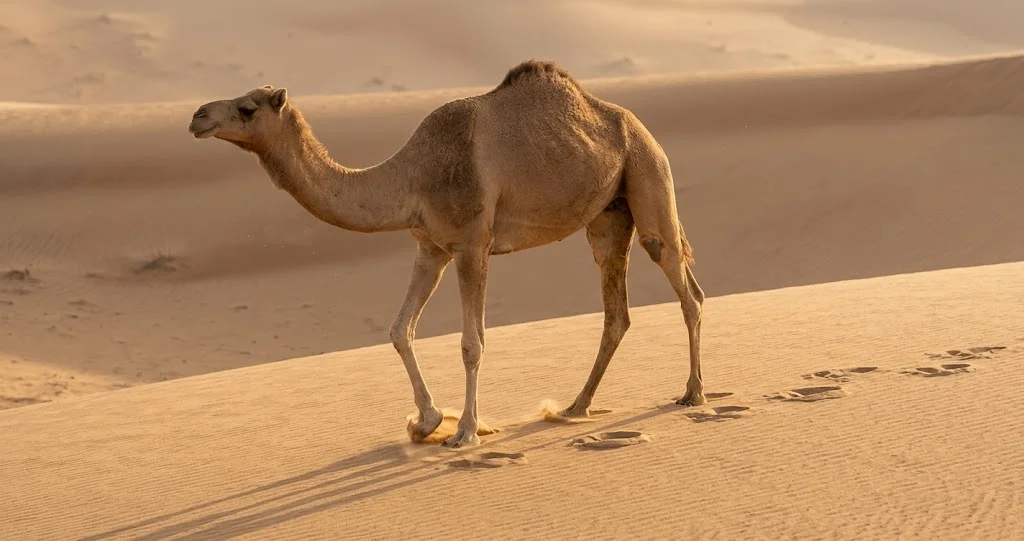
Camel tracks often appear broad and rounded compared with the sharper impressions left by many other hoofed mammals.
Broad Impressions
Because the padded underside contacts the ground, camel footprints can show a relatively wide impression.
The outline may appear oval, rounded, or somewhat irregular depending on how the foot lands.
Toe Markings
The paired toes may leave recognizable markings toward the front of the print.
However, their visibility varies.
On firm ground, the impression may be shallow. In loose sand, the edges may collapse and obscure finer details.
Sand Conditions Matter
Dry, loose sand often produces less sharply defined footprints than damp, compacted sand.
Wind can also alter tracks soon after they form.
For wildlife observers, identifying camel tracks is easier when the overall footprint shape, toe impressions, and sequence of steps are considered together.
Camel Feet Compared With Horse Hooves
Camels and horses are both large herbivorous mammals, but their feet reflect different evolutionary histories and mechanical designs.
| Feature | Camels | Horses |
|---|---|---|
| Weight-bearing toes | Two per foot | One main toe per foot |
| Ground-contact structure | Broad cushioned pad | Hard hoof capsule |
| Toe covering | Nail-like structures | Large keratinized hoof |
| Foot flexibility | Broad pad deforms under load | Hoof is comparatively rigid |
| Notable advantage | Movement over yielding ground | Efficient locomotion on relatively firm ground |
Different Foot Structures
Horse hooves have a tough outer wall and specialized internal tissues that support weight and absorb forces.
Their design is effective for walking and running across many types of terrain.
Camels, by contrast, rely heavily on broad soft-tissue pads.
Neither arrangement is universally superior.
Each reflects a different combination of anatomy, locomotion, body size, and evolutionary adaptation.
Different Terrain Challenges
A horse’s hoof may penetrate loose sand more readily under certain conditions because of its narrower contact area.
A camel’s broad pad can provide an advantage on soft substrates.
However, horses are highly capable travelers, and their performance depends on footing, speed, conditioning, and other factors.
The comparison illustrates how different mammals solve the mechanical challenge of supporting their body weight.
Do All Camel Species Have Similar Feet?
The living members of the genus Camelus share the basic two-toed, padded foot arrangement, although their habitats and overall body characteristics differ.
Dromedary Camels
Dromedaries (Camelus dromedarius) have one hump and are strongly associated with the hot, arid landscapes of North Africa and the Arabian Peninsula.
Their broad footpads are particularly useful when traveling across sandy terrain.
Bactrian Camels
Domestic Bactrian camels (Camelus bactrianus) have two humps and are associated with the colder, often more variable environments of Central Asia.
Wild camels (Camelus ferus) are a separate species also possessing the characteristic padded camel foot.
These camels encounter combinations of sandy, gravelly, and rocky surfaces.
All three share important foot adaptations, but their anatomy and locomotion should not be assumed identical in every detail.
Research comparing camelid feet shows that footpad development and mechanical properties vary across members of the family.
How Camel Feet Handle Desert Temperatures
Desert surfaces can become extremely hot under direct sunlight.
Camel footpads provide a protective interface between the body and the ground, but they do not make the animals immune to heat.
Thick Protective Surfaces
The outer surface of a camel’s footpad is covered with thickened, durable skin.
This helps resist ordinary abrasion and provides some separation between sensitive underlying tissues and the ground.
The cushioning layers also influence how mechanical forces pass through the foot.
Limits of Heat Tolerance
Extreme surface temperatures can still cause tissue damage.
Prolonged contact with very hot ground, especially under unfavorable conditions, may injure the footpads.
Sharp stones, hard surfaces, and repeated friction can also produce wounds.
How Camels Move Across Different Terrain
Although camels are famous for desert travel, they encounter a variety of ground conditions.
Soft Sand
Broad footpads are especially advantageous on loose sand because they spread weight across a relatively large area.
Their flexibility also allows the supporting surface to change shape during each step.
Rocky Ground
Camels can travel over rocky landscapes, but sharp stones and repeated impacts may injure their footpads.
Unlike hard-hooved animals, they lack a large rigid hoof capsule protecting the entire weight-bearing surface.
Mud and Uneven Surfaces
Wet, slippery, or deeply muddy ground creates different challenges.
A broad footpad may provide support, but it does not guarantee traction.
Camels can slip, lose stability, or sink when the substrate is particularly unstable.
Walking Gait
Camels commonly use a pacing gait, moving the front and rear limbs on the same side of the body in a coordinated sequence.
This characteristic contributes to their distinctive swaying movement.
Their foot anatomy works alongside limb mechanics, balance, and body posture to support efficient travel.
Other Camel Desert Adaptations
Camel feet are only one part of a larger collection of adaptations that help these mammals survive in challenging environments.
Water Conservation
Camels can tolerate substantial dehydration and conserve water through physiological mechanisms involving their kidneys, digestive system, and regulation of body temperature.
Their ability to survive periods without drinking varies with environmental conditions, diet, and activity.
Coat Insulation
A camel’s coat helps regulate heat exchange with the environment.
Its insulating properties can reduce heat gain from intense sunlight, although coat thickness differs among species and seasons.
Nostrils and Eyelashes
Camels have nostrils that can narrow to help limit the entry of airborne sand.
Their long eyelashes and protective eyelid structures help shield their eyes from windblown particles.
Fat Storage in Humps
Camel humps contain stored fat rather than reservoirs of drinking water.
This fat provides an energy reserve when food availability is limited.
These adaptations work together, but none makes camels completely resistant to dehydration, extreme heat, or physical injury.
Common Camel Foot Myths
Myth 1: Camels Have Hooves Like Horses
Camels have two toes with nail-like coverings and broad, cushioned footpads.
They do not possess the large, rigid hoof structure characteristic of horses.
Myth 2: Camel Feet Never Sink Into Sand
Broad pads help reduce ground pressure, but camels can still sink into sufficiently loose or unstable material.
Myth 3: Camel Footpads Are Filled With Water
The cushioning tissues contain fatty and fibrous components, not specialized water-storage chambers.
Myth 4: Camels Cannot Injure Their Feet
Camel footpads can suffer cuts, bruising, inflammation, and other injuries, especially on sharp or abrasive surfaces.
Myth 5: Every Camel Has Exactly the Same Foot Structure
Living camels share a recognizable anatomical arrangement, but variation exists among species and individuals.
Frequently Asked Questions
1. How many toes does a camel have on each foot?
A camel has two functional toes on each foot. Both are supported by broad cushioning structures, and each toe ends in a nail-like covering.
2. Why are camel feet so wide?
Their broad footpads help distribute body weight over a larger contact area, reducing average ground pressure and making movement across soft sand easier.
3. Do camels have hooves?
Camels do not have horse-like hooves. Their toes have hard nails, while most of the weight is supported by the padded underside of the foot.
4. Can camel feet get injured?
Yes. Sharp stones, broken glass, hard ground, and other hazards can damage camel footpads. Severe injuries may cause pain and lameness.
5. Are camel feet adapted only for sand?
No. Camels can travel across several types of terrain, including gravel and rocky ground. However, their broad, flexible pads are particularly advantageous on yielding surfaces.
6. Do Bactrian and dromedary camels have the same type of feet?
Both have two-toed feet with broad cushioning pads. Their general anatomical design is similar, although differences in size, proportions, and mechanical characteristics may occur.
Conclusion
The anatomy of camel feet demonstrates how evolutionary adaptations can help large mammals move across challenging environments.
Instead of relying on narrow, rigid hooves, camels use two toes supported by broad, flexible pads containing specialized cushioning tissues.
These structures distribute weight, moderate impact, and help reduce sinking into soft sand.
However, camel feet are not indestructible. Extreme temperatures, sharp objects, and unstable ground can still cause injuries or make movement difficult.
Combined with water conservation, protective coats, and other physiological adaptations, their unusual feet help explain how camels successfully inhabit some of the world’s most demanding landscapes.
The next time a camel crosses a desert dune, its broad footprints reveal an extraordinary example of anatomy working with the physical properties of the environment.
External Sources
1. San Diego Zoo Wildlife Alliance — Camel https://animals.sandiegozoo.org/animals/camel Explains camel species, broad feet, desert survival, and other anatomical adaptations.
2. University of Minnesota — Large Animal Anatomy: Distal Limb https://pressbooks.umn.edu/largeanimalanatomy/chapter/distal-limb/ Describes camel foot anatomy, including the broad weight-bearing pads and their role in sandy terrain.
3. Peer-Reviewed Research — Biomechanical Insights Into the Role of Foot Pads During Locomotion in Camelid Species https://pmc.ncbi.nlm.nih.gov/articles/PMC7051995/ Examines camelid footpad structure and the biomechanical role of cushioning tissues during locomotion.