
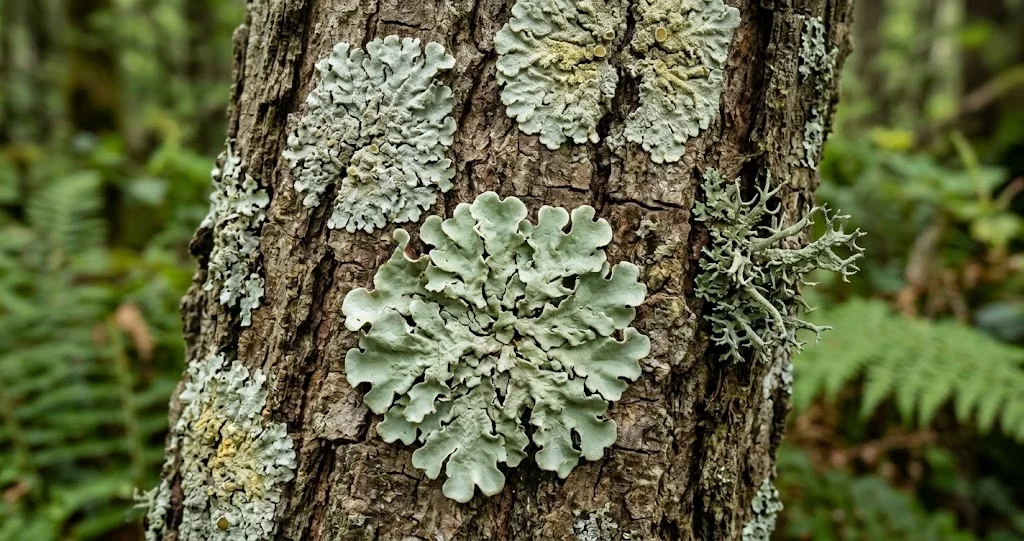
Lichens may look like ordinary plants, mosses, or colorful stains on rocks, but they are something far more unusual. They are not plants, and a lichen is not a single organism in the usual sense. Instead, lichens are biological associations involving a fungus and one or more photosynthetic partners, usually green algae or cyanobacteria.
Understanding what are lichens reveals one of nature’s most remarkable examples of organisms living together. These partnerships create distinctive structures capable of surviving on exposed rocks, aging tree bark, and other surfaces where many plants struggle to grow.
From forest ecosystems to backyard gardens, lichens contribute to biodiversity, nutrient cycling, and the gradual development of soils.
Table of Contents
- What Are Lichens?
- How the Lichen Partnership Works
- The Three Main Lichen Growth Forms
- Where Lichens Grow
- Do Lichens Harm Trees?
- How Lichens Reproduce and Spread
- How Lichens Survive Dry Conditions
- Lichens and Air Quality
- Lichens in Garden and Forest Ecosystems
- Common Lichen Myths
- Frequently Asked Questions
- Conclusion
What Are Lichens?
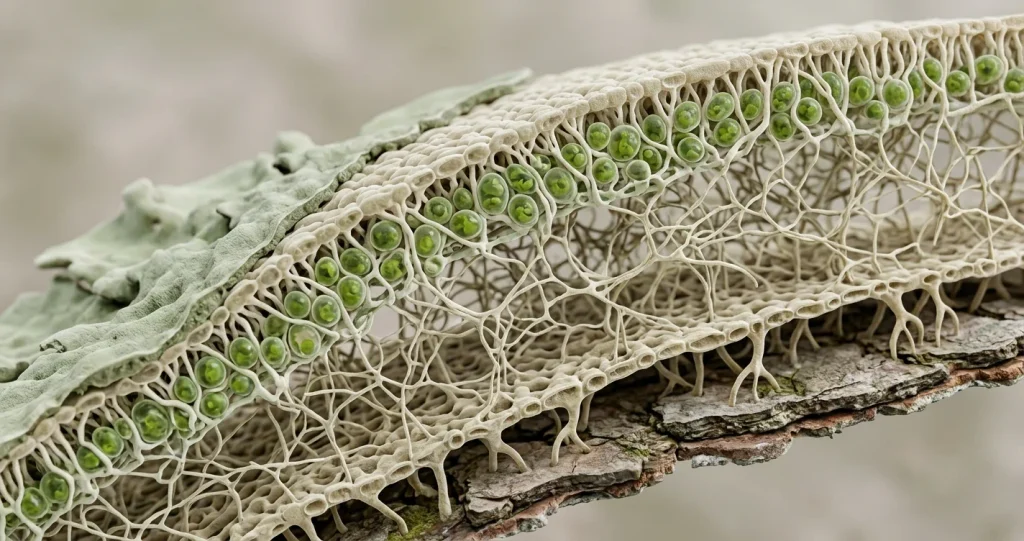
Lichens are associations in which a fungus lives closely with photosynthetic organisms. The visible body formed by this association is called a thallus.
The fungal partner, known as the mycobiont, usually determines the lichen’s overall structure and appearance.
The photosynthetic partner, called the photobiont, uses sunlight to produce organic compounds through photosynthesis.
Lichenized Fungi
Most lichen-forming fungi belong to the fungal group Ascomycota, although some belong to Basidiomycota.
Unlike ordinary green plants, these fungi cannot manufacture sugars through photosynthesis.
Instead, they depend on their photosynthetic partners for an important source of carbon.
Green Algae and Cyanobacteria
Many lichens contain microscopic green algae, while others contain cyanobacteria.
Cyanobacteria are photosynthetic bacteria rather than algae in the strict biological sense.
Some lichens contain both types of photobionts.
Certain cyanobacteria can also convert atmospheric nitrogen into biologically usable forms, making some lichens important contributors to nitrogen cycling.
More Than Two Partners
Modern research has revealed that lichen communities can include additional fungi, bacteria, and other microorganisms.
These organisms may influence the lichen’s structure, physiology, or ecological interactions.
Consequently, lichens are increasingly understood as complex biological systems rather than identical two-organism partnerships.
How the Lichen Partnership Works
The relationship between fungal and photosynthetic partners allows lichens to occupy environments that would be challenging for either partner alone.
The Fungus Provides Structure
The fungal partner forms most of the visible lichen body.
Its network of threadlike cells, called hyphae, creates a structure that holds the photobionts in position and helps regulate their exposure to environmental conditions.
The fungal tissues also contribute to attachment, water retention, and protection.
The Photosynthetic Partner Produces Food
Green algae and cyanobacteria capture sunlight and use it to produce organic carbon compounds.
Some of these compounds become available to the fungal partner.
In return, the fungus provides a structured environment that can offer advantages under particular conditions.
Water and Mineral Interactions
Unlike vascular plants, lichens have no true roots for absorbing water and minerals.
They obtain moisture from rain, dew, fog, and humid air.
Mineral nutrients can come from atmospheric deposits, dust, precipitation, and interactions with the surfaces on which they grow.
A Relationship With Many Variations
The lichen association is frequently described as mutualism, but this description does not capture every biological interaction.
The relative benefits and costs can vary among species and environmental conditions.
In some situations, the fungal partner exerts substantial control over the growth and reproduction of the photobiont.
Lichen biology therefore includes cooperation, dependency, and interactions that are not always equally beneficial.
The Three Main Lichen Growth Forms
Lichens are commonly grouped into three recognizable growth forms.
These categories describe appearance rather than evolutionary relationships.
Crustose Lichens
Crustose lichens form thin, crustlike layers that adhere closely to bark, stone, or other surfaces. They are often difficult to remove without damaging the underlying material.
Foliose Lichens
Foliose lichens have flattened, leaflike lobes. Their bodies are usually attached at multiple points, with portions that can lift away from the surface.
Fruticose Lichens
Fruticose lichens develop branching, shrubby, or hairlike structures. Some stand upright, while others hang from branches in delicate strands.
Where Lichens Grow
Lichens occur across an extraordinary range of habitats, from temperate forests to deserts and polar environments.
Tree Bark
Tree bark provides a stable surface for many lichen species.
Bark texture, acidity, moisture, and exposure to sunlight influence which species become established.
Rocks
Rock-dwelling lichens colonize exposed stone, including granite, limestone, and sandstone.
Some contribute to the gradual weathering of rock through physical and chemical processes.
Soil
Certain lichens grow directly on soil, especially in dry or nutrient-poor environments.
They may form part of biological soil crusts, helping stabilize the surface and reduce erosion.
Artificial Surfaces
Lichens can also colonize walls, gravestones, fences, and roof tiles.
Their presence reflects suitable environmental conditions rather than a requirement for living plant tissue.
Do Lichens Harm Trees?
One of the most common gardening concerns involves lichens growing on trunks and branches.
Fortunately, lichens growing on healthy tree bark generally do not harm the tree.
Lichens Are Not Tree Parasites
Lichens use bark primarily as a surface for attachment.
They do not normally penetrate living tree tissues to steal sugars or nutrients.
Their moisture and nutrient requirements are largely met through atmospheric sources.
Lichens and Tree Disease Are Different
A branch covered in lichens may look unhealthy, but the lichens are not necessarily responsible for any underlying problem.
Poor growth, declining foliage, or dying branches can result from disease, drought, root damage, or other stresses.
Lichens may simply be more visible when a tree’s canopy becomes thinner.
Why Older Branches Often Have More Lichens
Slow-growing branches provide relatively stable surfaces for colonization.
Older bark has also been exposed to airborne lichen propagules for longer periods.
Gardeners should investigate genuine symptoms of tree decline rather than automatically removing harmless lichens.
How Lichens Reproduce and Spread
Lichens have several reproductive strategies.
Some reproduce through fungal spores, while others disperse structures containing both fungal and photosynthetic partners.
Fungal Spores
Many lichen-forming fungi produce spores in specialized reproductive structures.
After dispersal, a fungal spore must encounter a compatible photobiont to establish a new lichen association.
This requirement can make successful establishment challenging.
Soredia
Soredia are tiny dispersal units containing photobiont cells surrounded by fungal hyphae.
Wind, water, or animals may carry them to new locations.
Because both main partners travel together, soredia can help establish new lichens without requiring an immediate encounter between separate organisms.
Isidia
Isidia are small projections that grow from the lichen’s surface.
They contain both fungal and photosynthetic components and can detach to produce new growth.
Fragmentation
Pieces of an established lichen may break away and continue growing when they reach suitable conditions.
Fragmentation is particularly useful for species with branching or loosely attached structures.
How Lichens Survive Dry Conditions
One of the most extraordinary characteristics of lichens is their ability to survive severe drying.
Unlike most garden plants, lichens can tolerate losing much of their water without immediately dying.
Desiccation Tolerance
Many lichens are poikilohydric, meaning their internal water content changes with environmental moisture.
During dry weather, they lose water and greatly reduce metabolic activity.
Photosynthesis and growth may nearly stop until moisture returns.
This ability allows many species to survive prolonged dry periods that would seriously damage ordinary plants.
Rehydration and Recovery
When rain, dew, or humid conditions return, lichens absorb water directly through their surfaces.
Their tissues become hydrated, and metabolic processes can resume.
Under suitable light and temperature conditions, photosynthesis may restart remarkably quickly.
However, lichens are not indestructible. Excessive heat, repeated environmental stress, and prolonged unsuitable conditions can still cause damage.
Why Lichens Grow Slowly
Many lichens grow only a small amount each year, although growth rates vary considerably among species.
Their limited periods of active metabolism, nutrient availability, and environmental conditions contribute to this slow development.
Some established lichens can persist for decades, and certain species may survive much longer.
Their longevity makes them fascinating organisms for studying environmental change.
Lichens and Air Quality
Lichens are widely studied because many species respond to changes in atmospheric pollution.
Their close contact with rainwater and airborne substances makes them useful biological indicators.
Why Pollution Affects Lichens
Because lichens absorb water and nutrients across their surfaces, they can also accumulate substances deposited from the atmosphere.
Certain pollutants, including sulfur compounds and excessive nitrogen deposition, can influence their growth and survival.
However, sensitivity differs significantly among species.
Some lichens decline under particular pollution conditions, while others tolerate or even benefit from increased nutrient availability.
How Scientists Use Lichens for Biomonitoring
Researchers study lichen communities to investigate environmental conditions over time.
They may examine species diversity, abundance, community composition, and concentrations of elements accumulated in lichen tissues.
Lichens Do Not Guarantee Clean Air
Finding lichens on a tree does not prove that the surrounding air is pollution-free.
Some species tolerate polluted environments better than others.
Climate, humidity, bark chemistry, and habitat conditions also influence their distribution.
Reliable environmental assessments require species identification, appropriate monitoring methods, and supporting measurements.
Lichens in Garden and Forest Ecosystems
Although lichens are often overlooked, they contribute to several ecological processes.
Supporting Wildlife
Lichens provide habitat and shelter for small invertebrates.
Some birds use lichen fragments when constructing nests, while certain animals feed on lichens directly.
In northern ecosystems, some ground-growing lichens are particularly important winter forage for caribou and reindeer.
Contributing to Soil Development
Lichens growing on exposed rock can contribute to weathering.
Over time, their activities help create conditions in which other organisms may become established.
When lichen tissues die and decompose, they can also contribute small amounts of organic material to developing soils.
Participating in Nutrient Cycling
Lichens containing nitrogen-fixing cyanobacteria can introduce biologically available nitrogen into ecosystems.
This contribution can be important in nutrient-poor habitats.
Their ecological roles complement those of other fungi, mosses, microorganisms, and plants.
Protecting Lichens in the Garden
Gardeners can support existing lichen communities by preserving suitable bark, stones, and undisturbed habitats.
Avoid unnecessary scraping, pressure washing, or chemical treatments on surfaces where lichens are growing.
Lichens on healthy trees generally require no control measures.
Common Lichen Myths
Myth 1: Lichens Are Mosses
Lichens and mosses are fundamentally different.
Mosses are small, nonvascular plants, while lichens are associations centered on fungi and photosynthetic partners.
Although they sometimes grow together, their biological structures differ.
Myth 2: Lichens Kill Trees
Lichens growing on bark are generally not parasitic and do not normally cause tree decline.
They may become more noticeable on aging or slow-growing branches.
Myth 3: Lichens Are Ordinary Mushrooms
Lichen-forming fungi belong to the fungal kingdom, but the lichen thallus is a specialized association with photosynthetic partners.
Some unrelated fungi produce familiar mushrooms, while a few lichen-forming fungi belong to mushroom-forming fungal lineages.
Myth 4: Every Lichen Benefits Both Partners Equally
Lichen relationships vary in their biological costs and benefits.
The fungus and photobiont do not necessarily gain equal advantages under every environmental condition.
Myth 5: All Lichens Indicate Perfect Air Quality
Different species have different pollution tolerances.
A single lichen’s presence cannot establish whether an environment is free of pollutants.
Frequently Asked Questions
1. Are lichens plants or fungi?
Lichens are associations involving a fungus and one or more photosynthetic partners. The fungal partner determines the scientific classification of most lichens, but the visible lichen body includes multiple organisms.
2. Do lichens damage tree bark?
Lichens generally grow on the surface of bark without stealing nutrients from living tree tissues. Their presence on an otherwise healthy tree usually requires no treatment.
3. How are lichens different from mosses?
Mosses are plants with their own photosynthetic cells. Lichens are biological associations in which fungal tissues contain algae or cyanobacteria that perform photosynthesis.
4. Can lichens survive without rain?
Many lichens tolerate extended dry periods by greatly reducing metabolic activity. They can resume normal biological processes when suitable moisture returns, although tolerance varies among species.
5. How quickly do lichens grow?
Lichen growth varies considerably with species, habitat, and environmental conditions. Many grow slowly, sometimes expanding only a few millimeters annually, while others can grow more rapidly.
6. Should gardeners remove lichens from trees?
Usually not. Lichens growing on healthy bark are generally harmless. Gardeners should focus on actual symptoms of tree stress, such as dieback, damaged roots, or declining foliage, rather than removing lichens unnecessarily.
Conclusion
Understanding what are lichens reveals an extraordinary biological partnership that challenges familiar distinctions between fungi, plants, and microorganisms.
Lichens combine fungal structures with photosynthetic partners, creating living systems capable of surviving on tree bark, exposed rocks, soil, and many other surfaces.
Their ability to withstand drying, reproduce through specialized structures, and contribute to ecological processes makes them important members of natural environments.
In gardens, lichens are usually harmless inhabitants rather than pests. In forests, they provide wildlife resources, participate in nutrient cycling, and help scientists investigate environmental conditions.
The next time you notice a pale green patch on a tree trunk or a colorful crust spreading across a stone, you are observing a remarkable community of organisms living together.
External Sources
1. British Lichen Society — What Is a Lichen? https://britishlichensociety.org.uk/learning/what-is-a-lichen Explains fungal and photosynthetic partnerships, their complexity, and lichen biology.
2. British Lichen Society — Lichen Biology https://britishlichensociety.org.uk/learning/lichen-biology Covers water absorption, desiccation tolerance, nutrition, and reproduction.
3. U.S. National Park Service — Bioindicators: Air https://www.nps.gov/subjects/air/bioindicators.htm Explains how scientists use lichens to monitor atmospheric nitrogen and sulfur pollution.