
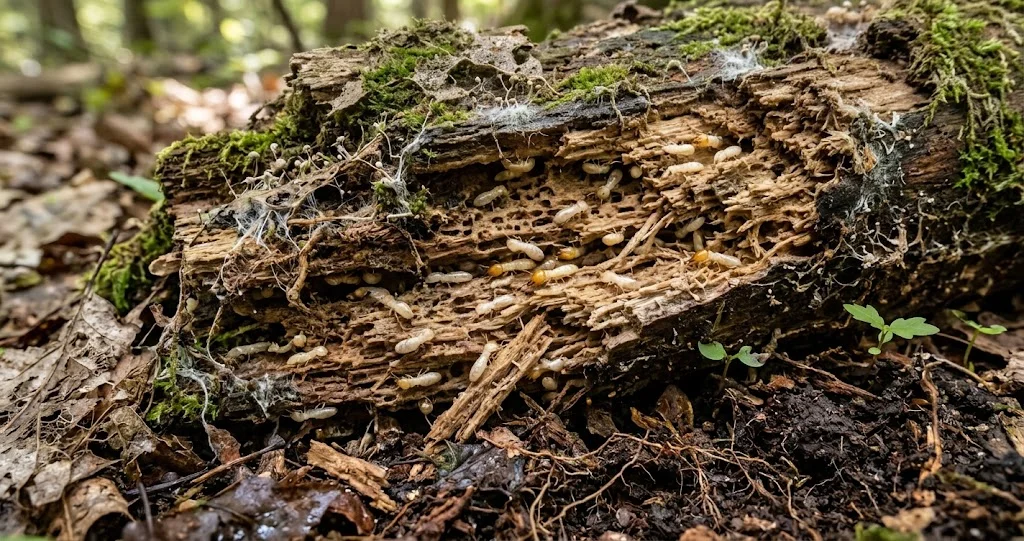
Beneath fallen logs, inside decaying tree trunks, and throughout the soil of tropical forests, millions of tiny insects are quietly transforming dead plant material into resources that support living ecosystems. These insects are termites, often called “white ants,” although they are not ants at all.
Their reputation is complicated. Homeowners recognize termites as potentially destructive pests, but ecologists study them as important decomposers and soil engineers.
The relationship between termites and soil health reveals how small organisms can influence nutrient cycling, soil structure, and water movement.
By breaking down wood, constructing underground tunnels, and interacting with microorganisms, termites help shape the environments in which plants grow. Their ecological contributions vary among species and habitats, but in many forests and grasslands, their activities are an important part of the natural soil ecosystem.
Table of Contents
- Why Termites Are Called White Ants but Are Not Ants
- How Termites Break Down Dead Wood and Plant Material
- How Underground Tunnels Affect Soil Structure
- Termites and Nutrient Cycling
- How Termites Influence Water Infiltration and Soil Fertility
- Why Termites Are Important in Forest Ecosystems
- Beneficial Termites Versus Termites That Damage Homes
- The Relationship Between Termites, Fungi, Microbes, and Plants
- Frequently Asked Questions
- Conclusion
Why Termites Are Called White Ants but Are Not Ants
Termites are sometimes called white ants because many worker termites have pale, soft bodies and live in large social colonies.
However, termites and ants belong to different evolutionary lineages.
Termites Belong to the Cockroach Lineage
Termites are classified within the insect order Blattodea, which also includes cockroaches.
Modern evolutionary research shows that termites evolved from cockroach-like ancestors.
True ants belong to the order Hymenoptera, alongside bees and wasps.
Although termites and ants independently evolved complex social systems, they are not closely related within the insect world.
How to Tell Termites and Ants Apart
Several physical characteristics help distinguish them.
| Feature | Termites | Ants |
|---|---|---|
| Body shape | Broad waist | Usually narrow waist |
| Antennae | Generally straight or beadlike | Usually elbowed |
| Worker appearance | Often pale and soft-bodied | Frequently darker and more hardened |
| Winged adults | Two pairs of similarly sized wings | Front wings generally larger |
| Evolutionary group | Blattodea | Hymenoptera |
These differences are especially useful when identifying insects found around wood or soil.
Termite Colonies Are Organized Societies
A termite colony typically contains reproductive individuals, workers, and defensive soldiers, although caste systems vary among species.
Workers perform tasks such as gathering food, maintaining tunnels, and caring for developing colony members.
Soldiers defend the colony using specialized jaws or chemical defenses.
This division of labor allows colonies to construct extensive nests and process large quantities of organic material.
How Termites Break Down Dead Wood and Plant Material
One of the most important termite benefits is their ability to process plant materials that are difficult for many animals to digest.
Wood contains cellulose, hemicellulose, and lignin, complex structural compounds that give plants strength.
Feeding on Dead Organic Matter
Many termite species consume dead wood, fallen branches, dry grasses, leaf litter, or other plant debris.
By feeding on these materials, termites contribute to decomposition.
Their chewing breaks larger pieces into smaller particles, increasing the surface area available for further biological processing.
The Importance of Cellulose Digestion
Cellulose is a major component of plant cell walls.
Many termites depend on microorganisms living inside their digestive systems to help break down cellulose and other plant carbohydrates.
These microbial partners include bacteria and, in certain termite lineages, specialized flagellated protists.
Different termite groups have different digestive systems and microbial communities.
Not Every Termite Eats the Same Food
Some termites specialize in wood, while others feed on grasses, soil-associated organic matter, or heavily decomposed material.
Certain tropical termites cultivate fungi as part of their feeding system.
These differences matter because termite species contribute to decomposition in different ways.
A colony feeding on fallen branches does not necessarily have the same ecological effect as a species consuming organic-rich soil.
How Underground Tunnels Affect Soil Structure
Termites are often described as ecosystem engineers because their activities physically modify their surroundings.
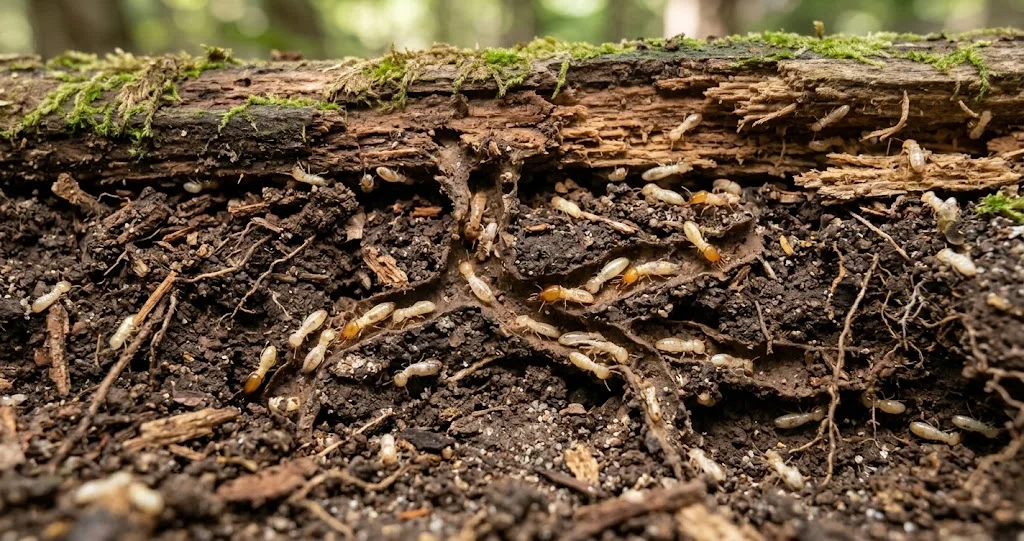
Their underground galleries, nesting chambers, and soil constructions can influence soil structure.
Termite Tunnels Create Pathways
Many subterranean termites excavate networks of tunnels through soil.
These passages connect feeding areas, nests, and sources of moisture.
Depending on their arrangement and stability, the tunnels can create pathways through which water, air, and other materials move.
Soil Mixing and Redistribution
Some termite species transport soil particles while building nests or protective galleries.
This activity can move material between soil layers or concentrate it in particular locations.
Termites may also combine soil with saliva, fecal material, and other substances to construct durable structures.
Changes in Soil Aggregation
Soil aggregation refers to the way mineral particles and organic matter combine into clusters.
Termite activity can alter aggregation through excavation, particle movement, and the construction of nests.
These effects may influence soil porosity and stability.
However, the results vary with termite species, soil texture, climate, and the type of structure being built.
Some termite constructions are relatively dense and can behave differently from the surrounding soil.
Termites and Nutrient Cycling
A healthy soil ecosystem depends on the movement of nutrients between living organisms, dead organic matter, and the surrounding environment.
Termites participate in this process by consuming, transporting, and transforming plant material.
Returning Organic Matter to the Soil
When termites feed on decaying vegetation, some of the material is incorporated into their bodies.
Other portions are processed through digestion and returned to the environment as waste.
Microorganisms can then continue decomposing these materials.
Through this process, nutrients contained in dead plants can gradually reenter biological and soil nutrient cycles.
Carbon Cycling
Wood and other plant materials contain substantial amounts of carbon.
As termites and their microbial partners process this material, some carbon becomes part of living biomass, some remains in organic residues, and some returns to the atmosphere through respiration and other microbial processes.
Termite digestion can also produce gases, including methane, with production varying among species and conditions.
Therefore, termites should not be described simply as organisms that store carbon or universally improve climate outcomes.
Nitrogen and Other Nutrients
Termite nests and associated soils sometimes contain different concentrations of nitrogen, phosphorus, and other nutrients compared with surrounding areas.
These differences can result from organic matter accumulation, microbial activity, and soil transport.
Nevertheless, nutrient enrichment is not uniform across all termite species or habitats.
The ecological effect depends on local conditions and the biological processes occurring within the colony.
How Termite Activity Can Influence Water Infiltration and Soil Fertility
Water movement is one of the most important factors affecting soil health.
In some environments, termite activity changes how rainfall enters and travels through the ground.
Underground Channels and Water Movement
Termite tunnels can function as macropores, relatively large spaces that allow water to move through soil.
In compacted or crusted soils, these openings may provide routes for water to reach deeper layers.
This can be particularly valuable in some dry environments where rainfall would otherwise run off the surface.
A study published in Agriculture, Ecosystems & Environment documented improved infiltration associated with termite activity in a traditional soil-restoration system in Burkina Faso.
However, researchers also emphasize that the effects depend on termite species and environmental conditions.
Why More Tunnels Do Not Always Mean Better Drainage
Not every termite tunnel improves water infiltration.
Some termite constructions contain densely packed soil, while others alter the surface in ways that restrict water movement.
Research in semi-arid environments has found that soil texture and termite activity interact in complex ways.
Consequently, termite presence alone cannot establish whether a particular soil drains well.
Localized Soil Fertility
Termite nests and surrounding soils may accumulate organic matter and nutrients.
In certain landscapes, these areas form localized patches of comparatively fertile soil.
Plants growing near such patches may benefit from improved nutrient availability, although responses vary among habitats.
The important principle is that termites redistribute and transform resources rather than create nutrients from nothing.
Why Termites Are Important in Forest Ecosystems
Forests constantly produce dead organic material.
Branches fall, trees die, leaves accumulate, and plant roots are replaced.
Without decomposers, the movement of nutrients through these ecosystems would be substantially different.
Recycling Fallen Wood
Termites are among the organisms responsible for processing dead wood.
Their feeding activities complement those of wood-decaying fungi, bacteria, beetles, and other decomposers.
This is especially important in warm environments where termites can be abundant and active throughout much of the year.
Supporting Forest Biodiversity
Termite colonies provide food for various predators, including birds, reptiles, amphibians, and mammals.
Their nests and abandoned structures may also offer habitat for other organisms.
These interactions connect termites to broader forest food webs.
Creating Different Soil Conditions
Termite activity can produce small-scale differences in soil structure, organic matter, and nutrient distribution.
Such variation contributes to habitat diversity.
A University of Georgia study of subterranean termites in temperate forests found evidence that termite activity transfers elements from wood into soil, including through the deposition of fecal material within constructed galleries.
These findings demonstrate that termite contributions are not limited to tropical forests.
Beneficial Termites Versus Termites That Damage Homes
The ecological importance of termites does not mean every termite colony should be welcomed near buildings.
Some species cause serious structural damage by feeding on wood used in construction.
Termites in Natural Habitats
In forests, termites commonly feed on fallen logs, dead branches, and other organic materials.
This activity contributes to decomposition and nutrient cycling.
Many termite species rarely interact with buildings.
Structural Pest Termites
Certain subterranean, drywood, and dampwood termites can infest buildings when suitable conditions exist.
Subterranean termites may construct protected mud tubes to reach wood above ground.
Drywood termites can establish colonies within suitable dry wood without maintaining the same soil connection.
Protecting Homes Without Treating Every Termite as a Pest
Homeowners should maintain appropriate building protection, including controlling moisture, correcting leaks, and preventing wood-to-soil contact where possible.
Suspicious mud tubes, damaged wood, or unexplained swarms warrant professional inspection.
However, discovering termites inside a decaying log in a distant woodland does not automatically mean a house is infested.
The goal is to protect buildings while recognizing the ecological roles of termites in natural environments.
The Relationship Between Termites, Fungi, Microbes, and Plants
Termites do not process organic matter entirely on their own.
Their relationships with microorganisms are fundamental to their biology.
Microorganisms Inside the Digestive System
Many termites depend on specialized gut microbes to help digest plant material.
These communities differ among termite lineages and can include bacteria, archaea, and protists.
The microorganisms help transform complex carbohydrates into compounds that the termite can use.
Termites That Cultivate Fungi
Certain termites, particularly fungus-growing species in the subfamily Macrotermitinae, maintain cultivated fungi within their nests.
Workers collect plant material and incorporate it into specialized fungal gardens.
The cultivated fungi help process the plant substrate, contributing to the colony’s nutrition.
This relationship is distinct from the gut-based digestion systems of other termite groups.
Connections With Plants
Termites influence plants indirectly through decomposition, soil modification, and nutrient redistribution.
Their activity may affect water availability, root environments, and localized fertility.
However, termites can also damage living plants or crops in some situations.
For readers interested in how other soil organisms process organic material, our guide to worm castings and healthier garden soil explains the role of earthworms and microorganisms in recycling organic waste.
Frequently Asked Questions
1. Are termites actually ants?
No. Termites are social insects belonging to the order Blattodea, which also includes cockroaches. Ants belong to Hymenoptera, alongside bees and wasps.
2. How do termites improve soil health?
Some termites contribute to soil health by decomposing organic matter, transporting nutrients, constructing tunnels, and changing soil structure. The effects vary among species and environments.
3. Do termite tunnels help rainwater enter the soil?
They can. Some underground galleries create pathways that encourage infiltration. However, the effect depends on soil texture, tunnel structure, and local conditions.
4. Are all termites harmful to buildings?
No. Many species primarily occupy natural habitats and feed on dead vegetation. A smaller number of economically important species are responsible for substantial structural damage.
5. Do termites eat living trees?
Some termites can attack living trees, particularly stressed or damaged individuals, while many others primarily consume dead plant material. Feeding behavior differs among species.
6. Should termites be removed from a garden?
Not automatically. Termites in natural decomposing wood may be performing normal ecological functions. However, colonies threatening structures, wooden supports, or valuable plants should be assessed by a qualified pest-management professional.
Conclusion
The relationship between termites and soil health illustrates how small insects can influence entire ecosystems through ordinary activities such as feeding, digging, and nest construction.
Although termites are often feared because certain species damage buildings, many play important roles in breaking down dead vegetation, redistributing nutrients, and modifying soil structure.
Their tunnels can influence water movement, while their interactions with fungi and other microorganisms contribute to the decomposition of complex plant materials.
These ecological effects are not identical across every termite species or habitat. Some termites provide important ecosystem services, while others create genuine agricultural or structural problems.
Understanding the distinction allows gardeners and nature enthusiasts to appreciate termites without ignoring the need for responsible pest management.
Beneath a fallen forest log, a termite colony may be doing far more than consuming wood. It may be helping transform yesterday’s plant material into part of tomorrow’s living soil.
External Sources
- Missouri Department of Conservation — Termites https://mdc.mo.gov/discover-nature/field-guide/termites Authoritative information about termite classification, identification, natural history, and ecological importance.