
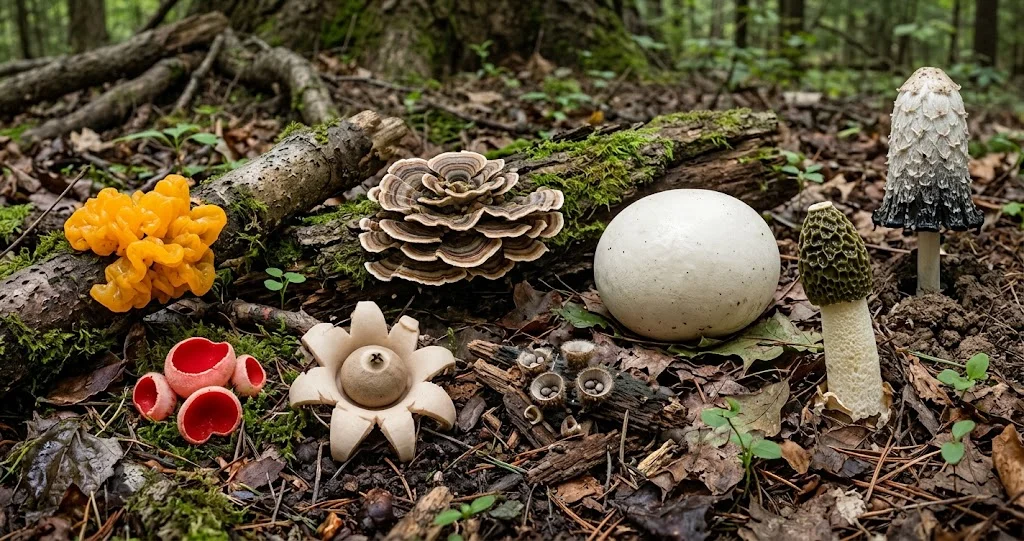
A mushroom that resembles a bird’s nest filled with tiny eggs. Another that melts into black ink. A strange, star-shaped fungus that opens when conditions are right. These are not imaginary organisms from a fantasy forest—they are real fungi found in woodlands, meadows, and gardens.
The world of unusual mushrooms is filled with extraordinary shapes, colors, and biological adaptations. Some fungi resemble delicate flowers, while others look like coral, miniature umbrellas, or brightly colored jelly.
Yet their unusual appearances serve important biological purposes. Mushrooms are reproductive structures produced by fungi, and their shapes often help protect or disperse spores.
Here are eight fascinating fungi worth recognizing during a woodland walk, along with the ecological roles that make them important members of natural ecosystems.
Table of Contents
- Turkey Tail — The Colorful Wood Recycler
- Giant Puffball — The Enormous Spore Factory
- Bird’s Nest Fungus — Tiny Cups With Hidden Eggs
- Common Stinkhorn — The Mushroom That Attracts Flies
- Shaggy Mane — The Mushroom That Turns to Ink
- Collared Earthstar — The Fungus That Opens Like a Star
- Witch’s Butter — The Golden Jelly Fungus
- Scarlet Elf Cup — The Bright Red Woodland Bowl
- Why Unusual Mushrooms Matter in Nature
- Responsible Mushroom Observation
- The Limitations of Photo-Based Identification
- Frequently Asked Questions
- Conclusion
1. Turkey Tail (Trametes versicolor)
Appearance and Habitat
Turkey tail is one of the most recognizable bracket fungi found on dead wood.
Its thin, fan-shaped fruiting bodies grow in overlapping clusters, displaying concentric bands of brown, gray, cream, orange, and sometimes bluish tones.
The bands resemble the patterned tail feathers of a wild turkey.
This fungus commonly grows on fallen hardwood branches, stumps, and decaying logs in temperate forests.
Ecological Role
Turkey tail is a white-rot fungus.
It produces enzymes that break down lignin and other structural components of wood, contributing to the decomposition of dead trees.
This process helps recycle organic matter within forest ecosystems.
Distinctive Adaptation
Unlike mushrooms with gills, turkey tail releases spores from tiny pores on its underside.
Several superficially similar bracket fungi exist, so appearance alone is insufficient for reliable species identification.
2. Giant Puffball (Calvatia gigantea)
Appearance and Habitat
The giant puffball looks like a large, smooth, white ball resting directly on the ground.
Some specimens grow to remarkable sizes, although dimensions vary with environmental conditions.
Giant puffballs are often found in grasslands, meadows, pastures, and nutrient-rich open habitats.
Ecological Role
Giant puffballs are generally considered saprotrophic fungi, obtaining nutrients from decomposing organic material.
They contribute to the breakdown and recycling of organic matter in soil.
Distinctive Adaptation
Unlike familiar cap-and-stem mushrooms, puffballs produce spores inside their rounded fruiting bodies.
As a mature puffball dries, its interior transforms into a powdery spore mass.
Disturbance by wind, rain, or animals can release these spores into the surrounding air.
Safety note: Some dangerous mushrooms have rounded, puffball-like stages. Never identify a wild mushroom as edible based only on its exterior appearance.
3. Bird’s Nest Fungus (Crucibulum laeve)
Appearance and Habitat
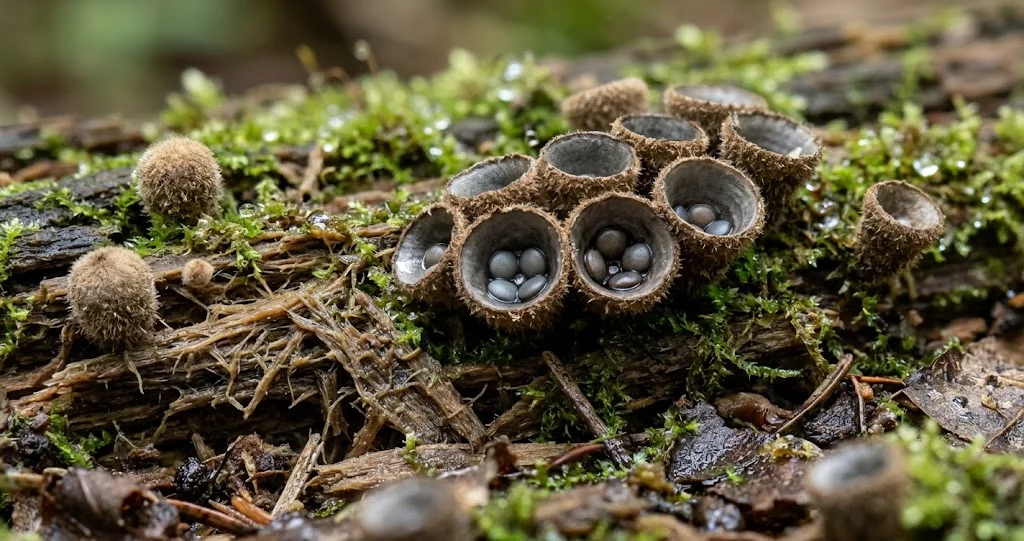
Bird’s nest fungi are among the most visually surprising fungi in nature.
Crucibulum laeve produces tiny cup-shaped fruiting bodies containing several pale, rounded structures resembling miniature eggs.
These structures are called peridioles.
The fungus commonly grows on decaying wood, wood chips, mulch, and other plant debris.
Ecological Role
Bird’s nest fungi are decomposers that obtain nutrients from dead organic material.
Their activity contributes to the gradual breakdown of woody debris.
Distinctive Adaptation
The cup functions as a splash dispersal system.
When a raindrop strikes the cup, it can eject the peridioles outward.
Each peridiole contains spores and may attach to nearby vegetation or other surfaces.
This remarkable mechanism uses the physical force of falling rain to disperse reproductive material.
4. Common Stinkhorn (Phallus impudicus)
Appearance and Habitat
The common stinkhorn begins as an egglike structure before developing into an upright fruiting body.
Its mature form has a pale stalk and a cap covered with dark, slimy, spore-bearing material.
The fungus is often found in woodlands, gardens, and areas containing decaying organic matter.
Ecological Role
Common stinkhorns are saprotrophic fungi that obtain nutrients from decomposing material.
They contribute to organic matter recycling in woodland soils.
Distinctive Adaptation
The stinkhorn’s most unusual feature is its strong odor.
The smell resembles rotting organic matter and attracts flies and other insects.
As insects visit the slimy cap, spores can adhere to their bodies or be transported after ingestion.
Instead of relying entirely on wind, the stinkhorn uses insects as important spore dispersers.
5. Shaggy Mane (Coprinopsis comatus)
Appearance and Habitat
Shaggy mane mushrooms have tall, cylindrical white caps covered with shaggy scales.
They often grow in lawns, grassy roadsides, disturbed soils, and open areas.
Young fruiting bodies may resemble elongated white candles.
Ecological Role
Shaggy mane is a saprotrophic fungus that grows in organic-rich soil.
It helps decompose organic matter and contributes to nutrient recycling.
Distinctive Adaptation
As the mushroom matures, its gills and cap begin to break down into a dark, ink-like liquid.
This process is called deliquescence or autodigestion.
The transformation helps expose and disperse mature spores as the cap progressively dissolves.
Although the appearance is dramatic, the process is a normal part of the fungus’s reproductive development.
6. Collared Earthstar (Geastrum triplex)
Appearance and Habitat
The collared earthstar begins as a rounded fruiting body that later splits open.
Its outer layer separates into pointed rays, creating a star-shaped structure around a central spore sac.
A distinctive collarlike formation may develop beneath the spore sac.
This fungus occurs in woodland habitats, often among leaf litter and decaying organic material.
Ecological Role
Collared earthstars are saprotrophic fungi associated with the decomposition of organic matter.
They participate in woodland nutrient cycling.
Distinctive Adaptation
The star-shaped outer layer helps expose and elevate the spore sac.
When raindrops or other disturbances strike the mature sac, spores can escape through a small opening near its top.
This allows the fungus to disperse spores without producing the familiar gills of a conventional mushroom.
7. Witch’s Butter (Tremella mesenterica)
Appearance and Habitat
Witch’s butter looks like a bright yellow or golden-orange mass of folded jelly.
Its soft, gelatinous fruiting bodies develop on dead branches, particularly those of hardwood trees.
The fungus can become more conspicuous during wet weather, when its tissues absorb moisture and swell.
During dry conditions, the fruiting body may shrink considerably.
Ecological Role
Unlike many fungi on this list, Tremella mesenterica is not primarily a direct wood decomposer.
It is a mycoparasite, meaning it obtains nutrients through an association with another fungus.
Its hosts include wood-decaying fungi in the genus Peniophora.
This makes witch’s butter part of a complex network of interactions involving dead wood and other fungi.
Distinctive Adaptation
Its gelatinous tissues can dry and later rehydrate when moisture returns.
This helps explain its changing appearance during wet and dry weather.
8. Scarlet Elf Cup (Sarcoscypha Species)
Appearance and Habitat
Scarlet elf cups produce brilliant red, cup-shaped fruiting bodies that stand out against brown woodland leaves.
The outer surfaces are generally paler, while the inner surfaces are vividly colored.
They often appear on decaying branches in damp woodland habitats during late winter or early spring.
Several closely related Sarcoscypha species have similar appearances.
Ecological Role
Scarlet elf cups grow on dead woody material and participate in its decomposition.
Their presence is associated with damp habitats where fallen branches provide suitable substrates.
Distinctive Adaptation
The bright inner surface is a spore-producing structure.
Unlike gilled mushrooms, these fungi belong to the ascomycetes, which produce sexual spores inside microscopic saclike structures called asci.
When conditions are suitable, mature spores can be forcibly discharged into the air.
Why Unusual Mushrooms Matter in Nature
The eight fungi in this guide demonstrate that mushrooms are more than decorative forest organisms.
Decomposition and Nutrient Cycling
Many fungi obtain energy by breaking down dead plant material.
Their enzymes help process compounds that would otherwise remain locked inside fallen wood, leaves, and other debris.
As decomposition proceeds, nutrients become available to other organisms through the broader soil food web.
The visible mushroom is usually only the reproductive structure. Much of the fungus exists as a network of microscopic threads called hyphae.
These threads collectively form a mycelium, which can spread through wood, soil, or other substrates.
Different Ecological Relationships
Not every fungus is a decomposer.
Some form beneficial associations with plant roots, while others live as parasites on plants, animals, or other fungi.
Witch’s butter demonstrates how one fungus can depend on another.
The Penn State Extension guide to fungi in landscape mulch explains how fungi contribute to the breakdown of organic materials.
Responsible Mushroom Observation
Discovering unusual mushrooms can make an ordinary walk through the woods feel like a scientific expedition.
However, responsible observation protects both people and natural habitats.
Photograph Without Disturbing
Whenever possible, photograph mushrooms where they grow.
Capture the entire fruiting body, surrounding habitat, and the material from which it emerges.
Avoid unnecessary removal or damage, particularly in protected natural areas.
Respect Local Regulations
Some parks and conservation areas prohibit collecting fungi.
Follow posted regulations and remain on established trails where required.
Never Taste an Unidentified Mushroom
Do not eat or taste wild mushrooms based on photographs, identification apps, or descriptions in this article.
Some poisonous species resemble harmless fungi, and serious poisoning can result from identification mistakes.
If mushroom ingestion is suspected to have caused poisoning, contact Poison Control in the United States at 1-800-222-1222 or seek emergency medical assistance.
The Limitations of Photo-Based Identification
Photographs are valuable for documenting fungi, but they cannot always establish a reliable species identification.
Important Features May Be Hidden
Identification may require examination of the underside, stem base, internal tissues, microscopic spores, or other characteristics that photographs do not reveal.
Age and weather can also change a mushroom’s appearance dramatically.
Lookalikes Can Be Dangerous
Some unrelated mushrooms resemble one another closely.
For example, a young mushroom in an enclosed developmental stage may superficially resemble a puffball.
Different species of scarlet elf cups may also be difficult to separate without microscopic examination.
Expert Verification Matters
Field guides and identification apps can help generate possibilities, but they are not substitutes for qualified local expertise.
For safety-critical identification, consult an experienced local mycologist or a recognized mycological organization.
Penn State Extension similarly cautions against relying on uncertain identification when wild mushrooms may be poisonous.
Frequently Asked Questions
1. What makes a mushroom unusual?
Unusual mushrooms may have unexpected shapes, colors, textures, or reproductive mechanisms. Examples include bird’s nest fungi that use raindrops to disperse spore packets and shaggy mane mushrooms that dissolve into dark liquid as they mature.
2. Are unusual mushrooms poisonous?
Toxicity varies among species. Some fungi are poisonous, while others are not known to be highly toxic. Appearance alone cannot establish safety, and no wild mushroom should be eaten without identification by a qualified local expert.
3. Where can unusual mushrooms be found?
Different species occur in forests, meadows, gardens, lawns, and areas containing decaying wood. Moisture, temperature, season, and available organic material influence when their fruiting bodies appear.
4. Why do some mushrooms grow on dead trees?
Many wood-inhabiting fungi produce enzymes that break down structural compounds in dead wood. They obtain nutrients from this material and contribute to decomposition.
5. Can mushroom identification apps accurately identify every species?
No. Apps can suggest possible identifications, but closely related species and dangerous lookalikes may be difficult to distinguish from photographs. Expert examination may be necessary.
6. Should mushrooms growing in garden mulch be removed?
Many mushrooms growing in mulch are harmless decomposers and do not require removal. However, keep children and pets from ingesting them, and investigate any signs of disease affecting living plants.
Conclusion
The world of unusual mushrooms reveals how creative fungal evolution can be.
Turkey tail forms colorful shelves on dead wood. Giant puffballs produce enormous rounded fruiting bodies. Bird’s nest fungi use raindrops to launch spore packets, while stinkhorns attract insects with powerful odors.
Shaggy mane mushrooms dissolve as they mature, earthstars open into striking geometric shapes, witch’s butter survives changing moisture conditions, and scarlet elf cups bring brilliant color to woodland floors.
Despite their differences, these fungi contribute to complex ecological relationships involving decomposition, reproduction, and interactions with other organisms.
For nature enthusiasts, observing mushrooms offers an opportunity to discover the remarkable diversity hidden within ordinary landscapes.
The safest approach is also the most rewarding: look closely, photograph carefully, respect the habitat, and never eat a wild mushroom based on a picture or general description.
External Sources
1. Penn State Extension — What Is Growing in My Landscape Mulch? Read the extension guide
Explains the ecological roles of fungi in decomposing woody organic material.
2. Penn State Extension — Preparing and Preserving Mushrooms Read the mushroom safety guidance