
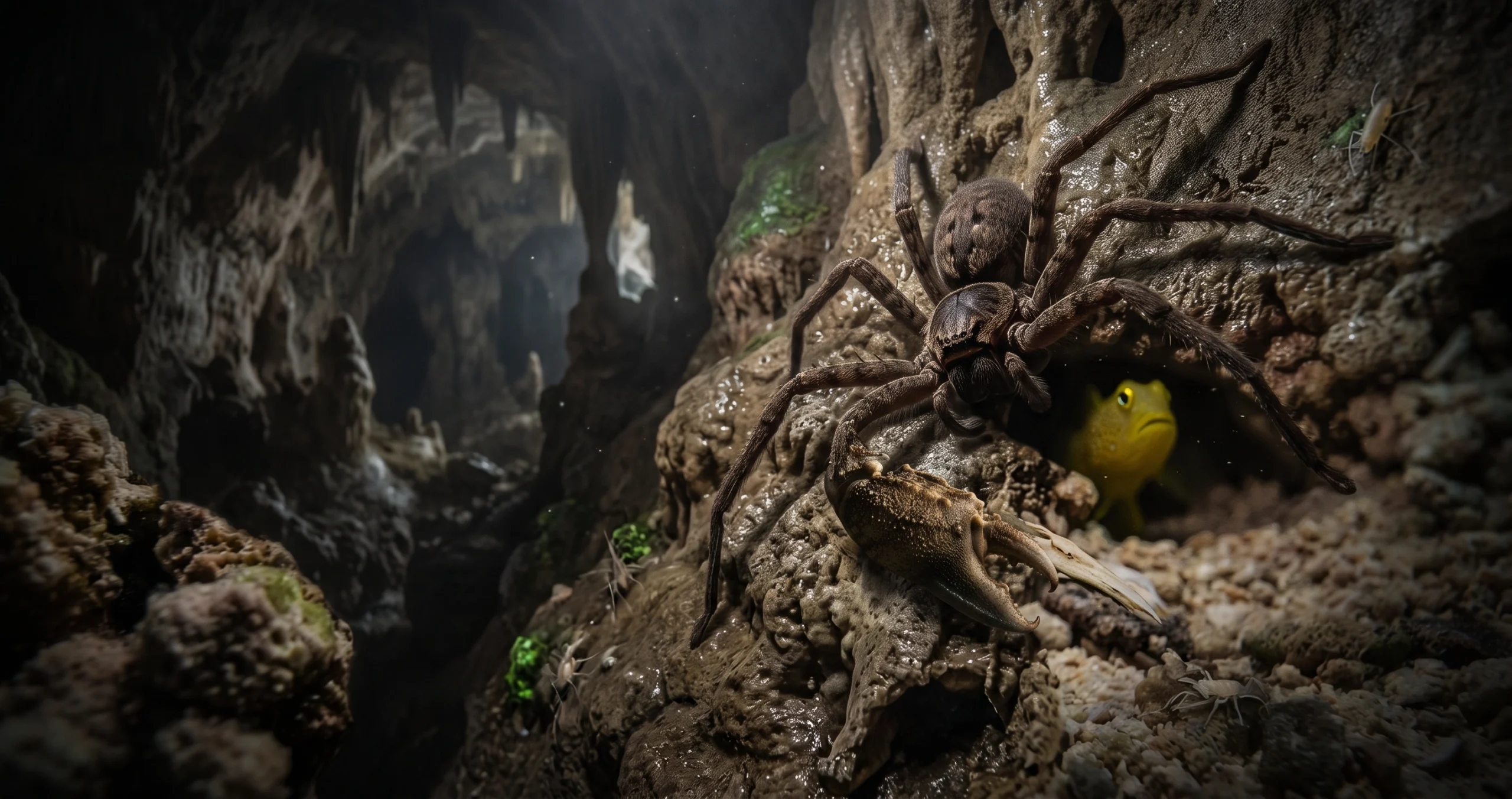
A spider stretched across a dinner plate sounds like something invented for a horror movie, yet one species can genuinely approach that scale. The giant huntsman spider size is extraordinary because Heteropoda maxima, discovered scientifically in Laos, can reach a leg span of roughly 30 centimeters, or about 12 inches. That makes it widely recognized as the world’s largest known living spider by leg span.
But “largest spider” depends on what you measure. Giant tarantulas can outweigh the giant huntsman substantially, while huntsman spiders achieve their remarkable dimensions through long, laterally oriented legs and a flattened body designed for moving through narrow spaces.
Despite their intimidating appearance, giant huntsman spiders are not the human-hunting monsters their proportions might suggest. Their anatomy is built for pursuing small prey, hiding in crevices, and moving rapidly through complex environments—not attacking people.
Table of Contents
- What Is the Giant Huntsman Spider?
- Giant Huntsman Spider Size: How Big Does It Get?
- Largest by Leg Span vs. Largest by Mass
- Giant Huntsman vs. Goliath Birdeater
- Why Huntsman Spiders Have Flattened Bodies
- Why Their Legs Point Sideways
- How Giant Huntsman Spiders Hunt
- Are Giant Huntsman Spiders Aggressive?
- Venom and Human Safety
- Why Huntsman Spiders Enter Buildings
- Common Myths
- FAQ
- Conclusion
What Is the Giant Huntsman Spider?
The giant huntsman spider is scientifically known as Heteropoda maxima. It belongs to Sparassidae, a family of spiders commonly called huntsman spiders.
The species was formally described in 2001 by arachnologist Peter Jäger from specimens associated with Laos.
Huntsman spiders are widespread across tropical and subtropical regions, although Heteropoda maxima itself has a much more restricted known distribution.
Members of the family are famous for several characteristics: relatively flat bodies, extremely long legs, rapid movement, and a hunting strategy that does not depend on constructing a conventional prey-catching web.
Instead, they actively pursue or ambush prey.
That lifestyle helps explain their name.
The giant huntsman takes the familiar huntsman body plan and pushes it to an extraordinary extreme.
Giant Huntsman Spider Size: How Big Does It Get?
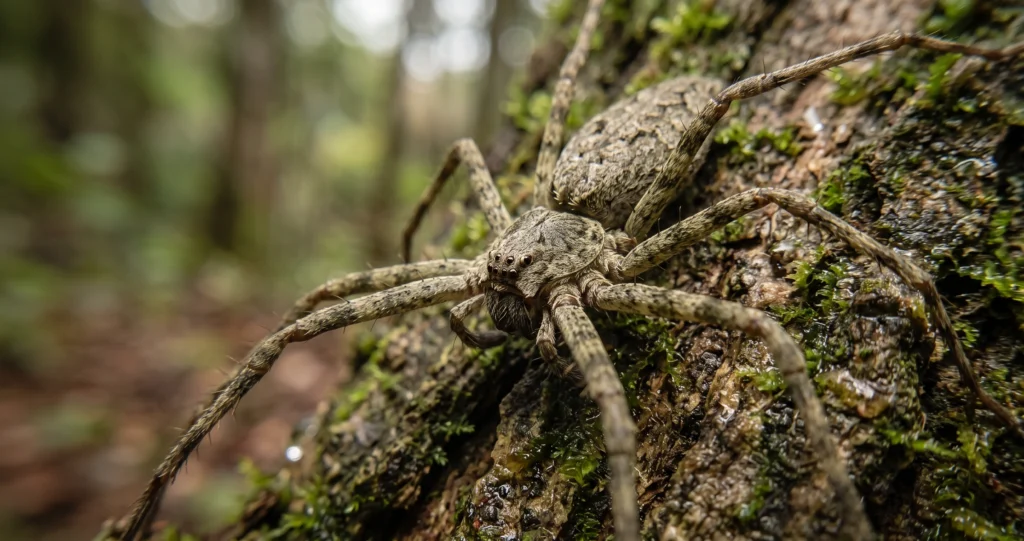
The most famous giant huntsman spider size measurement is its leg span.
Large specimens of Heteropoda maxima can reach approximately 30 centimeters, or close to 12 inches, across when the legs are extended.
That is roughly comparable to the diameter of a large dinner plate.
The spider’s actual body is far smaller.
Descriptions of the species report body lengths around 4.6 centimeters in particularly large individuals. Much of the spectacular overall dimension therefore comes from the elongated legs.
This distinction is important whenever spider size records are discussed.
A photograph showing a huntsman with its legs spread widely can make the animal appear massively built.
It isn’t.
Compared with the heaviest tarantulas, the body is relatively lightweight and flattened.
The giant huntsman’s record is primarily about reach.
What Does “Largest Spider in the World” Actually Mean?
There is no single scientifically meaningful measurement called “largest.”
Animals can be compared by body length, total length, leg span, weight, or body mass.
Different spiders win under different criteria.
Heteropoda maxima is generally regarded as the largest known living spider by leg span.
The Goliath birdeater, Theraphosa blondi, is usually considered the world’s largest spider by mass and among the largest by body size.
Other enormous tarantulas, including species within Theraphosa, also compete closely depending on the measurement and specimen.
So both of these statements can be correct:
The giant huntsman is the world’s largest spider by leg span.
The Goliath birdeater is the world’s heaviest spider.
The apparent contradiction disappears once the measurement is specified.
Giant Huntsman vs. Goliath Birdeater
The contrast between these spiders illustrates how evolution can produce “giant” animals in completely different ways.
The Goliath birdeater is a tarantula native to northern South America.
Its body is robust and heavily built, with thick legs and substantial mass. Large specimens can weigh well over 100 grams, with exceptionally large individuals reported around 170 grams.
The giant huntsman has a different architecture.
Its legs are proportionally longer and extend farther outward, producing a greater maximum span without requiring the same massive body.
Imagine comparing a heavyweight wrestler with a long-limbed basketball player.
Both might be described as large, but they are large in different dimensions.
This is why giant huntsman spider size claims should always mention leg span rather than simply declaring it “the biggest spider ever.”
Why the Giant Huntsman Is So Flat
One of the most interesting huntsman adaptations is easy to overlook because the enormous legs attract all the attention.
Huntsman spiders are dorsoventrally flattened.
In simpler terms, their bodies are compressed from top to bottom.
This allows them to enter narrow cracks and spaces that would be difficult for a rounder, thicker-bodied spider to use.
The adaptation can provide several advantages.
Crevices offer protection from predators and harsh environmental conditions. They can also provide daytime shelters for nocturnally active species.
For Heteropoda maxima, the flattened body may be particularly relevant to its association with limestone cave environments in Laos.
A thin profile combined with long, mobile legs creates an animal extremely well suited to navigating rock surfaces, fissures, and confined spaces.
Why Huntsman Legs Point Sideways
Look closely at a huntsman spider and you may notice that its legs do not project from the body quite like those of many familiar web-building spiders.
They have a laterigrade orientation.
That means the legs extend outward and somewhat sideways, giving the spider a crab-like stance.
This configuration is why some huntsman spiders are also informally called giant crab spiders.
The arrangement supports rapid lateral movement and helps the animal keep its body close to surfaces.
Together with the flattened body, laterigrade legs allow a huntsman to move efficiently across bark, rock, walls, and narrow surfaces.
They also contribute enormously to the giant huntsman spider size record.
The spider’s extraordinary span is not simply the result of being a scaled-up ordinary spider.
Its entire body plan emphasizes horizontal reach.
How Giant Huntsman Spiders Hunt
Huntsman spiders do not rely on the large, sticky prey-catching webs associated with orb-weavers.
They are active predators.
Their speed allows them to pursue insects and other small animals across surfaces.
A huntsman may remain concealed and then rapidly seize prey when an opportunity appears.
The front legs help capture and control the target while the spider delivers venom through its fangs.
Like most spiders, huntsman spiders use venom primarily as a tool for subduing prey.
Their diet consists largely of arthropods, although sufficiently large huntsman species can sometimes capture small vertebrates.
This does not mean giant huntsman spiders routinely hunt mice, birds, or other large animals.
Their primary ecological role is as predators of comparatively small prey.
For another remarkable arthropod adaptation, see our article on why katydids have ears on their front legs. Both animals demonstrate how dramatically arthropod anatomy can diverge from the body plans humans intuitively expect.
Speed Makes Huntsman Spiders Look More Dangerous
Size is only part of the reason huntsman spiders frighten people.
Speed matters too.
A large spider sitting motionless can be unsettling.
A large spider suddenly sprinting sideways across a wall creates an entirely different psychological reaction.
Huntsman spiders are capable of rapid bursts of movement.
But speed should not be confused with aggression.
For a huntsman, rapidly disappearing behind furniture, bark, or rock is usually an escape strategy.
A human represents an enormous potential threat rather than prey.
When disturbed, a spider that can run has an obvious defensive option: leave.
This is generally preferable to biting an animal thousands of times its own mass.
Are Giant Huntsman Spiders Aggressive?
Calling huntsman spiders “aggressive” toward humans is misleading.
They are predators, so they are certainly capable of rapid attacks on appropriate prey.
They may also defend themselves when trapped, handled, squeezed, or prevented from escaping.
That is not the same as actively seeking confrontation with people.
Huntsman spiders generally rely on camouflage, concealment, and rapid movement.
Bites can occur, particularly if someone tries to capture a spider by hand.
Females guarding egg sacs can also be more defensive than an undisturbed individual.
The safest approach is straightforward.
Do not handle large wild spiders unnecessarily.
Give them space and allow them an escape route.
Are Giant Huntsman Spiders Venomous?
Yes.
Like the great majority of spiders, huntsman spiders possess venom used to immobilize prey.
But “venomous” and “dangerous to humans” are not interchangeable.
A honeybee has venom.
So do many ants.
Medical significance depends on venom composition, dose, delivery, individual sensitivity, and other factors.
Available medical evidence from huntsman spider bites indicates that bites can cause local pain and other temporary symptoms, but huntsman spiders are not considered among the medically dangerous spider groups responsible for severe systemic envenomation.
An Australian clinical study of confirmed huntsman bites found pain was common but generally brief, with no cases of severe envenomation reported in the study.
That does not mean a bite should be deliberately provoked or ignored.
Any bite causing severe, worsening, or unusual symptoms warrants appropriate medical attention.
But the enormous giant huntsman spider size should not be interpreted as evidence of unusually dangerous venom.
Why Spider Size Does Not Predict Venom Danger
People often assume that the largest spiders must possess the strongest venom.
Evolution does not work that way.
Venom evolves according to prey, predators, physiology, and ecological requirements—not according to what humans find frightening.
Some comparatively small spiders possess medically important venom.
Many enormous tarantulas and huntsman spiders do not pose comparable systemic risks to healthy humans.
Large body size can even reduce the need for extraordinarily potent venom in some predators because physical strength contributes to prey capture.
Venom danger must therefore be evaluated species by species.
Leg span is not a toxicity scale.
Do Giant Huntsman Spiders Live in Houses?
The giant huntsman Heteropoda maxima should not be confused with every large huntsman encountered inside a building.
Many huntsman species occur in warm climates, and some regularly enter homes, sheds, garages, vehicles, and other structures.
Buildings provide many of the same features that natural shelters do.
There are narrow crevices.
There is protection from weather.
There may also be insects to hunt.
Their flattened bodies allow huntsman spiders to hide behind pictures, furniture, shutters, loose bark, wall fittings, and other surprisingly narrow spaces.
This ability is one reason people sometimes feel that a huge spider has “appeared from nowhere.”
It did not.
It was simply occupying a hiding place that seemed impossibly thin for a spider of that apparent size.
The Crevice Adaptation Changes How We See Their Size
The giant huntsman spider size becomes particularly interesting when considered alongside its flattened anatomy.
Humans tend to judge an animal by its widest visible dimensions.
For a huntsman, that means the legs.
But the spider’s survival may depend just as much on how little vertical space its body occupies.
It combines two apparently contradictory characteristics.
It is extremely wide when fully spread.
Yet it can become surprisingly thin when pressed against a surface or moving through a crevice.
This is an excellent example of why biological size cannot always be summarized by one measurement.
A huntsman is simultaneously enormous and remarkably compact.
Common Myths About Giant Huntsman Spiders
Myth 1: It Is the Heaviest Spider on Earth
No.
The giant huntsman is famous for its leg span.
The Goliath birdeater and related giant tarantulas have substantially heavier, more robust bodies.
Myth 2: Its Body Is 12 Inches Long
The famous measurement refers to leg span.
The actual body is only a fraction of that length.
Myth 3: Giant Huntsman Spiders Chase Humans
There is no evidence that humans are treated as prey.
Rapid movement toward a person can result from escape behavior, confusion, or the spider attempting to reach nearby shelter.
Myth 4: Bigger Spider Means Stronger Venom
Spider size does not reliably predict medical significance.
Huntsman venom is effective against their natural prey, but huntsman spiders are not generally regarded as dangerously venomous to humans.
Myth 5: Huntsman Spiders Trap People With Giant Webs
They do not construct large prey-catching webs like orb-weavers.
Huntsman spiders actively pursue or ambush prey.
Myth 6: The Giant Huntsman Is Common Everywhere in Southeast Asia
Heteropoda maxima is associated specifically with Laos and remains far less familiar biologically than widespread huntsman species.
A large huntsman seen elsewhere should not automatically be identified as the record-holding species.
Myth 7: A Huntsman’s Flat Body Means It Has No Internal Organs
Its body contains the normal major organ systems required by spiders.
Flattening is an anatomical adaptation, not the absence of internal complexity.
FAQ
What is the largest spider in the world?
It depends on the measurement.
Heteropoda maxima, the giant huntsman spider, is generally recognized as the largest living spider by leg span. The Goliath birdeater, Theraphosa blondi, is generally considered the largest by mass.
What is the maximum giant huntsman spider size?
The largest commonly cited leg span is approximately 30 centimeters, or around 12 inches.
Its body itself is much shorter.
Where does the giant huntsman spider live?
Heteropoda maxima was described from Laos and is associated with limestone and cave environments.
Knowledge of its exact distribution and natural history remains more limited than for many common huntsman species.
Why is the giant huntsman spider so flat?
The flattened body allows it to move into narrow crevices and remain close to rock or other surfaces.
This can provide shelter and facilitate movement through complex habitats.
Are giant huntsman spiders dangerous?
Their appearance is intimidating, but huntsman spiders are not considered among the spider groups posing major venom danger to humans.
They can bite defensively, so handling should be avoided.
Does a huntsman bite hurt?
Bites from huntsman species can cause local pain and other temporary symptoms.
The severity varies, and anyone experiencing significant or worsening symptoms after a spider bite should seek appropriate medical evaluation.
Can a giant huntsman spider kill a human?
There is no good evidence supporting the idea that Heteropoda maxima represents a lethal envenomation threat to healthy humans.
Its record-breaking leg span should not be confused with venom potency.
Does the giant huntsman make a web?
Not a large prey-capture web.
Huntsman spiders are active hunters, although spiders can still produce silk for purposes such as egg protection, retreats, and safety lines.
Are huntsman spiders useful?
As predators, huntsman spiders consume insects and other arthropods.
They are part of natural food webs and can contribute to controlling populations of potential pest species.
Conclusion
The giant huntsman spider size record sounds almost unbelievable: a spider capable of spanning approximately 12 inches from leg tip to leg tip.
Yet its dimensions become less mysterious once its anatomy is understood.
Heteropoda maxima is not built like an enormous tarantula.
Its body is comparatively thin, while extraordinarily elongated, sideways-oriented legs create its record-setting span. Those proportions reflect the huntsman lifestyle: moving quickly across surfaces, pursuing prey, and squeezing into narrow spaces where a thicker-bodied animal could not easily follow.
That is why asking for the “world’s largest spider” requires defining what large means.
By leg span, the giant huntsman takes the title.
By body mass, giant Theraphosa tarantulas such as the Goliath birdeater are heavier.
Neither measurement makes one spider more evolutionarily impressive than the other. They simply represent different solutions to surviving as large terrestrial arthropod predators.
The giant huntsman’s reputation also illustrates how appearance can distort perceptions of danger.
Long legs, rapid movement, and a wide silhouette trigger an understandable human fear response. But these characteristics are not evidence that the spider hunts people or possesses exceptionally dangerous venom.
Its speed primarily helps it catch prey and escape threats.
Its flattened body helps it disappear into crevices.
Its venom helps subdue animals small enough to eat.
Humans fit none of those categories.
Seen from the spider’s perspective, the giant huntsman is not a monster lurking in the darkness.
It is a remarkably specialized crevice-dwelling predator whose record-breaking dimensions reveal just how many different ways evolution can build a “giant” spider.
Suggested new tag: Spiders
Adding “Spiders” is useful because the existing tags do not provide an arachnid-specific grouping and future spider articles could reuse it.
Internal Link Suggestions:
- Why Katydids Have Ears on Their Front Legs
Use when discussing unusual arthropod anatomy. It creates a natural connection between the huntsman’s laterigrade, flattened body plan and another surprising arthropod adaptation. - How a Tarantula Defends Itself With Urticating Hairs
Use in the giant huntsman versus tarantula comparison to explain how large spiders from different families evolved very different defensive strategies.
External Dofollow Authoritative Sources:
- World Spider Catalog — Natural History Museum Bern
World Spider Catalog
Authoritative taxonomic resource for Heteropoda maxima, Sparassidae, species names, classification, and scientific literature. - Australian Museum — Huntsman Spiders
Australian Museum: Huntsman Spiders
Useful authoritative natural-history source for huntsman anatomy, flattened bodies, habitat, behavior, prey, and human interactions. - PubMed — Clinical Effects of Huntsman Spider Bites
PubMed scientific literature
Useful peer-reviewed evidence for discussing medically documented huntsman bites, symptoms, and why the family’s frightening appearance should not automatically be interpreted as severe venom danger.