
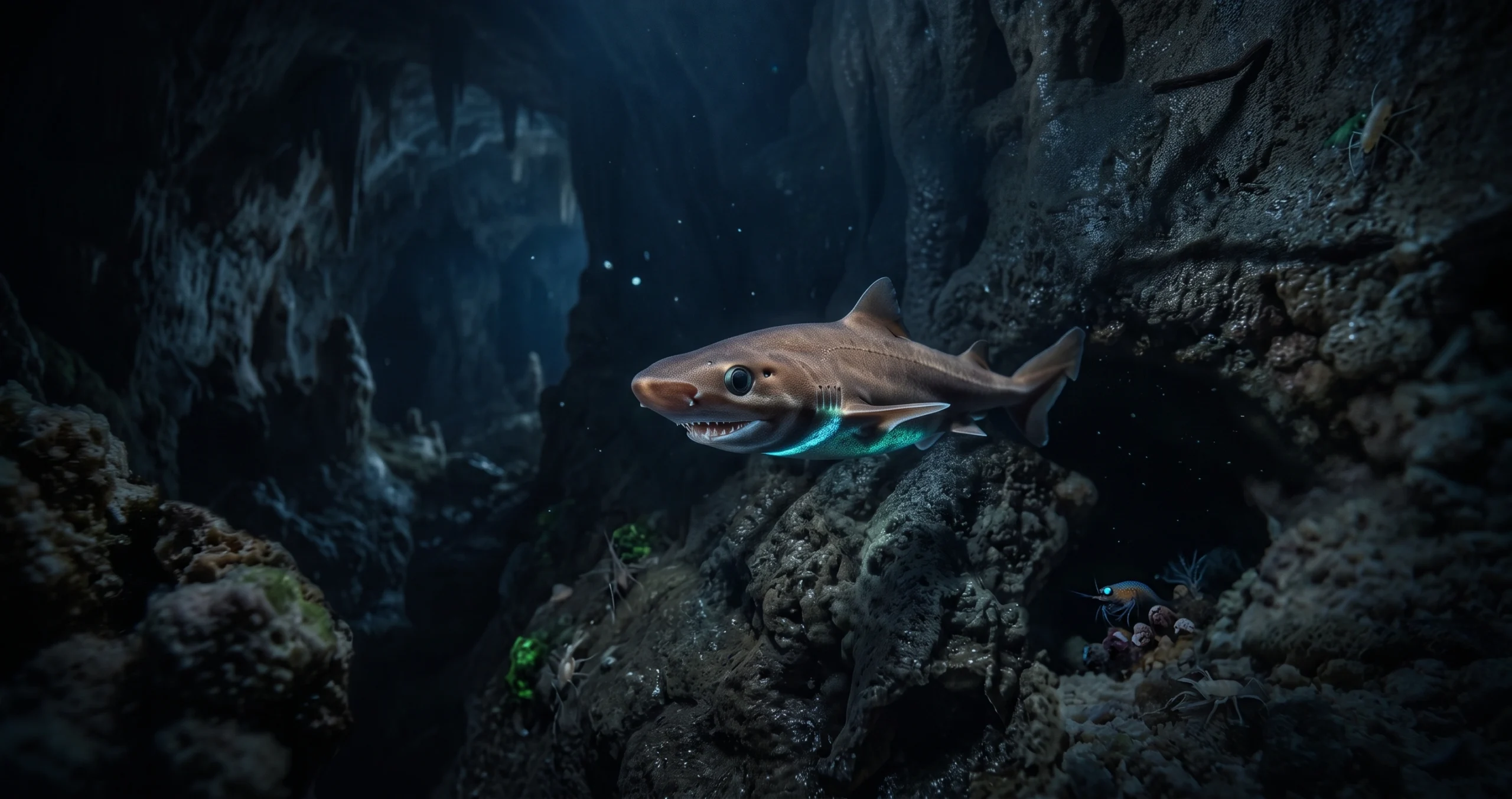
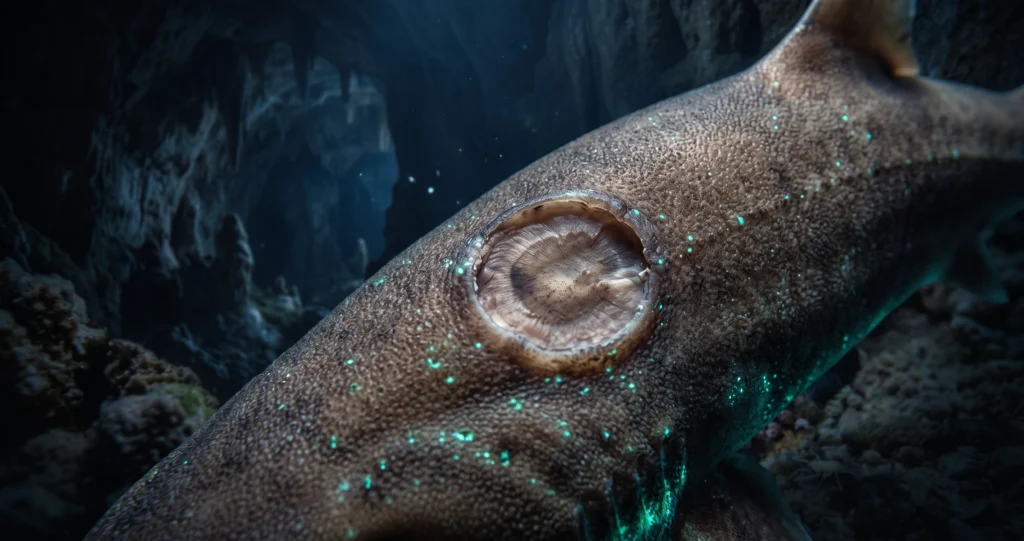
Some sharks kill prey by overpowering it. The cookiecutter shark uses a very different strategy: it takes a piece and leaves the victim alive. A typical cookiecutter shark bite is a deep, nearly circular crater produced when this small deep-sea predator attaches itself to a much larger animal and removes a plug of tissue.
Despite usually measuring well under a meter long, cookiecutter sharks attack animals many times their own size, including tuna, dolphins, whales, seals, other sharks, and rays. Characteristic wounds have even appeared on animals that humans rarely observe directly, allowing scientists to use the bites as indirect evidence of interactions in the open ocean.
The shark’s adaptations are equally unusual. It has powerful suction, oversized lower teeth, bioluminescent skin, and a feeding technique that turns its own body into a twisting cutting tool.
Table of Contents
- What Is a Cookiecutter Shark?
- Why the Cookiecutter Shark Bite Looks So Perfect
- How the Suction-and-Twist Mechanism Works
- The Teeth That Function Like a Saw
- Why Cookiecutter Sharks Glow
- Counterillumination and the Dark Collar
- Does Bioluminescence Help Lure Prey?
- What Animals Do Cookiecutter Sharks Attack?
- Why Large Animals Survive the Bites
- Encounters With Submarines and Undersea Equipment
- Do Cookiecutter Sharks Attack Humans?
- Life in the Deep Ocean
- Common Myths
- FAQ
- Conclusion
What Is a Cookiecutter Shark?
Cookiecutter sharks belong to the genus Isistius, with the best-known species being Isistius brasiliensis.
They are small members of the sleeper shark family, Dalatiidae, and inhabit tropical and subtropical oceanic waters around much of the world.
Most individuals are far smaller than the sharks people normally imagine as major predators. Isistius brasiliensis generally reaches only around half a meter in length, although larger individuals occur.
Yet body size tells only part of the story.
The cookiecutter has evolved to feed from animals dramatically larger than itself.
Rather than killing a whale, dolphin, tuna, or large shark, it can remove a mouthful of flesh and swim away.
That feeding strategy is known as ectoparasitic predation or facultative ectoparasitism, although cookiecutter sharks also consume smaller prey whole.
The distinctive wound explains their common name.
It resembles the circular hole left when a cookie cutter removes a piece of dough.
Why the Cookiecutter Shark Bite Is So Distinctive
A fresh cookiecutter shark bite can form a remarkably regular crater.
The geometry comes from the shark’s highly specialized mouth.
Its upper and lower jaws perform different jobs.
The upper teeth are relatively small and narrow. They help the shark establish and maintain contact with its target.
The lower teeth are much larger.
They form a continuous cutting edge along the lower jaw, almost like a miniature saw or curved knife.
Once the mouth is sealed against an animal, those lower teeth can cut deeply into the tissue.
But teeth alone do not explain the circular result.
The shark must move.
How the Suction-and-Twist Bite Works
The attack begins when a cookiecutter approaches a suitable target.
Its lips are thick and specialized for forming a seal.
The shark presses its mouth against the victim and uses suction to establish strong attachment. Anatomical features of the mouth and pharynx help create negative pressure.
Once attached, the upper teeth help anchor the shark.
The lower jaw penetrates the tissue.
Then comes the characteristic movement.
The shark twists or rotates its body while maintaining its grip.
As the lower teeth sweep through the flesh, they carve out a roughly circular or oval plug.
The shark then pulls away with the tissue.
The entire interaction can leave a wound far larger than someone might expect from such a small predator.
The Smithsonian’s Ocean Portal provides broader authoritative information on shark biology and the extraordinary diversity of feeding adaptations found among ocean predators.
The Lower Teeth Are an Extraordinary Cutting Tool
The lower jaw is arguably the cookiecutter’s most impressive anatomical feature.
Individual lower teeth are triangular, large relative to the shark’s body, and arranged closely together.
Together, they create a continuous cutting surface.
The shark even handles tooth replacement unusually.
Many sharks continually lose and replace individual teeth.
Cookiecutter sharks can replace an entire connected row of lower teeth at once.
They may also swallow the old tooth row.
That sounds counterproductive until mineral recycling is considered.
Teeth contain valuable calcium and other materials. In the nutrient-limited open ocean, recovering some of those resources may be beneficial.
The cookiecutter shark bite therefore depends on a highly specialized dental system that is maintained throughout the animal’s life.
Why Does a Cookiecutter Shark Glow?
If the teeth are remarkable, the skin may be even stranger.
Cookiecutter sharks possess photophores — specialized light-producing organs — across much of the underside of the body.
These photophores emit a greenish bioluminescent glow.
Why would a predator advertise itself with light?
Because in the open ocean, glowing can make an animal harder to see.
This apparent contradiction is explained by counterillumination.
During daylight, animals swimming in deeper water may be visible from below as dark silhouettes against the faint light filtering down from the surface.
A predator looking upward can detect that silhouette.
A cookiecutter’s ventral photophores can produce light that helps match the brightness of the water above.
Instead of appearing as a dark shark-shaped object, its outline becomes less conspicuous.
This is biological camouflage made from light.
The Mysterious Dark Collar
Cookiecutter sharks have another conspicuous feature near the head.
A dark band or “collar” encircles the throat region.
Unlike the surrounding ventral surface, this area lacks the same luminous appearance.
Scientists have proposed an intriguing hypothesis.
If most of the shark’s silhouette disappears through counterillumination but the dark collar remains visible, a larger predator might interpret the small dark shape as potential prey.
The predator approaches.
Instead of finding a tiny meal, it encounters the cookiecutter’s suction mouth and enormous lower teeth.
This has led to the popular description of cookiecutter sharks using bioluminescence as a lure.
However, the evidence requires careful wording.
Does Bioluminescence Really Lure Victims?
Counterillumination is strongly supported as a camouflage function in many marine organisms, including cookiecutter sharks.
The idea that the dark collar deliberately creates a prey-like lure is plausible and frequently discussed, but it is harder to demonstrate experimentally in wild cookiecutters.
Directly observing feeding behavior hundreds of meters beneath the ocean surface is extremely difficult.
The most responsible interpretation is therefore that bioluminescence likely contributes to camouflage, while the contrasting dark collar has been hypothesized to assist in attracting or deceiving larger animals.
The two functions are not mutually exclusive.
A cookiecutter could simultaneously hide most of its body and leave a small visual target.
That would make the cookiecutter shark bite the final stage of a remarkable deception.
What Animals Do Cookiecutter Sharks Attack?
The list of documented hosts is extraordinary.
Cookiecutter wounds have been reported on large bony fish such as tuna, billfish, and other pelagic species.
They also occur on sharks and rays.
Marine mammals are frequent targets.
Dolphins, porpoises, seals, and multiple whale species have been documented carrying characteristic scars.
Even some deep-diving species can bear cookiecutter wounds.
One reason these marks are scientifically useful is their distinctive appearance.
Researchers studying photographs of whales or dolphins may notice fresh wounds or old scars and infer that the animal overlapped geographically and vertically with cookiecutter sharks.
The shark’s feeding marks can therefore provide indirect ecological information.
Whales Can Carry Many Scars
For a large whale, a single cookiecutter shark bite is generally not catastrophic.
The relative scale is enormous.
A shark weighing only a few kilograms may remove a small plug of tissue from an animal weighing thousands of kilograms.
The wound can heal, leaving a pale, dark, or depressed scar depending on the species and healing stage.
Some marine mammals accumulate numerous scars over their lifetimes.
Scientists can use wound patterns as part of photographic studies, although not every circular mark on a marine animal should automatically be attributed to a cookiecutter.
Other injuries, parasites, infections, and predators can leave marks too.
Correct identification requires context.
Why Doesn’t the Cookiecutter Kill Its Prey?
Killing a whale would be impossible for such a small shark.
But it does not need to.
The feeding strategy works because the target is essentially a moving food source.
Removing one plug of tissue provides a meal without requiring the shark to overpower the entire animal.
This is energetically attractive.
Large prey can be dangerous, fast, and difficult to capture.
The cookiecutter turns the problem upside down.
It does not ask, “Can I kill this animal?”
It asks, in evolutionary terms, “Can I stay attached long enough to remove one mouthful?”
That makes enormous animals available as food resources to a surprisingly small predator.
Cookiecutters Also Eat Small Prey Whole
The circular-bite strategy is famous enough that another part of the diet is often forgotten.
Cookiecutter sharks can consume smaller animals whole.
Stomach-content studies have found squid, fish, and other prey.
Their feeding ecology is therefore more flexible than the name implies.
The specialized suction mouth and cutting teeth allow them to exploit large animals, but they are still sharks capable of eating appropriately sized prey.
This matters when describing the species as a “parasite.”
Cookiecutters behave partly like ectoparasites when taking tissue from large hosts, but they are also conventional predators.
Their ecology does not fit neatly into one category.
How Vertical Migration Helps Them Find Victims
Cookiecutter sharks spend much of their lives in deep oceanic water.
Evidence suggests they perform diel vertical migration.
During daylight hours, they may remain hundreds of meters below the surface.
At night, they can move upward into shallower water.
This behavior is widespread among ocean animals.
Huge numbers of fish, squid, crustaceans, and other organisms rise toward surface waters after sunset and descend again before daylight.
Following this movement gives cookiecutters access to a changing community of potential prey and hosts.
Bioluminescent camouflage is particularly useful in this environment, where visibility depends on faint downwelling light rather than complete darkness.
For another remarkable example of an ocean predator using physics in an unexpected way, see our article on how pistol shrimp produce one of the loudest sounds in the ocean.
Both animals demonstrate how small marine predators can compensate for limited body size with extreme specialization.
Cookiecutter Sharks Have Bitten Submarines
One of the strangest parts of cookiecutter history involves objects that cannot be eaten.
Reports associated with naval and oceanographic operations describe cookiecutter sharks biting exposed or soft components on submerged equipment.
The sharks are not trying to consume entire submarines.
Instead, certain smooth or rubberized surfaces may apparently trigger the same exploratory or feeding behavior used against large marine animals.
During the Cold War era, damage attributed to cookiecutter bites reportedly affected rubber coverings on sonar equipment, including components associated with submarines.
Even small damage to sensitive underwater equipment can create significant operational problems.
This gave a tiny shark an unexpectedly expensive reputation.
What About Undersea Cables?
Cookiecutter sharks are also frequently mentioned in stories about damage to submarine cables.
Here the evidence deserves caution.
Sharks have historically bitten undersea telecommunications cables, and shark-related cable damage is real. However, attributing every circular or tooth-related cable injury specifically to cookiecutter sharks is not justified.
Modern fiber-optic cables are heavily protected in vulnerable areas, and shark bites account for a very small proportion of contemporary cable failures.
The more firmly documented cookiecutter-equipment stories involve soft coverings and exposed components on submerged devices and vehicles.
The distinction matters because a fascinating true story does not need exaggeration.
A small shark biting sophisticated naval equipment is already remarkable.
Do Cookiecutter Sharks Bite Humans?
Documented human encounters are extremely rare.
This is largely because cookiecutter sharks spend much of their lives in deep offshore environments where people rarely swim.
A handful of incidents involving humans have been attributed or strongly suspected to involve cookiecutter sharks, particularly swimmers in open ocean conditions at night.
The wounds can be significant because the shark removes tissue rather than producing a superficial scratch.
Still, cookiecutters should not be presented as an important routine danger to beachgoers.
Their habitat and behavior make encounters with humans exceptionally uncommon compared with our enormous exposure to coastal waters.
For shark-incident context and scientifically reviewed information, the Florida Museum’s International Shark Attack File is a useful authoritative resource.
Common Myths About the Cookiecutter Shark Bite
Myth 1: Cookiecutter Sharks Cut Perfect Circles Like a Metal Tool
The wounds can be remarkably regular, but biological tissue and animal movement create variation.
Bites may be circular, oval, or irregular.
Myth 2: They Kill Whales
Cookiecutters remove relatively small plugs of tissue.
Large marine animals usually survive individual bites and may accumulate multiple scars.
Myth 3: The Shark Spins Like a Drill
The shark uses body rotation or twisting during feeding, but describing it as a high-speed underwater drill exaggerates the mechanism.
Suction, jaw anatomy, and movement work together.
Myth 4: Bioluminescence Is Used Only to Attract Prey
The strongest established function is camouflage through counterillumination.
A lure-like function involving the dark collar remains an intriguing hypothesis.
Myth 5: They Only Eat Pieces of Large Animals
Cookiecutter sharks also consume smaller prey whole, including fish and squid.
Myth 6: Cookiecutters Routinely Destroy Internet Cables
Sharks have damaged submarine cables historically, but widespread modern internet outages caused by cookiecutter sharks are largely a myth.
The better-documented cookiecutter interactions involve soft or exposed components of underwater equipment.
Myth 7: They Are Tiny but Extremely Aggressive Toward Humans
They are capable predators, but human encounters are exceptionally uncommon.
Their normal ecology involves pelagic and deep-water prey.
FAQ
How does a cookiecutter shark bite?
The shark forms a strong seal against its target using specialized lips and suction. Its upper teeth help maintain attachment while its large lower teeth penetrate the tissue.
Body movement then helps cut out a plug.
Why is a cookiecutter shark bite round?
The combination of a circular mouth, saw-like lower dental row, suction, and twisting motion produces the characteristic crater-shaped wound.
How big is a cookiecutter shark?
Most are surprisingly small compared with their victims, generally measuring well under one meter.
Their feeding strategy allows them to exploit animals vastly larger than themselves.
Do cookiecutter sharks glow?
Yes.
Photophores on much of the underside produce bioluminescence that likely helps camouflage the shark against downwelling light.
Does the glowing body attract prey?
Counterillumination is considered an important camouflage function.
The idea that the non-glowing dark collar resembles a small prey item and attracts larger animals is a compelling hypothesis, but it should not be treated as definitively demonstrated.
What animals do cookiecutter sharks bite?
Documented targets include whales, dolphins, seals, tuna, billfish, sharks, rays, and numerous other large marine animals.
Have cookiecutter sharks bitten submarines?
Cookiecutter bites have been associated with damage to soft or exposed components of submerged equipment, including naval systems.
They are presumably responding to these objects as they would large biological targets.
Are cookiecutter sharks dangerous to humans?
They are physically capable of causing substantial wounds, but encounters are extraordinarily rare because the sharks normally occupy deep offshore habitats.
Conclusion
The cookiecutter shark bite represents one of the ocean’s most unusual solutions to a fundamental predatory problem.
How can a small animal feed on something vastly larger and more powerful than itself?
Do not kill it.
Take one piece.
The cookiecutter’s entire anatomy supports that strategy. Specialized lips create suction against the victim. Small upper teeth assist attachment. Oversized lower teeth form a cutting edge, while body movement helps carve away the characteristic plug of tissue.
Then the shark disappears.
Its bioluminescence makes the strategy even more extraordinary.
Photophores across the underside can help conceal the shark through counterillumination, reducing its silhouette against faint light filtering from above. A dark, non-luminous collar may potentially contribute to deception or attraction, although that proposed lure function remains less certain than the camouflage explanation.
The list of victims demonstrates how successful the strategy is.
Whales, dolphins, seals, tuna, billfish, rays, and other sharks can carry the unmistakable crater-like wounds. Some survive repeated attacks, turning their skin into a record of encounters occurring far offshore and sometimes hundreds of meters beneath the surface.
Humans have inadvertently entered that ecological world too.
Cookiecutter sharks have reportedly damaged soft components on underwater equipment, demonstrating that their feeding machinery does not always distinguish perfectly between a large animal and an artificial object.
Yet the shark’s reputation should remain proportional to reality.
Cookiecutters are not miniature monsters terrorizing swimmers or systematically destroying the world’s undersea cables. Human bites are extraordinarily rare, and dramatic claims about their interactions with technology are often repeated with more confidence than the evidence supports.
The genuine biology is more interesting.
A shark barely longer than a person’s arm has evolved to feed from animals thousands of times heavier than itself.
It does so with suction, specialized teeth, carefully coordinated movement, and a body capable of producing its own camouflage light.
Few predators demonstrate more clearly that in evolution, being bigger than your prey is optional.
Being specialized enough to exploit it is what matters.
Internal Link Suggestions:
- How Pistol Shrimp Produce One of the Loudest Sounds in the Ocean
Link from the section discussing extreme adaptations among small marine predators. Both articles demonstrate how relatively small animals use specialized physics and anatomy to affect much larger organisms. - How Manta Rays Use Cleaning Stations — And Wait Their Turn
Link from the section discussing large marine animals carrying cookiecutter scars. It provides a natural pathway into another article about unusual interactions and behavior among ocean wildlife.
External Dofollow Authoritative Sources:
- Florida Museum — Cookiecutter Shark (*Isistius brasiliensis*)
Useful for authoritative information on identification, distribution, size, feeding biology, teeth, and characteristic wounds. - Smithsonian Ocean Portal
Useful for broader shark biology, deep-sea adaptations, bioluminescence, marine food webs, and ocean-predator context. - Florida Museum — International Shark Attack File
Authoritative resource for documented shark-human interactions and useful context when discussing the extremely limited risk cookiecutter sharks pose to people.