
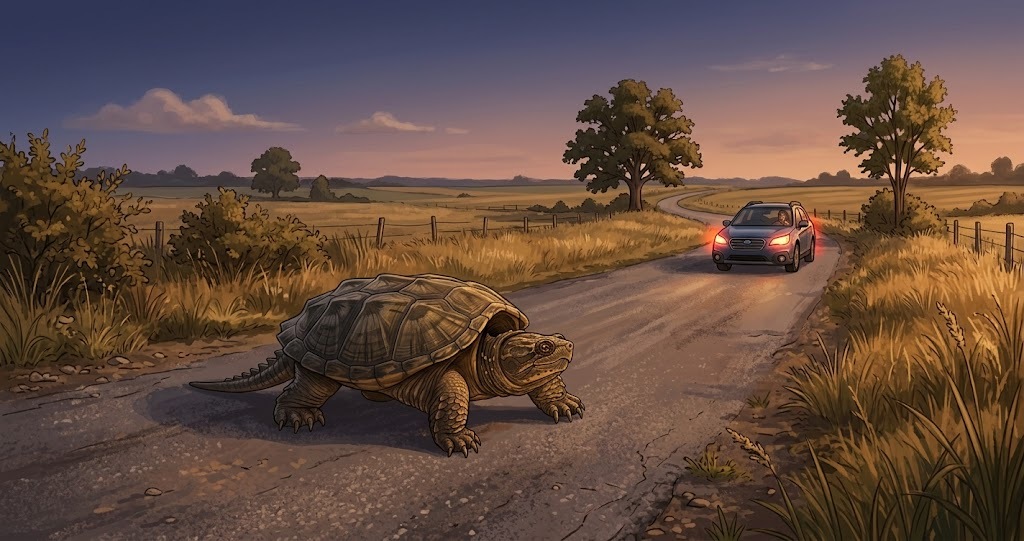
Seeing a turtle slowly crossing a road can seem strange, especially when the nearest pond is nowhere in sight. Understanding why turtles cross roads late summer requires looking beyond the road itself. Turtles routinely move between feeding areas, wetlands, nesting sites, seasonal refuges, and other habitats, and dry late-summer conditions can change which resources are available.
The largest wave of road-crossing activity for many U.S. freshwater turtles actually occurs earlier, often during spring and early summer when females travel to nesting areas. But turtles don’t stop moving afterward. As temporary wetlands shrink, young turtles disperse, and adults search for suitable water, food, or shelter, overland movement can continue into late summer.
When that journey intersects a road, a little careful assistance can make a major difference—but only if helping the turtle doesn’t put you or other drivers in danger.
Table of Contents
- Why Turtles Leave the Water
- Why Turtles Cross Roads Late Summer
- Late Summer Is Not the Main Nesting Season
- Shrinking Wetlands Can Trigger Movement
- Turtles Know Where They’re Going
- Why Roads Are Such a Problem
- Snapping Turtles on the Move
- Box Turtles Are Different
- Other Common U.S. Turtles You May Encounter
- How to Safely Help a Turtle Cross
- Why Direction Matters
- How to Move a Small Turtle
- How to Help a Snapping Turtle
- Why You Should Never Lift a Turtle by Its Tail
- When You Should Not Enter the Road
- What to Do With an Injured Turtle
- Why Relocating Turtles Is Usually Harmful
- Frequently Asked Questions
- Final Thoughts
Why Turtles Leave the Water
It’s easy to think of freshwater turtles as animals that should always be in a pond.
Their lives are more complicated.
Aquatic and semi-aquatic turtles frequently use both water and land during different parts of their annual cycles. They may leave water to nest, move between wetlands, search for food, disperse into new habitat, or reach seasonal refuges.
The U.S. Fish and Wildlife Service notes that turtles move in search of new territory, breeding opportunities, food, and nesting locations. U.S. Fish and Wildlife Service — Tips for Helping a Turtle Cross the Road
For some species, overland travel is a normal and necessary part of life.
A turtle found hundreds of yards from obvious water isn’t automatically lost.
Why Turtles Cross Roads Late Summer
There isn’t one universal reason behind why turtles cross roads late summer.
The explanation depends on species, sex, location, rainfall, habitat conditions, and time of year.
Earlier in the warm season, reproductive movement is extremely important. Female freshwater turtles commonly leave ponds and wetlands to search for suitable nesting sites, sometimes crossing roads in the process.
By late summer, that peak nesting period has passed for many species. But other movements continue.
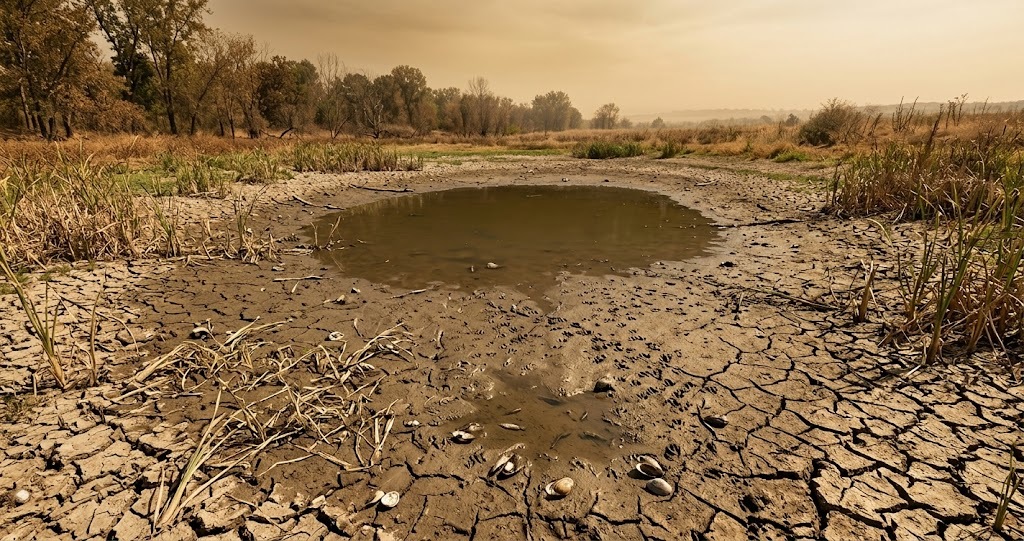
Temporary pools and shallow wetlands may shrink as summer progresses. Turtles using these habitats can move toward deeper or more permanent water.
Individuals may also travel between feeding areas or other parts of their established habitat.
Young turtles and hatchlings add another dimension. Depending on species and region, eggs laid earlier in summer may begin hatching during late summer or fall, creating another period when very small turtles can appear on land.
The result is a landscape in which turtle movement continues long after the most obvious nesting migrations have ended.
Late Summer Is Not the Main Nesting Season
This distinction is important for accuracy.
If you see a large turtle crossing a road in late August, don’t automatically assume she is looking for a place to lay eggs.
In many parts of the United States, the strongest nesting-related road movement occurs earlier.
MassWildlife, for example, tells motorists to be particularly alert from mid-May through early July, when turtles in Massachusetts travel across the landscape to find resources and nesting sites. MassWildlife — Why Did the Turtle Cross the Road?
Exact dates vary with latitude, species, and weather.
Southern turtles may operate on different seasonal schedules from turtles in New England or the Upper Midwest.
The useful rule is not “late summer equals nesting.”
Instead, remember that nesting explains a major portion of early-season movement, while habitat shifts, dispersal, food, water availability, and other seasonal needs can continue producing overland travel later.
Shrinking Wetlands Can Change Turtle Movement
Late summer can dramatically change shallow-water habitat.
A temporary pool that held water in spring may become a muddy depression by August. Small ponds can contract, and drought can accelerate the process.
For turtles capable of moving overland, remaining in a deteriorating habitat isn’t always the best option.
Some species move between wetlands naturally.
Blanding’s turtles provide an excellent example. The U.S. Fish and Wildlife Service notes that these turtles use shallow wetlands and may travel considerable distances overland in search of suitable habitats for breeding and feeding. U.S. Fish and Wildlife Service — Blanding’s Turtle
Roads fragment those movements.
A turtle following an ecological route that existed long before pavement may suddenly encounter two lanes of fast-moving vehicles.
Water Availability Shapes Animal Behavior
Turtles aren’t alone in responding dramatically to water availability.
Across the animal kingdom, species have evolved remarkably different strategies for dealing with drought, evaporation, and unreliable water sources.
Some move to find water. Others conserve it.
The kangaroo rat represents an extraordinary example of the opposite strategy. Our guide How Kangaroo Rats Survive in the Desert Without Drinking Water explores how desert rodents survive using highly specialized water-conservation adaptations.
Freshwater turtles generally face a different challenge.
For species dependent on aquatic habitat, reaching another suitable wetland can require traveling across terrestrial areas—and increasingly, across human infrastructure.
Turtles Usually Know Where They’re Going
A turtle crossing a lawn or road can look directionless.
That doesn’t mean it needs to be taken somewhere you consider better.
Turtles often have established home ranges and strong familiarity with local habitat. Moving one to a distant pond can place it in unfamiliar territory and may cause it to attempt to return.
MassWildlife specifically advises against moving turtles to supposedly better locations because they may try to return to familiar habitat, potentially crossing additional roads along the way. MassWildlife — Guide to Helping Freshwater Turtles
The same principle explains one of the most important road-rescue rules:
If you help a turtle cross, take it in the direction it was already traveling.
Don’t turn it around.
Don’t drive it several miles to a picturesque pond.
Help it overcome the immediate obstacle, then allow the turtle to make its own decisions.
Why Roads Are Particularly Dangerous for Turtles
Turtles evolved for longevity, not traffic.
Their protective shells are highly effective against many natural threats but provide little protection from a vehicle.
Roads are especially problematic because they can separate habitat components a turtle needs during its life.
A wetland may lie on one side while suitable nesting ground lies on the other. Two wetlands may be separated by pavement. A terrestrial feeding area may require crossing a road from a seasonal refuge.
The U.S. Fish and Wildlife Service identifies habitat fragmentation and vehicle collisions as important threats to turtles. U.S. Fish and Wildlife Service — How You Can Help Turtles
Long-lived turtle populations can be particularly sensitive to the loss of reproductive adults.
That’s why safely helping a road-crossing adult can matter.
Snapping Turtles on the Move
Common snapping turtles (Chelydra serpentina) are among the most recognizable road-crossing turtles in much of the United States.
They spend considerable time in aquatic habitat but regularly move over land.
A large snapping turtle can be intimidating when encountered on pavement.
On land, snapping turtles may defend themselves vigorously because they cannot withdraw completely into their shells like some other turtles. Their long neck allows them to reach surprisingly far toward the sides and front of their bodies.
This changes how you should help them.
Never treat a snapping turtle like a box turtle.
And never assume that a slow-moving turtle has a slow bite.
Box Turtles Are Different
Eastern box turtles (Terrapene carolina carolina) are primarily terrestrial.
That means seeing one away from water is completely normal.
A common mistake is finding a box turtle on land and deciding it needs to be placed in a pond.
It doesn’t.
Box turtles use forests, woodland edges, fields, shrubby areas, and other terrestrial habitats. They may cross roads while moving within their home range.
MassWildlife emphasizes that box turtles should not be transported to supposedly better locations because they may attempt to return to their original range. MassWildlife — Eastern Box Turtle
If a box turtle is safely moving through natural habitat, the best response is usually to leave it alone.
Other Common U.S. Turtles You May Encounter
Painted turtles are widespread aquatic turtles and frequently travel on land, particularly during nesting movements.
Sliders, including red-eared sliders, may also appear on roads near ponds, reservoirs, wetlands, and waterways.
Regional species add more variety.
Blanding’s turtles occur primarily in parts of the Midwest, Great Lakes region, and Northeast and are notable for substantial overland movements between wetlands.
Wood turtles use rivers and surrounding terrestrial habitats in portions of the Northeast and Upper Midwest.
Local conservation status matters.
Some turtles you encounter may be protected under state or federal law, so avoid unnecessary handling or relocation.
How to Safely Help a Turtle Cross
Before helping the turtle, protect yourself.
The U.S. Fish and Wildlife Service emphasizes that human safety comes first. Watch traffic carefully, pull over only where doing so is legal and safe, and don’t create an accident while attempting to prevent one. U.S. Fish and Wildlife Service — Turtle Road-Crossing Guidance
If traffic is light and the turtle is already moving safely, you may simply watch from a safe location while it completes the crossing.
If intervention is genuinely necessary and can be done safely, move the turtle directly across the road.
Keep the movement short.
Your job isn’t to choose its destination.
Your job is to remove the immediate road hazard.
Always Move the Turtle in Its Original Direction
This is the most important rule when discussing why turtles cross roads late summer and how to help them.
Watch which direction the turtle is facing before approaching.
Then move it to the roadside in that same direction.
A turtle turned around may simply attempt the crossing again after you leave.
Wildlife agencies consistently recommend allowing turtles to continue toward their original destination because they are moving toward resources or habitat they recognize.
Don’t take the turtle home.
Don’t relocate it miles away.
Don’t automatically put it in the nearest pond.
How to Move a Small, Non-Snapping Turtle
For a manageable turtle that you can confidently identify as non-aggressive, use both hands.
Hold the turtle securely along the sides or rear portion of the shell while keeping your fingers away from its head.
Keep it upright in its normal orientation.
Don’t flip it upside down.
Carry it only as far as necessary to reach the safe side of the road in its original direction.
Set it down away from the traffic lane and allow it to continue moving independently.
Wash your hands thoroughly afterward.
How to Help a Snapping Turtle
Snapping turtles require more caution.
The safest approach may be avoiding direct lifting altogether.
The U.S. Fish and Wildlife Service recommends techniques such as encouraging a snapping turtle onto a car mat and carefully sliding or dragging the mat across the road in the direction the turtle was traveling. U.S. Fish and Wildlife Service — Tips for Helping a Turtle Cross
MassWildlife similarly recommends using a broom to coax a snapping turtle into a plastic tub, box, or onto a car mat when movement is necessary. MassWildlife — Guide to Helping Freshwater Turtles
If an experienced person must physically handle one, control should be from the rear of the animal, keeping hands well behind the head and away from the sides where the long neck can reach.
If you’re uncertain, don’t attempt direct handling.
A large snapping turtle is powerful, and an improvised rescue isn’t worth a serious bite.
Never Pick Up a Snapping Turtle by the Tail
This rule deserves its own section.
A turtle’s tail is not a handle.
Lifting a snapping turtle by the tail can damage its spine and associated tissues. Both the U.S. Fish and Wildlife Service and MassWildlife specifically warn against this practice.
Dragging a turtle by its tail is also inappropriate.
Use a hands-off technique such as a car mat, container, or other wildlife-agency-recommended method instead.
The objective is to reduce injury, not exchange the danger of traffic for an injury caused by the rescue.
When You Should Not Enter the Road
Sometimes you cannot safely help.
A turtle on a multilane highway, blind curve, narrow bridge, or high-speed roadway can create a dangerous situation for anyone who stops.
Don’t suddenly brake in traffic.
Don’t stand in an active lane expecting drivers to maneuver around you.
Don’t allow children or pets to participate in a roadside rescue.
If conditions aren’t safe, prioritize human safety and contact local authorities or wildlife professionals when appropriate.
A well-intentioned rescue that causes a vehicle collision helps nobody.
What If the Turtle Is Injured?
A turtle hit by a vehicle may survive injuries that initially look severe, but significant trauma requires professional assessment.
Don’t assume a turtle with a damaged shell is dead.
If the animal has a major open wound, severe shell fracture, heavy bleeding, or another obvious serious injury, contact a licensed wildlife rehabilitator, veterinarian experienced with wildlife, or your state wildlife agency.
The U.S. Fish and Wildlife Service recommends professional assistance for turtles with major injuries. U.S. Fish and Wildlife Service — Sick or Injured Wildlife
Avoid experimenting with home treatment.
Wildlife rehabilitation is specialized work, and regulations governing possession of native wildlife vary by state.
Why Relocating Turtles Can Cause More Problems
Moving a turtle across a road is assistance.
Moving a turtle across town is relocation.
Those are very different actions.
Turtles can have strong connections to familiar home ranges and resources. A relocated turtle may attempt to return, exposing it to additional roads and unfamiliar hazards.
Relocation can also move diseases or parasites between wildlife populations.
This is particularly important with box turtles, which may occupy relatively small familiar ranges for long periods.
Unless authorized wildlife professionals tell you otherwise, leave healthy turtles within the landscape where they were found.
Frequently Asked Questions
Why do turtles cross roads in late summer?
There isn’t one reason.
Some are moving between wetlands, searching for suitable food or water, dispersing through their habitat, or responding to seasonal changes in water availability. Hatchlings may also begin appearing later in the season depending on species and region.
Do turtles cross roads because ponds are drying up?
Sometimes.
Shrinking temporary wetlands or drought conditions can encourage aquatic turtles to move toward more suitable habitat. However, you cannot determine a turtle’s exact motivation simply by seeing it on a road.
Are turtles still nesting in August?
Nesting timing varies by species, latitude, and climate, but the major nesting movement for many U.S. freshwater turtles occurs earlier in spring and early summer.
Late-summer travel should therefore not automatically be interpreted as nesting behavior.
Which direction should I move a turtle?
Always toward the side it was already trying to reach.
Turning it around can cause the turtle to attempt the crossing again.
Should I put a road-crossing turtle in water?
Not automatically.
Some species, including box turtles, are primarily terrestrial. Even aquatic turtles may have intentionally left water.
Help it across the immediate road hazard rather than deciding where it should live.
Can I pick up a snapping turtle?
Direct handling carries bite and injury risks.
When assistance is necessary, wildlife agencies recommend safer methods such as encouraging the turtle onto a car mat or into a container and moving it across without putting your hands near its head.
Never lift a snapping turtle by its tail.
Can snapping turtles bite behind themselves?
Their necks are remarkably long, and they can reach toward the sides of the shell.
Keep hands away from the head and forward half of the animal. If you don’t know how to safely handle one, use a hands-off method or leave it alone.
Should I take an injured turtle home?
Don’t keep wild turtles as pets or attempt long-term home treatment.
For major injuries, contact a licensed wildlife rehabilitator, appropriate veterinarian, or state wildlife agency for instructions.
Final Thoughts
Understanding why turtles cross roads late summer starts with recognizing that a road is only a human obstacle placed across a much older wildlife landscape.
Turtles move between the habitats and resources they need. Spring and early summer bring major nesting-related movements for many species, while later travel can involve changing wetlands, food, water, dispersal, seasonal habitat use, and eventually hatchlings.
When those journeys cross pavement, drivers can make a difference.
Slow down around wetlands and known turtle-crossing areas. If you encounter a turtle and conditions are genuinely safe, help it reach the side of the road it was already approaching.
Handle small, non-snapping turtles carefully. Give snapping turtles considerably more respect, preferably using a car mat or container technique rather than direct handling.
Never pick a snapping turtle up by its tail.
Never relocate a healthy turtle to a distant pond because the location looks better to you.
And never put yourself, passengers, or other drivers in danger.
The safest turtle rescue is a short one: remove the immediate road hazard when you can do so responsibly, put the turtle down in the direction it was already traveling, and let it continue the journey it had already chosen.
Internal Link Suggestions:
How Kangaroo Rats Survive in the Desert
Planarian Flatworms: The Animal You Can Cut Into Pieces
External Dofollow Authoritative Sources:
U.S. Fish and Wildlife Service — Tips for Helping a Turtle Cross the Road
https://www.fws.gov/story/tips-helping-turtle-cross-road
Massachusetts Division of Fisheries and Wildlife — Guide to Helping Freshwater Turtles
https://www.mass.gov/info-details/guide-to-helping-freshwater-turtles
U.S. Fish and Wildlife Service — How You Can Help Turtles
https://www.fws.gov/story/how-you-can-help-turtles