
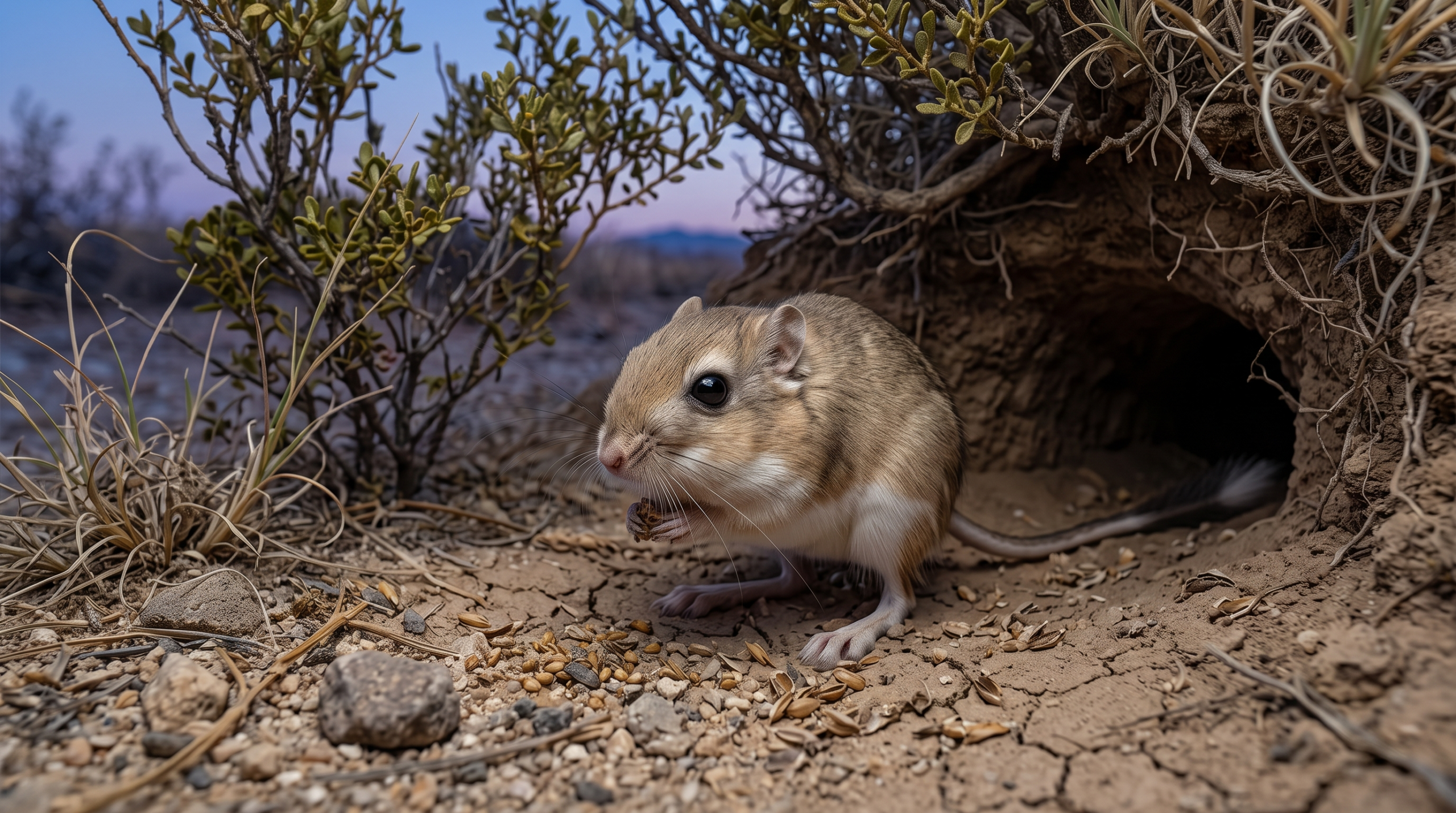
A kangaroo rat emerges from its burrow after sunset. The desert surface that was dangerously hot only hours earlier is beginning to cool. The small rodent pauses, listens, and then bounds across the open ground on powerful hind legs in search of seeds.
There may be no pond nearby. No stream. No dependable puddle waiting for it.
Yet some kangaroo rats can maintain water balance under suitable conditions without routinely drinking free-standing water.
This extraordinary ability is sometimes summarized by saying that kangaroo rats “make water from seeds.” There is a real physiological process behind that phrase, but the popular version is misleading. Dry seeds do not contain a hidden supply of drinking water that the animal somehow squeezes out.
Instead, nutrients from food are oxidized during metabolism, producing metabolic water inside the body. Just as importantly, kangaroo rats have evolved ways to lose remarkably little of that precious water.
The full story of kangaroo rat water adaptations therefore involves both sides of the water budget: obtaining water and conserving it.
An Animal Living Where Water Can Be Almost Impossible to Find
Deserts create a fundamental problem for mammals.
Mammalian cells require water. Blood, digestion, cellular chemistry, temperature regulation, kidney function and virtually every other physiological system depend on it.
But desert environments can provide little reliable surface water. Rain may be infrequent, humidity can be low, and intense daytime temperatures can dramatically increase evaporative losses.
A small mammal faces an additional challenge because its relatively high surface-area-to-volume ratio can make conserving water and controlling body temperature especially difficult.
Kangaroo rats solve the problem through a combination of physiology and behavior.
They obtain water from food and metabolism while restricting losses through urine, feces, respiration and evaporation. They are also largely nocturnal and spend much of the hot day inside sheltered underground burrows.
The remarkable fact is therefore not that kangaroo rats somehow live without water.
They cannot.
It is that certain species can survive without depending on a regular source of liquid water to drink.
Meet the Kangaroo Rat
Kangaroo rats belong to the genus Dipodomys and the rodent family Heteromyidae.
They are native to North America, with species occupying deserts, shrublands, grasslands and other dry or semi-arid environments, particularly in western North America.
Despite the name, they are not miniature kangaroos, and they are not ordinary rats of the genus Rattus.
“Kangaroo” refers to their distinctive style of locomotion.
Their hind limbs are greatly enlarged relative to their forelimbs, allowing them to move with powerful bipedal hops. A long tail contributes to balance and control.
Kangaroo rats also possess another characteristic feature: fur-lined external cheek pouches used for transporting food.
Many species feed heavily on seeds, although diets can also include vegetation and insects depending on species, season and habitat.
One particularly well-studied species is Merriam’s kangaroo rat, Dipodomys merriami, a small desert specialist found across portions of the southwestern United States and Mexico.
Research on this and other Dipodomys species has helped physiologists understand how mammals can maintain water balance under extreme aridity.
Can Kangaroo Rats Really Live Without Drinking Water?
Yes—with an important qualification.
Some kangaroo rats can maintain water balance without access to free-standing drinking water when diet, temperature and environmental conditions are suitable.
That is very different from saying:
“Kangaroo rats do not need water.”
Every kangaroo rat needs water.
Its cells contain water. Its blood contains water. Its kidneys require water to eliminate wastes. Water participates in chemical reactions throughout its body.
The extraordinary adaptation concerns where that water comes from and how efficiently it is conserved.
Instead of depending on a pond or stream, an animal can obtain some preformed water from food and generate additional metabolic water while oxidizing nutrients.
Its physiology and behavior then reduce the rate at which that water disappears.
So the biologically accurate statement is:
Some kangaroo rats can meet their physiological water requirements without routinely drinking free water.
Dry Seeds Are the Foundation of the System
Seeds are central to the ecology of many kangaroo rats.
They provide concentrated packages of nutrients capable of remaining available in dry environments long after greener vegetation has disappeared.
Seeds can contain carbohydrates, fats and proteins—the very nutrients that fuel metabolism.
They are also relatively easy to store.
Kangaroo rats forage across the desert surface collecting seeds and carrying them in specialized cheek pouches.
These pouches are unusual because they open externally beside the mouth and are fur-lined. Food transported in them does not need to sit inside the oral cavity soaked in saliva.
That arrangement is useful for an animal that may collect numerous small food items during a single foraging trip.
Some species scatter-hoard seeds in many small caches, while food can also be stored in or around burrow systems.
Caching allows an animal to exploit a temporary pulse of seed availability and consume those resources later.
What Is Metabolic Water?
Metabolic water is one of the most important concepts for understanding desert mammals.
Every animal needs energy to remain alive.
Cells obtain much of that usable energy by chemically oxidizing nutrients derived from food.
In simplified form:
food nutrients + oxygen → usable energy + carbon dioxide + metabolic water
The water produced during these reactions is called metabolic water.
It is created inside the animal as a consequence of cellular metabolism.
This is why the popular statement that kangaroo rats “extract water from dry seeds” requires correction.
Some foods contain pre-existing water, of course. Even a food described as dry is rarely chemically devoid of all moisture.
But metabolic water is something different.
It is not a reservoir of liquid hidden inside the seed.
It is newly produced during the chemical oxidation of nutrients after the animal has eaten and metabolized them.
How Much Water Can Food Metabolism Produce?
Different nutrients produce different amounts of metabolic water when completely oxidized.
A classic comparative-physiology rule of thumb is that oxidation of one gram of fat yields roughly 1.07 grams of metabolic water, compared with about 0.6 grams from carbohydrate and roughly 0.4 grams from protein. Exact physiological accounting can vary with the substrate and assumptions used.
This helps explain why energy-rich food can also contribute significantly to an animal’s internal water budget.
But metabolic water alone would not make desert survival possible.
Imagine producing a small quantity of water through metabolism and then immediately losing large quantities through dilute urine, wet feces, breathing and evaporation.
The balance would still fail.
Kangaroo rats therefore solve the desert-water problem with two complementary strategies:
produce or obtain water efficiently, and conserve it aggressively.
The second part is every bit as important as the first.
The Kidneys Are Central to Water Conservation
Mammalian kidneys constantly face a difficult task.
The body must remove metabolic wastes and regulate concentrations of salts and other dissolved substances without unnecessarily discarding water.
For an animal with easy access to drinking water, producing relatively dilute urine may be affordable.
For a desert rodent, it can be costly.
Kangaroo rats possess kidneys with exceptional urine-concentrating capabilities.
As in other mammals, urine concentration depends heavily on the architecture of the nephron, particularly the countercurrent system associated with loops of Henle and the renal medulla.
Desert-adapted rodents tend to possess structural and physiological characteristics that allow them to maintain steep osmotic gradients within the kidney.
Water can consequently be reabsorbed efficiently while wastes remain concentrated in a much smaller volume of urine.
The kidneys do not recover 100% of the water.
That would be physiologically impossible because urinary waste still needs to leave the body in solution.
Instead, kangaroo rats reduce the amount of water required for that excretion to an exceptional degree.
How Concentrated Is Kangaroo Rat Urine?
Kangaroo rats are famous for producing extremely concentrated urine, but exact values should be interpreted carefully.
Urine concentration is commonly expressed as osmolality—the concentration of osmotically active particles per unit of water.
Measurements can vary substantially among Dipodomys species and according to hydration status, diet and experimental conditions.
Classic renal-physiology studies of desert rodents have documented maximum urine concentrations well above those typical of humans and many less arid-adapted mammals.
The ecological significance is more important than turning the measurements into a viral ranking.
A highly concentrated urine means that nitrogenous wastes, salts and other solutes can be eliminated using comparatively little water.
Every small volume retained rather than excreted contributes to the animal’s overall water balance.
For a desert mammal obtaining much of its water indirectly, that conservation can determine whether the budget balances.
Saving Water With Every Breath
Kidneys are only part of the problem.
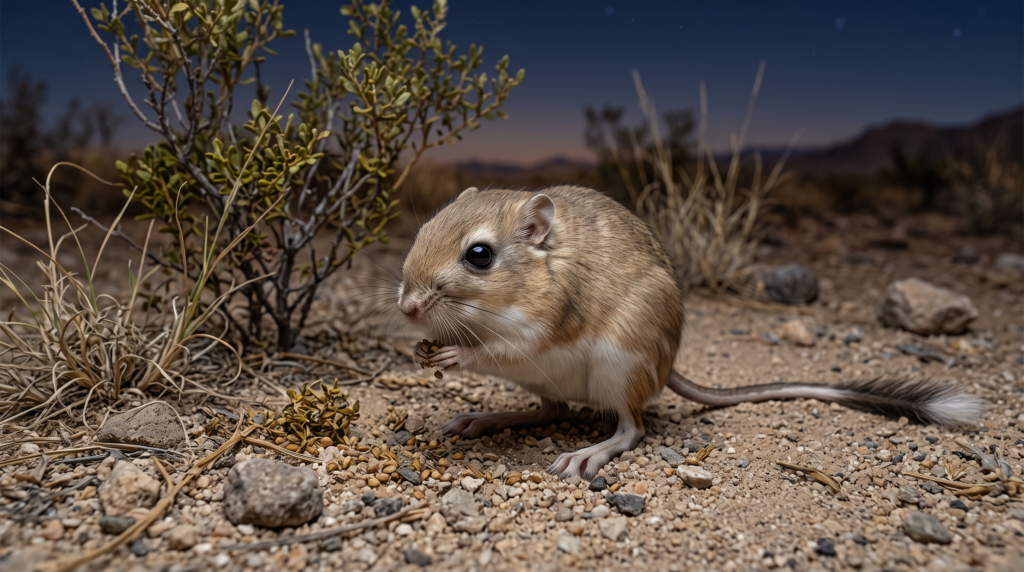
A mammal also loses water every time it breathes.
Air reaching the lungs must become warm and humid. When that moist air is subsequently exhaled, water vapor can leave the body with it.
Over thousands of breaths, respiratory evaporation can represent a substantial loss.
Kangaroo rats have nasal structures that help reduce this cost.
As exhaled air travels through the nasal passages, heat and moisture exchange can allow some water that would otherwise escape to be recovered.
The mechanism depends partly on temperature differences along the respiratory tract.
It is not perfect recycling.
Some respiratory water is still lost.
But reducing that loss breath after breath can have enormous consequences for an animal living on a tight water budget.
The Nose as a Water-Recovery System
During inhalation, relatively cool, dry environmental air passes through the nasal passages before reaching the lungs.
The nose helps warm and humidify that air.
This process can cool portions of the nasal surfaces.
When warm, moisture-rich air later moves outward during exhalation, it encounters those cooler surfaces. Some of its water vapor can condense rather than leaving the body entirely.
The recovered moisture can then remain within the respiratory system.
This form of countercurrent heat and water exchange occurs in various desert and cold-adapted mammals, but it has been studied particularly intensively in kangaroo rats.
The nose should not be imagined as a perfect condenser.
The animal still loses water through breathing.
The adaptation simply reduces the amount lost, improving the overall water economy.
Why Nocturnal Life Saves Water
A desert surface at midday can be an extraordinarily hostile place for a small mammal.
Solar radiation heats the ground. Air temperatures rise. Relative humidity may fall, and maintaining a safe body temperature can become increasingly difficult.
Kangaroo rats avoid much of that problem behaviorally.
Most are primarily nocturnal.
By emerging after sunset, they forage under conditions that are generally cooler and less thermally stressful than those encountered during the hottest part of the day.
Cooler conditions can reduce evaporative water loss.
The animal may also avoid needing to use water-expensive cooling mechanisms as intensively as it would under extreme daytime heat.
Water conservation is not necessarily the only explanation for nocturnality.
Predation risk, food availability, competition and other ecological factors also shape activity patterns.
But from the perspective of desert water balance, staying out of midday heat is extremely useful.
The Burrow Is More Than a Hiding Place
During much of the day, kangaroo rats remain underground.
A burrow is valuable as protection from predators, but it is also a microclimatic refuge.
The exposed desert surface experiences dramatic temperature fluctuations. Underground, soil buffers those extremes.
Burrows can therefore remain substantially cooler than the surface during hot daytime periods and warmer during cold nights.
Airflow is also reduced, and humidity can differ from that of the exposed atmosphere.
These conditions can decrease evaporative stress.
It would be misleading, however, to describe every kangaroo rat burrow as permanently warm and humid.
Burrow temperature and humidity depend on depth, soil properties, architecture, season, weather, occupancy and species.
The general principle is what matters:
an underground refuge provides a more buffered environment than the exposed desert surface.
For a small mammal attempting to conserve water, that difference can be critical.
Can Stored Seeds Become More Moist Underground?
This is one of the most interesting aspects of kangaroo rat ecology—and one that needs careful wording.
Seeds are hygroscopic to varying degrees, meaning their moisture content can change as they equilibrate with surrounding humidity.
A dry seed stored in an environment with higher relative humidity can potentially absorb water vapor from the surrounding air.
Researchers studying heteromyid rodents have long investigated whether food stored inside burrows can gain moisture under suitable microclimatic conditions.
Experimental and physiological work involving Dipodomys has shown that increases in seed water content can improve the animal’s water economy.
But this should not be transformed into the charming story that kangaroo rats deliberately “water their seeds” underground.
Seeds can exchange moisture with their environment as a physical process.
Whether meaningful hydration occurs depends on burrow humidity, seed characteristics, storage duration and environmental conditions.
The phenomenon should therefore be considered one potential contribution to water balance—not a universal underground irrigation system.
Why External Cheek Pouches Help
The cheek pouches of kangaroo rats are characteristic of heteromyid rodents.
Unlike the internal cheek pouches familiar from hamsters, these structures open externally and are lined with fur.
The arrangement is highly effective for transporting seeds.
A kangaroo rat can collect food rapidly, place it into the pouches and move it back to a cache without having to swallow it immediately.
External transport also means that stored food does not need to be carried inside a saliva-filled mouth.
This has often been discussed as potentially advantageous in water-limited environments because it avoids unnecessarily wetting collected seeds.
Still, the cheek pouch should not be presented as an organ that evolved exclusively for water conservation.
Food transport, harvesting efficiency, competition and caching behavior are also central to its function.
As with most adaptations, several ecological benefits can operate simultaneously.
What About Feces?
Water leaves the body through more routes than urine and breathing.
Fecal material also contains water.
Desert-adapted mammals can reduce this loss by reabsorbing water efficiently through the digestive tract, producing relatively dry feces.
Again, “dry” is relative.
Kangaroo rat feces are not completely devoid of water.
The physiological objective is to minimize unnecessary loss while still allowing waste to move through and leave the digestive system.
This contribution may appear small compared with dramatic kidney adaptations, but water balance is cumulative.
A little water saved through urine, a little through respiration, another amount through feces, and additional conservation through behavior can collectively make the difference between dehydration and equilibrium.
A Complete Water Budget
The easiest way to understand kangaroo rat desert physiology is to think like an accountant.
The animal has a water budget.
Water gains can include:
- preformed moisture already present in food;
- metabolic water generated when carbohydrates, fats and proteins are oxidized;
- additional moisture gained by stored foods under suitable environmental conditions;
- free water if it is available and consumed.
Water losses include:
- urine;
- feces;
- respiratory evaporation;
- evaporation across body surfaces;
- water associated with reproduction and other physiological processes.
Survival requires:
water gained ≈ water lost over time.
If losses consistently exceed gains, dehydration follows.
Every adaptation discussed in this article influences one side of that equation.
Metabolic water increases income.
Concentrated urine reduces expenditure.
Respiratory recovery reduces expenditure.
Nocturnal behavior reduces expenditure.
A buffered burrow reduces expenditure.
Seed storage helps stabilize access to the fuel needed to generate metabolic water.
There is no single “secret.”
The system works because many small and large adaptations reinforce one another.
Do Kangaroo Rats Ever Drink?
The popular statement “kangaroo rats never drink water” is too absolute.
Laboratory studies have demonstrated that some species, including well-studied desert forms, can maintain water balance without access to drinking water under appropriate conditions.
That establishes a physiological capability.
It does not prove that every wild kangaroo rat rejects free water whenever it encounters it.
Species differ, environments differ, and individual physiological conditions differ.
Animals may encounter water through moist foods, rainfall, dew or unusual surface-water opportunities.
The scientifically meaningful claim is therefore not that Dipodomys has somehow evolved an inability or refusal to drink.
It is that certain kangaroo rats are capable of meeting their water requirements without depending on free-standing water.
That is an extraordinary adaptation even without the absolute “never.”
Not Every Kangaroo Rat Is the Same
Dipodomys contains numerous species distributed across a range of dry North American environments.
Merriam’s kangaroo rat, Dipodomys merriami, has been central to many classic physiological studies because it occupies highly arid environments.
Other species live in different combinations of desert, shrubland, grassland and sandy habitats.
Body size differs.
Diet differs.
Kidney structure and concentrating capacity can differ.
Activity patterns, burrow environments and exposure to climatic extremes also vary.
A physiological measurement from D. merriami should therefore not automatically be assigned to every species in the genus.
This is particularly important when discussing extreme measurements such as maximum urine concentration or experimental survival without drinking water.
The broad suite of kangaroo rat water adaptations is shared conceptually across the group, but the degree of specialization varies.
Desert Survival Requires More Than Water Conservation
Water physiology is only part of the kangaroo rat’s desert toolkit.
Its elongated hind limbs enable rapid saltatorial—or hopping—locomotion.
That can be valuable when crossing open ground or escaping predators.
Kangaroo rats also possess acute sensory systems useful for detecting threats. Some species can perform impressive evasive jumps when confronted by snakes.
Seed caching allows them to move food from exposed foraging sites to safer storage locations.
Burrows provide protection not only from temperature extremes but also from many predators.
Behavior determines when the animal emerges and how long it remains exposed.
Desert survival is therefore not produced by one miraculous organ.
It is the result of anatomy, physiology and behavior functioning together.
Common Misconceptions About Kangaroo Rats and Water
“Kangaroo rats do not need water.”
False. Every kangaroo rat requires water for normal cellular and physiological function. Some simply do not need to obtain it by regularly drinking free water.
“They squeeze drinking water out of dry seeds.”
Misleading. Seeds provide nutrients that can be oxidized to generate metabolic water. This is a biochemical process inside the animal.
“Dry seeds contain enough liquid water to hydrate them directly.”
Dry seeds may contain some preformed moisture, but metabolic water is produced from nutrient oxidation rather than extracted as hidden droplets.
“Their kidneys recover every drop of water.”
No. Kangaroo rat kidneys conserve water exceptionally efficiently, but urine still contains water.
“Kangaroo rat urine is basically solid.”
No. It is highly concentrated liquid urine.
“Their burrows are always extremely humid.”
Burrow microclimate varies with species, soil, depth, season and environmental conditions.
“Kangaroo rats never drink under any circumstances.”
Too absolute. Some species can survive without drinking free water under appropriate conditions, which is not the same as proving that no individual ever drinks.
“All kangaroo rats have identical desert physiology.”
No. Dipodomys species occupy different environments and differ physiologically.
“Metabolic water is stored inside food before it is eaten.”
No. It is produced inside the body during oxidation of nutrients.
Frequently Asked Questions
How do kangaroo rats survive without drinking water?
Some species can obtain sufficient water from preformed food moisture and metabolic water while minimizing losses through highly concentrated urine, efficient respiratory water recovery, relatively dry feces, nocturnal activity and sheltered burrows.
What is metabolic water?
Metabolic water is water produced inside the body when nutrients such as carbohydrates, fats and proteins are oxidized during cellular metabolism.
Do kangaroo rats get water from seeds?
Yes, but in two different senses. Seeds contain some preformed moisture, and their nutrients can also be metabolized to generate new metabolic water. Saying the animal simply “extracts water from dry seeds” misses this distinction.
Why is kangaroo rat urine so concentrated?
Their kidneys can reabsorb water very efficiently while concentrating dissolved wastes into a relatively small volume of urine. This reduces one of the body’s major potential routes of water loss.
Do kangaroo rats ever drink water?
They can obtain water without routinely drinking under suitable conditions, but “never drinks” is an unnecessary and overly absolute claim. Behavior and physiological requirements can vary among species and circumstances.
How do kangaroo rat burrows help them survive?
Burrows buffer extreme surface temperatures, block solar radiation, reduce airflow and can provide a different humidity environment. These conditions help reduce thermal stress and evaporative water loss.
Conclusion
The kangaroo rat’s achievement is more sophisticated than the familiar claim that it “makes water from seeds.”
Seeds provide energy-rich nutrients. When those nutrients are oxidized during cellular metabolism, part of the chemical process produces metabolic water.
But producing water internally is only half the solution.
Kangaroo rat kidneys minimize urinary water loss by producing exceptionally concentrated urine. Nasal heat and moisture exchange recovers part of the water that would otherwise disappear with every breath. Efficient digestion limits fecal losses. Nocturnal activity reduces exposure to daytime heat, while underground burrows provide a buffered refuge from the harsh desert surface.
Seed collection and caching ensure access to the metabolic fuel that keeps the entire system operating.
Together, these kangaroo rat water adaptations allow some Dipodomys species to maintain water balance in environments where a dependable drinking source may be extraordinarily difficult to find.
The remarkable lesson is not that kangaroo rats can live without water.
No mammal can.
It is that evolution has produced a mammal capable of obtaining and conserving water so efficiently that, under the right conditions, drinking it directly may become unnecessary
Internal-linking opportunities
- Link desert animal adaptations to an article explaining how mammals survive extreme heat and aridity.
- Link metabolic water in animals to a guide explaining how cellular respiration produces water from nutrients.
- Link animal kidneys and water conservation to an article comparing renal adaptations in desert mammals.
- Link nocturnal desert wildlife to an article explaining why so many desert animals become active after sunset.
Authoritative external sources
- Schmidt-Nielsen, K. — classic comparative physiological research on desert animals and water balance, including extensive experimental work on kangaroo rats and other arid-adapted mammals.
- MacMillen, R. E. & Hinds, D. S. — physiological and ecological research on water regulation, energy metabolism, and environmental adaptation in heteromyid rodents.
- Journal of Mammalogy — peer-reviewed studies of Dipodomys ecology, physiology, diet, habitat use, and desert adaptations.
- American Journal of Physiology and comparative physiology literature — research on mammalian renal concentrating ability, respiratory water conservation, and desert water balance.
- Smithsonian’s National Zoo and Conservation Biology Institute — supplementary species information on kangaroo rats and heteromyid rodent adaptations.