
Spider Mites in Late-Summer Heat: How to Tell It’s Not Just Drought Stress
By late summer, a plant with pale, dry-looking leaves seems easy to diagnose: it needs more water. But when watering doesn’t improve the foliage, something much smaller may be responsible. Spider mites late summer heat problems often intensify during extended periods of hot, dry weather, producing leaf symptoms that gardeners can easily mistake for ordinary drought stress.
Spider mites are tiny arachnids related to spiders and ticks rather than true insects. They feed by piercing plant cells and removing their contents, creating characteristic stippling that can eventually progress to yellowing, bronzing, leaf drop, and fine webbing.
Before reaching for the hose—or a pesticide—the most important step is determining what is actually damaging the plant.
Table of Contents
- What Spider Mites Are
- Why Spider Mites Explode in Late-Summer Heat
- How Spider Mites Damage Plants
- Spider Mites vs. Drought Stress
- Look for Stippling, Not Just Yellow Leaves
- Check the Undersides of Leaves
- The White Paper Shake Test
- Why Webbing Is a Late Warning Sign
- Which Plants Are Most Vulnerable?
- Start With Water and Plant Health
- Wash Spider Mites Off Plants
- Insecticidal Soap for Spider Mites
- Why Coverage Matters
- Why Broad-Spectrum Pesticides Can Backfire
- Natural Spider Mite Predators
- Managing Spider Mites on Houseplants
- Common Spider Mite Control Mistakes
- Frequently Asked Questions
- Final Thoughts
What Spider Mites Are
Spider mites are extremely small plant-feeding arachnids in the family Tetranychidae.
One of the most widespread garden species is the twospotted spider mite, Tetranychus urticae. It attacks hundreds of plant species, including vegetables, fruits, ornamentals, and houseplants.
Adults are so small that identifying them individually without magnification can be difficult.
Gardeners are therefore more likely to notice the damage than the mites themselves.
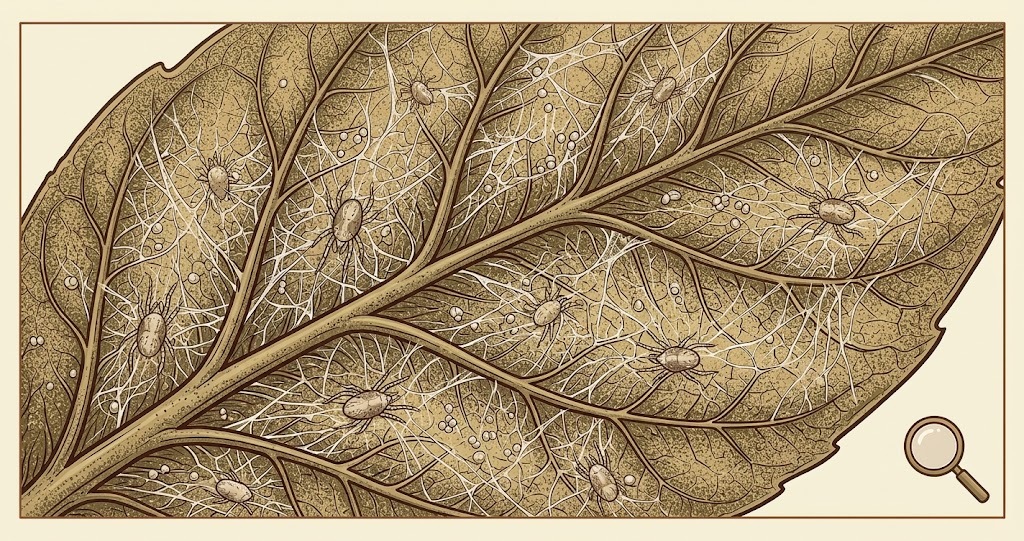
Spider mites typically concentrate on leaf undersides, where they puncture plant cells with specialized mouthparts.
Colorado State University Extension describes spider mites as among the most common pests of garden and landscape plants, particularly under hot, dry conditions. Colorado State University Extension — Spider Mites
Understanding that relationship with weather is the first clue when unexplained leaf damage appears in August.
Why Spider Mites Late Summer Heat Problems Escalate
Hot, dry weather creates conditions in which spider mite populations can increase rapidly.
Their development is temperature-dependent. When conditions are warm, mites progress through their life cycle faster, allowing generations to overlap.
The University of Minnesota Extension notes that twospotted spider mites thrive under hot, dry conditions and can become particularly damaging during drought. University of Minnesota Extension — Managing Spider Mites in the Home Garden
Heat isn’t acting alone.
Drought-stressed plants may also become more vulnerable to feeding damage, while dry conditions can reduce some of the environmental factors that normally suppress mite populations.
By late summer, several weeks of favorable weather may have allowed a population that began almost invisibly to become a serious infestation.
This is why spider mites late summer heat outbreaks can seem sudden.
The mites didn’t necessarily arrive yesterday. Their numbers may simply have reached the point where plant damage became obvious.
How Spider Mites Damage Plants
Spider mites don’t chew holes through leaves like caterpillars.
They feed at the cellular level.
Their piercing mouthparts damage individual plant cells, producing tiny pale or whitish dots on the leaf surface. This pattern is commonly called stippling.
A few damaged cells are easy to overlook.
Thousands create a noticeably faded appearance.
As feeding continues, leaves may become yellow, gray-green, bronze, or brown. Severe infestations can cause premature leaf drop and general plant decline.
Fine silk may eventually appear between leaves, stems, and growing points.
But waiting for obvious webbing before checking for mites is a mistake.
Plants can experience substantial feeding before the webbing becomes dramatic.
Spider Mites vs. Drought Stress
This is where diagnosis becomes tricky.
Both drought and spider mites can produce dull, yellowing, browning, or dropping leaves.
They can also happen simultaneously.
A plant suffering through a hot, dry August may genuinely need water while also supporting a growing spider mite population.
Look at the pattern rather than relying on one symptom.
Drought stress often causes wilting, drooping, leaf rolling, dry edges, or widespread decline associated with insufficient soil moisture.
Spider mite feeding more characteristically produces fine stippling across leaf surfaces.
As damage increases, that stippling merges into a washed-out or bronzed appearance.
The undersides of affected leaves may reveal mites, eggs, cast skins, or fine silk.
Soil moisture provides another clue.
If the root zone is dry and the entire plant wilts during the hottest part of the day, water stress is likely contributing.
If soil moisture is adequate but individual leaves continue developing fine speckles and bronzing, inspect for mites.
Look Closely at the Stippling
Stippling is one of the most useful early diagnostic signs.
Hold a suspicious leaf in good light.
Instead of uniform yellowing, you may see hundreds of tiny pale dots scattered across the surface.
The effect can look as though someone sprayed the leaf with extremely fine droplets of pale paint.
Early damage may be concentrated around certain leaves or sections of the plant.
As the infestation grows, the entire canopy can become affected.
Compare damaged foliage with a healthy leaf from another part of the same plant.
That side-by-side comparison often makes stippling much easier to recognize.
Check the Undersides of Leaves
Spider mites prefer protected areas.
Turn affected leaves over and examine the underside with a hand lens if you have one.
Look for tiny moving dots.
Depending on the species and life stage, mites may appear yellowish, greenish, orange, reddish, or almost translucent.
Twospotted spider mites commonly have dark spots on either side of their bodies, although these markings can vary.
You may also see translucent eggs or shed skins.
If you’re still uncertain, use one of the easiest spider mite diagnostic methods available.
The White Paper Shake Test
You don’t need laboratory equipment to check for spider mites.
You need a sheet of white paper.
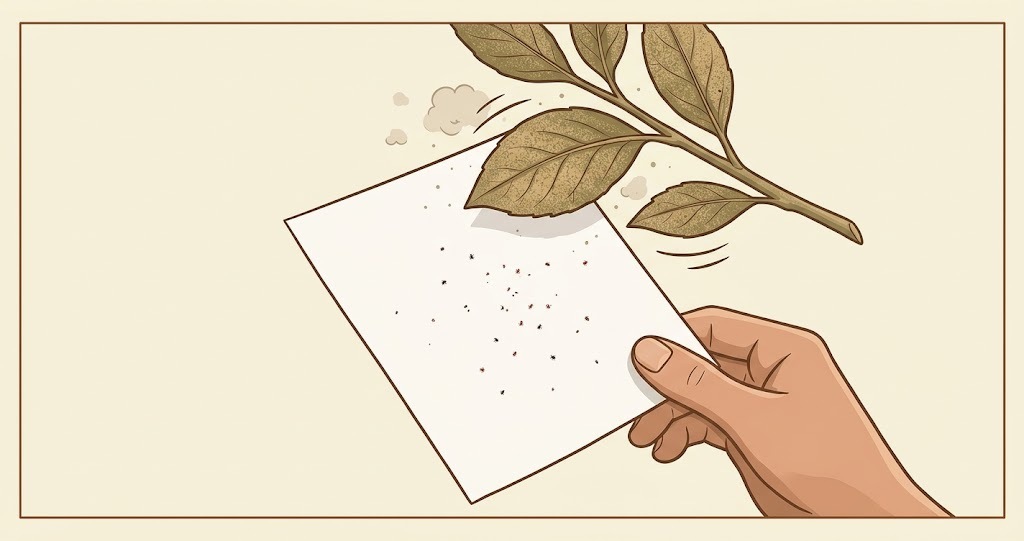
Hold the paper beneath a branch or suspicious leaf and firmly tap or shake the foliage over it.
Tiny organisms will fall onto the white surface.
Watch carefully.
Spider mites may initially look like grains of pepper or dust, but they will begin moving across the paper.
You can gently smear one with a finger. Plant-feeding mites may leave a colored streak, although simply observing movement is often enough to establish that tiny arthropods are present.
Colorado State University Extension recommends this paper test as a practical way to detect spider mites that are otherwise difficult to see. Colorado State University Extension — Spider Mites
Repeat the test on several parts of the plant.
One leaf isn’t always representative of the entire infestation.
Why Webbing Is a Late Warning Sign
Spider mites get their common name partly from their ability to produce silk.
During heavier infestations, webbing may cover leaf undersides, branch tips, flowers, and stems.
This can make diagnosis obvious.
But don’t use webbing as your only criterion.
Low populations may produce little visible silk, and some mite species produce less obvious webbing than others.
If you wait until a plant resembles a miniature spiderweb factory, the population may already be substantial.
Stippling plus a positive white paper shake test provides a much earlier warning.
Which Plants Are Most Vulnerable?
Spider mites have an enormous host range.
Common garden hosts include beans, cucumbers, melons, squash, tomatoes, eggplants, strawberries, and numerous ornamentals.
Roses and many landscape shrubs can also be attacked.
Indoors, mites frequently appear on tropical foliage plants and other houseplants, especially where air is warm and dry.
Plant susceptibility varies.
A healthy plant may tolerate low mite numbers with little visible damage, while a heat- and drought-stressed plant can deteriorate much faster.
This is why plant care remains part of spider mite management.
Start With Correct Watering
When dealing with spider mites late summer heat, don’t allow the host plant to become unnecessarily drought stressed.
Check soil moisture rather than guessing.
Water deeply when appropriate for the plant, soil, and weather conditions, allowing moisture to reach the active root zone.
Avoid repeatedly wetting only the top inch of soil.
At the same time, don’t respond to mites by keeping roots permanently saturated.
Overwatering creates oxygen-poor conditions and root problems that can weaken the plant further.
Our guide Why Watering Every Day Might Be Doing More Harm Than Good explains why watering frequency should be based on actual soil conditions rather than a rigid daily schedule.
The objective is consistent, appropriate moisture.
Wash Spider Mites Off Plants
A strong stream of water is one of the simplest first-line controls for manageable infestations.
Direct water particularly toward leaf undersides.
The spray physically knocks mites from foliage and can remove some webbing.
For sturdy outdoor plants, repeat washing periodically while monitoring the population with the white paper test.
This method has several advantages.
It leaves no pesticide residue, doesn’t encourage pesticide resistance, and causes minimal disruption to beneficial predators when performed carefully.
It also temporarily increases moisture around foliage, making conditions less favorable than the dry environment spider mites prefer.
However, don’t keep plants continuously wet.
Prolonged leaf wetness can encourage certain fungal and bacterial diseases, especially where airflow is poor.
Morning is generally a sensible time to wash outdoor plants because foliage can dry afterward.
Does Increasing Humidity Help?
Spider mites generally perform particularly well under hot, dry conditions.
Reducing severe drought stress and maintaining appropriate humidity around susceptible indoor plants can make the environment less favorable.
But humidity isn’t a stand-alone cure.
Don’t repeatedly mist plants while allowing a large infestation to continue unchecked.
And don’t create permanently wet foliage in a humid garden where fungal diseases are already a concern.
Think of humidity management as one component of prevention rather than a pesticide substitute.
Using Insecticidal Soap
When physical washing isn’t enough, insecticidal soap can be an appropriate lower-impact option for many plants.
These products work through direct contact.
That means the spray must actually reach the mites.
Because mites frequently live on leaf undersides, spraying only the top surfaces will produce disappointing results.
Use a product specifically labeled for the plant and pest you’re treating.
Follow all label directions regarding dilution, coverage, repeat applications, temperature restrictions, and plant sensitivity.
Don’t assume homemade dish-soap mixtures are equivalent to commercially formulated insecticidal soap.
Household detergents can contain degreasers, fragrances, and other ingredients that damage foliage.
Use a product intended and labeled for pest management.
Be Careful Spraying During Extreme Heat
This is particularly important in late summer.
Some pesticide products, including soaps and oils, can injure plants when applied under excessively hot conditions or when plants are drought stressed.
Read the label before application.
If the product warns against spraying above a certain temperature, follow that restriction.
Treating a mite infestation isn’t helpful if the treatment burns already stressed foliage.
When possible, address severe water stress before applying a contact treatment.
Why Broad-Spectrum Pesticides Can Backfire
A spider mite outbreak can tempt gardeners to reach for the strongest insecticide available.
That can make the problem worse.
Spider mites have natural enemies, including predatory mites, minute pirate bugs, lacewings, and other predatory arthropods.
Broad-spectrum insecticides can kill those beneficial organisms.
The University of Minnesota Extension warns that some pesticides can worsen spider mite problems by killing natural enemies while failing to provide effective long-term mite suppression. University of Minnesota Extension — Spider Mites
Some insecticides may also stimulate mite reproduction or allow surviving populations to rebound quickly.
Remember that spider mites aren’t insects.
An insecticide designed for common garden insects isn’t automatically an effective miticide.
Target the actual pest.
Protect Natural Spider Mite Predators
A healthy garden contains organisms you rarely notice.
Predatory mites are among them.
Unlike plant-feeding spider mites, predatory mites hunt other small arthropods and can help keep pest populations under control.
Lacewing larvae, lady beetles, predatory thrips, and minute pirate bugs may also feed on mites depending on the garden ecosystem.
Avoid routine “just in case” pesticide spraying.
Use treatments only when monitoring indicates that intervention is necessary.
This approach is part of integrated pest management: identify the pest, evaluate the severity, use cultural and physical controls first when practical, and choose targeted treatments when needed.
Spider Mites on Houseplants
Indoor infestations require a slightly different strategy.
First, isolate the affected plant from nearby houseplants if possible.
Spider mites can spread between closely spaced plants.
Wash the foliage thoroughly, paying particular attention to leaf undersides.
For smaller plants, a sink or shower can make this easier.
Inspect nearby plants as well.
Repeat the white paper shake test periodically because one treatment rarely removes every egg and mite.
If insecticidal soap is needed, follow the product label carefully and test a small portion of sensitive plants before treating the entire specimen when the label recommends doing so.
Common Spider Mite Control Mistakes
Assuming yellow leaves always mean drought
Check soil moisture and inspect foliage before watering again.
Mite stippling can imitate drought-related discoloration.
Waiting for webbing
Webbing often indicates an established infestation.
Use the white paper test when stippling first appears.
Spraying only the tops of leaves
Spider mites frequently concentrate underneath foliage.
Contact treatments need thorough coverage.
Using broad-spectrum insecticides immediately
You may kill predators that were helping suppress the mites.
Start with lower-impact management whenever practical.
Using homemade detergent sprays
Household soaps aren’t formulated as plant pesticides and can damage foliage.
Choose properly labeled insecticidal soap.
Treating once and forgetting about it
Eggs and surviving mites can produce another population.
Monitor plants after treatment and repeat control according to label instructions when necessary.
Ignoring watering problems
Mite management works better when the host plant isn’t simultaneously suffering severe drought stress.
Frequently Asked Questions
Why are spider mites worse in late summer?
Hot, dry weather favors rapid spider mite development and reproduction. Plants may also be experiencing drought stress at the same time, making feeding damage more noticeable.
How can I tell spider mites from drought stress?
Look for fine pale stippling rather than only generalized wilting or dry leaf edges.
Check leaf undersides and perform the white paper shake test. If tiny moving dots fall from the foliage, mites are likely present.
What is the white paper test for spider mites?
Hold white paper beneath suspicious foliage and tap or shake the plant.
Spider mites fall onto the paper and appear as extremely small moving dots, making them easier to detect than when they’re hiding on leaves.
Will spraying plants with water get rid of spider mites?
A strong water spray can physically remove many mites and is a useful first-line control for manageable infestations.
Repeated monitoring is important because eggs and surviving mites can rebuild the population.
Does insecticidal soap kill spider mites?
Properly labeled insecticidal soap can suppress spider mites through direct contact.
Coverage is essential, particularly on leaf undersides, and repeat applications may be necessary according to the product label.
Should I use insecticide on spider mites?
Avoid automatically using broad-spectrum insecticides.
They may kill predatory insects and mites that naturally suppress spider mite populations. Some products also don’t effectively control mites.
Can spider mites kill a plant?
Severe infestations can cause substantial leaf loss, reduced plant vigor, and potentially plant death, particularly when combined with heat and drought stress.
Healthy established plants often tolerate small populations better than already stressed plants.
Can spider mites spread to nearby plants?
Yes.
They can move between touching plants and may also be dispersed through air currents, clothing, tools, or newly introduced infested plants.
Final Thoughts
Spider mites late summer heat outbreaks are easy to misdiagnose because they often arrive at exactly the same time plants begin showing ordinary heat and drought stress.
Don’t diagnose from yellow leaves alone.
Look for the characteristic fine stippling created when mites feed on plant cells. Turn leaves over. Search for tiny moving dots and fine silk, and use the white paper shake test before deciding what treatment is necessary.
If mites are present, start with the least disruptive measures.
Keep plants appropriately watered without saturating the soil. Wash sturdy plants with a strong stream of water, concentrating on leaf undersides. Maintain reasonable humidity where appropriate, particularly around susceptible indoor plants.
When additional control is necessary, properly labeled insecticidal soap can be useful, but thorough coverage and correct timing are essential.
Most importantly, avoid turning a manageable mite problem into a larger one by indiscriminately spraying broad-spectrum pesticides.
Predatory mites and beneficial insects are part of your defense system.
Late-summer plants already have enough to handle from high temperatures and drying soil. Accurate diagnosis lets you give them what they actually need instead of adding another source of stress.ble Garden, Container Gardening, Nature
Internal Link Suggestions:
Why Watering Every Day Might Be Doing More Harm Than Good
Powdery Mildew on Squash and Cucumbers
External Dofollow Authoritative Sources:
Colorado State University Extension — Spider Mites
https://extension.colostate.edu/topic-areas/insects/spider-mites-5-507/
University of Minnesota Extension — Managing Spider Mites in the Home Garden
https://extension.umn.edu/yard-and-garden-insects/spider-mites
University of California Statewide Integrated Pest Management Program — Spider Mites
https://ipm.ucanr.edu/PMG/PESTNOTES/pn7405.html