
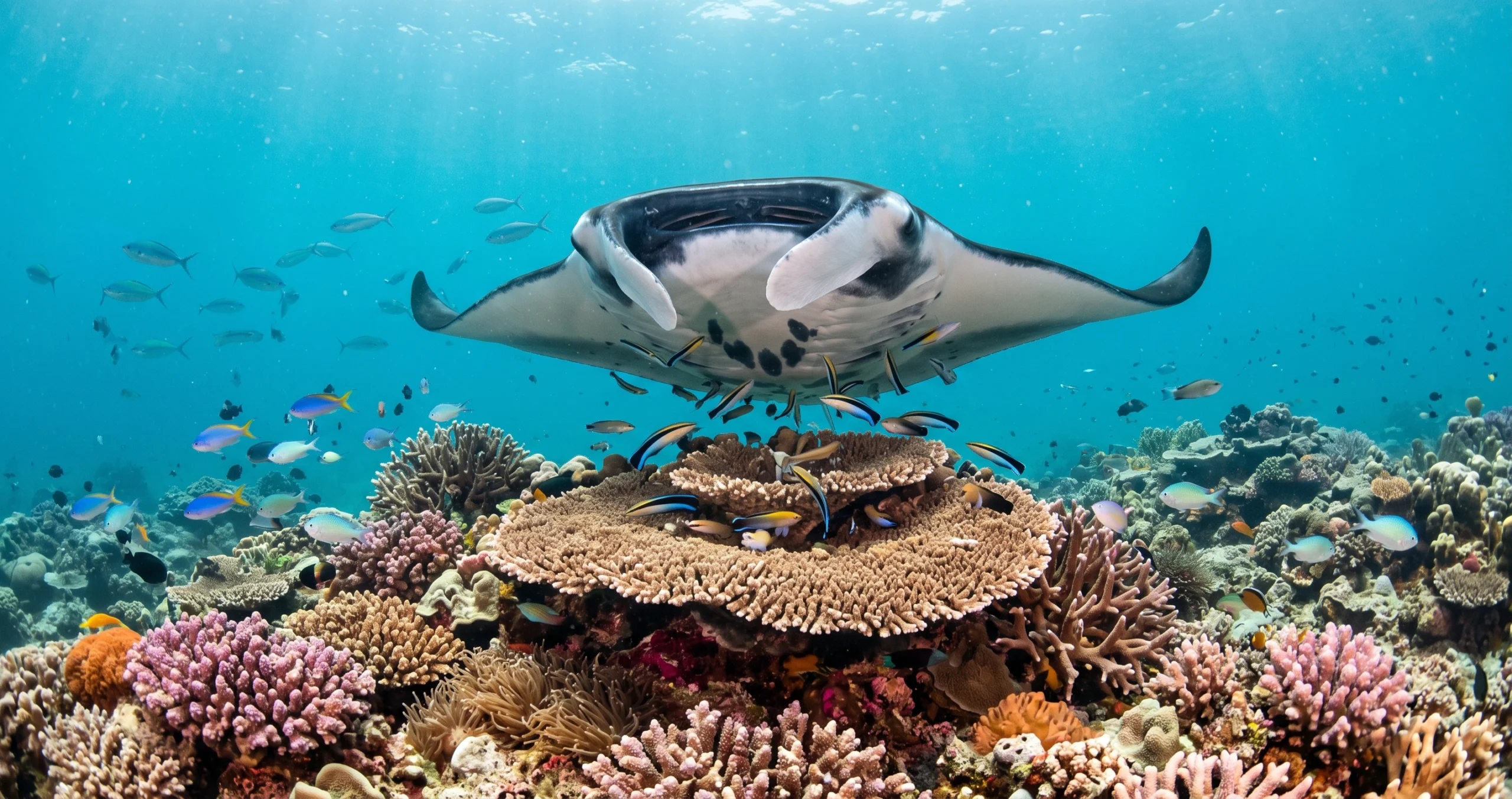
Above certain coral reefs, manta rays perform an unusual daily ritual. Instead of feeding or migrating, they slow down, hover over particular coral outcrops, and allow tiny fishes to swim across their bodies. A manta ray cleaning station functions almost like a service stop where cleaner wrasses and other fishes remove parasites, dead tissue, mucus, and debris while receiving a meal in return.
These sites are also surprisingly complex social spaces. Mantas repeatedly return to favored stations, associate with particular individuals, and can wait or circle nearby when another ray occupies the cleaning area. Research increasingly suggests that cleaning stations are important not only for hygiene but also for manta movement, memory, social relationships, and habitat use.
Table of Contents
- What Is a Manta Ray Cleaning Station?
- How the Cleaning Partnership Works
- Why Cleaner Wrasses Help Manta Rays
- Do Manta Rays Really Wait Their Turn?
- How Mantas Remember Cleaning Stations
- Manta Ray Intelligence and Cognition
- The Social Lives of Manta Rays
- Why Cleaning Stations Matter for Conservation
- Responsible Manta Ray Ecotourism
- Common Myths About Manta Rays
- Frequently Asked Questions
- Conclusion
What Is a Manta Ray Cleaning Station?
A cleaning station is a particular location where small cleaner animals establish themselves and larger “client” animals deliberately visit to have parasites and unwanted material removed.
On coral reefs, these stations often occur around prominent coral heads, reef outcrops, or “bommies.”
Reef manta rays (Mobula alfredi) are among their most impressive visitors.
Rather than simply passing over the reef, a manta approaching a station may slow down and position its enormous body above the cleaner fishes. It can repeatedly circle or hover around the site while cleaners inspect different parts of its body.
Research using acoustic tracking has shown that the distribution of bluestreak cleaner wrasse (Labroides dimidiatus) can strongly influence how reef manta rays use cleaning areas. At one studied site, cleaning interactions dominated manta habitat use within the monitored area. (PubMed Central (PMC))
That means a manta ray cleaning station is not simply a convenient place a ray happens to visit.
For some individuals, it can be a repeatedly visited destination important enough to influence their movements across the reef.
How the Cleaning Partnership Works
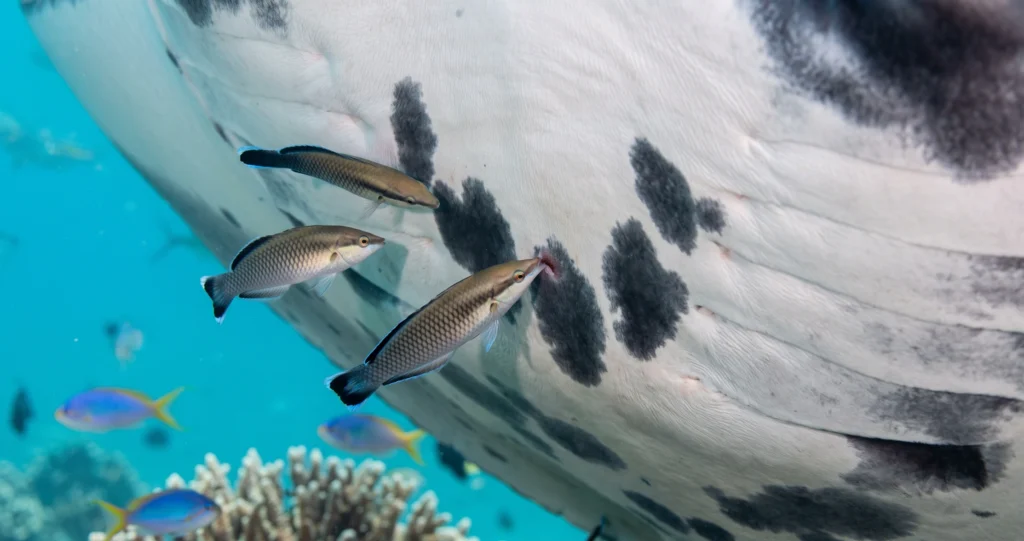
The relationship between manta rays and cleaner fishes is a classic example of cleaning mutualism.
Both participants receive a benefit.
The manta gains access to small fishes capable of reaching areas of its body that it cannot easily clean itself. The cleaner fish gains food.
Cleaner wrasses are particularly important participants.
The Manta Trust documents bluestreak cleaner wrasse, lyretail wrasse, blunt-headed wrasse, and other fishes cleaning manta rays. In some locations, angelfish and butterflyfish can also participate. (Manta Trust)
The cleaners pick material from the ray’s skin, wounds, mouth region, gills, and other accessible areas.
Their food can include ectoparasites, dead skin, mucus, and associated material.
This is why the relationship is described as mutualistic rather than simply one animal feeding on another.
The cleaner gets a meal. The manta receives maintenance.
Why Cleaner Wrasses Help Manta Rays
A manta ray may have an enormous body, but it has no hands, claws, or beak with which to groom itself.
Its large surface area also creates plenty of habitat for external parasites.
Cleaner fishes provide a solution.
At a manta ray cleaning station, the ray deliberately presents different body regions to the cleaners. Observations suggest that individual cleaner species may even concentrate their attention on different portions of the manta.
Recent remote-video research in Mozambique documented three cleaner-fish species interacting with mantas and found preliminary evidence that bluestreak cleaner wrasse and white-spotted butterflyfish differed in which body regions they serviced. (PubMed)
Cleaning can also help with wounds.
Removing damaged tissue or irritating organisms may contribute to maintaining skin health, although researchers continue investigating the full physiological benefits of cleaning in large marine animals.
What is clear is that mantas value these sites enough to return repeatedly.
Do Mantas Really Wait Their Turn?
Descriptions of mantas “queuing” at cleaning stations need some nuance.
They do not form a rigid human-style line with a formally established first-come, first-served rule.
However, observers at busy cleaning stations can see rays waiting nearby, circling, following established approach patterns, or occupying the cleaning area sequentially rather than every animal crowding directly onto the same coral head.
The important behavior is spatial organization.
A manta being cleaned needs to maintain an appropriate position over the reef while cleaner fishes work. Other rays can remain nearby and move through the station in sequence.
This creates the visual impression of a queue.
It is better scientifically to describe this as waiting, sequential access, or turn-like use rather than claiming mantas understand a human concept of queuing etiquette.
There is another reason to be cautious.
Behavior varies among locations, individuals, cleaning-station configurations, current conditions, and the number of animals present. A pattern observed at one reef should not automatically be treated as a universal rule.
Nevertheless, repeated visits and organized movement around a manta ray cleaning station demonstrate that these animals are doing far more than randomly swimming above coral.
How Mantas Remember Cleaning Stations
A manta may travel considerable distances between feeding, cleaning, and other important habitats.
Yet individual reef mantas can repeatedly return to particular cleaning sites.
Scientists have investigated this using acoustic telemetry.
In one study, researchers tagged 42 reef manta rays and established a fine-scale acoustic receiver array around a cleaning area. They then compared manta movements with reef structure and cleaner-wrasse distribution.
The rays’ space use was significantly associated with both hard coral habitat and bluestreak cleaner wrasse.
The researchers proposed that repeated long-term use of specific stations may indicate long-term memory and a cognitive map of shallow reef environments. (PubMed Central (PMC))
In practical terms, a manta appears capable of remembering where useful services can be found.
That has major conservation implications.
Destroying a cleaning station may not simply remove a patch of coral. It can remove a known resource from the mental and behavioral landscape of animals that have repeatedly returned there.
Manta Ray Intelligence and Cognition
Manta rays possess unusually large and complex brains for fishes.
But brain size alone should not be used as proof of human-like intelligence.
Scientists instead examine behavior.
Site fidelity is one clue. Mantas can repeatedly navigate back to important feeding and cleaning areas, suggesting substantial spatial memory.
Social behavior provides another.
Individual reef mantas do not simply form completely random aggregations. Long-term research indicates that they can preferentially associate with certain individuals.
Scientists have also investigated whether mantas respond to mirrors in ways potentially relevant to self-recognition. Such experiments are fascinating, but claims that mantas definitively “pass” the mirror self-recognition test remain debated and should be interpreted cautiously.
What researchers can say confidently is that manta behavior is considerably more complex than the outdated stereotype of rays as simple, solitary fishes.
A manta ray cleaning station provides an excellent place to see some of that complexity because it brings identifiable individuals together repeatedly.
The Social Lives of Manta Rays
One of the most important studies of manta social behavior followed reef mantas in Raja Ampat, Indonesia, for five years.
Researchers recorded more than 500 groups and used social-network analysis to determine whether repeated associations were simply accidental.
They were not.
The study found evidence that individual reef manta rays maintain preferred social relationships over time. Longer-lasting associations were especially evident between females. (the UWA Profiles and Research Repository)
The overall society resembled what behavioral ecologists call a fission-fusion system.
Individuals form groups, separate, and later associate in different combinations rather than remaining permanently inside one fixed group.
Cleaning stations played an important role.
The researchers found that differentiated social relationships were associated with strong fidelity to particular cleaning-station sites. (Macquarie University)
A manta ray cleaning station can therefore become something more than a parasite-removal service.
It can function as a recurring meeting point.
Cleaning Stations May Serve Multiple Purposes
Cleaning is the obvious reason for visiting, but these sites can support additional behaviors.
Mantas can socialize around them. Courtship behavior may occur nearby, and predictable aggregations create opportunities for individuals to encounter one another.
The Manta Trust notes that cleaning stations can also play roles in socializing, courtship, mating, predator avoidance, and thermoregulation. (Manta Trust)
These multiple functions make cleaning areas disproportionately important.
A relatively small coral outcrop might influence the behavior of animals ranging across a much larger marine area.
It also explains why protecting the physical station—and not simply protecting individual manta rays—is important.
Conservation Status and Threats to Manta Rays
There are multiple recognized manta species, and conservation status should not be generalized across all of them without distinction.
The reef manta ray (Mobula alfredi) is currently assessed as Vulnerable on the IUCN Red List, while the giant oceanic manta ray (Mobula birostris) is assessed as Endangered.
More broadly, sharks and rays face substantial global conservation pressure. The IUCN reports a high proportion of assessed sharks, rays, and chimaeras as threatened with extinction. (nrl.iucnredlist.org)
Fishing is a major concern.
Mantas may be targeted in some fisheries or captured unintentionally as bycatch. Their slow reproductive biology makes population losses particularly difficult to replace quickly.
Entanglement, boat strikes, habitat degradation, and unsustainable tourism can add further pressure.
Coral loss creates another indirect threat.
When reefs degrade, cleaner-fish habitat can disappear with them. The Manta Trust warns that degradation of coral cleaning stations could negatively affect reef manta health and reduce visitation to these important habitats. (Manta Trust)
Protecting mantas therefore requires protecting the ecological infrastructure they use.
For another example of an extraordinary marine adaptation, see our article on how giant tube worms survive without a mouth, gut, or sunlight.
Responsible Ecotourism at a Manta Ray Cleaning Station
Predictable manta aggregations have created valuable snorkeling and diving industries in destinations including the Maldives, Indonesia, Mozambique, Hawaii, and elsewhere.
Well-managed ecotourism can provide strong economic reasons to keep mantas alive.
Poorly managed tourism can do the opposite.
Research in the Maldives found that certain human behaviors—including approaching too closely, blocking a manta’s path, chasing rays, and approaching from directly in front—were associated with disturbance and interruption of natural behavior. Interactions within three meters increased avoidance responses. (Manta Trust Research Portal)
Research specifically examining divers at cleaning stations similarly found minimal disturbance when divers stayed more than three meters away and remained off the actual cleaning area. (Manta Trust Research Portal)
The Manta Trust’s responsible tourism resources provide research-based guidance for swimmers, snorkelers, divers, and operators.
The basic principle is simple: allow the manta to control the encounter.
Do not chase a ray for photographs. Do not touch it, block its path, swim directly above an active cleaning station, or crowd the coral head where cleaners operate.
Remain calm and maintain appropriate distance.
Touching is especially inappropriate. Apart from disturbing the animal, physical contact is unnecessary for observing natural behavior.
Visitors should also choose operators that provide pre-entry briefings, limit disturbance, respect local regulations, and treat cleaning stations as wildlife habitat rather than underwater entertainment venues.
Responsible tourism allows people to experience a manta ray cleaning station while preserving the behavior they traveled to see.
Common Myths About Manta Rays
Myth 1: Manta rays are dangerous because they have stingers
Manta rays do not possess the venomous tail spine associated with many stingrays.
They are large animals but are not equipped to sting people.
Myth 2: Cleaner fish are parasites living on manta rays
Specialized cleaner fishes are generally temporary service providers rather than parasites.
They obtain food while the manta benefits from having unwanted organisms and material removed.
Myth 3: Mantas line up exactly like humans
Mantas can wait nearby and use stations sequentially, creating queue-like patterns.
It is more accurate to describe this as organized or turn-like access than to assume they possess human rules of etiquette.
Myth 4: Cleaning stations are interchangeable
Research shows strong site fidelity.
Individual mantas may repeatedly return to particular locations, and cleaner-fish availability can strongly influence how they use reef habitat. (PubMed Central (PMC))
Myth 5: Mantas are solitary animals
They spend substantial time moving independently, but research has demonstrated structured social relationships and preferred associations among reef mantas. (the UWA Profiles and Research Repository)
Myth 6: Tourism automatically protects manta rays
Wildlife tourism can create conservation incentives, but poorly managed encounters can disturb natural behavior.
Its benefits depend heavily on responsible management.
Frequently Asked Questions
What is a manta ray cleaning station?
It is a reef location where manta rays deliberately visit cleaner fishes that remove parasites, dead tissue, mucus, and other material from their bodies.
Which fish clean manta rays?
Bluestreak cleaner wrasse are among the best-known cleaners. Other wrasses, butterflyfish, angelfish, and additional reef fishes may participate depending on the region. (Manta Trust)
Why don’t manta rays remove parasites themselves?
Their body shape provides limited ability to physically groom much of their skin. Cleaner fishes can reach areas that mantas cannot easily service themselves.
Do manta rays really wait their turn?
Mantas can remain nearby, circle, and use cleaning areas sequentially when stations are occupied. Calling this “queuing” is useful descriptively, but scientists should avoid assuming it follows the same cognitive rules as human line-forming behavior.
Do manta rays remember cleaning stations?
Evidence strongly supports repeated site fidelity. Acoustic tracking suggests mantas can maintain long-term knowledge of productive cleaning sites and navigate back to them. (PubMed Central (PMC))
Are manta rays intelligent?
They possess large brains and demonstrate sophisticated spatial, social, and behavioral abilities. Research has documented long-term site fidelity and preferred social associations, although human-like interpretations of manta cognition should be made cautiously.
Can you touch a manta ray while diving?
Responsible wildlife guidelines recommend not touching mantas. Visitors should maintain distance and allow the animals to choose whether to approach.
Why are cleaning stations important for conservation?
They concentrate important behaviors into relatively small areas. Protecting these sites can preserve access to cleaning services, social interactions, and other activities while also supporting responsible wildlife tourism.
Conclusion
A manta ray cleaning station demonstrates how something as small as a cleaner wrasse can influence the movements of one of the ocean’s largest rays.
The relationship begins with mutualism. Cleaner fishes gain food by removing parasites and unwanted material, while mantas receive a service they cannot easily perform themselves.
But cleaning stations reveal much more.
Mantas remember these locations and return repeatedly. They can wait or circle while stations are occupied, associate with preferred individuals, and participate in dynamic social networks centered partly around these important reef sites.
That complexity changes how we should think about manta conservation.
Protecting the animal alone is not enough. The coral outcrops, cleaner-fish communities, travel corridors, feeding grounds, and social gathering sites that structure a manta’s life also require protection.
Tourists have a role as well.
A manta hovering above a cleaning station is performing natural behavior essential to its ecology. Staying back, avoiding the cleaning area, never touching or chasing the animal, and allowing the manta to determine the encounter can keep that behavior intact.
The result is better for both wildlife and visitors.
When given space, a manta ray does not need to perform for us. Simply watching one glide toward a familiar reef, settle above a tiny group of waiting cleaner fish, and participate in a relationship repeated across generations is remarkable enough.
2 Internal Link Suggestions:
- How Giant Tube Worms Survive Without a Mouth, Gut, or Sunlight — a strong internal connection to another article about unusual marine ecology and interspecies relationships.
- The Vampire Squid: A Harmless Deep-Sea Animal With a Terrifying Name — useful related reading for visitors interested in unusual ocean wildlife.
3 External Dofollow Authoritative Sources:
- Peer-reviewed study — Mutualism Promotes Site Selection in a Large Marine Planktivore — acoustic-tracking research examining how cleaner wrasse and cleaning stations influence reef manta habitat use and site fidelity. (PubMed Central (PMC))
- Manta Trust — Mobulid Behavioural Ecology — authoritative information about cleaning behavior, cleaner species, courtship, feeding, and manta ecology. (Manta Trust)
- IUCN Red List of Threatened Species — authoritative conservation assessments and threat classifications for manta rays and other sharks and rays. (nrl.iucnredlist.org)