
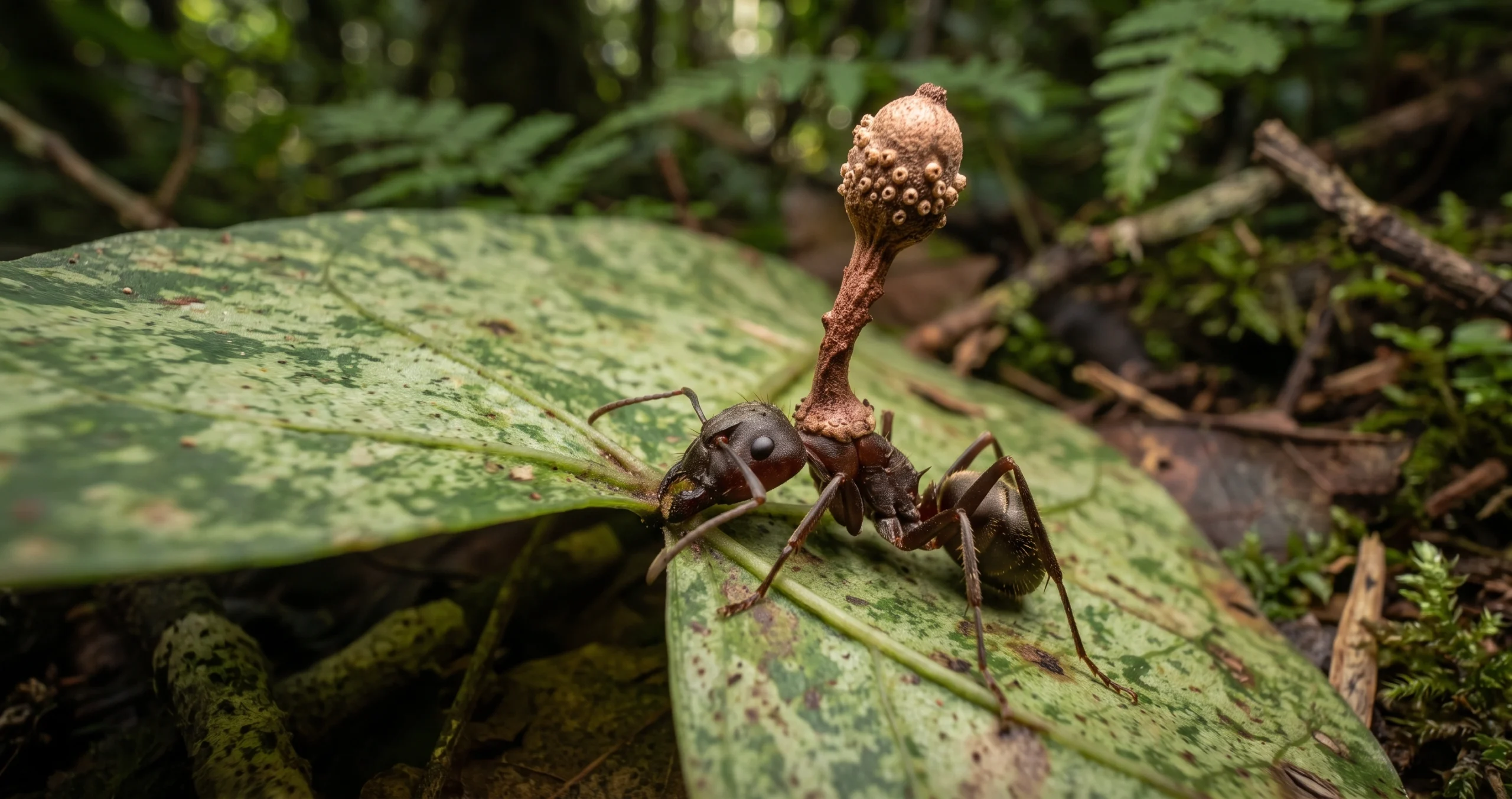
Deep in tropical forests, a carpenter ant leaves its colony and begins behaving in ways that seem completely out of character. It wanders through vegetation, climbs to a particular location, clamps its jaws onto plant tissue, and dies. Days later, a fungal structure emerges from its body. This extraordinary zombie ant fungus is part of the Ophiocordyceps unilateralis species complex, a group of specialized parasites capable of manipulating ant behavior in ways that improve fungal reproduction.
The popular idea is that the fungus simply “takes over the ant’s brain.” Research reveals something considerably stranger. Fungal cells extensively colonize muscles and other tissues while apparently leaving the brain physically uninvaded, even though the brain’s chemistry changes. Scientists are therefore investigating a remarkable possibility: the fungus may manipulate behavior partly from outside the central nervous system, using the ant’s body almost like a biological puppet. (The Pennsylvania State University)
Table of Contents
- What Is the Zombie Ant Fungus?
- Zombie Ant Fungus Infection Step by Step
- How the Fungus Changes Ant Behavior
- The Famous “Death Grip”
- Does the Fungus Control the Brain or the Muscles?
- Why the Death-Grip Location Matters
- What Happens After the Ant Dies?
- Other Parasites That Manipulate Their Hosts
- Common Zombie Ant Myths
- Frequently Asked Questions
- Conclusion
What Is the Zombie Ant Fungus?
The name “zombie ant fungus” usually refers to fungi within the Ophiocordyceps unilateralis species complex.
Rather than representing one fungus capable of controlling every ant, this is a diverse group containing highly specialized fungal parasites. Research has revealed substantial hidden diversity, with different fungal species associated with particular ant hosts. (Penn State)
Carpenter ants in the tribe Camponotini are especially famous hosts.
The relationship is a powerful example of what evolutionary biologists call an extended phenotype. The parasite’s genes ultimately produce effects that extend beyond its own body by changing the behavior of another organism.
For the ant, infection is fatal.
For the fungus, however, killing the host is not enough. The ant must die somewhere that allows the fungus to complete its development and transmit spores efficiently.
That requirement appears to have driven the evolution of remarkably precise behavioral manipulation.
Zombie Ant Fungus Infection Step by Step
The process begins when an ant encounters infectious fungal spores in its environment.
After successful infection, the fungus develops inside the host. Rather than immediately killing the ant, it needs time to grow while the infected individual remains alive.
During much of this period, the ant may continue moving.
Eventually, however, behavior begins to change dramatically.
Step 1: Infection and internal growth
Once infection becomes established, fungal cells proliferate inside the ant.
Microscopic reconstruction of infected ants has shown fungal cells distributed through large portions of the host’s body, including the head, thorax, abdomen, and legs. Many cells appear connected into extensive networks surrounding host tissues. (The Pennsylvania State University)
At this point, the ant increasingly becomes a combination of insect and fungal biomass.
Step 2: Normal behavior breaks down
The infected ant eventually stops behaving like a healthy colony worker.
Research on manipulated carpenter ants has documented erratic walking and convulsions. Instead of efficiently following established trails, infected ants can wander unpredictably.
Convulsions can cause them to fall from higher vegetation.
In one intensively studied system in Thailand, this behavior brought infected ants from the forest canopy into the cooler, more humid understory. (Penn State)
Step 3: The ant climbs vegetation
Eventually, the infected ant climbs vegetation and reaches a location suitable for fungal development.
This behavior is crucial.
The fungus will soon kill its host, which means the ant’s final position determines the environmental conditions experienced by the fungus afterward.
Temperature and humidity can influence fungal growth.
The ant has effectively become a vehicle carrying the parasite toward its reproductive site.
Step 4: The ant bites
Then comes the most famous stage of zombie ant fungus manipulation.
The ant clamps its mandibles onto vegetation.
Depending on the fungus-host system and environment, manipulated ants may bite leaves, leaf veins, twigs, or other plant material.
Once the bite occurs, the ant becomes firmly attached.
Step 5: The ant dies
The ant dies while gripping the vegetation.
But the parasite’s reproductive cycle is far from finished.
The dead ant now provides both nutrients and a stable platform from which the fungus can continue developing.
How the Fungus Changes Ant Behavior
The precision of the manipulation is what makes the system scientifically fascinating.
A parasite that simply made an ant sick would not necessarily benefit.
A dying ant might collapse inside its colony, fall somewhere unsuitable for fungal growth, or be removed by nestmates.
Instead, Ophiocordyceps produces a sequence of abnormal behaviors culminating in attachment to vegetation.
Field research in Thailand found manipulated ants dying in concentrated areas sometimes called “graveyards.” Ants commonly bit vegetation around 25 centimeters above the soil, where the microclimate was favorable for fungal development. (Penn State)
Researchers also found temporal precision.
In the studied population, transitions from wandering to the final bite were synchronized around solar noon.
These patterns suggest that zombie ant fungus manipulation has been shaped by natural selection to place the host where and when fungal reproduction has a greater chance of succeeding.
The Famous “Death Grip”
The ant’s final bite is sometimes called the death grip or death bite.
Researchers examining the mandibles of manipulated ants found that the jaws penetrated deeply into plant tissue. Changes to mandibular muscles effectively helped lock the dead ant in position. (Penn State)
Later work revealed an even more remarkable mechanism.
A 2019 study of mandibular muscles found evidence of extreme contraction in infected ants. Despite widespread fungal colonization and muscle damage, motor neurons and neuromuscular junctions remained present. (Penn State)
Researchers also observed fungal structures precisely penetrating muscles and found extracellular vesicle-like particles that could potentially participate in producing the abnormal contraction.
The result is exceptionally useful to the parasite.
Once the ant is dead, it cannot actively maintain its grip. The altered mandibular system nevertheless keeps the corpse attached while the fungus continues developing.
Does the Zombie Ant Fungus Control the Brain or the Muscles?
This is where one of the most common descriptions of zombie ants becomes misleading.
You will often read that Ophiocordyceps “invades the ant’s brain.”
Current evidence suggests a much more complicated relationship.
Using advanced microscopy and three-dimensional reconstruction, researchers examined infected carpenter ants and found fungal cells extensively distributed through the body.
Muscle fibers were heavily colonized.
The brain was different.
Fungal cells accumulated around it, yet researchers found no fungal cells actually invading the brain tissue in the examined ants. (The Pennsylvania State University)
That discovery produced an intriguing hypothesis.
Instead of directly occupying the brain and operating it like a pilot sitting inside a cockpit, the fungus may manipulate the ant through peripheral tissues, chemical signaling, metabolic changes, and extensive interactions with muscles.
Penn State researchers described the possibility using a puppeteer analogy: fungal networks surrounding and invading muscles might influence the host’s movements without physically entering its brain. (The Pennsylvania State University)
However, saying “the fungus controls muscles, not the brain” would also oversimplify the evidence.
The Brain Still Changes
Although fungal cells apparently do not invade the brain during behavioral manipulation, the infected ant’s brain is not functioning normally.
Research examining brain metabolites found significant changes during manipulation.
Scientists detected alterations involving neuromodulatory compounds, energy use, stress-related chemistry, and signs associated with neurodegeneration. They also found unusually high levels of ergothioneine, a fungal-derived compound with neuroprotective properties. (Penn State)
This creates a fascinating biological puzzle.
The fungus may be physically preserving certain aspects of the brain while profoundly altering the physiological environment surrounding it.
Earlier experiments also demonstrated species specificity.
A particular Ophiocordyceps could kill several experimentally exposed ant species but successfully produce its characteristic behavioral manipulation only in its natural host. When researchers exposed the fungus to brain tissue from different ant species, it produced different combinations of metabolites. (Penn State)
So the best interpretation of current evidence is not that scientists have discovered one simple “mind-control chemical.”
Zombie ant fungus manipulation appears to involve a complex interaction among fungal networks, host muscles, chemical signals, metabolism, the nervous system, and specialized host-parasite evolution.
Why the Death-Grip Location Matters
For Ophiocordyceps, location can determine reproductive success.
After killing the ant, the fungus must continue growing outside a living host.
That exposes it to environmental conditions.
Too much heat, insufficient moisture, or an unsuitable physical location could prevent proper development.
Research on manipulated ants in Thai forests found corpses concentrated in humid understory vegetation rather than randomly distributed through the forest. The biting height in that system averaged around 25 centimeters above the ground. (Penn State)
The location provides another advantage.
The fungus eventually needs to transmit infectious material to new hosts.
A securely attached ant suspended above areas where susceptible ants move can provide an effective platform for releasing spores.
This explains why the death grip is so important.
The ant is not simply manipulated into committing suicide. Its body is positioned as part of the parasite’s reproductive machinery.
What Happens After the Ant Dies?
After host death, fungal development continues.
The fungus consumes resources from the ant while maintaining the corpse as a platform.
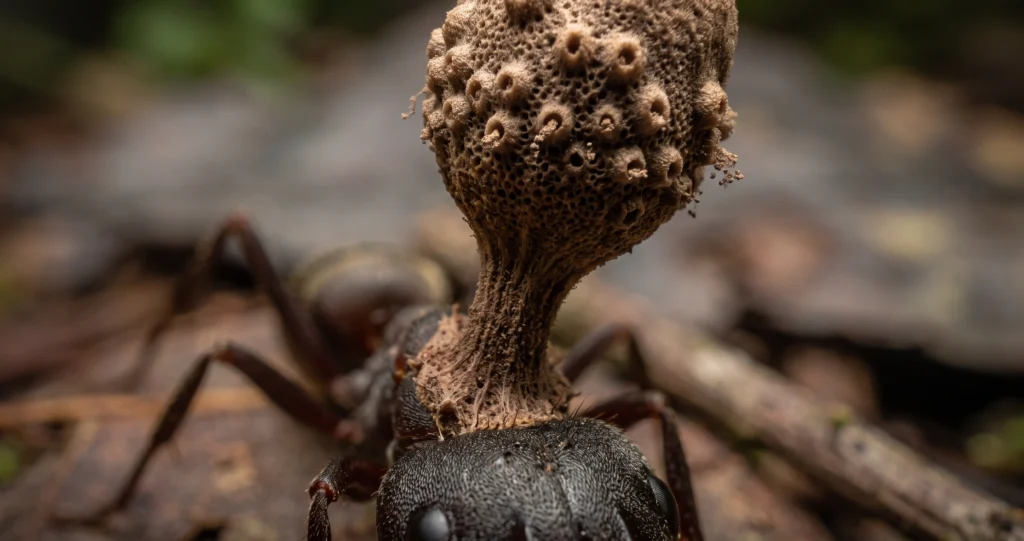
Eventually, a specialized reproductive structure develops from the dead host.
Mature fungal structures produce spores capable of continuing the infection cycle when suitable ants encounter them.
The corpse therefore becomes something like a biological launch platform.
This explains why natural selection could favor increasingly precise manipulation.
Fungi that killed hosts randomly would frequently end up in poor locations. Fungi capable of altering host behavior so that death occurred under favorable conditions would have better opportunities to reproduce.
Over evolutionary time, that advantage could produce the extraordinary specificity scientists observe today.
For another remarkable example of an organism manipulating its environment for reproductive success, read our article on how male bowerbirds build and decorate elaborate bowers to attract a mate.
Other Parasites That Manipulate Their Hosts
The zombie ant fungus may be famous, but behavioral manipulation by parasites has evolved repeatedly.
Hairworms provide one spectacular example.
Certain hairworms develop inside terrestrial insects such as crickets. When the parasite reaches maturity, the infected host can display altered behavior that brings it toward water, allowing the adult worm to emerge into the aquatic environment it needs for reproduction.
Toxoplasma gondii provides a vertebrate example.
This microscopic parasite reproduces sexually in felids. Infection can alter aspects of rodent responses to cat-associated odors, potentially increasing opportunities for infected prey to be consumed by the parasite’s definitive host.
Lancet liver flukes offer another remarkable case.
During part of their complicated life cycle, these parasites infect ants. Under particular environmental conditions, an infected ant may climb vegetation and clamp onto it, increasing the likelihood of being eaten by grazing mammals.
Parasitic wasps can also manipulate hosts.
Some parasitoid larvae alter host movement or defensive behavior in ways that improve the survival of developing offspring.
These examples reveal an important evolutionary principle.
Parasites do not need human-like intentions to manipulate hosts. Natural selection simply favors parasite traits that improve transmission and reproduction.
Common Myths About the Zombie Ant Fungus
Myth 1: The fungus physically fills the ant’s brain
Evidence from detailed microscopy shows extensive fungal colonization throughout the body while the brain itself can remain physically uninvaded. (The Pennsylvania State University)
The brain’s chemistry nevertheless changes substantially during manipulation.
Myth 2: The ant is technically undead
“Zombie ant” is a memorable nickname, not a biological description.
The ant remains alive during the behavioral manipulation and eventually dies. Its corpse then supports fungal reproduction.
Myth 3: One fungus infects every ant species
The Ophiocordyceps unilateralis group contains multiple specialized fungi.
Host manipulation can be remarkably species-specific. (Penn State)
Myth 4: The fungus simply forces the ant to climb as high as possible
The final location is not necessarily extremely high.
In one well-studied tropical system, manipulated ants commonly died on understory vegetation approximately 25 centimeters above the soil. (Penn State)
Myth 5: Scientists know exactly how mind control works
They do not.
Research has identified extensive muscle colonization, metabolic changes, fungal networks, hypercontracted mandibular muscles, and other mechanisms, but the complete chain connecting infection to complex behavioral manipulation remains an active scientific problem.
Myth 6: Zombie ant fungi could turn humans into zombies
There is no evidence that Ophiocordyceps can manipulate humans this way.
These parasites represent highly specialized relationships produced through long periods of coevolution with particular insect hosts.
Frequently Asked Questions
What is the zombie ant fungus?
The term commonly describes specialized fungi in the Ophiocordyceps unilateralis species complex that infect ants and alter their behavior before killing them.
How does zombie ant fungus control ants?
The complete mechanism remains unresolved. Research indicates extensive fungal networks interact with muscles and other tissues, while the brain can remain physically uninvaded despite major biochemical changes. (The Pennsylvania State University)
Why does the infected ant bite a leaf or twig?
The bite anchors the ant’s body in a location where environmental conditions can favor fungal development and subsequent transmission.
Is the death grip caused by muscle changes?
Research has found severely altered mandibular muscles and evidence of hypercontraction during the death grip. Motor neurons and neuromuscular junctions nevertheless remain present. (Penn State)
Does the fungus eat the ant?
The fungus grows throughout the host and uses its resources. After the ant dies, fungal development continues before reproductive structures mature.
Can zombie ant fungus infect people?
There is no evidence that these specialized ant-manipulating Ophiocordyceps fungi can infect and behaviorally manipulate humans.
Where are zombie ants found?
Different Ophiocordyceps species occur in various regions, particularly in ecosystems containing their specific ant hosts. Members of the broader complex have been studied in tropical forests in Asia, South America, and elsewhere.
Conclusion
The real biology of the zombie ant fungus is stranger—and scientifically more interesting—than the familiar story of a fungus simply hijacking an insect’s brain.
Ophiocordyceps infection transforms the host gradually. Fungal cells proliferate through the body, normal ant behavior deteriorates, and the infected worker eventually leaves its usual routine, moves through vegetation, and performs the characteristic death grip.
Then the ant dies exactly where the parasite needs a stationary platform.
Research suggests that this extraordinary behavioral manipulation does not require fungal cells to physically invade the brain. Instead, extensive fungal networks interact with muscles and other tissues while the ant’s brain undergoes profound biochemical changes.
The death grip provides the final piece of the system. Hypercontracted mandibular muscles help anchor the corpse while the fungus completes its reproductive development.
No conscious planning is required.
Natural selection repeatedly favored fungal variants that were better at reaching hosts, manipulating their behavior, securing their corpses in favorable microclimates, and transmitting spores to another generation.
What appears to us as biological “mind control” is therefore the product of an extraordinarily specialized evolutionary relationship—one in which the boundary between the behavior of a host and the reproductive strategy of its parasite becomes almost impossible to see.
2 Internal Link Suggestions:
- Inside the World’s Largest Garter Snake Mating Gathering — useful related reading about another extraordinary animal behavior shaped by environmental and biological signals.
- How Male Bowerbirds Build and Decorate Elaborate Bowers to Attract a Mate — another example of highly specialized behavior produced through evolutionary selection.
3 External Dofollow Authoritative Sources:
- Penn State — “Zombie ant” brains left intact by fungal parasite — overview of the PNAS research showing extensive fungal networks throughout infected ants while the brain remains physically uninvaded. (The Pennsylvania State University)
- Penn State research — Zombie ant death grip due to hypercontracted mandibular muscles — peer-reviewed research on the muscular mechanisms involved in the characteristic death grip. (Penn State)
- Penn State research — Behavioral mechanisms and morphological symptoms of zombie ants — peer-reviewed field research examining manipulated walking, biting behavior, death-grip timing, and the ecological importance of the final location. (Penn State)