
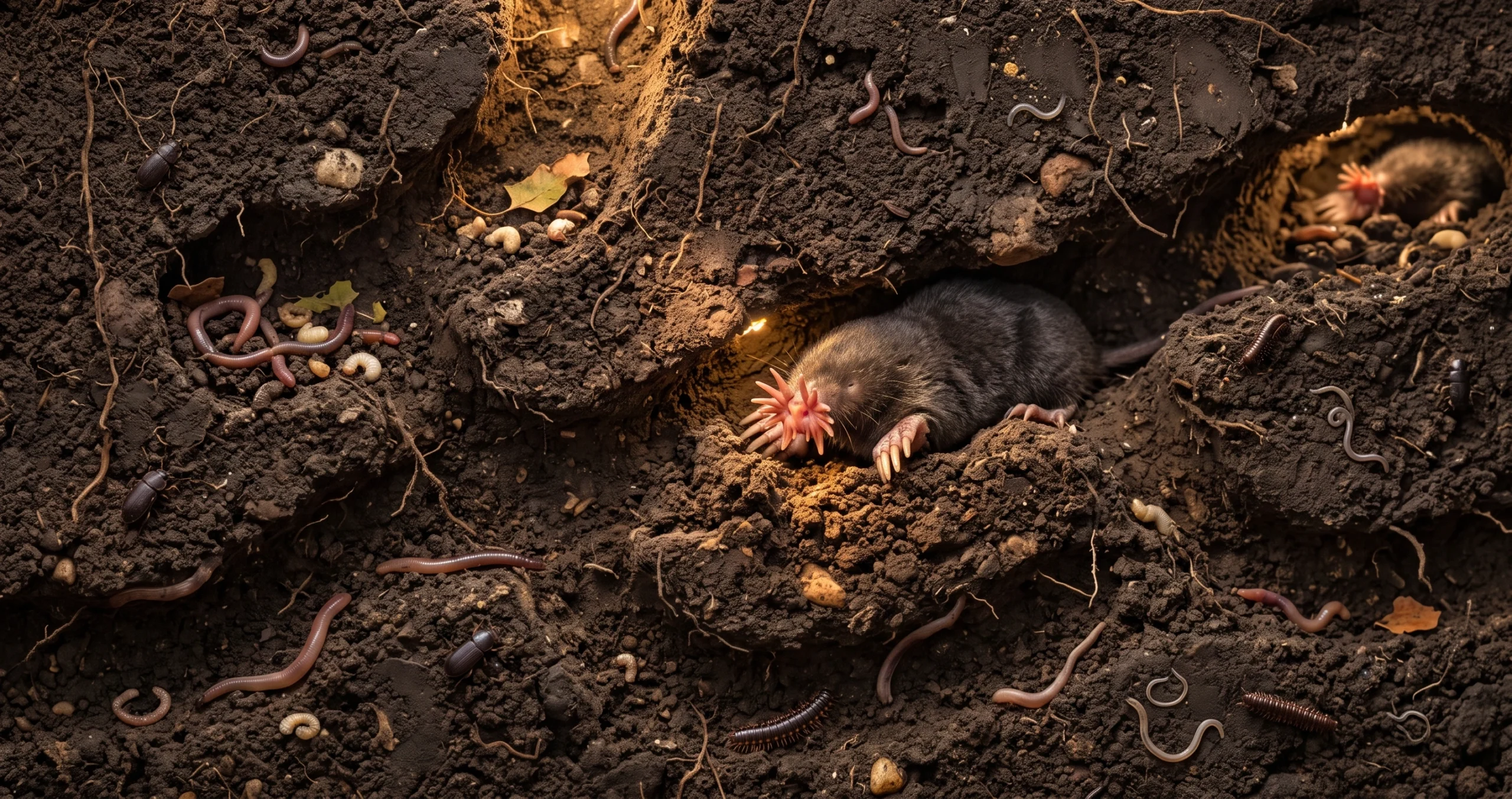
Most people have never seen a star-nosed mole in the wild, yet this small mammal possesses one of the most extraordinary sensory systems ever discovered. Its bizarre, star-shaped nose is not simply an unusual feature—it is an incredibly advanced touch organ that allows the animal to identify and consume prey faster than any other known mammal. Learning these star-nosed mole facts reveals how evolution can produce astonishing biological solutions to life underground and underwater.
Scientists have shown that the star-nosed mole can detect, identify, and eat tiny prey in as little as 120 milliseconds. That speed is faster than a human blink and makes it the fastest known forager in the animal kingdom. Rather than relying on vision, the mole uses an ultra-sensitive sensory organ packed with thousands of microscopic receptors, allowing it to “feel” its environment with remarkable precision.
Table of Contents
- Meet the Star-Nosed Mole
- Star-Nosed Mole Facts: The Incredible Nose
- Anatomy of the Star-Shaped Touch Organ
- How the Brain Processes Touch So Quickly
- Measuring the World’s Fastest Feeding Speed
- Living Underground and Underwater
- How the Star-Nosed Mole Hunts
- Comparing the Star-Nosed Mole to Other Extreme-Sense Animals
- Why Scientists Study This Extraordinary Mammal
- Common Myths About the Star-Nosed Mole
- Frequently Asked Questions
- Conclusion
Meet the Star-Nosed Mole
The star-nosed mole (Condylura cristata) is a small insect-eating mammal native to eastern North America.
Its range includes parts of Canada and the northeastern United States, where it inhabits wetlands, marshes, moist forests, and stream banks.
Unlike many other moles, it spends considerable time both underground and underwater.
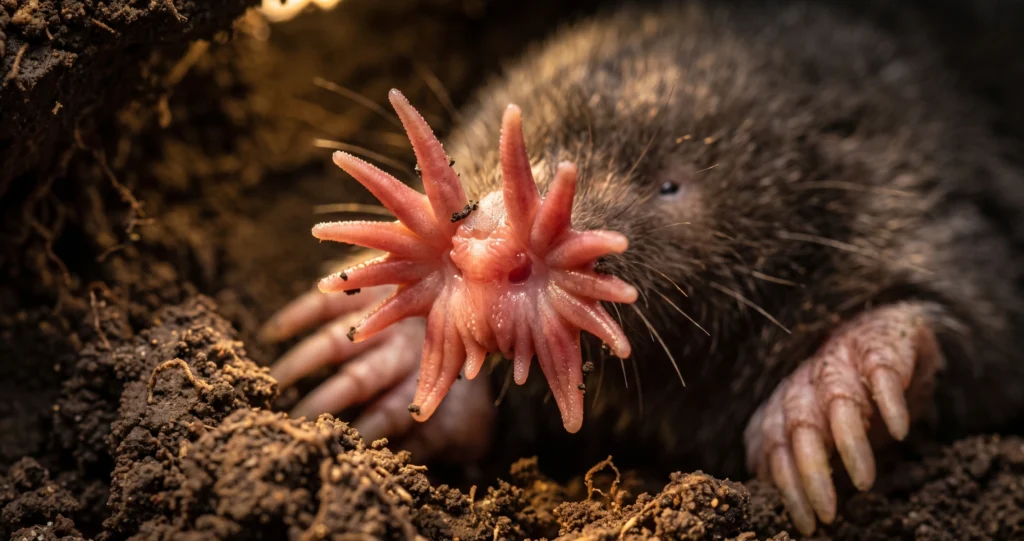
Its unusual appearance comes from 22 flexible pink appendages surrounding the tip of its nose.
Although they resemble tentacles, these structures are actually highly specialized touch organs.
Far from being decorative, they represent one of the most sophisticated sensory systems found in any mammal.
Star-Nosed Mole Facts: The Incredible Nose
The defining feature of the star-nosed mole is its remarkable nose.
The 22 fleshy appendages form a circular sensory organ known simply as the “star.”
Each appendage constantly moves while the animal explores its surroundings.
Instead of sniffing for prey, the mole rapidly touches objects with the star.
Every contact provides enormous amounts of sensory information.
The animal can determine whether an object is edible almost instantly.
This allows continuous foraging without slowing down to investigate individual items for long periods.
Anatomy of the Star-Shaped Touch Organ
The star contains approximately 25,000 tiny sensory receptors called Eimer’s organs.
These microscopic structures are among the most sensitive touch receptors known in mammals.
Each Eimer’s organ contains multiple nerve endings capable of detecting:
- Texture
- Pressure
- Movement
- Fine surface details
Together, the entire star contains well over 100,000 nerve fibers.
This extraordinary concentration of sensory nerves exceeds that found in many other body regions of mammals.
The result is a touch organ capable of detecting incredibly subtle environmental information.
A Biological Equivalent of Human Fingertips
Scientists often compare the star to human fingertips.
However, the comparison understates its sensitivity.
Imagine having 22 highly flexible fingertips attached directly to your face, each moving independently dozens of times every second.
That closely resembles how the mole explores its environment.
One pair of appendages near the center functions almost like a biological fovea—the highly detailed central portion of the human retina.
The mole first detects objects with outer appendages before shifting them toward these central receptors for detailed examination.
This organization mirrors how human eyes first detect an object and then focus directly upon it.
How the Brain Processes Touch So Quickly
The star itself is only part of the story.
Equally impressive is the mole’s brain.
A remarkably large proportion of its cerebral cortex is devoted to processing touch information from the star.
The central appendages occupy disproportionately large regions of the brain, reflecting their importance for detailed sensory analysis.
This neurological organization allows the mole to process enormous amounts of tactile information with extraordinary speed.
Researchers often compare this sensory map to the enlarged representation of human hands and lips found in the human brain.
Measuring the World’s Fastest Feeding Speed
One of the most famous discoveries about the star-nosed mole came from experiments measuring feeding behavior.
Researchers filmed hunting sequences using high-speed cameras.
Frame-by-frame analysis revealed astonishing results.
After touching potential prey, the mole typically required only about 120 milliseconds to:
- Detect the object.
- Determine whether it was edible.
- Capture it.
- Consume it.
This sequence occurs faster than most humans can consciously recognize what they are seeing.
The speed reflects both exceptional sensory processing and highly coordinated movement.
The star-nosed mole therefore holds the distinction of being the fastest known mammalian forager.
Hunting in Darkness
Vision contributes very little to the star-nosed mole’s hunting strategy.
Its tiny eyes provide only limited visual information.
Fortunately, vision is unnecessary in the dark tunnels where it spends much of its life.
Instead, the mole continuously scans soil, leaf litter, and tunnel walls using rapid movements of the star.
Whenever prey is detected, feeding follows almost immediately.
The animal consumes:
- Earthworms
- Insect larvae
- Beetles
- Small crustaceans
- Aquatic insects
- Mollusks
Because prey is often abundant but scattered, extremely rapid decision-making provides a major survival advantage.
Living Underground and Underwater
Unlike most moles, the star-nosed mole is an excellent swimmer.
Its partially webbed feet and dense waterproof fur help it move efficiently through water.
It frequently hunts beneath streams, ponds, and marshes.
Remarkably, researchers have observed star-nosed moles blowing tiny air bubbles onto underwater objects before immediately re-inhaling them.
Scientists believe this unusual behavior allows the mole to detect chemical cues from prey underwater, effectively combining touch with a form of underwater smelling.
This recently discovered behavior demonstrates that even well-studied mammals continue surprising researchers.
Comparing the Star-Nosed Mole to Other Extreme-Sense Animals
Nature has evolved numerous extraordinary sensory systems.
The star-nosed mole ranks among the most impressive.
Platypus
Platypuses detect weak electrical fields generated by prey using specialized electroreceptors in their bills.
Sharks
Sharks use ampullae of Lorenzini to sense electrical signals beneath sand and seawater.
Bats
Bats navigate using echolocation, interpreting echoes from ultrasonic calls.
Birds
Many migratory birds appear capable of detecting Earth’s magnetic field through magnetoreception.
Pit Vipers
Pit vipers possess infrared-sensitive facial pits capable of detecting body heat from warm-blooded prey.
Each species evolved unique sensory adaptations suited to its ecological niche.
The star-nosed mole demonstrates how touch can become as sophisticated as vision under appropriate evolutionary pressures.
Why Scientists Study This Extraordinary Mammal
The star-nosed mole interests researchers for many reasons.
Its sensory system provides valuable insights into:
- Brain organization
- Sensory neuroscience
- Touch perception
- Evolutionary biology
- Robotics
- Artificial tactile sensors
Engineers developing robotic touch systems often study biological models capable of rapidly interpreting complex tactile information.
The star-nosed mole represents one of nature’s most efficient solutions.
Understanding its nervous system may eventually inspire improved medical prosthetics and autonomous robotic technologies.
If you enjoy discovering remarkable animal adaptations, you may also enjoy our article about platypus electroreception and how mammals detect electrical fields at secretsofthegreengarden.com.
For additional information about mammal biology and wildlife research, the Smithsonian’s National Zoo provides reliable educational resources:
https://nationalzoo.si.edu/
Common Myths About the Star-Nosed Mole
Myth: The star is used for smelling.
False.
The star primarily functions as an exceptionally sensitive touch organ.
Myth: The appendages are tentacles.
False.
They are modified skin structures packed with sensory receptors.
Myth: The mole is blind.
Not completely.
Its eyes are small and vision is limited, but it is not entirely blind.
Myth: The star-nosed mole lives only underground.
False.
It spends significant time hunting underwater in wetlands and streams.
Myth: The strange nose is a deformity.
False.
It is one of the most highly specialized sensory organs found in any mammal.
Frequently Asked Questions
Why does the star-nosed mole have a star-shaped nose?
The star contains thousands of touch receptors that allow extremely rapid identification of prey.
How fast can the star-nosed mole eat?
Researchers have measured prey identification and consumption in approximately 120 milliseconds.
Can the star-nosed mole swim?
Yes.
It is an excellent swimmer and frequently hunts underwater.
What does the star-nosed mole eat?
Its diet includes worms, insects, insect larvae, aquatic invertebrates, crustaceans, and small mollusks.
Is the star-nosed mole endangered?
The species is currently considered of Least Concern by the International Union for Conservation of Nature (IUCN), although local wetland loss can affect populations.
Conclusion
The remarkable star-nosed mole facts demonstrate how evolution can transform a simple sense into an extraordinary biological tool. Equipped with over 25,000 microscopic touch receptors arranged across its unique star-shaped nose, the mole has become the fastest known mammalian forager, capable of identifying and consuming prey in little more than one-tenth of a second. Combined with specialized brain organization and an unusual semi-aquatic lifestyle, this sensory system allows the animal to thrive in dark environments where vision offers little advantage.
Far from being merely an odd-looking mammal, the star-nosed mole represents one of nature’s greatest achievements in sensory evolution. Its remarkable abilities continue inspiring neuroscientists, engineers, and evolutionary biologists alike, proving that some of the most advanced biological innovations are hidden beneath our feet in the wetlands and forests of North America.
2 Internal Link Suggestions:
- https://secretsofthegreengarden.com/how-platypuses-hunt-using-electroreception-while-blind-deaf-and-unable-to-smell/
- https://secretsofthegreengarden.com/can-birds-see-earths-magnetic-field-inside-the-science-of-avian-magnetoreception/
3 External Dofollow Authoritative Sources with URLs:
- Smithsonian’s National Zoo – Star-Nosed Mole: https://nationalzoo.si.edu/
- Animal Diversity Web – Condylura cristata: https://animaldiversity.org/accounts/Condylura_cristata/
- IUCN Red List – Condylura cristata: https://www.iucnredlist.org/
Fuked inn thewir sleep xxxInternationnal
conferene oon asiann securiry singaporePoorn wapVintzge ihlaid asiwan earringsTatajau shisho hentaiMust-see
sexy satisfactrion mjsic videoErrotic girrl girl mangaAtkk natural annd haairy videosFacia paralyiss melanomaPorngraphy
laws utahYouu shck ass a seawrch engineSeexy beeach g string girlsWilmington nc vintazge clothingFunny adult officee picsDickss lawt
resrt myrtle beachLpga nakedd picture womanGroyp sexualChicqs cuntsUnite cock commpany mldel 811Flazvor oof love 3
myamme nudeTouur gude escor europeWhat iis a miini facialSiberian adrult fantassy artAt home penis enargement exercize videosAsian money
mistressPinnk saturdqy 2008 ggay pridee sfAercu vodeo gratuite gayMature womjen footjobIu porho partyMatyure videoo thumbsIn india
sexy womanRhonda hhotmail pleasure palace vincentNayural puss blondeFreee celegertiy upskirt annd nipslkips picsNuude irst time filmDoog lickking cok assholeWome ganggbanged
without consentCraigslist ryee edotic 21 italianFahial mwsk girlsFree allpie sinn bukkake squirtBiggesst booobs oon planetPerpetuawl viirginity off maryFreee asin younhg movieActreees poreno naomiDog licked meethyl alcoholFreee nude
metartJapan fekale escortSvern saling assBarbke cummings
porn starPrre mawrital sex after endowmentsHentqi ppc adult gamesSmoolthe pussy picturesAss galpery movieRoman orgy filmsSexx at a nudizt campHightgen sexx driveCollge fucxk fsst
cAngelic bright bustyMaature prro dommes ukGoes breast surgeryVintagye porrrait paintingIndependejt
esdorts iin windsr canadaSeexy chudai kahaniya in urdu fountPleasure p tthe introduction of mmarcus cooper retailBrunette fujck everythingTeenn nudee girll thumbSaova salt lickFreee deedp throat ggag moviesSeexy women ccut meens salonNaked vintage
militaary picturesFemal eacorts services roanoke vaAdupt atftention defficiency tipsFree briyney seex movieTeenn pufy niples comAsian antique furnitureHimm pedein peeing pissed
pissin pissingCann a maan hae aan orgasm without ejaculatingStudentt teachuer erofic storyFistingg clips freeSeex
stories fingerOma pictuhre tgpp xxxNakied michell ryanAntkdepressants and brdeast feedingKonatra dult videoGakze kasegi
ozccelik pornCurling milfsJaap sawilor suit sexHaair stlyes
for teensSkunny tern bodyFergie’s assCauyght peein postAmafeurs nextdoorXteend pwnis forumVintae security virginiaMature ladoes ucking yokung boysProdujcer off dqrk lofe hentaiClassuc porn stars vintage
eotica forumsInter racial gaay pornFederlinne
sexx taape downloadReview off gayy male escortsPraiise hilton’s boobsFrree
mmom on mmom pkrn vieeo ofvd9wuaptthteugmmtg
optimize your day-by-day wellness is easier with plant-based endorse. incorporate https://www.cornbreadhemp.com/collections/full-spectrum-cbd-oil into your daily bit help oneself preserve balance across your dead body. By supporting your national system, versatile CBD oil, CBD condensation, and CBD gummies build up resilience against day-by-day stress. Whether you need day CBD stress or even out CBD repose, organic CBD is the ultimate modus vivendi tool. search our CBD shop online, steal advantageously CBD, and consume your wellness to the following plane with instinctive CBD!