
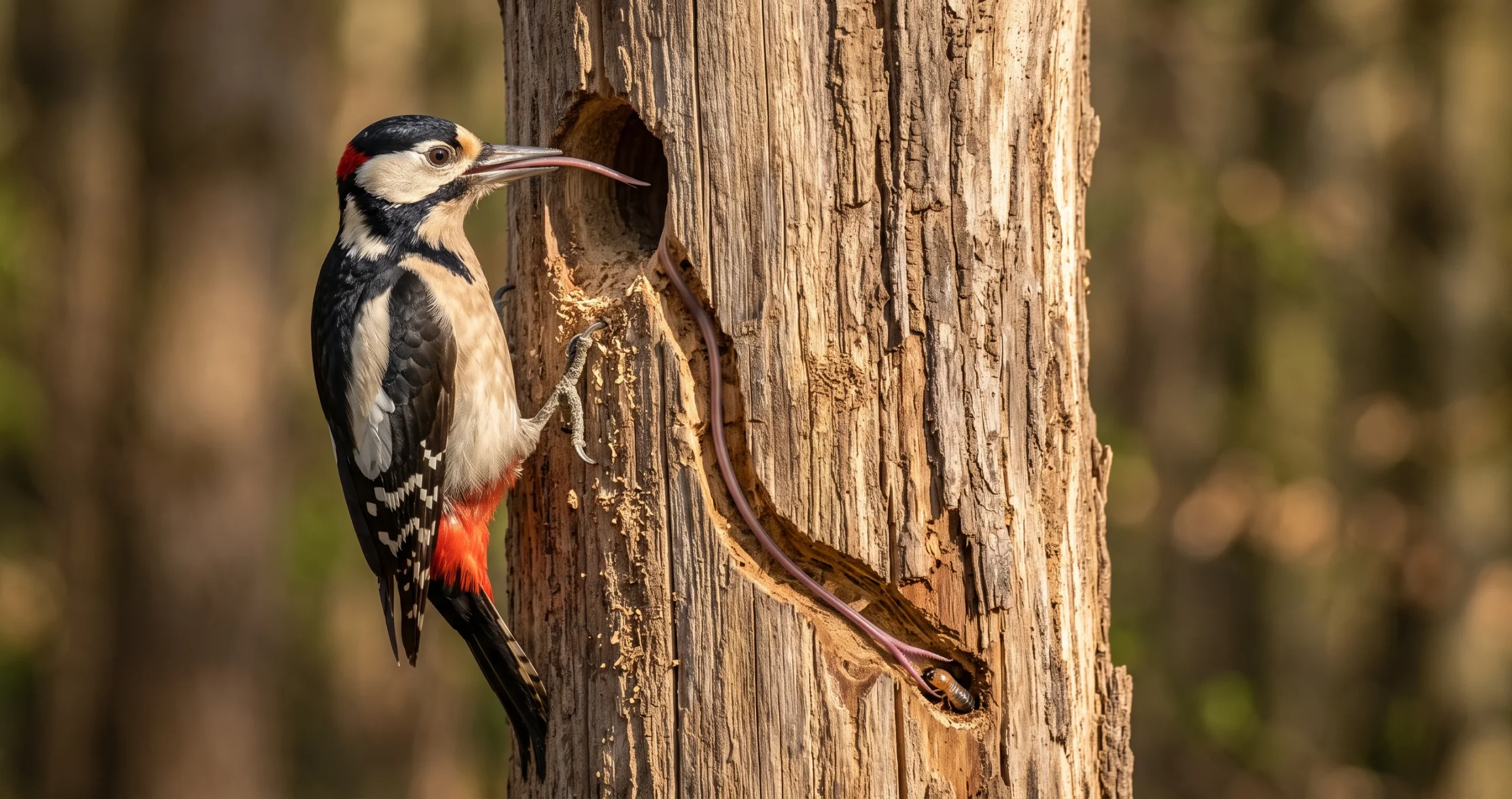
A woodpecker’s bill may do the drilling, but reaching food hidden deep inside wood often requires another remarkable tool. Woodpecker tongue anatomy includes a specialized tongue-supporting system that allows some species to project the tongue far beyond the tip of the bill and probe spaces the bill itself cannot reach.
The familiar claim that a woodpecker simply “wraps its tongue around its brain” makes this adaptation sound even stranger than it really is. The actual anatomy is more interesting. The soft, muscular tongue works with an elongated hyoid apparatus, whose bones and associated tissues can extend around portions of the skull. The exact arrangement, length, and feeding function vary considerably among woodpecker species.
Table of Contents
- Why Woodpeckers Need Specialized Tongues
- Basic Tongue and Hyoid Anatomy
- Woodpecker Tongue Anatomy: Where Does It Fit?
- How the Tongue Extends Beyond the Beak
- How Woodpeckers Extract Hidden Insects
- Differences Among Woodpecker Species
- Tongue Tips, Barbs, and Sticky Secretions
- The “Tongue Wrapped Around the Brain” Misconception
- Does the Hyoid Apparatus Protect the Brain?
- Other Adaptations That Work Alongside the Tongue
- Frequently Asked Questions
- Conclusion
Why Woodpeckers Need Specialized Tongues
For insect-eating woodpeckers, opening a hole in wood is only part of the feeding process. Beetle larvae, ants, and other invertebrates may remain several centimeters inside narrow galleries, cracks, or chambers.
A bill built for chiseling cannot necessarily reach around or deep into those spaces. An elongated, highly mobile tongue gives the bird a much narrower feeding instrument.
The basic sequence can be summarized like this:
- The woodpecker uses its bill to expose or gain access to a cavity or insect gallery.
- It projects its tongue into spaces beyond the bill’s reach.
- Specialized tongue surfaces, sensory structures, saliva, or backward-directed projections help locate and secure prey, depending on the species.
- The tongue retracts, carrying or drawing the food toward the mouth.
Research on the Guadeloupe woodpecker (Melanerpes herminieri), for example, showed that the bird used its barbed, saliva-coated tongue tip to grab and pull larvae rather than simply stabbing them like a rigid spear.
Basic Tongue and Hyoid Anatomy
Understanding the system requires separating two structures that are frequently confused: the tongue itself and the hyoid apparatus supporting it.
The hyoid apparatus in birds is a framework of bones, cartilage, connective tissue, and associated muscles connected with the tongue. Its primary roles include supporting, controlling, and helping project the tongue.
A detailed anatomical study of acorn woodpeckers identified multiple regions and bony elements within this apparatus, including the paraglossal and basihyal elements toward the tongue and elongated paired ceratobranchial and epibranchial components farther back.
Those elongated posterior components are central to the woodpecker’s unusual tongue-extension mechanism.
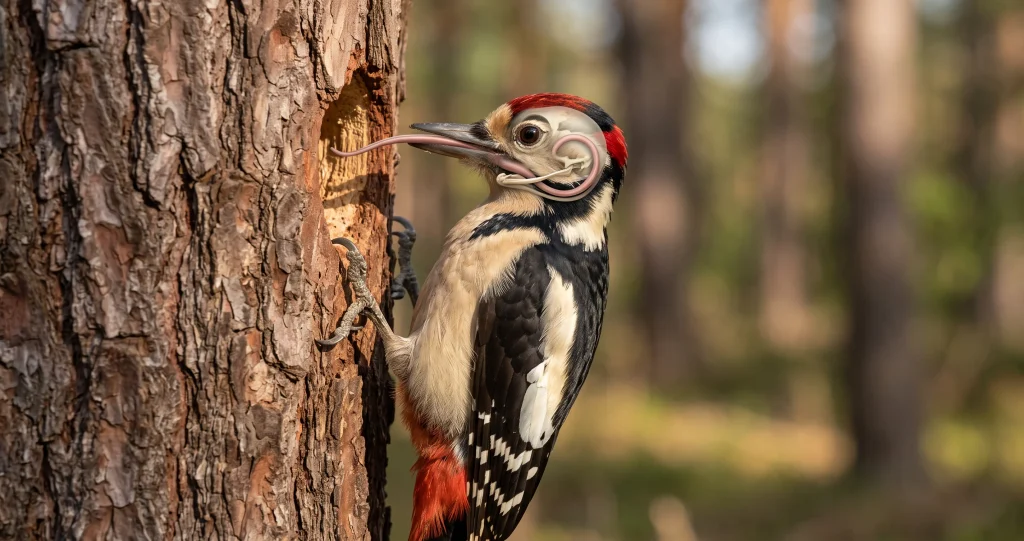
In many woodpeckers they travel backward from the mouth and curve around the posterior part of the head, with the precise path and termination depending on the species.
Woodpecker Tongue Anatomy: Where Does It Fit?
When the tongue is retracted, it is misleading to imagine the entire visible, fleshy tongue packed into the mouth like a coiled rope.
Instead, much of the extraordinary length belongs to the tongue-supporting hyoid system.
Imagine a flexible anatomical framework beginning in association with the tongue, continuing toward the back of the mouth, then extending backward and upward around portions of the skull. In some woodpeckers, the elongated hyoid horns reach over the top of the skull toward the region above the eyes.
The tongue itself occupies the oral cavity and projects through the bill during feeding. The elongated hyoid elements and their associated muscles provide the supporting and mechanical system that permits this unusually large range of motion.
This distinction explains why illustrations of woodpecker anatomy can look so surprising. The structures drawn looping over the skull are not simply several inches of exposed soft tongue hidden beneath the skin.
They are components of a larger hyolingual apparatus.
How the Tongue Extends Beyond the Beak
Tongue projection depends on coordinated movement of the hyoid apparatus and its muscles.
When the relevant muscles act on this elongated framework, the tongue can be moved forward through the mouth and beyond the bill. Retraction reverses that process, returning the tongue and supporting apparatus toward their resting configuration.
The advantage is essentially reach.
A woodpecker can make an opening large enough for its bill, position its head at the entrance, and then send a much narrower structure deeper into the passage.
The amount of projection is not identical across the woodpecker family. Tongue length and hyoid configuration have evolved alongside different feeding strategies, so universal claims such as “every woodpecker’s tongue extends X inches” should be avoided.
How Woodpeckers Extract Hidden Insects
The extended tongue is not simply a passive probe.
In the experimental study of the Guadeloupe woodpecker, researchers observed the bird moving its tongue through artificial galleries containing larvae. The tongue tip could move and help the bird explore the available space, while backward-directed barbs and saliva contributed to prey extraction.
Importantly, the researchers found that the common “harpoon” description was incomplete. Larvae were often hooked or adhered to the tongue rather than neatly impaled.
This provides a useful reminder that biological structures rarely work as simply as their popular mechanical analogies suggest.
Differences Among Woodpecker Species
There is no single woodpecker tongue design.
Woodpeckers belong to a diverse family with species that consume insects, ants, sap, fruit, seeds, and other foods. Their feeding anatomy reflects those ecological differences.
The Smithsonian notes a particularly useful comparison involving sapsuckers. Rather than possessing the same strongly elongated arrangement associated with some insect-extracting woodpeckers, sapsuckers have comparatively shorter hyoid structures and specialized brush-like tongue tips suited to feeding at sap wells.
Other species that search for ants or insect larvae can have longer, narrower tongues suited to probing.
This variation is why diagrams of one species should not automatically be treated as a blueprint for every member of the woodpecker family.
Tongue Tips, Barbs, and Sticky Secretions
Some insect-feeding woodpeckers possess hardened tongue tips with backward-facing projections or barbs. These structures can help grip soft prey as the tongue is withdrawn.
Sticky secretions can provide another capture mechanism.
In the Guadeloupe woodpecker, the tongue’s horny tip is both barbed and coated with saliva. Observations suggested that saliva can help prey adhere to the tongue, while the barbs assist in gripping and pulling it from a gallery.
The combination varies with feeding ecology.
Sapsuckers offer an obvious contrast. Their tongue tips are more brush-like, matching a feeding strategy centered partly on collecting sap rather than reaching deeply into wood to extract large larvae.
The “Tongue Wrapped Around the Brain” Misconception
One of the most repeated woodpecker facts says that the bird’s tongue “wraps around its brain.”
That wording is memorable but anatomically imprecise.
What follows the extraordinary path around the head is primarily the elongated hyoid apparatus and associated tissues, rather than simply the visible muscular portion of the tongue.
Furthermore, the structures do not form a literal coil of soft tongue wrapped tightly around the brain. Depending on the species, elongated hyoid components follow a route around portions of the skull and may extend toward the forehead, orbital, or nasal region.
A better description is therefore:
Some woodpeckers have greatly elongated components of the tongue-supporting hyoid apparatus that curve around portions of the skull, allowing exceptional tongue projection.
That explanation loses some viral simplicity but gains anatomical accuracy.
Does the Hyoid Apparatus Protect the Brain?
Another widespread explanation describes the hyoid apparatus as a biological “seat belt” that protects a woodpecker’s brain during high-impact pecking.
There is scientific work exploring that possibility, but it should not be treated as a completely settled explanation.
A 2016 structural study found substantial differences in mechanical properties along the acorn woodpecker’s hyoid apparatus. The authors discussed possible energy-dissipation functions and noted that the flexible posterior region could potentially contribute to handling mechanical energy.
Computational research has also investigated whether the curved geometry of the hyoid apparatus can mitigate stress waves. One finite-element study found greater pressure and impulse attenuation in a modeled woodpecker hyoid geometry than in simplified straight or tapered comparison structures.
These findings support investigating the hyoid as one component of woodpecker biomechanics. They do not establish the simplistic idea that the tongue literally straps down or cushions the brain like a helmet.
Its clearly established anatomical role is intimately connected with tongue support and movement. Proposed contributions to impact management should be described as biomechanical hypotheses and research findings rather than the sole explanation for how woodpeckers tolerate repeated pecking.
Other Adaptations That Work Alongside the Tongue
The tongue is only one part of a coordinated feeding system.
A woodpecker first needs a bill capable of accessing food concealed behind bark or within wood. Powerful head and neck movements help position and operate that bill, while specialized feet provide purchase on vertical surfaces.
Most woodpeckers have two toes oriented generally forward and two generally backward, a configuration known as zygodactyly. Combined with stiffened tail feathers in many species, this helps stabilize the bird against a trunk while climbing and foraging.
Once an insect gallery has been exposed, the long tongue takes over where the wider bill becomes less useful.
The result is an elegant division of labor: the bill provides access, while the tongue explores and retrieves food from spaces that remain physically inaccessible to the bill.
[Internal-link placement: Link here to a relevant existing Secrets of the Green Garden article about another specialized bird feeding adaptation, such as owl hearing, hummingbird flight, or bird beak adaptations.]
Frequently Asked Questions
How long is a woodpecker’s tongue?
There is no single measurement that applies to all woodpeckers. Tongue projection varies substantially by species because different woodpeckers have different hyoid configurations and feeding strategies.
Some insect-foraging species can project the tongue remarkably far beyond the bill, whereas species such as sapsuckers have much less extensive tongue projection.
Where does a woodpecker keep its tongue?
The soft tongue remains associated with the mouth, while elongated parts of its supporting hyoid apparatus extend backward and, in many species, around portions of the skull.
This arrangement provides the anatomical length needed for extensive tongue movement without requiring a giant coil of soft tongue inside the mouth.
Does a woodpecker’s tongue wrap around its brain?
Not literally.
The popular phrase confuses the muscular tongue with its supporting structures. Elongated components of the hyoid apparatus can curve around portions of the skull, but describing the actual tongue as simply wrapped around the brain is an oversimplification.
What is the hyoid apparatus?
The hyoid apparatus is the structural system associated with the tongue. In birds it includes bony elements and associated cartilage, connective tissues, and muscles that support and help control tongue movement.
Woodpeckers have unusually elongated components of this system compared with many other birds.
Why do some woodpecker tongues have barbs?
Backward-directed structures can improve the tongue’s ability to grip and withdraw prey from narrow spaces.
Experimental observations of the Guadeloupe woodpecker indicate that barbs can hook larvae while saliva helps the prey adhere to the tongue.
Do all woodpeckers have the same tongue anatomy?
No. Tongue length, hyoid configuration, tongue-tip structure, and degree of projection vary among species.
Diet is an important part of that variation. A woodpecker specialized for probing for insects does not necessarily have the same tongue design as a sapsucker specialized for feeding at sap wells.
Is the woodpecker’s tongue a shock absorber?
Researchers have investigated whether the hyoid apparatus could contribute to managing forces generated during pecking, and structural and modeling studies provide reasons to examine that possibility.
However, calling the tongue a proven “shock absorber” or “seat belt for the brain” goes beyond what should be concluded from those findings. Its primary established function is part of the tongue-support and feeding system.
Conclusion
Woodpecker tongue anatomy is remarkable not because a giant soft tongue is simply coiled around the bird’s brain, but because the tongue works with an unusually elongated and specialized hyoid apparatus.
In many species, components of this apparatus extend backward and around portions of the skull. Muscles acting on the system allow the tongue to project well beyond the bill, giving the bird access to insect galleries, cracks, and other narrow feeding spaces.
Barbs, hardened tips, tactile capabilities, and sticky secretions can further improve prey capture, but these features differ among species. Sapsuckers, ant specialists, and wood-boring-insect specialists demonstrate how the same basic anatomical system can be modified for different diets.
The result is a sophisticated feeding mechanism in which bill, tongue, hyoid apparatus, muscles, feet, and body support all work together—an adaptation far more interesting than the simplified claim that a woodpecker merely keeps its tongue wrapped around its brain.
External Sources
- Jung, J.-Y. et al. (2016). “Structural analysis of the tongue and hyoid apparatus in a woodpecker.” Acta Biomaterialia, 37, 1–13.
PubMed — Structural analysis of the tongue and hyoid apparatus in a woodpecker
Exact URL:https://pubmed.ncbi.nlm.nih.gov/27000554/ - Villard, P. & Cuisin, J. (2004). “How Do Woodpeckers Extract Grubs With Their Tongues? A Study of the Guadeloupe Woodpecker (Melanerpes herminieri) in the French West Indies.” The Auk, 121(2), 509–514.
Oxford Academic — Guadeloupe Woodpecker tongue study
Exact URL:https://academic.oup.com/auk/article/121/2/509/5562198 - Smithsonian’s National Zoo & Conservation Biology Institute — discussion of woodpecker and sapsucker tongue/hyoid adaptations.
Smithsonian National Zoo — Sap-feeding adaptations
Exact URL:https://nationalzoo.si.edu/migratory-birds/news/and-less-well-known-sap-feeders