
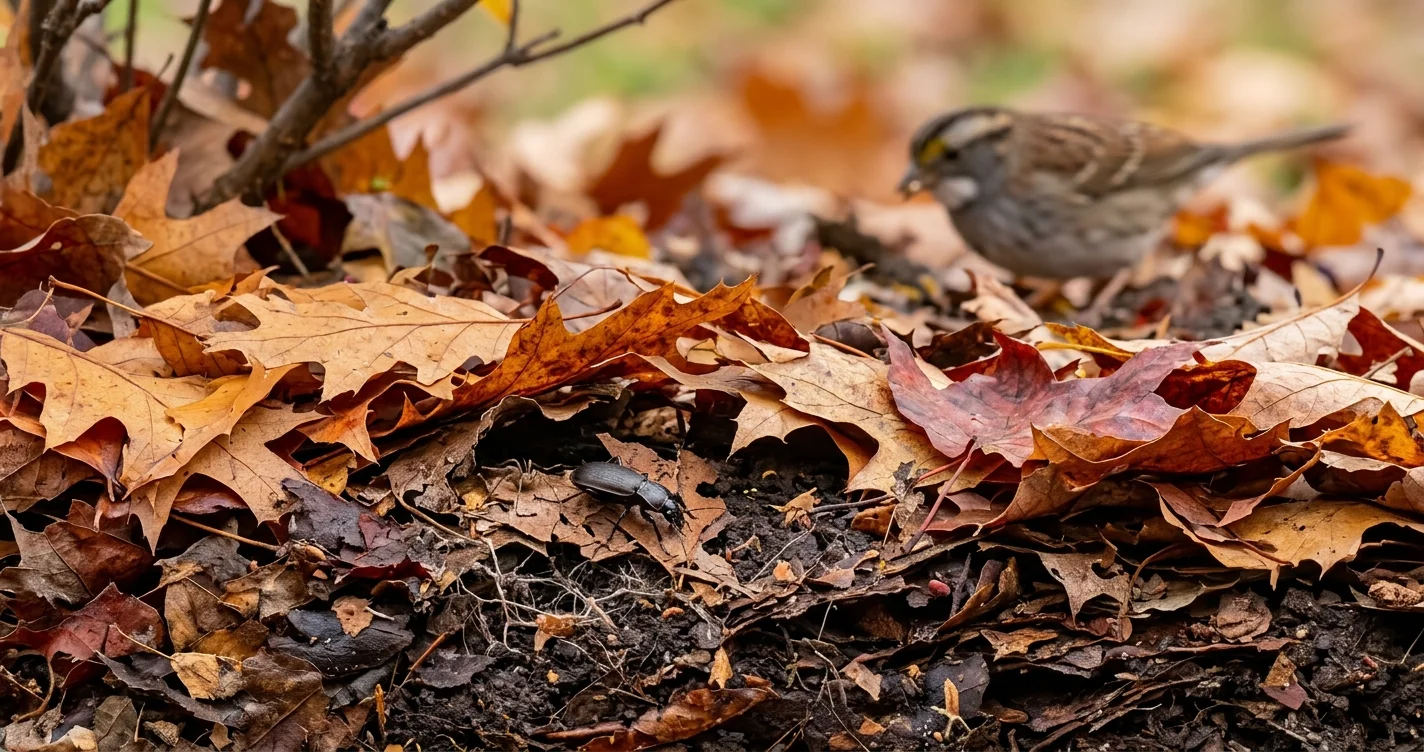
Fallen leaves are often treated as garden waste, but keeping some fallen leaves for wildlife can support an active community of insects, spiders, decomposers, and ground-feeding birds. Beneath this natural layer, leaves slowly break down while creating shelter, influencing moisture at the soil surface, and providing places where wildlife can search for food.
That does not mean every leaf should remain exactly where it falls. A wildlife-friendly approach is more practical: keep leaves where they provide useful habitat, and move them away from paths, drains, vulnerable plants, and other areas where they may cause problems.
Table of Contents
- Why Fallen Leaves for Wildlife Are So Valuable
- What Happens to Leaves After They Fall
- Fallen Leaves for Wildlife: What Lives Beneath Them
- How Birds Find Food in Leaf Litter
- How Fallen Leaves Feed the Soil
- Why Leaf Litter Creates a Useful Microhabitat
- Why Fallen Leaves Matter in Fall and Winter
- When Too Many Fallen Leaves Become a Problem
- How to Leave Fallen Leaves for Wildlife Safely
- Best Places to Keep Leaves in Your Yard
- FAQ About Fallen Leaves for Wildlife
- Conclusion
Why Fallen Leaves for Wildlife Are So Valuable
A fallen leaf may look inactive, but its ecological role does not end when it separates from a tree.
In forests and other naturally vegetated habitats, dead leaves accumulate on the soil as leaf litter. This layer contains fresh leaves at the surface and increasingly fragmented and decomposed material underneath.
Fungi, bacteria, and invertebrates participate in breaking down this organic material. At the same time, the physical spaces among leaves create small sheltered environments used by many organisms.
For homeowners, keeping some fallen leaves for wildlife is therefore less about leaving a garden messy and more about preserving part of a natural ecological process.
Leaves can continue contributing to a garden long after their green growing season has ended.
What Happens to Leaves After They Fall
Decomposition begins gradually after leaves reach the ground.
Moisture wets plant tissues, soluble compounds can leach from the leaves, and microorganisms colonize the dead material. Weathering and physical fragmentation also weaken leaves over time.
Fungi and bacteria play major roles in decomposition. Different invertebrates can further fragment or consume decaying plant material, increasing the contact between organic matter and decomposer organisms.
The process is not equally fast everywhere. Temperature, moisture, leaf chemistry, soil conditions, and tree species can all influence decomposition.
Some leaves remain recognizable for a long time, while others break down much more quickly.
Eventually, much of the original leaf structure disappears as its materials are processed and incorporated into broader soil and nutrient cycles.
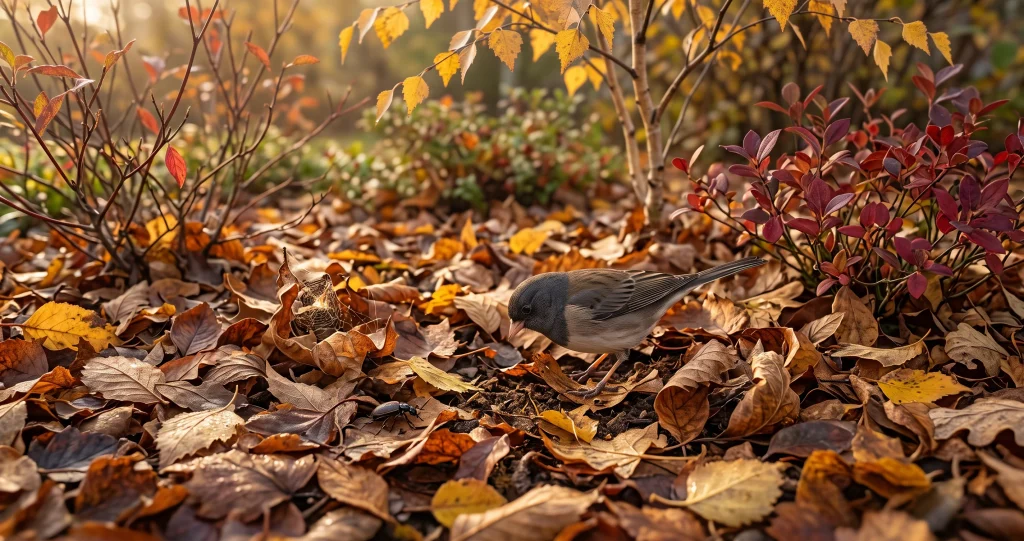
Fallen Leaves for Wildlife: What Lives Beneath Them
The spaces underneath autumn leaves can create a very different environment from exposed soil.
Leaf litter may reduce direct exposure to sunlight and wind while helping maintain more humid conditions close to the soil surface. Those characteristics can make it useful habitat for small organisms.
The exact community varies considerably by region, season, vegetation, climate, and garden management.
Beetles
Many beetles spend part or all of their lives at ground level.
Depending on the species, beetles found around leaf litter may be predators, scavengers, herbivores, fungus feeders, or decomposer-associated organisms.
Some beetle larvae also develop in soil, decaying vegetation, or other organic material.
Leaving leaf litter does not guarantee that particular beetle species will appear, but it preserves physical habitat that many ground-dwelling invertebrates can use.
Spiders
Spiders are another familiar component of the ground-level food web.
Some species hunt among dead vegetation rather than constructing conspicuous webs above the garden. Overlapping leaves provide surfaces, crevices, and sheltered spaces where small predators can move and search for prey.
These spiders can themselves become food for larger animals.
Springtails
Springtails are tiny arthropods commonly associated with soil, fungi, and decomposing organic material.
Many species feed on fungi, microorganisms, algae, or decaying material. They can occur in large numbers while remaining almost unnoticed because of their extremely small size.
Their presence demonstrates how much biological activity can occur within a thin layer of dead vegetation.
Millipedes
Many millipedes feed primarily on decaying plant material.
By consuming and physically fragmenting dead vegetation, they participate in the decomposition process alongside microorganisms and other organisms.
They do not single-handedly turn leaves into soil. Decomposition is a complex biological and chemical process involving entire communities.
Fungi and Bacteria
Some of the most important organisms in leaf litter cannot easily be seen.
Fungi and bacteria colonize dead plant tissues and break down organic compounds. Their activity is fundamental to decomposition and nutrient cycling.
A leaf-covered bed can therefore contain extensive biological activity even when little appears to be happening at the surface.
How Birds Find Food in Leaf Litter
One of the most visible reasons to keep fallen leaves for wildlife is the connection between leaf litter and ground-feeding birds.
Seeds, small arthropods, and other potential foods can become mixed into this surface layer.
Dark-eyed Juncos are classic ground foragers. They commonly search on or near the ground and can scratch through leaf litter while looking for food.
Various sparrows and other ground-feeding birds also search among dead vegetation.
This does not mean a pile of leaves will automatically attract a particular bird. Bird presence depends on geographic range, season, surrounding habitat, vegetation, food availability, predators, and many other factors.
The broader principle is more reliable: retaining natural ground structure preserves potential foraging habitat that disappears when a garden is stripped to bare soil.
The Cornell Lab of Ornithology’s Dark-eyed Junco guide describes the species’ characteristic ground-foraging behavior.
How Fallen Leaves Feed the Soil
Leaves contain carbon and nutrients acquired while they were attached to a living plant.
After leaf fall, those materials enter decomposition pathways. Microorganisms and invertebrates process the dead tissue, while environmental conditions influence how nutrients are transformed and released.
This process is more complicated than saying that leaves instantly become fertilizer.
Different nutrients behave differently during decomposition, and their availability can change over time. Some can temporarily become incorporated into microbial biomass before later becoming available through further decomposition.
Still, removing every autumn leaf also removes organic material from the location.
Keeping an appropriate amount within garden beds allows part of that material to remain within the local biological cycle.
Why Leaf Litter Creates a Useful Microhabitat
A layer of leaves physically changes conditions where air meets soil.
The leaves can shade the ground and reduce direct exposure to wind and sunlight. They also intercept rainfall and influence moisture conditions near the surface.
For small organisms, these changes can be significant.
A beetle moving beneath overlapping leaves experiences a different environment from one crossing exposed, dry soil.
This is one reason fallen leaves for wildlife can be particularly useful beneath shrubs, hedges, and established trees. These locations naturally combine plant cover with ground-level organic material.
However, more is not automatically better.
A loose natural layer and a deep compacted mat are not the same thing.
Why Fallen Leaves Matter in Fall and Winter
Wildlife resources change dramatically as summer ends.
Many flowering plants stop blooming. Some insects enter dormant or less visible life stages, migratory animals depart, and annual plants die.
Dead vegetation then becomes increasingly important as part of the physical structure of the garden.
Some arthropods overwinter in or around leaf litter, while others remain active when conditions permit. Ground-feeding birds can continue searching through leaves for available seeds and invertebrates.
The National Wildlife Federation’s guidance on leaving leaves describes several animals whose life cycles can be associated with fallen leaves and other ground-level plant material.
Combining leaf litter with standing seedheads, shrubs, grasses, and other vegetation creates more habitat layers than a completely cleared garden.
When Too Many Fallen Leaves Become a Problem
Keeping fallen leaves for wildlife should not be interpreted as a rule against autumn maintenance.
Leaves can be useful in one location and problematic in another.
Lawns
A heavy, persistent layer of leaves can shade turf and interfere with its normal growth.
Instead of bagging those leaves immediately, gardeners can move some from lawns into shrub borders, woodland-style beds, or other suitable areas.
Leaves can also be shredded where appropriate.
Small Plants
Thick mats of wet leaves may cover low-growing or sensitive plants.
Removing or redistributing excess material can prevent small plants from being overwhelmed while still keeping organic matter elsewhere in the garden.
Paths and Steps
Wet leaves can become slippery.
Walkways, stairs, patios, driveways, and frequently used access areas should remain safe and functional.
Leaves collected from these surfaces can often be relocated instead of discarded.
Storm Drains
Leaves should not be allowed to obstruct drainage infrastructure.
Moving them into suitable garden areas prevents them from becoming a drainage problem while keeping some of their ecological value on the property.
Diseased Leaves Need Special Consideration
Not every fallen leaf should automatically remain in place.
Some plant pathogens survive or reproduce on infected plant debris. Removing affected leaves can therefore be an important management strategy for particular diseases.
There is no universal rule covering every plant disease.
Gardeners should first identify the problem and follow recommendations from a reliable local university extension service, plant-health authority, or other regional horticultural source.
Healthy leaf litter and heavily infected plant debris should not automatically be managed in exactly the same way.
Fire Risk Can Change the Recommendation
Local climate is another important consideration.
In areas exposed to significant wildfire risk, accumulated combustible vegetation near buildings may conflict with defensible-space recommendations.
Fire safety takes priority.
Gardeners living in fire-prone regions should follow local or state guidance about vegetation, leaf litter, mulch, and combustible materials around homes and other structures.
This illustrates why ecological gardening advice should rarely be treated as universal.
A practice appropriate beneath shrubs in a humid eastern garden may require substantial modification in a dry, fire-prone landscape.
How to Leave Fallen Leaves for Wildlife Safely
The easiest approach is not to stop autumn cleanup completely. Instead, change where the material goes.
Leaves collected from driveways, patios, and frequently used lawn areas can often be moved beneath established trees and shrubs.
They can also be placed in appropriate perennial borders or naturalized sections of the yard.
This keeps fallen leaves for wildlife in locations where their physical structure and eventual decomposition can remain useful without compromising important functional areas.
Gardeners with large quantities have additional options.
Excess leaves can be used to make leaf mold, added appropriately to compost, or shredded for use in suitable beds.
A mixed strategy often works better than a single rule.
Keep some leaves intact. Move others. Shred or compost the excess.
Best Places to Keep Leaves in Your Yard
Established shrubs are one of the most practical locations.
Leaves naturally collect underneath woody vegetation, where they can create ground cover without necessarily interfering with garden use.
Areas beneath mature deciduous trees may also be appropriate, particularly where turf is not the priority.
Hedges, woodland-style borders, native plant beds, and less intensively managed corners can accommodate additional leaf litter.
The objective is not to cover every available surface.
A garden containing several designated leaf-litter zones can retain more ecological structure while still maintaining clear lawns, paths, entrances, and recreational spaces.
Keeping fallen leaves for wildlife can therefore be compatible with a landscape that still looks deliberately maintained.
Whole Leaves or Shredded Leaves
Both can be useful, but they are not identical.
Shredding increases the number of smaller pieces and changes the physical structure of the material. Smaller pieces can be convenient for composting and certain mulching applications.
Whole leaves retain larger overlapping spaces that can create shelter for small organisms.
Mechanical shredding may also affect insects or other organisms already present in collected material.
For gardeners prioritizing wildlife habitat, retaining some intact leaves in suitable areas while shredding or composting excess material provides a practical compromise.
A Leaf Layer Is Part of a Larger Food Web
The real ecological value of fallen leaves becomes clearer when they are viewed as one stage in a continuous biological cycle.
A tree uses sunlight, carbon dioxide, water, and nutrients to produce leaves. Those leaves support life while attached to the plant and eventually fall to the ground.
Microorganisms colonize them.
Invertebrates use or consume them.
Predators feed on some of those organisms.
Birds search through the layer for seeds and small prey.
Meanwhile, decomposition continues returning components of the original plant material to the surrounding ecosystem.
Leaf litter therefore connects the tree canopy, soil, microorganisms, invertebrates, and larger animals.
Removing all dead vegetation interrupts some of these connections.
Preserving selected areas of fallen leaves for wildlife keeps more of that natural structure within the garden.
A Wildlife-Friendly Yard Can Still Look Maintained
Wildlife gardening is sometimes portrayed as a choice between a perfectly manicured property and an unmanaged landscape.
It does not have to be either.
Clear paths can run beside leaf-covered shrub beds. A maintained lawn can border a naturalized area. Leaves removed from a patio can be relocated beneath a hedge.
These visual boundaries can make wildlife-friendly areas appear intentional.
Gardeners can also combine leaf litter with standing perennial stems, seedheads, native shrubs, water sources, and other habitat features.
The result is not simply a yard where leaves were forgotten.
It is a landscape where some natural processes are deliberately allowed to continue.
Readers interested in building on this approach can explore other guides on Secrets of the Green Garden covering bird habitat, pollinators, native plants, and wildlife-friendly gardening.
FAQ About Fallen Leaves for Wildlife
Should I leave all fallen leaves in my yard?
No. A selective approach is more practical.
Keep suitable leaves beneath established trees, shrubs, hedges, and in naturalized beds while clearing paths, drains, vulnerable plants, and locations where fire-safety guidance requires vegetation removal.
Do birds actually search through fallen leaves?
Yes. Several ground-feeding birds forage among leaf litter for seeds and small invertebrates.
Dark-eyed Juncos are a familiar North American example, although the birds using a particular garden depend on region, season, and habitat.
What animals live beneath fallen leaves?
Depending on the location, leaf litter can contain beetles, spiders, springtails, millipedes, insect larvae, and many other organisms.
Some species live there for extended periods, while others use leaf litter only during particular life stages or seasons.
Will fallen leaves kill my lawn?
A thick layer left over turf for an extended period can shade grass and interfere with normal growth.
Moving excess leaves into garden beds, compost, or a leaf-mold pile can prevent this while keeping the material on the property.
Should diseased leaves be removed?
Sometimes.
Certain plant diseases can persist in infected debris, making sanitation useful. Follow disease-specific recommendations rather than assuming all leaves should either remain or be removed.
Are shredded leaves good for wildlife?
Shredded leaves still provide organic material and can be useful as mulch or compost ingredients, but shredding changes the physical habitat created by intact leaves.
Keeping some whole leaves while processing excess material provides both options.
Conclusion
Keeping fallen leaves for wildlife is a simple way to preserve part of the natural transition between living vegetation and soil.
Leaf litter can provide sheltered microhabitats for invertebrates, contribute to decomposition and nutrient cycling, and create natural foraging opportunities for ground-feeding birds. Its value continues after the bright colors of autumn have disappeared.
The goal is not to leave every leaf untouched. Move leaves away from paths, drains, sensitive plants, diseased areas, and places where fire management requires clearance.
Then allow some to remain beneath trees, shrubs, hedges, and appropriate garden beds.
A few deliberately managed leaf-litter areas can help transform autumn cleanup from complete removal into a more balanced approach that works for both homeowners and wildlife.