
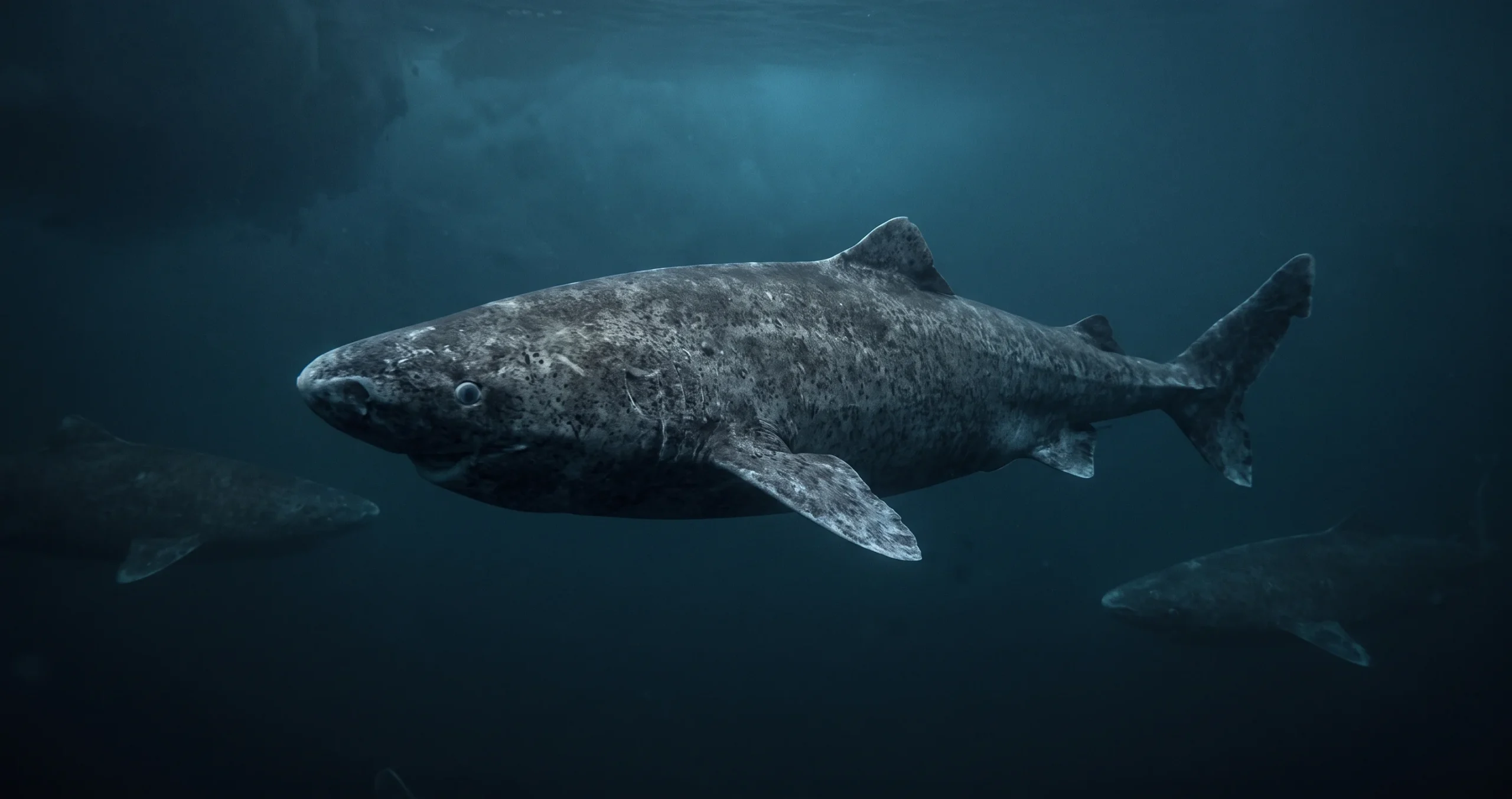
In the cold, dark waters of the Arctic and North Atlantic lives an animal whose lifetime may span several human centuries. The extraordinary Greenland shark lifespan has made Somniosus microcephalus one of the most fascinating subjects in marine biology and aging research.
Scientists estimate that Greenland sharks live for at least 250 years, while some individuals may survive for well over 400 years. NOAA notes that the largest shark examined in a landmark aging study had an estimated age range of 272 to 512 years.
Their extreme longevity is only part of the story. Greenland sharks grow exceptionally slowly, mature very late, inhabit frigid environments, and possess physiological characteristics researchers are still working to understand.
Table of Contents
- Meet the Greenland Shark
- How Scientists Estimate Greenland Shark Age
- Greenland Shark Lifespan and the Eye-Lens Discovery
- Why Cold Water May Favor a Long Life
- One of the Slowest-Growing Sharks
- Reproduction on a Century-Long Timeline
- Why Extreme Longevity Creates Conservation Challenges
- What Greenland Sharks Could Teach Us About Aging
- Common Myths About Greenland Sharks
- Frequently Asked Questions
- Conclusion
Meet the Greenland Shark
The Greenland shark inhabits cold waters of the Arctic and North Atlantic. Adults can reach several meters in length, making the species one of the largest predatory sharks living in cold northern seas.
These sharks spend much of their lives in environments dramatically different from the warm, brightly lit waters associated with many familiar shark species. Greenland sharks regularly inhabit deep, cold water and have been recorded at great depths. NOAA reports that the species can tolerate Arctic waters throughout the year.
Their movements also reflect their slow-paced biology. Rather than being high-speed hunters like some pelagic sharks, Greenland sharks generally move remarkably slowly.
That lifestyle fits a larger biological pattern: slow growth, low energy expenditure and extraordinary longevity.
How Scientists Estimate Greenland Shark Age
Determining the age of a shark is surprisingly difficult.
For many fish, researchers can examine hard structures that accumulate growth layers. Scientists have also traditionally used growth bands in shark vertebrae, although research has demonstrated that such bands do not always represent one year of growth.
Greenland sharks present an even greater challenge. Their skeletons are made of cartilage, and they lack the convenient calcified structures researchers can use to reliably count annual growth increments.
Scientists therefore needed another biological clock.
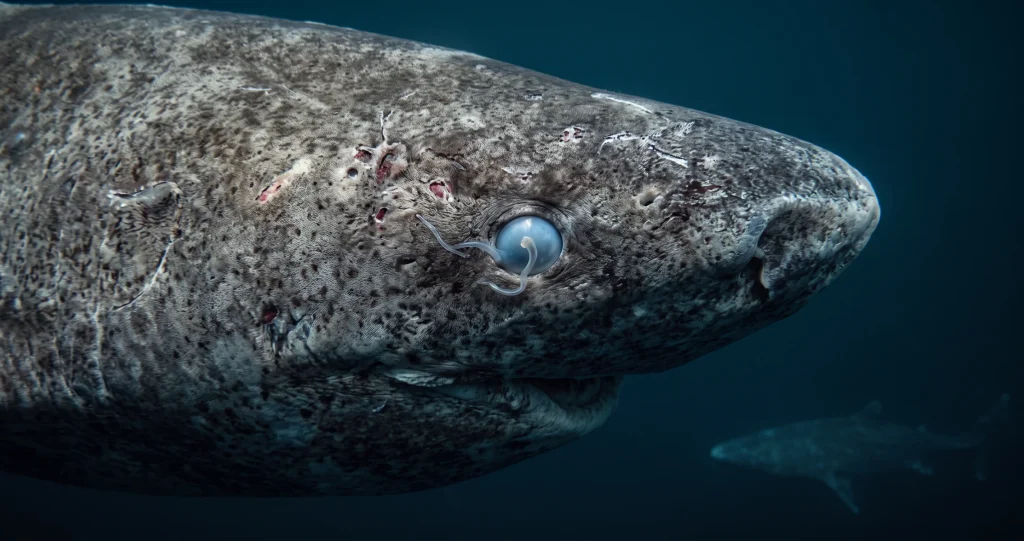
They found one in an unexpected place: the shark’s eyes.
A Natural Time Capsule Inside the Eye
The lens of a vertebrate eye contains proteins formed during early development. Some of the proteins near the center of the lens remain remarkably stable throughout the animal’s life.
That makes the center of the eye lens something like a biological archive.
Researchers realized that radiocarbon analysis of this material could provide information about when a Greenland shark was born. Instead of trying to count uncertain growth rings, scientists could analyze carbon isotopes preserved in tissue formed early in the shark’s life.
NOAA describes how proteins in the Greenland shark’s eye lens can effectively preserve chemical information from around the time of birth.
This approach transformed scientific understanding of the Greenland shark lifespan.
Greenland Shark Lifespan and the Eye-Lens Discovery
A landmark 2016 study analyzed the eye lenses of 28 female Greenland sharks.
Radiocarbon dating produced astonishing age estimates. The largest individual, approximately five meters long, was estimated at about 392 years old, with substantial uncertainty around that central estimate. NOAA summarizes the estimated range for that animal as approximately 272 to 512 years.
That uncertainty matters.
Scientists cannot simply say that a particular Greenland shark was exactly 392 years old. Radiocarbon dating provides estimates and probability ranges rather than a precise birth year.
Even the conservative estimates, however, established the species as the longest-lived vertebrate currently known to science.
The discovery means some Greenland sharks swimming today could conceivably have been born centuries before modern industrial society.
For more information on the research behind these remarkable animals, NOAA’s overview of Greenland shark longevity provides an accessible explanation of the aging evidence.
Why Cold Water May Favor a Long Life
Why should the Greenland shark lifespan be measured in centuries when most vertebrates live dramatically shorter lives?
There is probably no single explanation.
One leading idea involves the shark’s cold environment and slow physiology.
Greenland sharks are ectothermic animals, meaning their body temperature is strongly influenced by the surrounding water. Living in consistently cold environments affects biochemical reactions, muscle performance, digestion and overall energy use.
Researchers have therefore investigated whether low metabolic demands contribute to their slow pace of life.
A scientific review in Frontiers in Marine Science notes that Greenland sharks are expected to have very low mass-specific metabolic rates because of their large size, cold environment, slow growth and slow swimming behavior. Researchers are still working to determine precisely how metabolism contributes to their extraordinary longevity.
This distinction is important.
It is tempting to reduce the story to “cold water makes sharks live longer.” Biology is more complicated. Temperature, body size, metabolism, genetics, cellular maintenance and evolutionary history may all contribute to the Greenland shark lifespan.
One of the Slowest-Growing Sharks
Greenland sharks do not simply live slowly. They grow slowly as well.
NOAA reports growth of less than about one centimeter per year.
Imagine adding only a tiny amount of body length each year while eventually reaching several meters long. Achieving a large adult size can therefore require an enormous amount of time.
This extremely slow growth is closely connected with the species’ broader life-history strategy.
Instead of growing rapidly, reproducing young and producing generations in quick succession, Greenland sharks operate on a biological timetable measured in decades and centuries.
That strategy works under stable natural conditions, but it can become a serious disadvantage when additional mortality is introduced.
Reproduction on a Century-Long Timeline
One of the most remarkable consequences of slow growth involves sexual maturity.
Scientists have estimated that female Greenland sharks may not become sexually mature until they are roughly 150 years old, although major uncertainties remain around their reproductive biology.
This means a shark could potentially live longer than a human lifetime before producing its first offspring.
Researchers still lack detailed information about pregnancy, reproductive frequency and population structure. The difficulty of observing large sharks across enormous Arctic and deep-sea habitats makes these questions particularly challenging.
The broader pattern is nevertheless clear: extreme longevity does not mean rapid population replacement.
It means the opposite.
Why Extreme Longevity Creates Conservation Challenges
The Greenland shark lifespan makes the species biologically extraordinary, but its slow life cycle can also make populations vulnerable.
A species that matures only after many decades cannot quickly replace adults removed from the population. Slow growth and late maturity are recognized conservation concerns for many sharks. NOAA notes that these characteristics generally increase sharks’ vulnerability to excessive fishing mortality.
Greenland sharks were historically targeted for their large, oil-rich livers. Today, accidental capture in commercial fishing gear is a major concern.
Longlines, gillnets and bottom trawls can unintentionally capture Greenland sharks while fisheries target other species. Researchers have consequently emphasized reducing bycatch and improving safe handling and release practices.
The mathematics of recovery are unforgiving.
Removing a mature shark might eliminate an animal that required more than a century to reach reproductive age. Replacing that individual is nothing like replacing a fast-growing fish capable of reproducing after only a few years.
Understanding population size, reproductive rates, movements and post-release survival is therefore essential for effective conservation.
Readers interested in other remarkable marine adaptations can also explore the ocean wildlife coverage on Secrets of the Green Garden, including articles examining how marine animals survive extreme environments.
What Greenland Sharks Could Teach Us About Aging
The Greenland shark is increasingly interesting to researchers outside traditional shark biology.
Any vertebrate capable of surviving for several centuries raises an obvious scientific question: how does its body remain functional for so long?
A long-lived animal must continually deal with cellular damage, protein maintenance, DNA damage and other biological processes associated with aging.
Researchers are investigating whether Greenland sharks possess unusual genetic or physiological mechanisms that contribute to this durability.
However, some popular explanations remain ahead of the evidence. For example, antioxidant defenses alone have not provided a simple explanation for the shark’s longevity. A review of alternative animal models for aging noted that research comparing oxidative-damage defenses did not support an unusually strong antioxidant system as the key explanation.
That makes the shark even more scientifically interesting.
Extreme longevity may emerge from several interacting characteristics rather than one biological “anti-aging switch.”
Future genomic studies could help identify genes involved in DNA maintenance, immune function, metabolism, cancer suppression and cellular repair. Physiological research may also reveal how the shark’s heart, muscles and other tissues remain functional over such enormous timescales.
These findings will not automatically translate into methods for extending human life. Humans and Greenland sharks evolved under dramatically different environmental and biological conditions.
Instead, these animals offer researchers a natural experiment in vertebrate longevity.
Understanding how evolution produced such a long-lived vertebrate may reveal fundamental principles about aging that scientists can compare across species.
Common Myths About Greenland Sharks
Myth: Scientists found a Greenland shark that was exactly 500 years old
No individual has been proven to be exactly 500 years old.
Radiocarbon dating produces estimated age ranges. The famous large female examined in the 2016 study had a central estimate of roughly 392 years, but the uncertainty interval extended from approximately 272 to 512 years.
Myth: Every Greenland shark lives for 400 years
The research does not demonstrate that every individual reaches that age.
As with other animals, individuals presumably experience different survival outcomes. The evidence demonstrates exceptional longevity at the species level, not a guaranteed lifespan for every shark.
Myth: Cold water alone explains their longevity
Cold temperatures probably contribute to the shark’s slow biological pace, but researchers have not identified a single cause of its extraordinary lifespan.
Metabolism, body size, physiology, genetics and environmental stability may interact in complicated ways.
Myth: Greenland sharks never move quickly enough to hunt
Their normal swimming speeds are slow, but that does not mean they survive entirely by scavenging.
Evidence indicates a varied diet, and researchers continue investigating how such slow-moving predators capture living prey. Their feeding ecology remains an active area of study.
Myth: Extreme longevity protects the species from extinction
Longevity can actually create conservation problems when combined with slow growth and late reproduction.
A population made up of animals that require many decades to mature may recover extremely slowly after losses.
Frequently Asked Questions
How long can a Greenland shark live?
Current evidence suggests Greenland sharks can live for several centuries. NOAA states that scientists estimate a lifespan of at least 250 years and that individuals may potentially exceed 500 years.
What is the oldest Greenland shark ever found?
The best-known aging study produced a central estimate of approximately 392 years for its largest shark, with an estimated range of about 272 to 512 years.
Because radiocarbon dating involves uncertainty, describing the animal simply as a confirmed 392- or 500-year-old shark would be misleading.
How do scientists determine Greenland shark age?
Researchers analyze radiocarbon in proteins from the center of the shark’s eye lens.
These proteins form early in development and remain relatively unchanged, preserving chemical information that can help researchers estimate when the animal was born.
Why is the Greenland shark lifespan so long?
Scientists do not yet have a complete answer.
Cold temperatures, slow growth, large body size, low energy demands and other physiological or genetic adaptations are among the factors being investigated.
How fast do Greenland sharks grow?
They grow exceptionally slowly. NOAA reports growth of less than approximately one centimeter per year.
When do Greenland sharks reproduce?
Females are thought to reach sexual maturity only after more than a century, with estimates commonly placing maturity around 150 years.
Important aspects of reproduction remain poorly understood, which is one reason continued research is essential.
Are Greenland sharks endangered?
Their unusually slow life history makes them vulnerable to human-caused mortality, especially accidental capture in fishing gear. Researchers emphasize that understanding bycatch, population structure and reproductive biology is important for long-term management.
Can studying Greenland sharks help humans live longer?
Greenland sharks may help scientists understand general biological mechanisms associated with longevity, cellular maintenance and aging.
That does not mean their biology can simply be transferred to humans. Their greatest scientific value may come from comparing their adaptations with those of shorter-lived vertebrates.
Conclusion
The extraordinary Greenland shark lifespan changes the way we think about the limits of vertebrate life. An animal alive in today’s Arctic Ocean may have begun its life centuries before modern fisheries, engines or electricity transformed the human world.
Radiocarbon dating of eye-lens tissue gave researchers the evidence needed to reveal this astonishing timeline. Yet the discovery created almost as many questions as it answered.
Scientists still want to understand how cold-water physiology, metabolism, genetics and cellular maintenance interact to support such extreme longevity. At the same time, the shark’s slow growth and extraordinarily late maturity show why long life can come with serious conservation vulnerabilities.
The Greenland shark is therefore more than a biological record holder. It is a living laboratory for studying aging, adaptation and survival on a timescale almost unmatched among vertebrates.
External Sources:
- NOAA Ocean Service — Greenland Shark Longevity
NOAA: How long do Greenland sharks live? - Frontiers in Marine Science — Greenland Shark Research and Management
Frontiers: Advancing Research for the Management of Long-Lived Species - NOAA Fisheries — Shark Conservation
NOAA Fisheries: Shark Conservation