
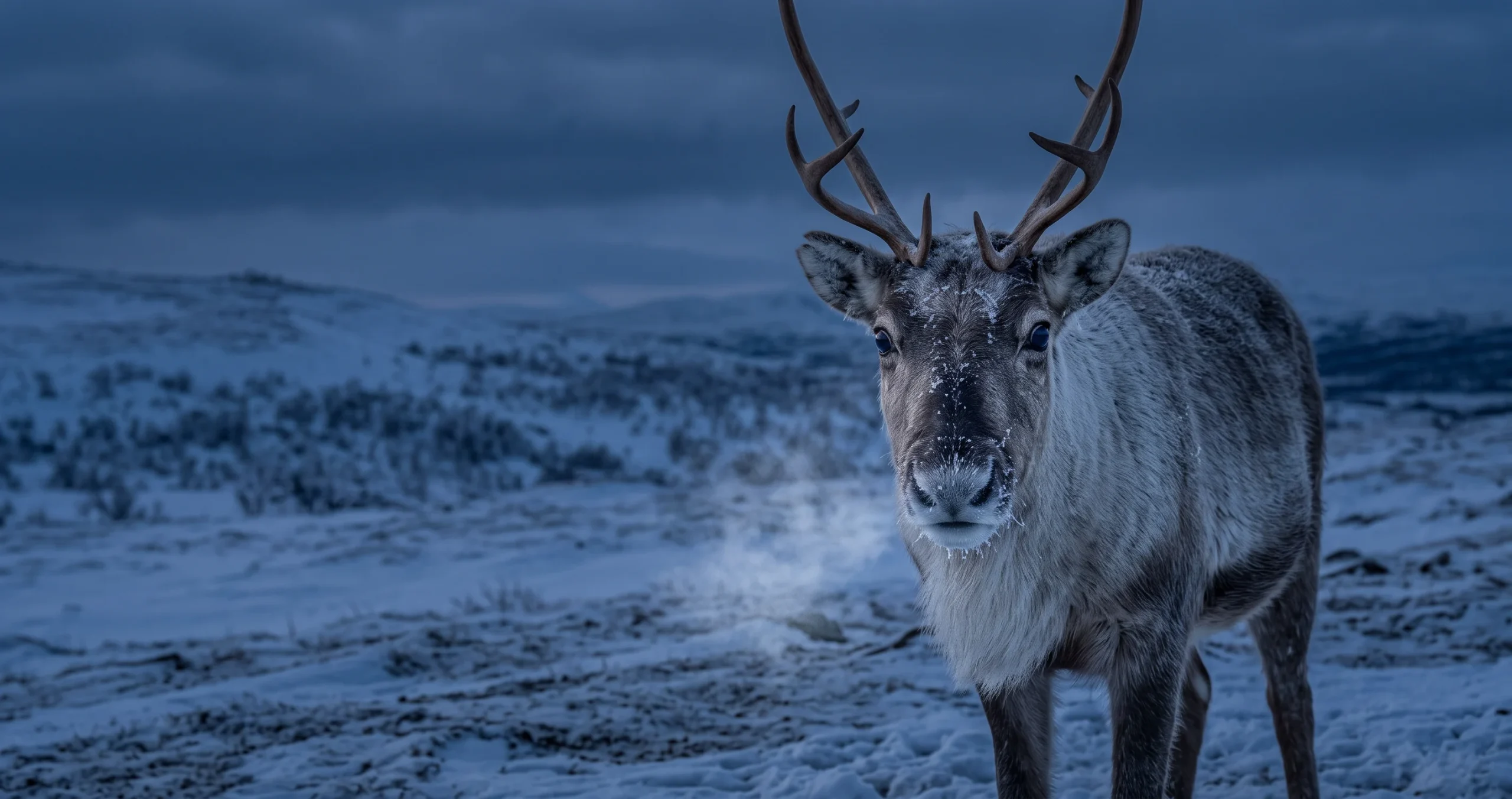
For months of the Arctic summer, reindeer can live under almost continuous daylight. Then winter arrives and their visual world shifts toward prolonged darkness and extended blue twilight. Remarkably, reindeer eyes winter adaptation includes a physical change inside the eye: a reflective structure behind the retina shifts from predominantly golden in summer to deep blue in winter.
This is not a change in ordinary iris color. It occurs in the tapetum lucidum, the reflective tissue responsible for the familiar “eye shine” seen in many mammals. Research suggests that reindeer can physically reorganize this biological mirror as the Arctic light environment changes, altering how light behaves inside the eye.
Table of Contents
- Living Between Continuous Daylight and Winter Darkness
- How the Reindeer Retina Works
- The Tapetum Lucidum: A Mirror Behind the Retina
- Reindeer Eyes in Winter Turn Deep Blue
- How Collagen Spacing Changes the Color
- What Prolonged Pupil Dilation May Be Doing
- Does the Blue Tapetum Improve Winter Vision?
- Arctic Twilight Creates an Unusual Visual World
- Reindeer Can Also Respond to Ultraviolet Light
- How the Eye Change Fits Reindeer Sensory Biology
- Why Other Arctic Animals Face Similar Challenges
- FAQ
- Conclusion
Living Between Continuous Daylight and Winter Darkness
At high Arctic latitudes, the seasonal difference in illumination is extreme.
During summer, the sun may remain above the horizon for weeks. During winter, it can remain below the horizon for prolonged periods, leaving reindeer operating in darkness and extended twilight.
That presents a visual system with conflicting demands.
An eye adapted exclusively for bright summer conditions would not necessarily perform optimally during the dim winter. Conversely, maximizing sensitivity to scarce winter light could create disadvantages during continuous summer illumination.
Reindeer appear to have evolved an unusual solution: parts of their visual system change seasonally.
Researchers studying reindeer collected in northern Norway found a striking seasonal shift in the reflective properties of the tapetum lucidum. Summer animals had predominantly golden tapeta, whereas winter animals displayed a deep blue reflection.
How the Reindeer Retina Works
Light entering a reindeer eye passes through the cornea and lens before reaching the retina at the back of the eye.
The retina contains photoreceptor cells that convert incoming light into electrical signals. Those signals are processed by retinal neurons and ultimately transmitted toward the brain through the optic nerve.
As in other mammals, the retina contains rods and cones with different visual roles. Rod-dominated pathways are particularly important for sensitivity under low illumination, while cones contribute to vision under brighter conditions and to spectral discrimination.
But reindeer possess another structure behind their photoreceptors that becomes particularly important in the Arctic winter.
It is called the tapetum lucidum.
The Tapetum Lucidum: A Mirror Behind the Retina
Anyone who has seen a cat’s eyes shine in headlights has witnessed the basic effect of a tapetum lucidum.
Light entering an eye does not necessarily get absorbed by a photoreceptor on its first journey through the retina. In animals with a tapetum, some of that uncaptured light reaches the reflective layer behind the retina and is redirected through the photoreceptor region.
That gives photons another opportunity to be detected.
The tapetum can therefore increase visual sensitivity under dim conditions.
Reindeer possess a type known as a tapetum fibrosum, common among ungulates. Its reflective structure is formed largely from organized collagen fibrils.
The arrangement of those microscopic collagen structures turns out to be critical.
Reindeer can apparently change that arrangement seasonally.
Reindeer Eyes Winter Adaptation Turns the Tapetum Blue
The seasonal transformation is dramatic.
In the 2013 study Shifting Mirrors: Adaptive Changes in Retinal Reflections to Winter Darkness in Arctic Reindeer, researchers examined eyes from summer and winter reindeer.
Summer tapeta appeared predominantly golden, sometimes with turquoise around their edges.
Winter tapeta were deep blue.
Measurements confirmed that this was not merely a subjective color impression. The spectral properties of reflected light had changed significantly between the seasonal groups.
The researchers also found differences in retinal sensitivity between summer- and winter-adapted animals.
The obvious question was how the same tissue could transform from a golden reflector into a blue one.
The answer appears to lie at a microscopic scale.
How Collagen Spacing Changes the Color
The tapetum does not need golden or blue pigment to produce these colors.
Its optical properties depend on its physical nanostructure.
The reindeer tapetum contains organized collagen fibrils whose spacing affects which wavelengths are preferentially reflected. The 2013 research found reduced collagen spacing in winter tapeta compared with summer tissue, corresponding to a shift toward shorter-wavelength reflection.
Later work published in 2022 examined the mechanism in greater optical detail.
Researchers described the tapetum as a tunable photonic structure in which the arrangement of collagen fibrils and the volume of fluid between them influence reflected wavelengths. Their modeling and experiments supported the idea that changes in fibril spacing and organization can shift the tapetum from its summer gold-turquoise state toward deep blue.
The researchers tested aspects of this model by allowing tapetal tissue to lose inter-fibril fluid through evaporation while monitoring changes in its reflectance.
The results supported the proposed relationship between fluid volume, collagen organization, and reflected color.
This makes the reindeer tapetum less like a painted mirror and more like an adjustable biological optical material.
What Prolonged Pupil Dilation May Be Doing
The next part of the proposed mechanism begins with the pupil.
During the bright Arctic summer, the pupil can constrict in response to abundant illumination. During prolonged winter darkness, it remains dilated for much longer periods.
The 2013 researchers proposed that prolonged pupil dilation may interfere with normal drainage of fluid from the eye.
They measured significantly higher intraocular pressure in winter animals than in summer animals. They suggested that persistent pupil dilation could contribute to this pressure increase, which in turn could compress the collagen structure of the tapetum.
Compression would reduce spacing between collagen fibrils.
Smaller spacing changes the wavelengths that the tapetum preferentially reflects, shifting its appearance toward blue.
There is an important scientific distinction here.
Researchers measured seasonal differences in intraocular pressure, tapetal color, collagen spacing and retinal sensitivity. The causal chain in which prolonged pupil dilation raises pressure and thereby compresses the tapetal collagen was proposed as an explanation for how those observations may be connected.
The later 2022 study further supported a structural mechanism involving changes in inter-fibril fluid and collagen spacing, but explicitly noted that the possible role of seasonal intraocular-pressure changes as the trigger was not directly investigated in that study.
That distinction prevents an intriguing hypothesis from being presented as completely settled fact.
Does the Blue Tapetum Improve Winter Vision?
The blue winter tapetum is associated with increased retinal sensitivity.
The original researchers proposed that the winter configuration may scatter incoming light differently through the photoreceptor region rather than reflecting as much of it directly back out of the eye. This could increase the opportunity for photons to encounter photoreceptors.
There may be a tradeoff.
Increasing sensitivity through greater scattering could potentially reduce visual resolution. In the darkness of an Arctic winter, however, detecting faint objects may sometimes be more useful than obtaining the sharpest possible image.
The 2022 research added another intriguing piece.
Arctic twilight has a strongly shifted spectral environment, and the researchers found that the winter tapetum’s blue reflectance corresponds well with the shorter wavelengths prominent during extended Arctic twilight.
This supports the interpretation that seasonal tuning of the tapetum could be visually advantageous.
Still, matching the spectrum of Arctic twilight and demonstrating altered retinal sensitivity are not the same as directly proving every behavioral advantage in a free-ranging reindeer.
The distinction between measurement and interpretation matters.
Arctic Twilight Creates an Unusual Visual World
Winter in the high Arctic is not simply a darker version of summer.
When the sun remains below the horizon, atmospheric conditions produce extended periods of twilight with a spectral composition different from ordinary daylight.
Research published in 2022 highlighted the importance of ozone-blue Arctic twilight, showing how the spectral peak of winter twilight relates to the blue-shifted tapetal reflector.
Snow further transforms the visual environment.
It reflects large amounts of available light, while objects such as vegetation, rocks, predators and other animals differ in their reflectance characteristics.
Reindeer therefore need to distinguish useful visual information against an environment that can be simultaneously dim, blue-shifted and dominated by snow.
This helps explain why sensory adaptations in Arctic animals cannot be understood simply by comparing them with animals living at temperate latitudes.
Reindeer Can Also Respond to Ultraviolet Light
The changing tapetum is only one remarkable feature of reindeer vision.
Experimental research has shown retinal responses to ultraviolet wavelengths in reindeer. Their ocular media allow substantial short-wavelength light to reach the retina, extending their sensitivity beyond what humans perceive as visible light.
Why might that matter?
Snow strongly reflects ultraviolet radiation, while some biologically important objects absorb more of it. Researchers have proposed that UV sensitivity could enhance contrast for features such as food or other relevant objects against snow.
However, proposed ecological advantages should again be distinguished from direct demonstrations of how wild reindeer perceive and use every UV contrast.
Electrophysiological evidence demonstrates retinal responsiveness. It does not reproduce the subjective visual experience of the animal.
For readers interested in other remarkable adaptations to extreme environments, explore more wildlife biology at Secrets of the Green Garden.

How the Eye Change Fits Reindeer Sensory Biology
Vision is only one component of surviving the Arctic.
Reindeer must locate food, navigate complex terrain, remain aware of predators, communicate with other animals and function through enormous seasonal changes in temperature and daylight.
Their sensory biology therefore works as an integrated system.
Smell is particularly important for locating food and interpreting the environment. Hearing provides information beyond the visual field. Vision adds spatial, movement and contrast information that can remain valuable even when illumination becomes extremely low.
The seasonal tapetum demonstrates something broader about Arctic biology.
Adaptation does not always mean evolving one permanent anatomical solution. In some cases, the same structure can display phenotypic plasticity, changing its physical properties as environmental conditions shift.
The reindeer eye effectively remodels part of its optical system between seasons.
Why Arctic Animals Face Unusual Visual Challenges
Most animals experience daily transitions between daylight and darkness.
High-Arctic animals face something more extreme.
The normal 24-hour light-dark cycle can largely disappear around the solstices. Summer produces prolonged illumination, while winter produces prolonged darkness and twilight.
These conditions affect far more than vision. Seasonal light is deeply connected with biological rhythms, activity, reproduction and physiology across Arctic species.
For reindeer, the challenge is especially interesting because their eyes must function across enormous changes in both light intensity and spectral composition.
The golden-to-blue transformation of the tapetum is a striking example of how evolution can exploit the physical properties of biological tissue to address that problem.
FAQ
Do reindeer eyes really turn blue in winter?
The iris does not simply change from gold to blue. The dramatic color shift occurs in the tapetum lucidum behind the retina. Studies found predominantly golden summer tapeta and deep-blue winter tapeta.
Why are reindeer eyes golden in summer?
The summer arrangement of collagen fibrils in the tapetum produces a gold-turquoise reflective appearance similar to the tapetal reflection found in other ungulates. Its physical structure preferentially reflects different wavelengths than the compressed winter configuration.
Why are reindeer eyes blue in winter?
Winter tapeta have altered collagen spacing and organization that shift reflection toward shorter wavelengths. Research supports a role for changes in inter-fibril spacing and fluid volume in producing the blue reflection.
Does pupil dilation cause the color change?
It is a proposed mechanism rather than a completely demonstrated causal chain. Winter animals showed higher intraocular pressure, and researchers proposed that prolonged pupil dilation could contribute to increased pressure and compression of the collagen structure.
Does the blue tapetum help reindeer see in darkness?
Winter-adapted animals showed increased retinal sensitivity, and researchers proposed that the blue tapetum increases photon capture by changing how light is scattered through the photoreceptor region. This provides strong physiological evidence for a benefit, although specific behavioral advantages in wild animals remain partly interpretive.
Can reindeer detect ultraviolet light?
Electrophysiological research has demonstrated retinal responses to ultraviolet wavelengths. Scientists have proposed that this sensitivity may improve contrast between important objects and highly UV-reflective snow.
Are reindeer the only animals whose tapetum changes seasonally?
Current research describes reindeer as the only mammal known to show this pronounced seasonal tuning of tapetal reflectance. Researchers have suggested that comparable mechanisms could potentially exist in other animals with similar tapetal structures exposed to prolonged seasonal changes, but that possibility should not be treated as established.
Conclusion
The story of reindeer eyes winter adaptation is more remarkable than a simple seasonal color change.
As Arctic illumination shifts from continuous summer daylight toward prolonged winter darkness and blue twilight, the reflective tapetum behind the reindeer retina changes from predominantly golden to deep blue. Measurements show accompanying changes in collagen spacing, intraocular pressure and retinal sensitivity, while newer optical work supports a mechanism involving the organization and fluid spacing of collagen fibrils.
Scientists have proposed that this winter configuration increases the eye’s ability to capture scarce photons, potentially sacrificing some image sharpness in exchange for sensitivity.
Combined with responsiveness to ultraviolet wavelengths, the shifting tapetum reveals an animal whose visual system is unusually well matched to one of Earth’s most extreme seasonal light environments.
The reindeer does not simply endure the Arctic winter with the same eyes it uses in summer.
Part of its optical system physically changes with the season.
Internal Sources :
- A Secrets of the Green Garden article covering Arctic fox adaptations, Arctic wildlife or another cold-climate mammal.
- A Secrets of the Green Garden article about unusual animal vision, ultraviolet perception or nocturnal adaptations.
External Sources :
- Stokkan, K.-A. et al. (2013). “Shifting Mirrors: Adaptive Changes in Retinal Reflections to Winter Darkness in Arctic Reindeer.” Proceedings of the Royal Society B. Read the peer-reviewed study
This study documented the golden-to-blue seasonal tapetal change, differences in collagen spacing, increased winter intraocular pressure and increased retinal sensitivity. - Fosbury, R. A. E. & Jeffery, G. (2022). “Reindeer Eyes Seasonally Adapt to Ozone-Blue Arctic Twilight by Tuning a Photonic Tapetum Lucidum.” Proceedings of the Royal Society B.
Read the peer-reviewed study
This research investigated the tapetum as a tunable photonic structure and provided further evidence linking collagen organization, inter-fibril fluid and seasonal spectral reflectance. - Hogg, C. et al. (2011). “Arctic Reindeer Extend Their Visual Range into the Ultraviolet.” Journal of Experimental Biology.
Journal of Experimental Biology study
The study provided experimental evidence that the reindeer visual system responds to ultraviolet wavelengths, adding another dimension to our understanding of Arctic reindeer vision.