
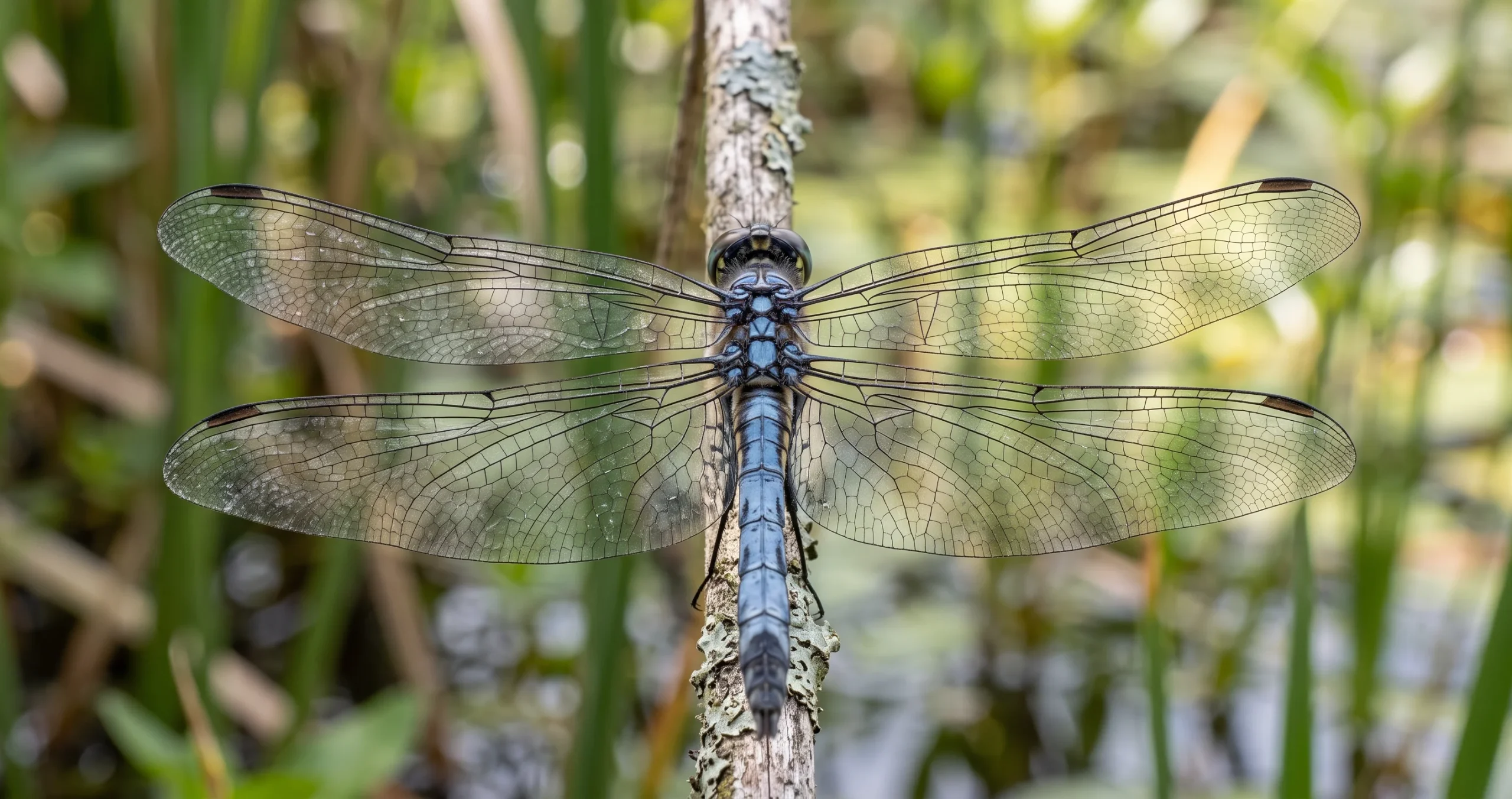
A dragonfly hovering over a pond can suddenly accelerate, bank into a tight turn, reverse direction, or intercept a flying insect with extraordinary precision. Behind those maneuvers is an unusual flight system: two forewings and two hindwings whose movements can be coordinated in multiple ways.
Understanding dragonfly wing flight means looking beyond the simple idea that dragonflies have “four independently moving wings.” Their four wings do have unusually flexible control, but forewing and hindwing motions interact aerodynamically. Dragonflies exploit changes in wing timing, stroke geometry, angle of attack, and body orientation to generate the forces required for hovering, acceleration, turning, gliding, and aerial hunting.
Table of Contents
- Why Four Wings Make Dragonflies Different
- Dragonfly Wing Flight Starts at the Thorax
- Forewings and Hindwings Do Different Jobs Together
- Why Wingbeat Timing Matters
- How Dragonfly Wings Generate Lift and Thrust
- Hovering on Four Wings
- Acceleration and Rapid Takeoff
- How Dragonflies Make Tight Turns
- Gliding Without Constant Flapping
- Four-Wing Control as a Hunting Adaptation
- Dragonflies Compared With Two-Winged Insects
- FAQ
- Conclusion
Why Four Wings Make Dragonflies Different
Dragonflies belong to the insect order Odonata. Like their damselfly relatives, adult dragonflies retain two functional pairs of membranous wings.
The front pair are the forewings, while the rear pair are the hindwings. Unlike butterflies and many other four-winged insects, dragonflies do not mechanically couple the two pairs so that they must always operate as a single functional surface.
This gives them considerable control over the relative motion of the two wing pairs.
During different flight behaviors, the forewings and hindwings can flap with different phase relationships. Their movements can approach synchronous flapping during some force-demanding maneuvers or become substantially out of phase during other modes of flight.
This does not mean each wing behaves as an aerodynamically isolated propeller.
The air moved by one wing changes the flow encountered by another. Understanding those interactions is central to understanding dragonfly agility.
Dragonfly Wing Flight Starts at the Thorax
The sophisticated control behind dragonfly wing flight originates in the thorax.
Dragonflies possess direct flight musculature associated with the wing bases, providing unusually direct control of wing motion compared with insect flight systems dominated by indirect deformation of the thorax. Anatomical work also shows that describing their flight apparatus as containing only direct muscles would be an oversimplification; both direct and indirect muscle components occur in Odonata.
The wing base itself is mechanically complex.
Changes in muscle activity and wing-base mechanics allow the animal to control important kinematic variables such as stroke amplitude, wing rotation, angle of attack, and the relative timing of forewing and hindwing strokes.
Those variables determine how aerodynamic forces develop during each wingbeat.
A dragonfly therefore does not need four wings doing four unrelated things. It needs four aerodynamic surfaces whose motions can be precisely coordinated for the current maneuver.
Forewings and Hindwings Do Different Jobs Together
Look closely at a dragonfly and the two wing pairs are not identical.
Hindwings in many dragonflies are broader near their bases than the forewings. Wing shape varies among species, reflecting differences in body size, ecology, and flight behavior.
More important during flight is the relationship between the two pairs.
A forewing moving through the air generates vortices and a wake. Moments later, the hindwing may encounter some of that disturbed air.
The reverse interaction can occur as well.
Depending on wing position and timing, these interactions can change lift, thrust, drag, and aerodynamic efficiency. They can sometimes be beneficial and sometimes detrimental.
That means four wings create both an opportunity and a problem.
The dragonfly gains more possibilities for controlling aerodynamic force, but it must manage interactions between closely spaced flapping surfaces.

Why Wingbeat Timing Matters
One of the most fascinating variables in dragonfly aerodynamics is phase relationship.
Imagine the forewing beginning its downstroke. The hindwing could begin its own downstroke at nearly the same time, slightly earlier, slightly later, or much later in the cycle.
Changing this timing changes how the wings encounter one another’s wakes.
Experiments using mechanical dragonfly models have demonstrated that forewing–hindwing phase can significantly influence aerodynamic performance. In one study, appropriate phasing allowed the hindwing to interact with the forewing’s wake in a way that reduced wasted lateral motion in the airflow and improved aerodynamic efficiency.
Other numerical work has similarly shown that tandem-wing interactions depend strongly on phase difference and can alter both lift and efficiency.
There is therefore no single universally “best” phase.
The useful relationship depends on the flight condition and the aerodynamic objective.
In Phase and Out of Phase
When forewings and hindwings move closer to synchrony, their combined action can generate large aerodynamic forces under suitable kinematics.
This can be useful when rapid acceleration or strong weight support is required.
During other behaviors, dragonflies commonly use more strongly offset wingbeats. Reviews of free-flight observations report out-of-phase flapping as common and show that different phase relationships produce different patterns of wing–wake interaction.
The timing between wing pairs is therefore something like an aerodynamic control setting.
Changing it changes what the four-wing system does to the surrounding air.
How Dragonfly Wings Generate Lift and Thrust
A dragonfly stays airborne by accelerating air and producing aerodynamic forces through its flapping wings.
As a wing sweeps through the air at an appropriate angle, pressure differences and vortical flow around the wing contribute to aerodynamic force.
Flapping insect wings also operate under strongly unsteady conditions.
One important feature is the leading-edge vortex, or LEV. During parts of the stroke, a vortex can remain associated with the leading region of the wing, contributing to aerodynamic force production.
Research on climbing dragonflies has documented leading-edge, wing-tip, and trailing-edge vortices combining into vortex structures associated with substantial lift generation.
By adjusting wing orientation and stroke direction, dragonflies can redirect the resultant aerodynamic force.
A stronger upward component supports or raises the body. A larger forward component contributes to acceleration.
Changing those force vectors rapidly is fundamental to dragonfly maneuverability.
Hovering on Four Wings
Hovering is especially demanding because the insect cannot rely on forward speed to maintain airflow over its wings.
Instead, the wings themselves must continuously generate the aerodynamic forces required to support body weight.
Dragonflies accomplish this through repeated flapping strokes with carefully controlled wing orientation.
Forewing–hindwing phasing becomes particularly interesting during hovering because each wing pair operates close to the wake of the other.
Mechanical-model experiments have shown that some phase relationships can reduce aerodynamic efficiency, while others allow more favorable wake interactions. One experiment found that a particular hindwing-leading phase could reduce the aerodynamic power required for a given mean lift compared with isolated wing pairs.
Later simulations likewise found major differences in aerodynamic performance as phase angle changed.
The lesson is not that one phase setting explains every hovering dragonfly.
Instead, four-winged hovering provides multiple ways of distributing force and interacting with the wake.
Acceleration and Rapid Takeoff
Dragonflies can transition from near-stationary flight to rapid movement with impressive speed.
High-speed studies of voluntary takeoff show how rapidly their wing kinematics can change.
In one experimental analysis, dragonflies became airborne after roughly one wingbeat. During the subsequent takeoff sequence, the measured phase difference between forewing and hindwing changed considerably, while angle of attack also varied.
These changes altered aerodynamic force production.
More synchronous wing motion can favor strong force generation under certain conditions, while modifying stroke angle and wing orientation changes the balance between vertical force and thrust.
This provides a dragonfly with something more sophisticated than simply “flapping harder.”
It can reconfigure how four wings contribute to the maneuver.
How Dragonflies Make Tight Turns
A turn requires aerodynamic asymmetry.
If all four wings continuously generated identical forces on both sides of the body, the dragonfly would have difficulty producing the rotational moments required for rapid maneuvering.
Instead, it can modify wing kinematics and force production between the left and right sides while simultaneously adjusting body orientation.
Changes in stroke amplitude, wing angle, timing, and aerodynamic force can contribute to roll, pitch, and yaw.
This is one reason dragonfly movement can look so abrupt.
The animal does not always need a wide, aircraft-like banking circle. It can alter aerodynamic moments across successive wingbeats and redirect its flight path rapidly.
Flight studies document dragonflies performing demanding maneuvers across cruising, hunting, territorial flight, hovering, climbing, and other behavioral modes.
Gliding Without Constant Flapping
Four wings are useful even when they stop flapping.
Dragonflies can glide, holding their wings extended while forward motion drives airflow across them. Their long, relatively lightweight wings then generate aerodynamic forces without continuous powered strokes.
Gliding can reduce the immediate muscular work associated with flapping, although its usefulness depends on speed, airflow, species, and flight conditions.
The corrugated structure characteristic of dragonfly wings also has interesting aerodynamic consequences.
Rather than being smooth miniature aircraft wings, dragonfly wings contain veins and corrugations that influence airflow and structural stiffness. Research reviewed in the scientific literature suggests these structures can affect aerodynamic behavior, especially at the unusual Reynolds numbers and angles of attack experienced by flying insects.
Four-Wing Control as a Hunting Adaptation
Dragonflies are not merely agile fliers.
They are aerial predators.
Adults pursue insects including flies, midges, mosquitoes, and other suitably sized flying prey. Aerial hunting demands rapid visual tracking and precise interception.
A moving target may suddenly accelerate or change direction.
The dragonfly must continually update its own flight path while remaining stable enough to capture the prey with its legs.
Flexible four-wing control is extremely useful under those conditions.
A dragonfly can alter force production, accelerate, climb, turn, decelerate, or hover as the interception develops. Wing phasing gives it another aerodynamic variable that can be adjusted alongside stroke amplitude, angle of attack, wing rotation, and body orientation.
This does not mean four wings alone explain hunting success.
Dragonfly predation also depends on sophisticated vision, sensory processing, body control, and the ability to predict or respond to prey movement.
The wings provide the aerodynamic machinery that turns those sensory decisions into motion.
For more about these insects from their aquatic beginnings to aerial adulthood, see our guide to the dragonfly life cycle.
Dragonflies Compared With Typical Two-Winged Insects
Dragonflies are not automatically more maneuverable than every insect with only two functional wings.
True flies, or Diptera, demonstrate why such a comparison would be misleading.
Adult true flies possess one functional pair of wings. The second ancestral wing pair is modified into small sensory structures called halteres, which help detect body rotations during flight. The Smithsonian notes that many flies are themselves exceptionally agile, with some capable of hovering and moving backward or sideways.
The difference is therefore primarily architectural.
A fly combines one aerodynamic wing pair with highly specialized rotational sensors. A dragonfly retains two functional aerodynamic wing pairs and can vary their relative kinematics.
Both designs can produce remarkable flight performance.
Dragonflies simply solve the problem using a distinctive four-wing configuration that provides a particularly rich range of aerodynamic interactions.
Why Dragonfly Wing Flight Is So Remarkable
The most impressive feature of dragonfly wing flight may not be any single maneuver.
It is versatility.
The same four wings can support hovering, powerful acceleration, climbing, rapid turning, forward flight, backward flight, and gliding. Research shows that changing the timing between forewing and hindwing strokes can alter the wakes generated by the wings and consequently affect lift, thrust, and efficiency.
Dragonflies are therefore not simply beating four wings instead of two.
They are operating a dynamically adjustable aerodynamic system.
FAQ
Do dragonflies control all four wings independently?
Dragonflies have unusually flexible control over their four wings, aided by direct musculature associated with their wing bases. However, saying that every wing always operates completely independently is misleading. Their wing movements are coordinated, and the aerodynamic wake produced by one wing can strongly affect another.
Why do dragonflies have four wings?
Two functional wing pairs provide multiple aerodynamic surfaces whose relative timing and kinematics can be varied. This contributes to the broad flight repertoire seen in dragonflies, although four wings also create complex aerodynamic interactions that must be managed.
Can dragonflies hover?
Yes. Dragonflies can maintain low-speed and hovering flight by generating weight-supporting aerodynamic forces through repeated flapping strokes. Forewing–hindwing timing influences the aerodynamic interaction between the two pairs.
Can dragonflies fly backward?
Yes. Free-flight research has documented backward dragonfly flight and analyzed how wing kinematics and wing–wing interactions contribute to it.
Why don’t the forewings and hindwings always flap together?
Changing their phase relationship changes how each pair interacts with the airflow and vortices produced by the other. Different timing patterns can therefore alter force production and aerodynamic efficiency.
How do dragonflies turn so quickly?
They can change wing kinematics and aerodynamic force distribution while reorienting the body. Differences between left and right wing forces generate rotational moments that allow rapid changes in direction.
Are dragonflies better fliers than flies?
They use different flight systems, so a simple ranking is not scientifically useful. Dragonflies have four functional aerodynamic wings with variable forewing–hindwing coordination, while true flies use one functional wing pair plus sensory halteres and can themselves be extraordinarily agile.
Conclusion
Dragonfly flight is extraordinary not because four wings simply produce four times the control, but because those wings form a coordinated and adjustable aerodynamic system.
Forewings and hindwings can operate at different relative phases, changing how their vortices and wakes interact. Along with adjustments in stroke amplitude, wing rotation, angle of attack, body orientation, and left–right force production, this allows dragonflies to shift between hovering, acceleration, turning, climbing, gliding, and aerial pursuit.
That versatility is especially valuable to an aerial predator.
When a tiny insect changes direction in front of a hunting dragonfly, the predator has an aerodynamic system capable of changing with it. The remarkable precision of dragonfly wing flight emerges from the interaction of four wings, muscles, airflow, sensory information, and extremely fast control.
Internal Sources:
- The Fascinating Dragonfly Life Cycle.
- Insect Orders Explained: A Beginner’s Guide to the Major Groups of Insects.
External Sources:
- Thomas, A. L. R. et al. / Royal Society — research and review literature on dragonfly and damselfly flight mechanics, wing kinematics, vortices, and flight performance. Flight of the Dragonflies and Damselflies
- Maybury & Lehmann / Royal Society research summarized through the open-access study examining how forewing–hindwing phasing can affect aerodynamic efficiency and wake interaction. Phasing of Dragonfly Wings Can Improve Aerodynamic Efficiency by Removing Swirl
- Scientific Reports — experimental and numerical investigation of dragonfly wing and body motion during voluntary takeoff, including changing forewing–hindwing phase relationships and aerodynamic forces. Experimental and Numerical Investigation on Dragonfly Wing and Body Motion During Voluntary Take-off