
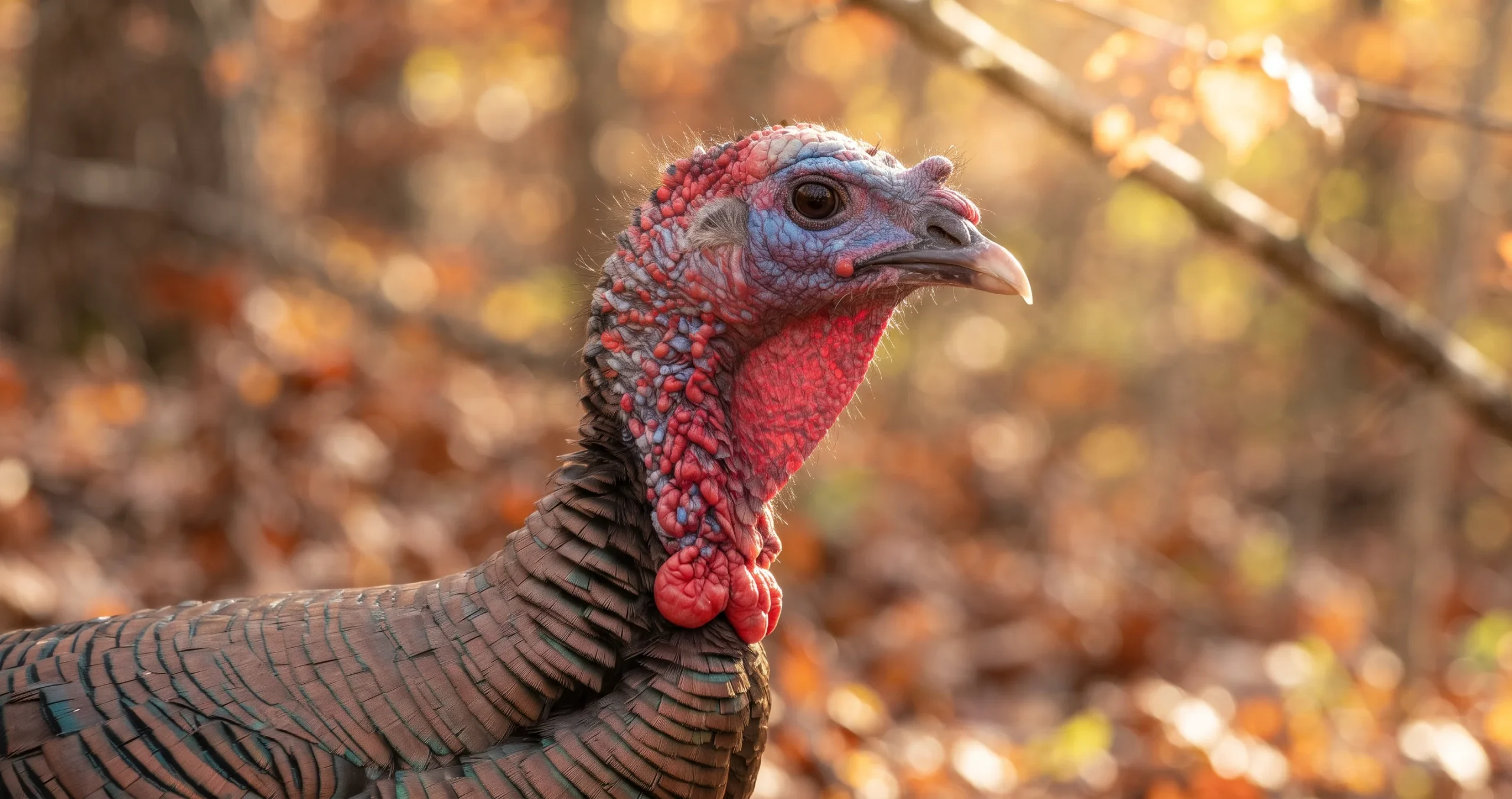
With its colorful head, dangling snood, textured neck, and unusual chest beard, the wild turkey is one of North America’s most distinctive birds. These unusual features are more than decorative details. They play important roles in communication, courtship, and social behavior.
Understanding wild turkey snood, wattle, and beard anatomy reveals how these birds communicate without relying entirely on vocal sounds. Their appearance can change noticeably depending on excitement, reproductive activity, and interactions with other turkeys.
Whether you encounter wild turkeys in a woodland, an open field, or your backyard, recognizing these anatomical features can help you better understand their fascinating behavior.
Table of Contents
- What Makes Wild Turkey Anatomy Unique?
- Wild Turkey Snood, Wattle, and Caruncles Explained
- Why Wild Turkeys Have Bare Skin on Their Heads
- How Wild Turkeys Change Their Head Color
- What Is a Wild Turkey’s Beard?
- How These Features Influence Courtship
- Differences Between Wild and Domestic Turkeys
- How to Identify Male and Female Wild Turkeys
- Observing Wild Turkeys Responsibly
- Frequently Asked Questions
What Makes Wild Turkey Anatomy Unique?
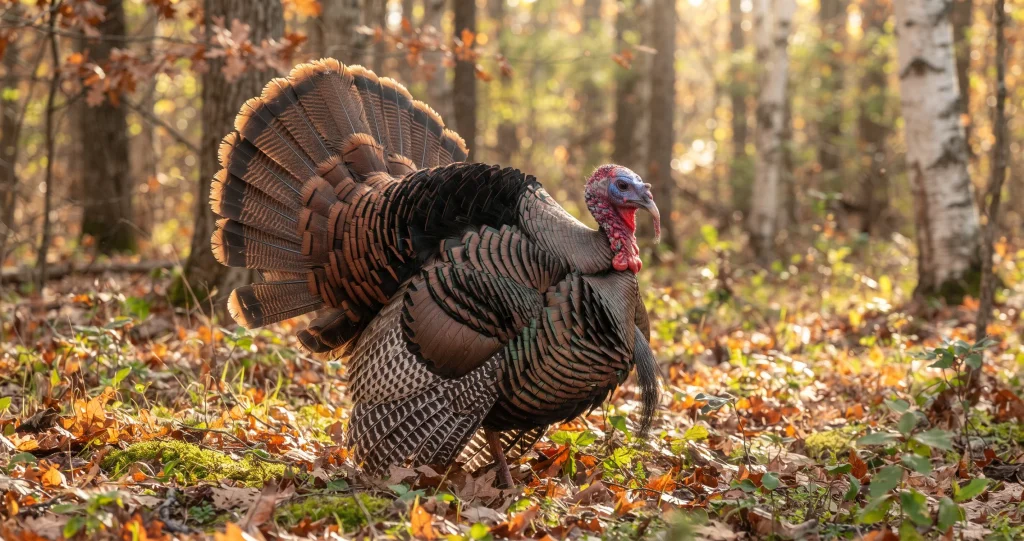
The wild turkey (Meleagris gallopavo) is a large ground-dwelling bird native to North America. It belongs to the same family as pheasants, quail, and several other familiar game birds.
Although wild turkeys spend much of their time walking and searching for food, they are capable of flight and commonly roost in trees at night.
Their bodies are covered with overlapping feathers that can display bronze, copper, green, and reddish iridescence under suitable lighting.
Their heads and upper necks, however, have relatively little feather coverage. Instead, these areas display several specialized fleshy structures.
The most recognizable features include the snood, wattle, caruncles, and exposed skin. Adult males also commonly possess a prominent beard projecting from the chest.
These structures are particularly noticeable during the breeding season, when males display their physical characteristics to potential mates and competing males.
Wild Turkey Snood, Wattle, and Caruncles Explained
The fleshy structures on a turkey’s head are frequently confused with one another. Although they are located close together, each has a distinct appearance and anatomical position.
The Snood: The Fleshy Structure Above the Bill
The snood is a flexible projection of skin located on the forehead, immediately above the bill.
When a turkey is relaxed, the snood may appear relatively short. During courtship or heightened excitement, it can become elongated and hang down over the bill.
Both male and female turkeys possess snoods, but the structure is generally much larger and more conspicuous in mature males.
Blood flow and changes in tissue tension contribute to its changing appearance.
Why Is the Snood Important?
The snood functions as a visual signal during social and reproductive interactions.
Research on turkey behavior suggests that snood length can influence female mate preferences and interactions between competing males.
However, snood length alone cannot reliably establish a bird’s overall health, age, or reproductive success.
The Wattle: Loose Skin Beneath the Throat
The wattle is the loose, fleshy fold of skin hanging beneath the turkey’s throat and extending along part of its neck.
It is particularly prominent in adult males, although females also have less developed fleshy neck structures.
The wattle may appear pink, red, or relatively pale depending on blood circulation and the bird’s physiological condition.
During courtship displays, increased coloration can make the wattle more visually noticeable.
The wild turkey snood and wattle are therefore separate structures: the snood originates above the bill, while the wattle hangs beneath the throat.
Caruncles: The Raised Bumps on the Head and Neck
Caruncles are the rounded, irregular fleshy growths distributed across parts of a turkey’s head and neck.
They are especially prominent around the lower neck of mature males, where larger caruncles can create a distinctive textured appearance.
Their size and coloration may become more noticeable during reproductive displays.
Caruncles are normal anatomical features, not tumors, parasites, or signs of disease simply because they look unusual.
Quick Guide to Wild Turkey Anatomy
| Anatomical feature | Location | Main characteristic |
|---|---|---|
| Snood | Above the bill | Flexible, elongated fleshy projection |
| Wattle | Beneath the throat | Loose fold of exposed skin |
| Caruncles | Head and neck | Rounded, fleshy bumps |
| Bare skin | Head and upper neck | Changes in visible coloration |
| Beard | Center of the chest | Bundle of stiff, hairlike filaments |
| Spurs | Back of the lower legs | Hard projections used during competition |
Why Wild Turkeys Have Bare Skin on Their Heads
Unlike many familiar backyard birds, wild turkeys have largely unfeathered heads and upper necks.
This exposed skin makes changes in coloration particularly visible during social interactions.
The skin contains blood vessels and underlying tissues that influence its appearance under different physiological conditions.
Communication Through Appearance
The exposed skin allows turkeys to display visual signals that would otherwise be hidden beneath feathers.
Changes in head color, snood length, and the appearance of the caruncles can accompany excitement, courtship, and competitive behavior.
These visual signals work alongside vocalizations, body posture, and feather displays.
A Possible Role in Temperature Regulation
Bare skin can also participate in heat exchange between the body and the surrounding environment.
Changes in blood circulation near the skin’s surface may influence heat loss.
Nevertheless, the exposed head should not be understood solely as a cooling mechanism. Its role in visual communication is particularly important during reproductive and social displays.
How Wild Turkeys Change Their Head Color
One of the most fascinating aspects of wild turkey snood and wattle anatomy is the ability of these structures to change their visible coloration.
A male turkey’s head may display combinations of red, blue, white, and pink. These colors can change over relatively short periods.
What Causes the Color Changes?
Changes in blood flow, blood vessel dilation, and the optical properties of the skin influence the colors visible on a turkey’s head.
Red coloration is associated with blood circulating through superficial tissues. Blue and whitish appearances also involve how light interacts with the skin’s underlying structure.
The process differs from the permanent coloration of feathers.
What Different Head Colors Can Indicate
Head coloration may accompany different behavioral states:
- Red: Often associated with heightened arousal or intense social interactions.
- Blue: Frequently visible during reproductive displays and other states of excitement.
- White or pale coloration: May appear during particular courtship displays or changes in physiological state.
- Pink or muted coloration: Common outside intense displays.
These colors should not be treated as a precise emotional dictionary. A red head does not automatically mean aggression, and a blue head does not necessarily indicate happiness.
Interpreting turkey behavior requires observing coloration together with posture, movement, vocalizations, and surrounding circumstances.
What Is a Wild Turkey’s Beard?
Unlike the snood and wattle, the beard does not grow on the turkey’s head. It emerges from the center of the chest and resembles a bundle of coarse, dark hair.
Despite its appearance, the beard consists of highly modified feather filaments rather than mammalian hair.
These stiff structures contain keratin, the same structural protein found in ordinary feathers and claws.
Do Female Turkeys Have Beards?
Most adult male wild turkeys possess a beard, but some females develop one as well.
The percentage of bearded females varies among populations. Their beards are generally shorter and thinner than those of mature males.
Occasionally, a male turkey may develop multiple beards, although this is relatively uncommon.
Can Beard Length Reveal a Turkey’s Age?
Beards generally become longer as male turkeys mature. Unlike ordinary body feathers, beard filaments are not replaced through the usual annual molting process.
However, friction against vegetation, soil, and snow can gradually wear away their ends.
A long beard may suggest a mature male, but it cannot determine the bird’s exact age. Commonwealth of Pennsylvania
How These Features Influence Courtship
Spring is the season when the wild turkey snood, wattle, caruncles, and other physical ornaments become especially noticeable.
Male turkeys perform elaborate displays that combine visual signals, movement, and sound.
The Famous Turkey Strut
During a courtship display, a male turkey spreads his tail feathers into a broad fan, lowers his wings, and raises his body feathers.
His snood may elongate while his exposed head and neck display vivid colors.
These coordinated changes create an impressive appearance that can attract females and communicate with nearby males.
Female Mate Selection
Studies of turkey behavior suggest that females often prefer males with relatively long snoods.
Snood length can also influence interactions between competing males, demonstrating that this structure has significance beyond its decorative appearance.
The precise contribution of beard length and caruncle characteristics to mate selection is less clearly understood.
Differences Between Wild and Domestic Turkeys
Domestic turkeys descend from wild turkeys and share many of the same anatomical characteristics.
Both possess snoods, wattles, caruncles, and other recognizable turkey features. However, selective breeding has produced substantial differences in body size, proportions, plumage, and mobility.
Body Size and Movement
Wild turkeys generally have relatively streamlined bodies with strong legs and well-developed wings.
Many commercial domestic breeds have been selected for greater body weight and larger breast muscles. These characteristics can limit their ability to fly effectively.
Traditional heritage breeds may retain greater mobility and more closely resemble their wild relatives.
Differences in Head and Neck Anatomy
The wild turkey snood and wattle may appear less exaggerated than those of some heavily bred domestic varieties.
Domestic males can develop particularly large fleshy ornaments around their heads and necks.
However, considerable variation exists among breeds, individuals, and reproductive conditions.
| Feature | Wild turkey | Domestic turkey |
|---|---|---|
| Body shape | Relatively streamlined | Often heavier and broader |
| Plumage | Typically dark and iridescent | Varies widely by breed |
| Flight | Capable of short, strong flights | Often limited in heavy breeds |
| Snood and wattle | Prominent in mature males | Sometimes more developed |
| Habitat | Woodlands, fields, and forest edges | Managed farms and domestic settings |
How to Identify Male and Female Wild Turkeys
Male wild turkeys are known as toms or gobblers, while adult females are called hens. A juvenile male is commonly called a jake.
Although the wild turkey snood and wattle provide useful identification clues, observing several characteristics together produces more reliable results.
Identifying an Adult Male
Adult males generally have larger bodies, more pronounced head ornaments, darker iridescent feathers, and a visible chest beard.
Their leg spurs are usually more developed than those of females.
During spring, gobbling and elaborate strutting displays provide additional identification clues.
Identifying an Adult Female
Female turkeys generally have smaller bodies, muted brown plumage, and less prominent fleshy head structures.
Their heads often have duller gray-blue coloration and more fine feathering than those of males.
These relatively subdued colors provide useful camouflage during ground nesting.
Identifying Juvenile Males
Young males typically have shorter beards and smaller spurs than mature gobblers.
When a juvenile male fans its tail, the central feathers are often longer than the surrounding feathers, producing an uneven outline.
An adult male’s fully developed tail usually forms a more uniform fan.
Observing Wild Turkeys Responsibly
Wild turkeys can sometimes be observed along woodland edges, in open grasslands, and in suburban neighborhoods.
Early morning is often a rewarding time to watch them searching for food or moving between sheltered areas.
Use binoculars to examine the wild turkey snood, wattle, and other distinguishing features without approaching the birds.
Avoid feeding turkeys directly, chasing them, or deliberately provoking display behavior. Give nesting females and groups with young birds additional space.
Like other ground-foraging birds, wild turkeys depend on suitable habitats that provide food, shelter, and seasonal resources.
Frequently Asked Questions
What is the difference between a turkey snood and a wattle?
The snood grows above the bill and can extend downward over it. The wattle is the loose fold of skin beneath the throat.
Do female wild turkeys have snoods and wattles?
Yes. Female turkeys possess both structures, although they are generally smaller and less conspicuous than those of mature males.
Why does a wild turkey’s head turn blue?
Changes in circulation and the way light interacts with underlying skin tissues contribute to blue coloration. This appearance may accompany courtship and other states of heightened activity.
What are the bumps on a turkey’s head called?
They are called caruncles. These fleshy structures are normal anatomical features found on the head and neck.
Is a turkey’s beard made of hair?
No. The beard consists of stiff, modified feather filaments that resemble coarse hair.
Can female turkeys grow beards?
Yes. Some female wild turkeys develop beards, so the presence of a beard alone does not conclusively identify a male.
Why does a turkey’s snood become longer?
The snood can elongate as its physiological state changes, particularly during reproductive displays and interactions with other turkeys.
Can wild turkeys fly?
Yes. Despite their large bodies, wild turkeys can fly and frequently use this ability to escape danger or reach elevated nighttime roosts.
Conclusion
The unusual anatomy of a wild turkey reveals how physical structures can serve multiple biological purposes.
The wild turkey snood, wattle, caruncles, exposed skin, and beard contribute to a remarkable system of visual communication. Some structures also assist with temperature regulation, while others may influence reproductive behavior.
Understanding these features makes identifying male and female turkeys easier and provides valuable insight into their seasonal activities.
What might initially appear to be an unusual collection of fleshy ornaments is actually part of a complex biological system shaped by evolution, social interaction, and reproduction.
The next time a wild turkey crosses a woodland path or displays its magnificent tail, take a moment to appreciate the remarkable anatomy behind its appearance.
Internal Sources
1. why wild turkeys change face color
https://secretsofthegreengarden.com/why-wild-turkeys-change-face-color/?utm_source=chatgpt.com
External Sources
1. Wild Turkey Appearances
Explains the biological functions of the snood, beard, caruncles, and spurs, including their roles in mate selection and social dominance. The National Wild Turkey Federation. https://www.nwtf.org/content-hub/wild-turkey-appearances?utm_source=chatgpt.com
2. Wild Turkey Biology
Detailed scientific information about beard composition, male and female identification, changing head coloration, and differences between wild and domestic turkeys. Pennsylvania Game Commission. https://www.pa.gov/agencies/pgc/wildlife/discover-pa-wildlife/turkey?utm_source=chatgpt.com
3. Turkey Identification and Anatomy
An educational illustrated guide identifying the snood, wattle, caruncles, beard, spurs, and courtship behaviors. Indiana Department of Natural Resources. https://secure.in.gov/dnr/fish-and-wildlife/files/fw-turkey-ID-graphic.pdf?utm_source=chatgpt.com