
Introduction
Most plants survive by absorbing water and nutrients through their roots while producing energy from sunlight. But in some of the world’s most nutrient-poor environments, that strategy alone isn’t enough.
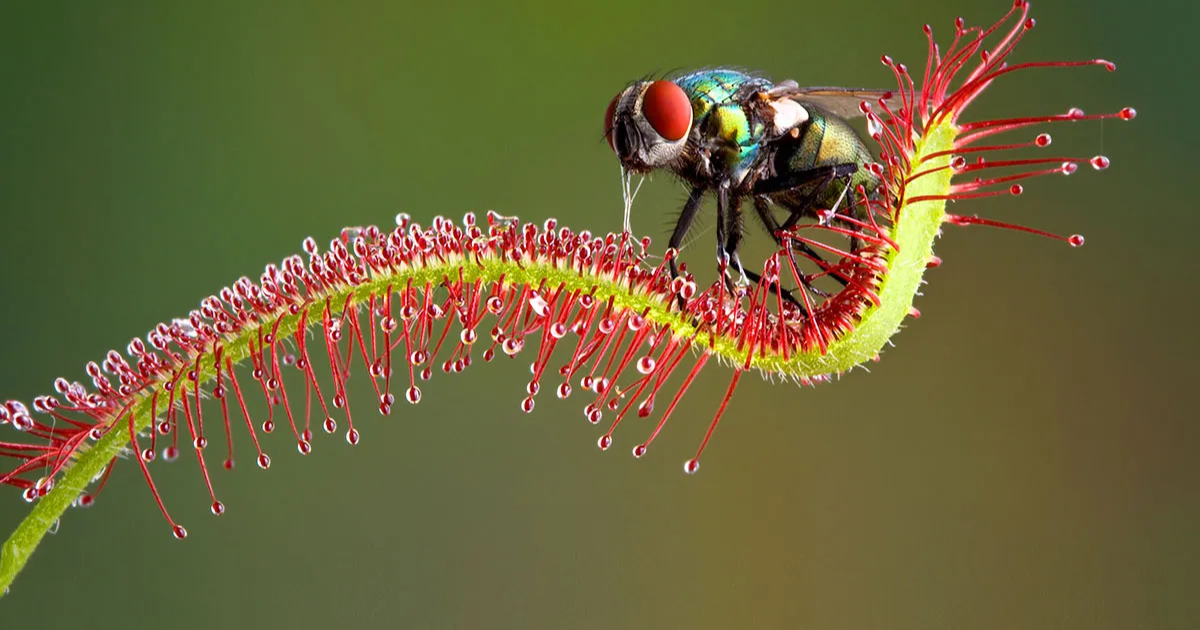
Enter the sundew—a remarkable group of carnivorous plants that evolved a completely different solution. Instead of relying solely on the soil, sundews capture insects with leaves covered in glistening sticky droplets. Once an unsuspecting insect becomes trapped, the leaf slowly curls around its prey and releases digestive enzymes that break it down, allowing the plant to absorb valuable nutrients.
With more than 200 species found across every continent except Antarctica, sundews are among the most widespread and fascinating carnivorous plants on Earth. Their unique hunting strategy has captivated botanists, gardeners, and nature enthusiasts for centuries.
What Is a Sundew?
Sundews belong to the genus Drosera, one of the largest groups of carnivorous plants.
Their name comes from the tiny droplets covering their leaves, which sparkle in sunlight like morning dew. These droplets are not water—they are a sticky mucilage produced by specialized glandular hairs called tentacles.
The glistening appearance attracts insects searching for nectar or moisture. Once they land, escaping becomes extremely difficult.
Although sundews may appear delicate, they are highly specialized predators that have evolved over millions of years to survive where many other plants struggle.
Why Did Sundews Become Carnivorous?
Carnivorous plants did not evolve because they lacked sunlight. Instead, they typically grow in habitats where the soil contains very little nitrogen and phosphorus—two nutrients essential for healthy growth.
Common sundew habitats include:
- Peat bogs
- Marshes
- Wet heathlands
- Acidic wetlands
- Sandy soils
- Moss-covered seepages
These environments are often constantly moist but extremely poor in nutrients.
Capturing insects allows sundews to obtain nitrogen, phosphorus, potassium, and other minerals that are scarce in the surrounding soil.
How Sundews Catch Their Prey
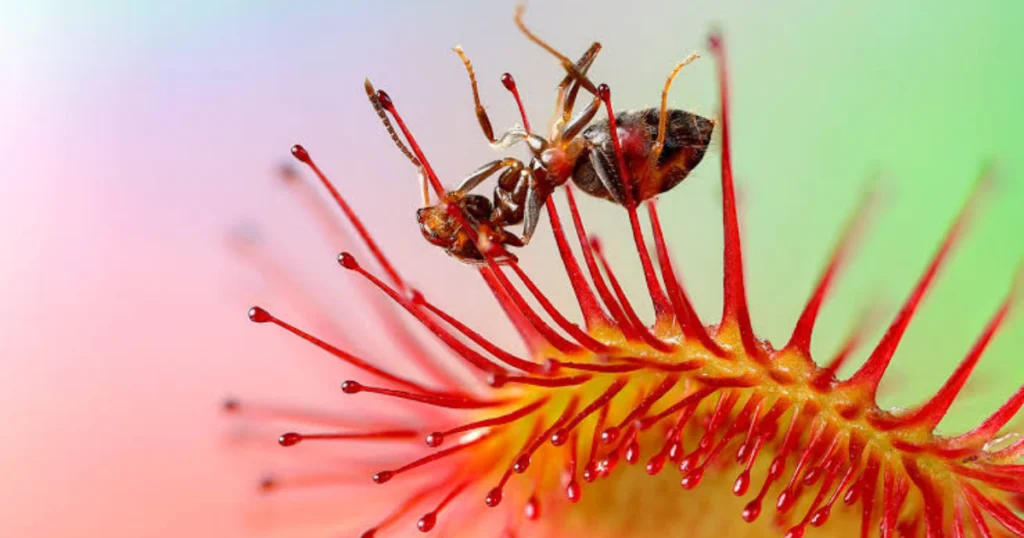
Each sundew leaf is covered with dozens or even hundreds of tiny red tentacles.
At the tip of every tentacle sits a droplet of sticky mucilage.
These droplets serve two important purposes:
- Reflect sunlight, making the plant appear covered in nectar.
- Trap insects that touch the surface.
Once an insect lands, the sticky mucilage clings to its legs and wings.
The harder it struggles, the more tentacles become involved, increasing the insect’s contact with the adhesive.
For small insects, escape is usually impossible.
The Leaf Slowly Closes Around the Insect
Unlike the Venus flytrap, which snaps shut in a fraction of a second, sundews rely on slower movement.
After detecting prey, nearby tentacles gradually bend toward the trapped insect.
In many species, the entire leaf slowly curls inward over several hours or even days.
This movement increases contact between the digestive glands and the prey, improving nutrient absorption.
The speed varies depending on the species, temperature, and size of the insect.
How Sundews Digest Insects
Once the prey is securely trapped, the plant releases digestive enzymes similar to those produced by animal digestive systems.
These enzymes break down soft tissues into simple nutrients that the plant can absorb through specialized glands on the leaf surface.
The process may take several days, depending on the size of the insect.
Once digestion is complete, the leaf gradually reopens, leaving behind only indigestible parts such as wings or the outer exoskeleton.
The leaf is then ready to capture another meal.
How Many Insects Can a Sundew Catch?
There is no fixed number.
The claim that a single sundew catches exactly 2,000 insects per year is not supported by scientific research and should not be presented as a universal fact.
The number depends on many factors, including:
- The species of sundew.
- Plant size.
- Climate.
- Local insect populations.
- Length of the growing season.
A healthy sundew may capture numerous small insects throughout the year, but there is no scientifically established annual average that applies to all species.
What Do Sundews Eat?
Most prey consists of tiny insects that naturally visit wet habitats.
Common prey includes:
- Fungus gnats
- Mosquitoes
- Small flies
- Midges
- Ants
- Tiny beetles
- Springtails
Larger species occasionally capture bigger insects, but sundews generally specialize in very small prey.
Where Are Sundews Found?
Sundews occur on every continent except Antarctica.
They are especially diverse in:
- Australia
- South Africa
- South America
- Europe
- North America
- Southeast Asia
Different species have adapted to tropical rainforests, temperate wetlands, alpine environments, and even seasonally dry climates.
Are Sundews Dangerous?
Not at all.
Although they digest insects, sundews pose no danger to humans or pets.
Their digestive enzymes are relatively mild and are designed for tiny prey.
Touching the sticky droplets may damage the plant by removing its mucilage, so it is best to observe rather than handle these fascinating plants.
Why Are Sundews Important?
Carnivorous plants play valuable ecological roles.
They help regulate populations of small insects while providing habitat for specialized organisms that have adapted to live alongside them.
Many sundew habitats also support rare orchids, mosses, amphibians, and other wetland species.
Because wetlands are increasingly threatened by drainage, pollution, and development, many sundew populations require habitat protection.
Can You Grow Sundews at Home?
Yes.
Many sundew species are popular among carnivorous plant enthusiasts.
Successful cultivation requires conditions similar to their natural habitats.
Generally, they prefer:
- Bright light.
- Distilled, rain, or reverse-osmosis water.
- Nutrient-poor growing media such as sphagnum peat mixed with silica sand or perlite.
- High humidity for some species.
Ordinary potting soil and fertilizers should be avoided because they can damage or kill carnivorous plants.
Practical Tips
- Never fertilize sundews.
- Water only with mineral-free water whenever possible.
- Provide plenty of bright light.
- Avoid touching the sticky tentacles.
- Do not feed large insects to the plant.
- Protect natural wetlands where carnivorous plants grow.
Common Mistakes
Using Tap Water
Many tap water supplies contain minerals that gradually damage carnivorous plants.
Planting in Regular Garden Soil
Sundews naturally grow in nutrient-poor substrates.
Rich compost or fertilized potting mixes can be harmful.
Feeding Large Insects
Oversized prey may rot before digestion is complete.
Assuming Carnivorous Plants Need Fertilizer
Sundews evolved specifically to obtain nutrients from insects instead of fertile soil.
Frequently Asked Questions
Why are sundews sticky?
The sticky droplets are mucilage produced by specialized glands that trap insects and begin the digestion process.
Can sundews hurt people?
No. They are harmless to humans and pets.
Why do sundews eat insects?
They obtain nitrogen, phosphorus, and other nutrients that are scarce in the nutrient-poor soils where they naturally grow.
How fast do sundews close?
Most species respond gradually over several hours rather than snapping shut like a Venus flytrap.
Can sundews survive without insects?
Yes. They still produce energy through photosynthesis, but insect prey provides valuable nutrients that support healthier growth, especially in nutrient-poor environments.
Conclusion
Sundews demonstrate one of nature’s most remarkable adaptations. Growing in soils where essential nutrients are scarce, these extraordinary plants evolved sticky leaves, slow-moving tentacles, and digestive enzymes that allow them to supplement their nutrition by capturing insects.
Far from being aggressive predators, sundews are highly specialized survivors perfectly adapted to some of the world’s most challenging habitats. Their glittering leaves and ingenious trapping mechanisms remind us that even the smallest plants can evolve surprisingly sophisticated solutions to life’s challenges.
Internal Linking
Learn about another amazing plant that responds to its environment:
https://secretsofthegreengarden.com/scarlet-pimpernel-poor-mans-weather-glass/
Discover the hidden underground partnerships that help forests thrive:
https://secretsofthegreengarden.com/wood-wide-web-mycorrhizal-networks/
Explore another fascinating natural phenomenon:
https://secretsofthegreengarden.com/why-periodical-cicadas-emerge-every-13-or-17-years/
Recommended External Sources
- Royal Botanic Gardens, Kew – https://www.kew.org/science
- International Carnivorous Plant Society – https://www.carnivorousplants.org
- Missouri Botanical Garden – https://www.missouribotanicalgarden.org